Is it Time For a Battery Calibration

10 comments started 2026-09-05 last 2026-09-19
GivEnergy ProductsBattery
#1 Maxwell

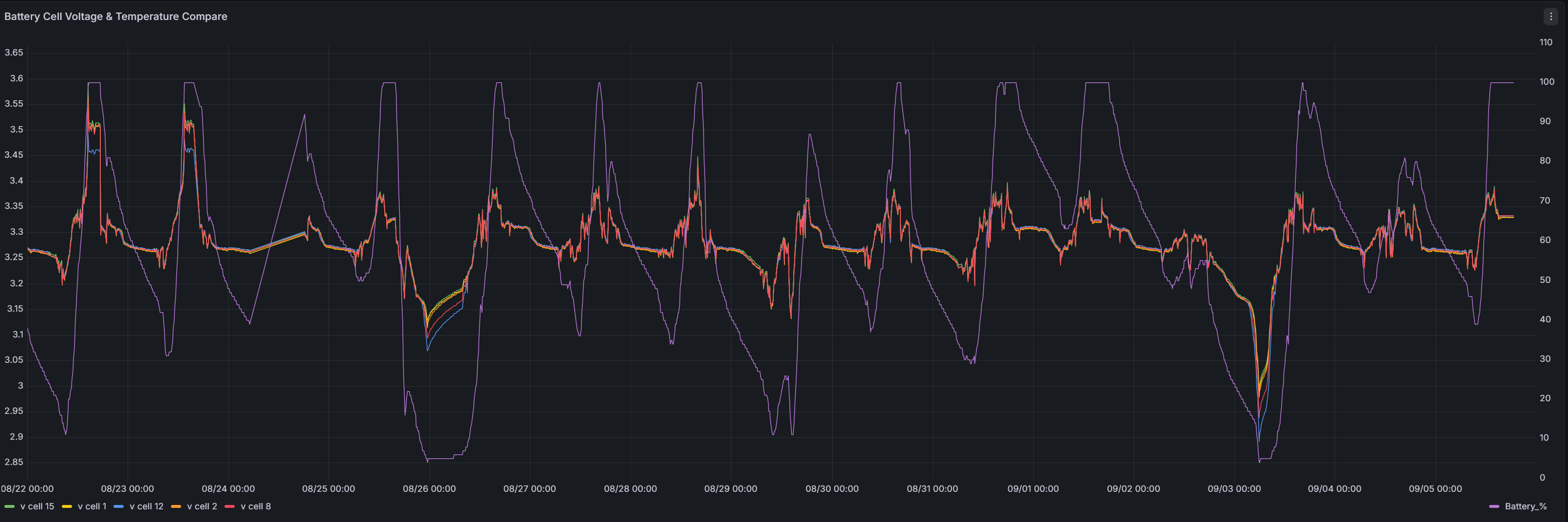
I notice that there has been a drop in the battery cell voltages. See the enclosed graph. My battery has run down on a couple of occasions, you can see that in the data. And it reports 100 SOC. The maximum battery voltage is sitting around 53/54v when before it was around 57v. Battery is 2nd gen 9.5kwh on fw 3020. Is it time to pay the piper and force a calibration ?

D
#2 DD

Maxwell looks like you don't routinely run the battery down to a low soc (and allow it to sit there), which I understood to help it track the state.

#3 hoggy

I do two a year based on temperature changes as that seems to have the most impact on mine.
One in Spring when it warms up and another at end of Summer when it cools down.

W
#4 wrighar

I'd empty the battery one sunny morning and leave it at 4% for 30mins, then allow it to charge up to 100% and leave it there for 30mins and recheck, before deciding to do a Calibrate.

It may just need to see it min and max's again, and 3020 should work it out and I believe 3020 and newer do mini calibrates each full charge/discharge.

V
#5 Vestas

wrighar I'd empty the battery one sunny morning and leave it at 4% for 30mins

It may take a lot longer than that - my "record" is SoC going from 4% to 1%* over the course of six hours before recovering 1.6kWh charge from rebalancing. That's a verified 1.6kWh as I forced a discharge.

In terms of calibration & temperature I find 20C ambient seems to work best. I made the mistake of calibrating at 28C last year and my undervoltage automation (48V) kicked in a few times over winter. Battery goes from 12C ambient to 29C so YMMV.

*the inverter emergency 290W charge should have kicked in after it sat at 2% for >30 mins but didn't.

V
#6 Vestas

As an aside I need to do a calibration myself, although I know cell15 is the outlier so I just tend to nudge* that cell towards 3.65V where the BMS (3015) will decide that's the battery full. That with a few forced discharge cycles keep it reasonably sane.

Having said that its common in summer to be >1kWh out on SoC and I think that's probably the cause of all the overvoltage warnings. Same as last year etc. If the battery is 10% out on SoC then the inverter may not reduce charge current (10 step stuff, begins at 90%) at all before the battery BMS hits OV alarm.

*automation changes charge rate if SoC is out & basically blips the battery until cell15 hits 3.55V, which will then top out at 3.61V & the SoC is "right" - well 100%, which may not be the case etc etc.


#7 Maxwell

Thanks for the replies. Battery management is one of those black magic areas. Even GE's guidance isn't particularly quantitative. So, for example nothing here about how long the battery needs to be at min/max levels during the "soft" re-calibration etc

https://givenergy.com/resource-hub/customer-guides/how-to-calibrate-your-givenergy-battery/

I have no previous data to compare my current results with as the data i used to pull via the cloud api didn't contain battery voltage or cell voltage data. So, i don't know if the jump from 57v to 54 is normal at this time of year. But, then the spec sheets for these batteries says the nominal voltage is 51.2v ( so nominally 3.2v/cell). I wonder if the 57 volt maxes i have seen are where the battery voltage has spiked during re-charge (and accounts for the over voltage warnings) and now the charging peak is only hitting 54v (no more over voltage errors). Will leave the re-calibration at the moment. Find some time later in the year to kick one off.

V
#8 Vestas

Finally did a calibration overnight. Pleasantly surprised to find I've only lost 0.98Ah in a year.

Battery is now at 175.55Ah after 1456 cycles.

W
#9 wrighar

I wonder if I need to do one. SoC jumps from 97% to 100%, and 4% is 3.2v per cell, maybe a little high.

currently 192.8Ah, was 200Ah before Aprils cal when a new inverter was fitted.

825 cycles

V
#10 Vestas

wrighar Its probably about the right time to do it - average ambient temperature etc.