
Grid Draw

40 comments started 2022-10-16 last 2022-10-20
GivEnergy ProductsBattery
D
#1 Dean

Hi
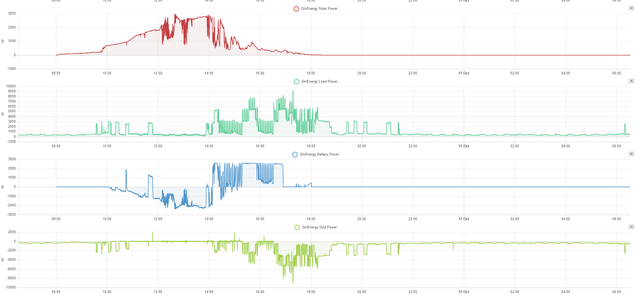
I have a 8.2 battery and I am noticing what I view as an unacceptable amount of draw from the grid when the battery should be taking care of demand. Please see the picture linked below, which shows a period of an hour whereby demand was taken from the grid and an amount from the battery (less than the 3kwh limit).
My question is, is this not normal or expected behaviour from a Givenergy battery ?

Picture link: https://docs.google.com/document/d/1wwcoOK_TPAZRq_7EaGcVKnJa8PzD__QJSEWEKmHRJYM/edit?usp=sharing
A
#2 anglefire

Not sure you can draw that conclusion. I assume you are looking at the red troughs at the end of the trace? The data capture is every 5 minutes on the portal - so the chances are it is transient peaks in the main. You do have a lot of corresponding spikes on the other side, suggesting intermittent loads which the inverter simply cannot cope with,

D
#3 Dean

So intermittent loads that the inverter cannot cope with. This was simply due to turning on one oven at this time. The net result is the inverter's inability to manage the load as I expect is costing me money, I watched my smart meter's display 'money spent' increase over this period.
So yes, I can draw any conclusion I feel, and right now it seems the conclusion is the inverter cannot cope with the demand of an everyday appliance's intermittent load even if within it's maximum delivery capacity.
All in all this points to a poorly performing & costly to own inverter.

M
#4 mbrennen

There is also lag where sudden demand on the system will draw off the grid till the inverter ramps up battery out put so this can cause grid draw. Minor amounts are how the inverter balances demand fluctuation. I've had a few 10's of watts draw up and down things like the fridge compressor kicking in and lights being turned on and off. Initially on getting my sytem installed I thought it was an issue but the total daily grid draw amounts is tiny especially on a sunny day. Hope this helps?

R
#5 Rubikcube

Certain appliances (steam irons, induction hobs, and microwaves on defrost setting) that switch on and off frequently will draw some power from the grid. I wouldn't expect an oven to do that unless it is faulty. If the oven is a problem, consider using an air fryer instead, which is more economical anyway.

I would be more concerned that you are buying energy overnight and then exporting through the day which will likely be costing you far more.

A
#6 anglefire

Dean No inverter can cope with step loads. One oven with switch from nothing to 3kW in about 0.2seconds and due to the resistance of the elements changing with temperature, there will probably be a spike for a fraction too.
The grid copes because its massive. Try it on a petrol generator and you will hear it slow down.

I monitor my system using Home Assistant - with approximately 10 second poling - rather than 5 minutes which is what the portal does.

Was a Sunday, so lunch was cooked as well as washing, hence the large load.
But you can see the load switching quite quickly at times and the grid being used to take up the slack. Particularly around 4pm when something was on an off a lot - probably the oven. There is also some export too as the inverter can't unload that fast either.

You also need to look at the actual kWh used rather than the instantaneous loads. That will give you a true picture.

Rubikcube I wouldn't expect an oven to do that unless it is faulty

Yes it will!

T
#7 Tonycooper

Dean I have the same issue periodically where there is consumption from the grid, with the corresponding increase shown at the IHD, despite the battery being sufficiently charged. The battery output seems to freeze at 14W despite the load varying. I had reported this situation to GivEnergy and they stated that the load is too small to trigger the battery to respond, but it is very intermittent and I can have days on "normal" operation and then 1 day where this occurs. The only thing I have noted is that when it occurs it generally requires solar pv generation to cause a reset.

#8 Cdent

You're looking at data points recorded every 5 minutes, if something turned on before the inverter had chance to ramp up and it was at this 5 minute data point it'll record it. Not all readings are taken at the same time either, so the grid reading could be taken a few seconds before the battery reading. The only way to get more granular data is using GivTCP on something like Home Assistant.

You also don't say what inverter you have. Gen 1 vs. Gen 2 have different max outputs. I can see one the first spike where the battery provides around 2.6kW of power and the extra was met by the grid, if you have a Gen 1 inverter (limited to 2.6kW) then this is to be expected and is normal behaviour.

Z
#9 Zakalwe

Dean

Dean So intermittent loads that the inverter cannot cope with. This was simply due to turning on one oven at this time. The net result is the inverter's inability to manage the load as I expect is costing me money, I watched my smart meter's display 'money spent' increase over this period.
So yes, I can draw any conclusion I feel, and right now it seems the conclusion is the inverter cannot cope with the demand of an everyday appliance's intermittent load even if within it's maximum delivery capacity.
All in all this points to a poorly performing & costly to own inverter.

With respect, you made an assumption, probably without that much research, that you are starting to realise is incorrect. There is no obligation on the world to operate in the ways that you "expect" it to.

D
#10 Dean

Zakalwe I rather its you making the assumption there

D
#11 Dean

So, it's a 2.4kwh table top oven. only six months old. My concern is that the draw is over a time, 60 minutes or so and the inverter never takes care of it. I've raised it with support now to see what they say

As for drawing overnight and then exporting during the day, I get paid three times as much to export (FIT deal) as I am charged for cheap rate overnight, so I make money.

T
#12 Tim

Dean You've posted a graph with no time on the axis and you don't say which bit of grid import is unacceptable. The grid import earlier in the day is presumably, battery charge, so there should be no issue with that. The grid import later in the day looks to be snapshots illustrating a thermostatically controlled load.

I think other forum members have been trying to reassure you that the snapshots are just points in time. The inverter will meet the full demand of over at 2.4kW but it needs 10-30 seconds to ramp up to meet the demand when the thermostat switches on and similarly, it needs 10-30 seconds to ramp down when the thermostat switches off. We have this when the ironing pile is being worked through. Our Thursday consumption is usually 0.8kWh more than an average non-ironing day. If the snapshot is taken alternately when your oven is switching on, then off, you will see spikes. We have found that the only way to avoid this erratic consumption is to do the ironing when we are exporting, but I'm not brave enough to make this suggestion; I'm just grateful it gets done. We have however, resolved to cook our main meal at lunchtime (even if we don't eat until later) as if it needs to go in the over, we are more likely to be exporting in the middle of the day.

The portal is fine for looking at trends over time, but not the minute-by-minute. Maybe look at import/export over days and weeks rather than shorter timescales? I think your inverter is working just fine, unless you have other data to suggest otherwise.

S
#13 SimonP
  1. I thought there was a restriction on getting FiT payments for anything other than the solar generation from an older (PV only) system, installed when Fit was available -- i.e. based on that system's generation meter.
  2. If you use the Givenergy App on a phone or tablet it updates every 10 seconds and gives an (almost) live indication of what's happening.
T
#14 Tim

SimonP

Dean As for drawing overnight and then exporting during the day, I get paid three times as much to export (FIT deal) as I am charged for cheap rate overnight, so I make money.

Simon; good point. @Dean you will be being paid FIT payments on the generation measured by your FIT MCS meter installed with your original array. AFAIK, you are paid 50% of your MCS-reported generation at your FIT rate whether it is exported or not. The energy imported overnight will be at your supplier tariff rate and your export during the day will be at your supplier tariff or SEG rate. If you haven't got a SEG tariff yet, then it's time to get one. But you aren't being paid FIT for export from your batteries as it doesn't go through your MCS meter (or if it does, your supplier invalidated your FIT agreement).

D
#15 Dean

Tim ks Thanks Tim, My real concern is at the right side of the graph, so later in the day. The behavior shows a grid draw due to a demand, however when I put our kettle on which draws about the same amount as the table top oven, the inverter takes care of that just fine, no grid draw. So it appears the inverter is not handling one particular appliance !?
I do appreciate that the timestamp is five minutes intervals, but as shown by my smart display, this costs me money and the duration of this draw is approximately one hour. Anyway, I see what support have to say

D
#16 Dean

Tim I don't export from my battery, just solar. And i'm fully signed up for FIT payments. Off the point from my original post.

T
#17 Tim

Dean So it appears the inverter is not handling one particular appliance !?

It's not the inverter, it's the appliance switching on and off. Like our iron, it looks like your table-top oven has a narrow band between the thermostat switch on and off resulting in it switching frequently. The inverter is working hard to match the demand. When you switch your kettle on, it draws a continuous 3kW (or whatever) for two or three minutes until the water boils when it switches off; instantaneous demand but sustained for a longer period of time.

D
#18 Dean

Tim As I suspected, the Sage oven we are using is pulsating its heating element (5 sec on 5 sec off) on the 'Bake' setting. So yes, you are right, the inverter cannot handle this and again this evening the draw was from the grid.
Disappointing to me that the inverter cannot deal with this.

A
#19 anglefire

Dean I use inverters a lot with what I do for work - different application as its motors with inertia, but it's along the same principle. Reaction times are just not there - Dinorwig power station takes 16seconds to get from no load to full load if sat spinning on air and synchronised with the grid - 75seconds from a standstill - so I really do think you are expecting too much.

#20 Cdent

Dean sounds like expected results from the inverter then, much like many of us mentioned in our posts.

D
#21 Dean

anglefire No, I am not 'expecting too much' from a system that costs thousands and is sold to the general public. Technically the inverter cannot deal with certain appliances / loads so not performaning as expected for me, this should be made clear at point of sale as it is clearly a performance issue for the system which sounds like it cannot be resolved.

Z
#22 Zakalwe

Dean

Dean No, I am not 'expecting too much' from a system that costs thousands and is sold to the general public. Technically the inverter cannot deal with certain appliances / loads so not performaning as expected for me, this should be made clear at point of sale as it is clearly a performance issue for the system which sounds like it cannot be resolved.

Unless YOU made it a condition of sale then you haven't a leg to stand on. The inverter is working exactly as designed and in line with other similar products at the same price. Your expectations are unreasonable and are not inline with reality.
Please show me an inverter at this price point that you have found that does act inline with your expectations. Surely, if this particular point was important to you then you will have done copious research?
The central issue here is that you "expected" the product to do something that it is not designed for, and probably is impossible at this price and technology level.

#23 positor1

I was made aware of this limitation at the outset, I think your beef is with the salesman. i do have sympathy for you though. you should have been told this.

D
#24 Dean

Zakalwe To be blunt...absolute rubbish. My expectations were as sold to me.

#25 Cdent

Dean maybe have a chat with your sales person then

#26 hoggy

On & Off Every 5 seconds is going to be a challenge for any inverter but you could set your inverter to export while using it.
Not the greatest fix in the world but it would cover the load without having to chase up and down it's ramp curve.

Z
#27 Zakalwe

Dean
If you expressly asked the sales person this and had it confirmed that it would act in the way that you requested and can prove this then you may have a case under the Consumer Rights Act 2015. How long have you had it?
https://www.citizensadvice.org.uk/about-us/our-work/citizens-advice-consumer-work/the-consumer-rights-act-2015/

Also, if you prove this and have paid for some or all of the purchase by credit card then you also may have a claim against the credit card issuer under Section 75.
https://www.moneysavingexpert.com/reclaim/section75-protect-your-purchases/#table
As long as you paid over £100 by credit card then the issuer become jointly and severally liable for the sale.

The first port of call is with the people that you purchased it from. However, if you used a credit card you can also open a Section 75 claim against the credit card issuer without approaching the sales people.

D
#28 DanH

I note you haven't said whether your battery is charging at the time.

I've noted that the change in state for the battery from charge to discharge is in the region of 10 to 15 seconds so any solar activity takes up the slack to the generation it has at the time but the storage will take a little longer.

I have this exact 'problem' with my large appliances but have pretty much worked out how to minimise the switching issue - you can't eradicate it.

#29 positor1

Dean To be blunt...absolute rubbish. My expectations were as sold to me.

so you are saying you were lied to? or i am talking rubbish?

D
#30 Dean

positor1 No not you at all, I appreciate your view.
Bottom line is the domestic consumer who this type of product is aimed at is initially aware of the beneifts of a such a system, but not the technical limitations etc. Whilst as I have said, this is a dissapointment, i do not think it serious enough to warrant misselling claims which end up costly and difficult to prove.
I do feel however, sales people of such systems shuld be well versed in the benefits and the pitfalls of such expensive systems and be open with the consumer with such details.
I appreciate the constructive comments made here, it has helped me understand limitations of the system, what will and won't work in terms of appliances with such a system too.

Z
#31 Zakalwe

"Caveat emptor", as always, applies.

D
#32 Dean

Zakalwe Standard, buyer be aware. However, If you were sold a car which you subsequently found the gearbox did not perform well in cold weather, but were never informed, different story.

#33 hoggy

If you were sold a car which you subsequently found the gearbox did not perform well in cold weather

Don't be giving the guy who bought my old van any ideas...

M
#34 mrand31

I would have suggested that the fault lies with the oven, not the inverter. A 10 second cycle is far more rapid than an oven should need! That is microwave oven territory!

C
#35 chris_p

I know this doesn't help but my installer made very clear how the system works and that I would still see a little bit of import from the grid each day, no matter how good the solar generation was due to ramp up of the battery or inverter. Even the Eon sales guy told me this.

Sounds like you may have been mis-sold, @Dean if they told you differently.

W
#36 wilfleek

Yes @Dean, you are being unreasonable IMHO, but to try to be supportive - could you arrange your system to utilise the EPS output of the inverter for that specific oven circuit? With due regard to earthing and isolation requirements?

I suspect that might work as you desire.

Or get another oven that doesn't work in such a stupid fashion.

D
#37 Dean

wilfleek 'Unreasonable' - Really !.... I was after constructive views but some just make personal remarks which is real shame and sad to read.
It's a new Sage oven, please go ahead and call Sage to tell them their product is stupid

W
#38 wilfleek

So there we go, the mildest of disagreements and you are insulted.
And you obviously missed the helpful, constructive, part of my reply, too.

Ah well. I won't lose any sleep.

D
#39 Dean

wilfleek Would not expect you to. Neither would I expect to be called 'Being unreasonable' when expressing a view. I read and took the 'helpful & constructive part of your reply', thanks for that.
Let's leave it now, I have all that I need from this thread. Sleep well.

#40 Mickey (GivEnergy)

Hey guys,

Considering the discussion of this thread has been resolved, I'll be locking it to negate further discussion about false information given to this customer.

#41 Mickey (GivEnergy)