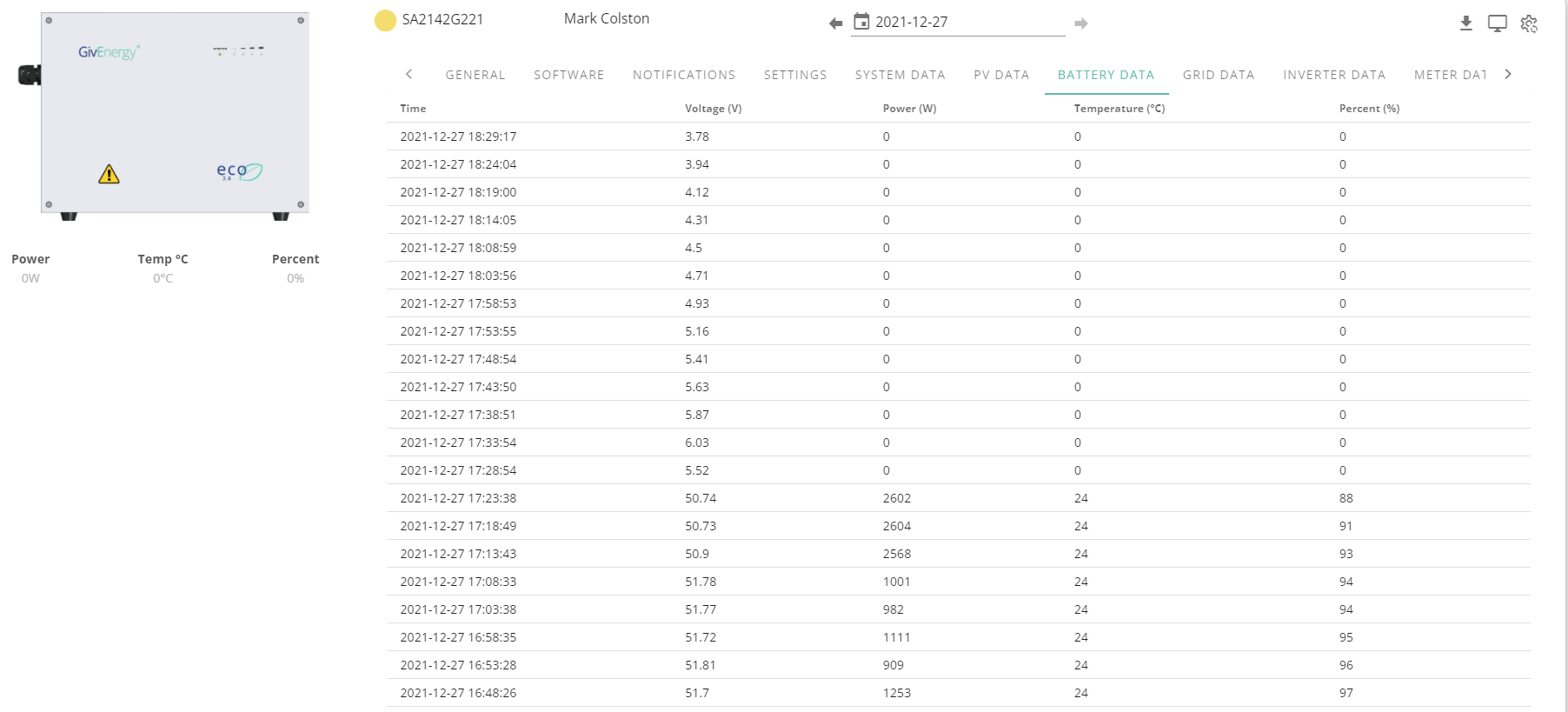
My battery wasn't fitted at commissioning with a USB memory stick - something I'll get sorted with the supplier - so I've put one in to be able to update the firmware (Currently 3001, though displaying 0 for a day or so)
I turned off both battery and inverter to do this.
The cloud portal is showing the battery has a capacity of 0.51kWh - should be 8.2kWh (It was showing this before I turned it off - something I was hoping a reboot would sort actually)
Is this something that a SOC will sort or is it something Support need to look at?
Battery Information Rubbish!

anglefire mine did weird stuff like this when it didn't like the USB I put in (another side effect was discharge only at 1600W rather than 2600). Doubt you'll get response from support until Jan but if everything is working other than it just saying wrong numbers it's not the end of the world until then.
If you can be bothered you could take it out again and see if it comes back in the portal I guess.
Side note: the API for me atleast is still down, not sure where the beta portal pulls the battery size from but this may just be a default value if it can't get a response.
Yeah that is true. USB was a Sandisk 64Gb job I had lying around - formatted it - though not sure if it needs to be FAT.
I may well get the information from the API site - that would make sense to be fair.

Ah Ok, I'll swap it out for another one - I'll probably have to buy one as I don't think I have one that small!
SanDisk tend to format the sector sizes slightly different to other drives and can give compatibility issues.
Try a different card vendor
I've ordered a 16Gb Integral one. Will be here tomorrow, so I'll put that in then. Hopefully the certificate will be sorted on Wednesday as I doubt the right person to update it is in the office today or tomorrow. As frustrating as it is, its not the end of the world and everyone does need a holiday - I know I do!
Seems I have a fault somewhere along the line. Using the battery to feed the house causes the breaker (100A!) to trip when it get above about 2600W

Do you literally have to install a usb inside it for the firmware updates to work!?
MrChaz Yes you do. Its clearly stated in the commissioning instructions on the GivEnergy site https://kb.givenergy.cloud/article.php?id=14

anglefire sounds like you potentially have a loose connection on the DC side.
Copper relaxes a bit after being compressed so your supposed to go around and retighten all connections after "tidying up/ cup of tea" BUT I suspect a lot of issues on here (including the USB sticks missing) are from installers rushing to finish before the GE commissioning door closes at 5pm.
*IF you know what your doing with isolations you could go and nip the battery/inverter/mcb connections up BUT be warned DC has far fewer protections than AC and nothing like RCD trips in milliseconds - so if it bites you'll very much know about it.
hoggy Thanks - the installers didn't actually finish until about 7:30 in the evening and was actually commissioned the next day.
I have no issue with tightening the terminals - I'm an electrical engineer so am well aware of the risks of DC in particular.
The question is though that the battery charges ok, but doesn't discharge so terminal tightness is perhaps not the issue.
I do have a clampmeter that works on DC, so might see what it pulls on discharge - has max lock so can see what it peaks at too,

Its a 3.6kW GivEnergy Hybrid. So should be ok - and as you say charging is less current for a given power due to the higher voltage. But even so its about 52A compared to 46A - on a 100A breaker......

anglefire yeah sorry I should have qualified all that with "in tandem with a loose connection on the breaker heating it up"
Only other obvious check would be that the breaker is actually for DC. Think they are Givenergy own branded now (I ended up with a Mueller fused disconnector for some reason in 2020 - looks naff but barring a dead short it'll never trip!)
Yes its a GivEnergy branded 100A breaker. I was generating a massive 72W a few minutes ago - but that will pass soon!
Just been out and had a tweek of the terminals on the isolator - I'll do the ones in the battery when the new memory stick arrives. They weren't overly loose - but did get a turn on the outgoing (to inverter) side.
I then measured the current and it was 53A peak (recorded on the website as 2602W - which I think is the limit from memory) - so all that is reasonable. Time will tell if the tweek was it or weather its something else.
Well, its been back on and supplying the house since about 2pm - not had many long sustained full power discharges - only recorded 2.5kW for about 20minutes every 5 on the portal.
The five minute refresh of data is a bit annoying if I’m honest but I can see much more instant readings on my in house display from the smart meter. It’s great knowing that the battery (or even better, PV) is covering my house use, even at times of high demand.
We have a lot of things that exceed the battery capacity. Solar at the moment is not doing much and both together won’t cover our peak (if the inverter capacity was ok, but at 3.6kw it’s not). A friend of mine has had solar for about 10years and this December is the worst he has seen.
Had an issue with the 100A switch on mine, all seemed ok then lots of random things, wouldn't discharge but charged ok, discharge at low wattage (500w), random drop outs where I had to go and recycle the battery and inverter system etc.
In the end I managed to reproduce the fault on 2 occasions via the reboot, by just touching the 100A switch and then taking the backlash out of the mechanical motion of the switch it would either restart (tell tale sound of metal fingers resonating coming from the battery) or disconnect the battery.
100A switch replaced which then resulted in a couple of odd instances of SoC drop off down to 0%, pushed the firmware update it completed a battery calibration and it's been all good since.
So the 100A switch cut out was driving the battery into sleep mode, the subsequent issues I think we driven by not calibrating the battery post switch replacement, having a mismatch between my inverter and battery firmware for a couple of days.
Ultimately the GE hybrid inverter and 8.2kwh battery 6kwp of PV and Zappi and Eddi only cost me 2k more than a single Powerwall. Yes it can only support 2.5kw of home demand via the battery (instead of 5kw) and it's 3/5ths of the capacity but it's been good value for money despite the issues I've had.
c_squared
The 2.6kW limit to battery output from hybrid is only really an issue if you still have unused battery at the end of the day, otherwise its simply using the same energy just quicker. Once it runs out you are using the same amount of energy from the grid. It took me a little while to get my head around that.
My battery runs out now at about 4pm, leaving me 7 hours before recharge. Thats as there is so little PV currently that the battery is supporting the house on its own for the first part of the day. I don't even bother PV optimising overnight charging currently and just charge to 100% overnight as I know there will be so little there is no point.
My system will go back to optimising charging in the spring, when he equations I use in my automation for charging will start to demand <100% SOC charge overnight based on SolCast forcast. Until then I just know that I will be topping up fully and depleting completely every day
My home automation records how often I go over the output limit so need grid top up. Yes I do see it, but its for a kettle etc so short lived. My big loads are time shifted to overnight so are irrelevent to daytime peaks which the battery supports ( In the summer I run heavy loads in the day as then PV suppliments battery so higher limit ). I have been using that insight to determine the cost effectivness of additional storage ( so it doesnt run out so early ) and additional inverter ( so the peak power is greater ). For my circumstances the cost of an another inverter for occassional peaks just isn't worth it. I am on the fence for capacity as my 8.2 battery meets most of my needs for 6 months a year when PV is topping it up during the day, so will reassess in a year when I can see the data.
I do have access to lots of local data with very quick refresh cycle. I really geeked out on it when I had my system. I have to say, I barely ever look at it now as the system does what it says on the tin.
Seye "Until then I just know that I will be topping up fully and depleting completely every day" - completely agree - and good way to think about it in terms of "do I use the whole battery each day anyway" irrespective of the 3kw max inverter.
What algorithm do you use with the sol forecast, I'd be interested to do something similar once solar actually starts generating some surplus again! It's been very dull this last few weeks.
(4kw Array, 10,4kwH battery, emoncms current clamps for data analysis including calling the givenergy API for battery %)
a slightly longer response than I planned, but some ideas that you may not have coinsidered yet....
I calculate my "spare energy" over the day by using SolCast forecast to predict PV generation and then I subtract my baseload for the house. In simple terms that derives the energy I would export but will use to charge the battery instead.
I never charge < 40% as I know my PV doesnt meet household demand until about 10am. My cheep period finishes at 04:30 so I always have at least 6 hours demand on the battery, so the SolCast calculations are determining how much to charge above that to make my battery reach SOC that will last all day until cheep power slot comes arounf again. Note that isn't always 100%, it a more complex calculation factoring in load expectation and PV.
If its been really sunny then there may still be enough charge in the battery to meet the calculated SOC demand, say 40%, so it does automatically enable off grid living as much as possible. (Note: in the summer to get that to work you need to timeshift washing machines etc back to max PV generation time to acheive that, other seasons run them at the timeslot thats cheep so not using the battery )
Charging tha battery stops discharge, so I always charge for the full time period but change the target SOC.
(interesting question in the summer is whether to do that, thats in the advanced optimisation process )
SolCast gives probability rating for PV, I am pretty conservative as I have been caught out by over optimising in the past. As charging overnight is substantially cheeper than using power in the day thats the better side to be ( 1 day I got it wrong cost be 4 days worth of optimised savings ). If you over charge the battery that just means the battery still has some energy stored when it comes round to charging again, you havn't explited its full capacity. Again if you think holistically thats just means you charge less tomorrow so you get the saving tommowow rather than today ( so its not a real problem )
Again holistically, I have a solar diverter too. If I miscalculate and PV supplies more energy than the battery can store, I store the energy in the form of hot water. If you want to PV hot water you need to think where that fits inthe equation. If PV charges the battery there may not be enough for hot water. Do you then heat hot water at night or use gas?
If you don't have a solar divertor you can also think differently once you have a battery. Just use a high power smart switch to turn it on full power for a calculated time each day. £20 for a smart switch rather than £100s for a solar diverter :-). I did that too, as a play. It worked really well. When SOC > 80% and PV generating over 1.5kW and load < 800w, switch on immersion heater for 15 mins ( simlar logic to if you are on agile and plunge procing occurs, distant history ! )
If you have an EV, thats just another 'sink' for spare energy. So the order may be battery -> HW -> EV
Spare energy just goes to the next sink, The likelyhood of any going to the grid is very low ( unless of course you want it too as on SEG not FIT like I am ;-) )
Initially I fully optimised charging for Agile. I calculated how many kW were required to reach desired SOC, retrieved all the slots, sorted them in price order then invoked just in time charging for as many slots as required. That worked well, and way before Octopus got around to delivering a working solution.
I don't do any of that now as on GO and just charge based on a timer to the required demand SOC. I deleted nearly all my code ( well archived it ) as it just isnt required any longer
Summary of this is that it doesnt need to be compicated. I have been there and done that, and did it very well.
If you think of your entire energy system at home it isnt necessary to over optimise. It would be quite interesting to see the real world difference, between full optimisation and a simple seasonal adjustment i.e. 4 times a year change the demand SOC. e.g. 100%, 80%, 60%, 40% ( as much as I really like the technical real time version ). I would bet the difference will be small and dont really justfy the effort.
I did it just for fun, and because I could

I'm doing much the same as Seye (though he may have influenced me somewhat 😆) I'm on Go Faster, I charge to a set % based on Solcast (averaging the estimate with the 10percent one so it's a bit pessimistic), and use an algorithm to set the max charge based on my experience but tending towards over-charging rather than under. I don't have any other 'sinks' at the moment so it's pretty simple (I also have solar hot water, and my gas price is presently not too bad, so there's not really much motivation to use electricity for HW). This time of year I'm charging to 100% every night (the code only changes the target if it needs to) - I think the last time it reduced it to a lower target was in August.
(2kW PV, 8kWh battery)

I'm afraid to report that I do none of this fancy stuff and have for the last 12 months simply charged to 100% regardless each night at 5p and exported excess PV at 5p the other way.
QED
Just charging to 100% SoC on my 8.2kwh battery on Go overnight, load shifted dishwasher and washing machine via their timers and also charging EV.
Battery pretty much does me the whole days load aside from peak loads above the 2.5kw, ie kettle and a 10.5kw shower.
Once my 6kw PV array starts producing decent amounts of energy again it's going to get complicated - Solcast is off for me at this time of year as I get shading from my neighbours roof on my lower string that it can't adjust for.
Worst part of my install was the Eddi hot water heater, it's only there to take any extra instead of export but I've realised it's pointless at the moment. I have a modern gas boiler directly above the hot water tank, so it's very efficient for heating hot water and still a lot to cheaper to buy a unit of gas instead of throwing that into a tank heating element. I get 4p of SEG so I'm actually better off using it that way at the moment. That's before you get into the merits of daily runs of the CH/HW pump and boiler system for reliability etc.
A 2nd battery would give me more flexibility in terms of daily use, I wouldn't have to optimise as I do now. It's also a lot of money for an issue that only infects me for 1-3 months of the year and I wouldn't see any return on that for the other 9 months.
It all comes back to pence per kWh paid, this time of year the closet to 5p the better - by the time summer hits I want that as close to 0p as possible.
I share your goal
I use "Octopus Watch" on my phone to keep an eye on my £p/kW. I too want it as low as possible. My lowest possible rate is 5.5p. Currently running at 8.5p so I am quite happy with that.
The second factor to be mindful of is the actual qualtity of kWh consumed. Whilst 8.5p for imported energy is low ( only 3p above the lowest possible ) I am using a lot more at this time of year. My cost is actually £2/day. In the summer I do get £p/kW to 5.5p and daily cost < £0.50p. On very sunny days down to zero, but thats rare.
Be aware, such tools dont give the full picture. If I import just 1kW at full rate it would say 13.5p even though I may have had 18kWh of PV. To get the full calcualtion of your own £/kW cnsumed you need to do that locally as commodity tools dont take account of PV
These considerations are why the decisions to increase storage capacity / PV generating capacity are complex, and differnent for everyone as it depend on so many factors.
FYI My personal break even for another 8.2Kw battery currently lokks to be about 6.5 years, reducing to 3 years as the gap between peak rate and cheep rate widens. I will make that descion when my Go tariff ends
@Seye agree completely about the quality of the kWh consumed, if you don't understand how you consume energy prior to an install being specified it's not going to be optimal for you.
I'm initially worked on a 23kwh per day average including charging the EV, that's 20kwh on Go (AC to DC losses) @£1 per day and 3 full price units and the standing charge kicking it up another £1 - highlights the quality of unit argument!
I've been averaging 21.8kwh at £1.90 per day (inc standing charge) and 7.89p per kWh for the last 27 days (Octopus Watch again). PV has been managing about 1.5kwh per day on top of that number.
I don't expect to be using anything like that from the grid for 6 months of the year on a decent generation day and the more PV DC I can feed the battery the better in terms of efficiency.
As we currently don't spend much time 'off battery' even at this time of year, the return on another unit would be excessive. The smallest battery would do but that lack of unlimited throughput is putting me off.