Gen Meter and GivEnergy App not correlating

27 comments started 2022-12-30 last 2023-03-10
Commisioning
J
#1 Jumbo99

Hi there, since install in Nov, the physical Gen meter (Estrom Modbus) is showing 98kwh generated, but the App, for the total generated, is showing 48kwh generated between 24th Nov and last night. Why is there a disparity, does anyone know? Is this normal?

C
#2 cluelesscris

Jumbo99 If your setup is hybrid Inverter then defintely not. If you have an AC inverter attached as a reftrofit then a small difference can be expected as the AC Inverter will be measuring generation with a clamp. If this is the case check the position of it and that it is properly closed and maybe not getting interference from other nearby high power cables. If it all seems OK the clamp itself my be faulty. Such a big difference is going to affect the inverters actions and you will probebly be seeing more export when you should be charging.

If you want more detailed responses, please include details of your installation. This often triggers response from users with similar setups and therefore much more useful.

J
#3 Jumbo99

Thank you. The inverter is the Hybrid HY3.6, with a 5.2 battery. The installer checked the clamp and said it was ok, then suggested it would double count. I didn’t buy that. So something is not right. I’ve purchased through E.on, in the meantime if anyone else has a view it would be good to know, or resolved a similar thing? Out of interest the clamp is installed inside my fuse board, and surely that has the potential for interference. Where have other people got clamps installed?

C
#4 cluelesscris

Jumbo99 Hmmm. It is very suspicious that the physical meter is recording pretty much twice the inverter says it's generating. This would suggest double dipping. Do you have an ev charger or hot water diverter in the system and where is it attached? It might help you to draw out the layout of your system including the position of any clamps and meters. Coloured crayons to trace power flow under various conditions and you might twig why the meter could be doubling up. I seem to recall another thread somewhere where the hybrid installation had the wrong type of meter in the layout and was unable to track power flow both ways and was therefore measuring both generation and discharge as generation. Ordinarily, this wouldn't have been a real issue other than they had an original FIT scheme and were therefore at risk of reporting incorrect generation.

J
#5 Jumbo99

Hi there, the clamp is in the fuse board, and I suspect that’s where the problem lies. Is everyones in the consumer box? There would be a lot of interference in there, surely!! The installer has checked the clamp and thinks it’s ok. There is nothing else, no EV point or anything for water. Interesting that a colleague has a similar sized FIT system and his Gen meter shows similar to mine over the period. I’ll have to speak to E.on. I’ve lost faith in the subcon that they used. Also, how is SEG calculated? Is that based on the Gen Meter?

C
#6 cluelesscris

If there's only one clamp that's measuring load so the inverter knows when to divert excess solar to charge or to discharge to support load. What's the total discharge and total charge from grid from the battery since November? The hybrid has only one connection to your mains and if the phyisical meter is on that line it will measure anything coming out of the inverter - and that will include discharge from batteries which may have been charged from grid.

J
#7 Jumbo99

Hi there. So….for period from 24/11 to now (12.35pm on 30/12/2022)
App is as follows (kWh):
Generation to home: 48.97
Grid to home: 331.57
Battery to home: 21.93*
Total consumption: 402.47
‘* the battery hardly charges. 99% of that is me forcing from grid!

Physical meters as follows (kWh):
Grid meter: 364.9
Generation meter: 98.78

C
#8 cluelesscris

Jumbo99 What is grid to battery?

C
#10 cluelesscris

OK so 49 generation to home. 21 grid to battery. 22 battery to home. Total through the meter on the line to the inverter is 93 ish. I'm assuming the meter in question is an EM115. Does it cycle through a display? If it's bidirectional it should cycle through numbers including Total Active Energy (M), Total Active Import (down arrow) and Total Active Export (up arrow). The M and arrows are usually at the far right when looking at the readings. Make a note of these and see how they correlate with your app readings. If your meter is not cycling use the button to cycle though the display.

J
#11 Jumbo99

cluelesscris

It’s an OB115-MOD (not EM115 if that makes a difference), cycling display as follows:
Up arrow shows 1.2
Down arrow shows 365.3
M shows 366.5

By the way thank you for trying to help, means a lot!!

C
#12 cluelesscris

And the same for the Eastron? This is the key one.

J
#13 Jumbo99

Should have added that Gen to grid so far today is zero

J
#15 Jumbo99

Eastrom:
IMP 63.48kwh
EXP 35.44kwh
M 98.92kwh
M 139.42KVArh
IMP 128.99 KVArh
EXP 10.42KVArh
M MD -2732 with a small w underneath (only negative figure there).

C
#16 cluelesscris

There's your answer....

J
#17 Jumbo99

cluelesscris sorry I’m really thick with these things… 😂can you please explain for my numpty brain? Is the clamp upside down?

C
#18 cluelesscris

98.92 is total energy passing through the meter - both ways.

Import is power flowing from the inverter. (hint: Generation to house + battery to house + generation to grid + battery to grid)

Export is power flowing to the inverter from grid (grid to battery).

J
#19 Jumbo99

Got it, thanks

So, on that basis, the app shows:
Gen to house : 49
Batt to house 21 (as said nearly all force generated from grid)
Gen to grid 0.86
Batt to grid 0.3
Total 72.16, still a fair way short of what the meter says (98.9)

Is everyone’s like this (ie 30% out)? I’d expect numbers to easily correlate given it all is supposedly coming from one common bit of kit - the inverter?

C
#20 cluelesscris

Jumbo99 you are comparing the wrong numbers. Compare your calculated number to the import number not the total. If you want to compare with the total also add in the grid to battery.

J
#21 Jumbo99

I need to talk to E.ons tech team. I want them to explain this to me as it isn’t written down anywhere, and the installer could not explain it other than some vague statements about double counts. The figures do not add up. It can’t be that far out.

C
#22 cluelesscris

It's not that far out.

There are tolerances in measurement (clamps especially) and inverter calculations to take into account. The inversion process itself is lossy - up to 10% each way. Looking at your numbers it all looks within what most of us are experiencing.

A
#23 AlanStevens

Before I had my Givenery system fitted in July 2022 by NPES Wolverhampton (a retrofitted hybrid inverter and 8.2 kWh battery to a dual 10 and 6 panel SPV system) I had a solar generation meter which simply measured what the panels produced on a daily basis. When it came to providing the reading for the next FIT payment, I just provided the next reading.
The new system has a bidirectional generation meter (Emlite M22 Model Number ECA2.nv) which is very confusing in terms of what it is recording regarding solar panel generation, compared to the generation recorded by the Givenergy system (presumably through the EM115 meter)

Part of the issue has become even more complicated since I started to use off-peak electricity to charge the battery overnight. The bidirectional meter provides 3 readings, Export, Import, and Net.

When I charge the battery overnight, both the Export and the Import values seem to increase by the amount charged, resulting in no change in the Net reading, and even when there is solar generation the Net Reading doesn’t reflect the solar generation as recorded by the Givenergy system.

It is now time for me to submit my FIT generation for the period of 30th November2022 to 28th February 2023, to EDF (who have been providing my FIT payments for the last 10 years) by providing a reading from the Emlite M22. But I don’t know what reading to give them.

I have been recording monthly totals since July, when installation of the Givenergy system occurred.
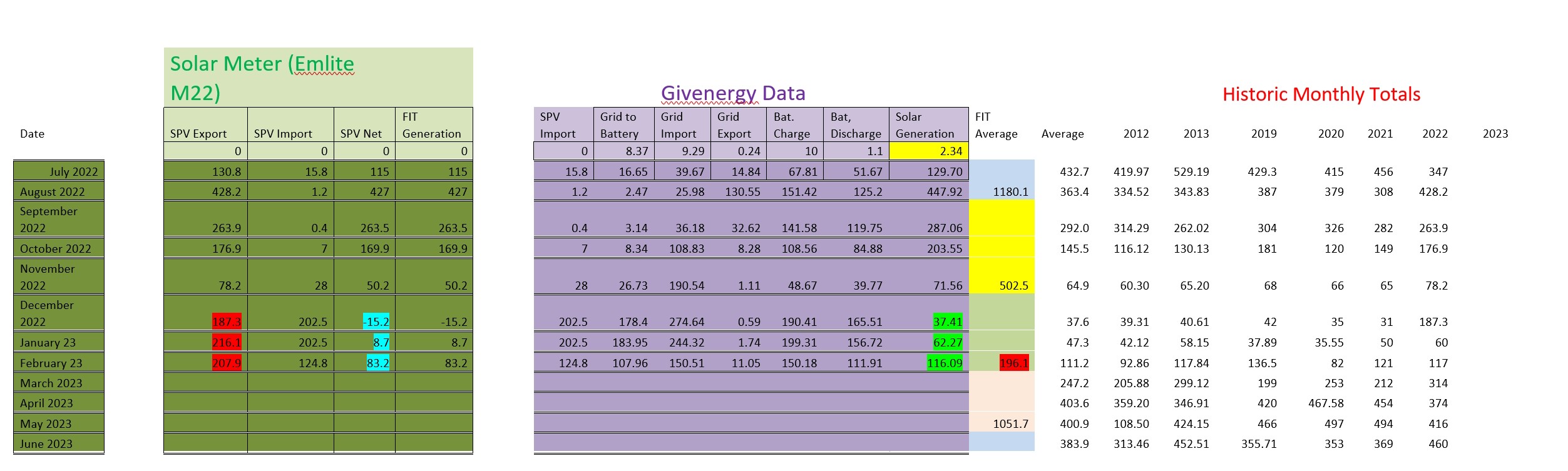
Below are tables showing the monthly totals from the Emlite meter, the Givenergy System and thirdly the historic (and therefore expected) FIT units generated in 2012/2013 and also since 2019 and, from these, the average FIT for each of the 4 quarters.
If I use the SPV Export figures for December 2022-February 2023 (highlighted red), the total FIT would be over 600; way above the average over the years for this period of 196.1.
If I use the Emlite SPV Net values for the same period (highlighted blue), this give a vastly underestimated FIT of only 76.
The Givenergy system meter gives a more realistic Solar Generation value of 215.77 (monthly values highlighted in green) which are in keeping with the average of 196.1.
EDF have registered the Emlite as the generation meter (it is they who required the replacement of my simple generation meter – a Landis Gyr E110) and are not likely to accept the Givenergy EM115 generation figures.
Is it possible that the bidirectional meter is wired up incorrectly?
Can you contact me to help me understand what is going on and how I can maintain my FIT payments by providing the correct readings?

Attached is an image of the various meter readings since the Givenergy System was installed in July compared with the historic generation reading per month and per FIT quarters

T
#24 Tim

AlanStevens The numbers from installation to November look feasible. They are of the right order of magnitude. I presume the first month reflects an installation towards the end of the month. After November it doesn't look right. I always plug in the actual meter reading into the spreadsheet and do the calcs from that. It doesn't feel right that you have consumed more to charge battery than you have had out of it when there is also at least some PV. On the other hand, if your 8.2kWh battery had been fully charged and discharged every day, with a round-trip efficiency of 85%, you could have consumed all of your SPV generation for the winter months? (8.2kWh battery x 15% losses x 30 days = 36.9kWh). In fact, even the Givenergy data for battery charge/discharge suggests that the energy put into your battery compared to that coming out gives a 20% loss. Looking at the Battery charge minus Grid to Battery suggests SPV of about 60kWh for the three months. Not what you want to hear and only you know whether you have charged and discharged your battery to this extent. That would be my guess given the information.

By the way, I view the Givenergy EM115 meter data as "information only". It's fun to see but neither your energy supplier nor your FIT supplier will set any store in the accuracy of their data. Their meters are the ones with money attached and so they are the ones that are always right.

If it is the case that your winter generation has been lost to operating the new system, it may be a bitter pill to swallow but you should gain far more from having the battery by accessing off-peak energy and overall, should be winning hands down.

A
#25 AlanStevens

Tim
Hi Tim, Thanks for your feed-back.
You are correct in saying that the numbers look OK up to November. It was from November 22nd that Octopus Energy turned on peak and Off-peak (Economy7) tariff and I started to charge the battery at night. I have got the daily meter readings but thought that the monthly totals give an overall summary. Indeed, during January, I recorded morning and evening values in an attempt to get my head round what was happening between evening (no solar + overnight charge yet to occur), and early morning (Overnight battery charge occurred but no solar generation).
What concerns me is that the FIT rewards you for generation irrespective of what happens to that generated energy (they assume 50% in-house consumption and pay a pittance/unit for 50% of the generation). With the old meter and no battery, it was a simple, single reading, from the generation meter given once every 3 months - EDF subtracted the higher from the lower reading and paid per unit generated and a small amount on 50% of the generation).
As far as I know that arrangement shouldn't have changed. What has changed is that I now have a bi-directional meter, which doesn't clearly tell me what has been generated because it seems to be masked by any incoming electricity that I use to charge the battery.
As I said in my description above, I tried to clarify with EDF what was the number they wanted to calculate my generation. I'm sure that they said (but not in writing) the export value. This was pretty accurate of my generation up to November (and presumably will be accurate later in the year as I rely less on the grid to charge the battery and move onto solar charging again), but I was and alerted that things were not correct when January's daily solar production was 6 kWh daily!!!. But from what you are saying the bidirectional meter is not capable of separating Solar generation from battery-charge input and adds the 2 together. If the net figure is used it seems to severely under-estimate the solar generation (certainly for this winter quarter) by 60%. (Givenergy data seems OK re solar generation for this winter quarter and compares well with historical values for that quarter.
Regarding efficiency, I know that conversion from AC to DC and vice-versa isn't 100% efficient but at some point in the system there must be something that is measuring the pure generation from the panels and, on the old system that was the unidirectional meter between the inverter and the grid and that was not affected by whether I was consuming the juice in-house or exporting it to the grid. I assume that with my current system the bidirectional meter is in a similar place (between inverter and grid). But does it ignore what I consume in-house or export but doesn't ignore what I import to charge the battery. .
I have also been plugging in all the measurements that my Smet2 meter is recording. Is there a way of using that to calculate what is being generated/imported/exported?

T
#26 Tim

AlanStevens the bidirectional meter is not capable of separating Solar generation from battery-charge input and adds the 2 together.

Not quite, the bidirectional meter cannot differentiate between solar generation to the consumer unit and battery discharge. That's why battery charge (SPV Import) is subtracted from SPV Export and the difference appears in the SPV Net. Obviously, not all of the solar generation reaches the consumer unit when it is generated because your hybrid inverter diverts surplus generation to charge the battery, but over a period of time, all of the solar generation (minus inefficiencies) will be recorded. I believe that it is the SPV net that your FIT supplier would be asking for for FIT payments.

It does seem odd that SPV import for December and January are the same and the calculated inverter losses (assuming the registered meter values are correct) are really quite high. I don't know where the apparent problem lies if all of your recorded meter readings are correct. Don't know what else to suggest.

A
#27 AlanStevens

Hi Tim, I checked my maths and the SPV import for December January aren't the same.
If you would care to look at actual figures for my Smart Meter / SPV Meter I could send you a spreadsheet. (Presumably one can upload a spreadsheet with the upload button?) The am/pm figures that I input in January might provide illumination if one is used to analysing these meter readings (which I am not used to doing and they baffle me 🙁
).
I appreciate your input. Perhaps you may be aware of other threads in the Givenergy Community which may make helpful reading for me.
With Thanks
Alan