New PV/Battery tariff from Octopus announced

40 comments started 2023-02-15 last 2023-02-21
Home AutomationGivEnergy Products
M
#2 MarkyG82

What's the current Go night rate? I'm on 7.5p at the mo but aware that has crept up. This looks good if you have some heavy export particularly in the summer when export might be high in the post 1600 time slot.

S
#3 Smk82

MarkyG82 12p import I think for 4 hrs. Intelligent is 10p if you have something compatible for 6.

You wouldn’t find an eV user using this as there simply isn’t sufficient time for cheap rate import to charge the car (unless your very lucky and either WFH (so can charge from solar most of the time) or retired)

M
#4 MarkyG82

Smk82 I do have a PHEV so the Go tariff works perfectly for me. My deal runs out in the autumn so hopefully the deals keep rolling in.

Z
#5 Zakalwe

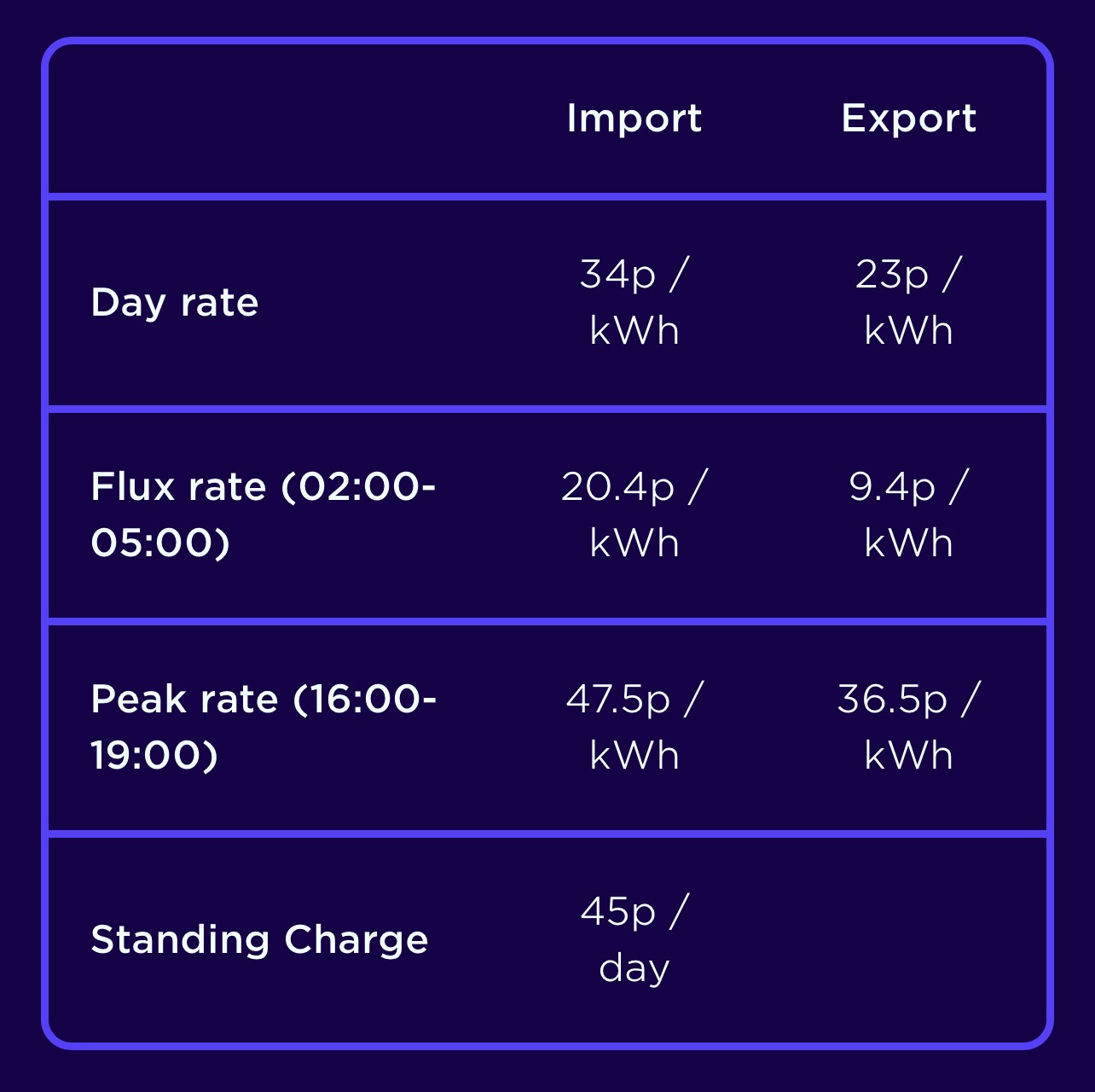
I'm on IO with an off-peak of 7.5 and a peak of 39.25. Looks like i am in for some serious pain when I come to renewal time!
It's an interesting tariff from a concept point of view, but it just doesn't offer enough off-peak time. Plus, you will need a highly configurable inverter to be able to take full advantage of the timings....I am not sure that my GivEnergy system would be able to cope with those timings without a lot of manual intervention.

M
#6 MrChaz

Our Intelligent Octopus is 44p peak / 10p off peak which is 5 hours long.
In the winter I think IO is going to work out a lot cheaper than that, at least for me, because we're putting a solid 12kW into the batteries every night and I'm not convinced we'd export enough (even at 4x price) to offset that

L
#7 lantix

I'd need my inverter to support two charge periods before taking this tariff - 02:00 - 05:00, and another to juice the battery again between 14:00 -16:00 to cover my usage during peak time on cloudy days. I don't think this is currently possible without automation?

As someone currently on a fixed flat-rate tariff of 33p p/kwh for another year, this would be very tempting to cash in on the higher export rate and the cheaper overnight power for the battery.

Z
#8 Zakalwe

MrChaz

IO is 6 hours off-peak, isn't it?

C
#9 CARLMW

I find this interesting as to be fair it’s designed around solar with battery customers. I do have an EV but can charge free at work and only do low mileage. 3 hours a night if I need it is almost half my 45 kWh battery so not a problem for local journeys. The problem I think is that AC charging from any source is fairly useless if you have a big car with a big battery. This will only get worse as battery capacity increases and with so many 7kw AC chargers out and about or in homes this problem will get worse not better!

H
#10 hamilton

You can see why they have done it, it completely rules out energy arbitrage, they effectively know you can be off grid and they want you off grid completely during the peak time.
It may appear to be a good tariff at the end of this year or it may be terrible. I am hopefully going to stick with agile (if they leave it active).
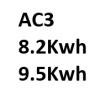
I personally would struggle with a 3 hour offpeak rate, my 8.2kw battery sometimes takes slightly longer and if agile is low for longer I drop the charge rate.

Agile has 3 modes,
Toxic (not worth exporting and bouncing the cap 90% of the day)
Super cheap, not worth exporting but also cheap enough to top up when needed.
Super high, energy arbitrage is key.

K
#11 Karen

I was wondering how easy it would be to swap between this new tariff ad E7? As my battery is outside I really need to do a long slow overnight charge to keep it warm in the winter, and I don't think 3 hours would be enough, but in the spring/summer when it is warmer and I don't really need to import to top up the battery the export rates look much more reliable that Agile Outgoing half hourly SEG. As I already have E7 set up I'm guessing it would just be a case of changing the timings for the registers and setting up one new one? What do people think - easy? Or will it take as long and be as much hassle as setting up E7 was?

N
#12 naltsta

This definitely looks like it would be good for me, but maybe summer only…

The fact that the day export rate is higher than the flux import rate means it’s worth fully charging your battery overnight even if it’s going to be beautifully sunny… no thinking required

#13 positor1

naltsta
with only a 16p profit I wouldn't bother, it is not simply making 16p as there is a consequential albeit small detriment to the batteries, they will only last so long with X amount of throughput.
Also the rates for export on agile are low at the moment but i would hate to be stuck on an export of less than 50p per kwh.

Surely eco 7 at up to 18p per kwh makes much more sense if you have batteries?

L
#14 LordHippos

This tariff looks OK at first glance but I think it really depends on your numbers. I don't think it's terrible, but it's definitely geared to make abusing it basically impossible.

I ran my stats since September, I am on Go (without an EV) which is 7.5p off-peak / 40p peak. This expires for me on the anniversary of the install, so 01/09 as per start date. After which I guess I'd either get a new Go offer at the more expensive pricing, or need to look at alternatives if they want proof of EV ownership some day.

Based on my figures my export is low, so that aspect for these months is irrelevant more or less. I am incentivised to export nothing as much as possible due to SEG being so terrible with Go.

The GE inverter stats are 4 of the charts you can look at via the Energy section of the inverter, I didn't include the two battery ones.

The nice thing about Flux and similar options though is low maintenance, to make the most of Go I have to adjust the battery charge based on forecasts, the most efficient way is to never over-charge the battery by much, and leave enough room for the solar to charge to full + load-shift various appliances like dish washers and washing machines into the sunnier days.

C
#15 CARLMW

naltsta I agree at least for the summer! As you say worth charging the battery each night and not worrying about the days weather. After a year of owning a PV and battery system I’m after a low to no maintenance tariff rather than looking at forecasts. Not a great tariff for EV drivers who are often using more energy in their cars than the whole house uses!

H
#16 hamilton

I've just signed up for the roll out. My main concern was that agile export could remain terrible, in the dead zone all summer.
It works out £20 cheaper over the last year when compared to Economy 7
As a comparison for Agile (nov 2022) since it was launched, the flux tariff would have only cost me £7 extra in total.

My circumstances are that I export lost through the summer and overall only draw around 1MW from the grid per year,
The standing charge works out more expensive than the amount of energy used.
If I remained the same, my standard energy costs would work out as 11.4p per kwh.
Having a schedule means no surprises like I currently have with agile. this may make the system a bit boring but predictable.

I carried out a test charge yesterday and it can charge fully in the 3 hours available.

K
#17 kram

They run a Tesla tariff which doesn’t include a requirement for a car at a flat import/export all day.

That would be way simpler for most customers of the battery supports an octopus can control your battery protocol.

Regardless, this isn’t cheap enough for EV users, although the improved export rates are welcome. TBH the SEG rates should be moving up from the joke rates anyway.

Sadly this seems a bit complicated to me, but I guess you only know if it meets your requirements.

T
#18 TX200

kram Tesla have pulled out of that tariff, it's coming to an end. Octopus Flux coming instead.

P
#19 phoenix

Anyone know if this tariff is only for people with batteries? (obviously it's aimed at them)

Personally, as I would expect to be a small net exporter at peak hours over the year (so that's a wash) and a large net exporter overall, I am not sure that there would be any economic benefit to me adding a battery at these rates. Am I missing something?

S
#20 stevelewis

phoenix Depends on your circumstances. Making a few assumptions:

  • You have a battery with 8kWh of usable capacity and 85% round-trip efficiency
  • Battery is fully charged overnight throughout the year and discharged in the peak rate period
  • For 180 days of the year that's pure export... buy at 20.4p, sell at 36.5p. 18080.85*(.365-.204) = £197 saved
  • For 180 days when you're not generating until 19:00 you avoid import... buy at 20.4p, sell at 47.5p. 18080.85*(.475-.204) = £331 saved (this is an optimistic estimate, but savings would be at least £197).
  • Total annual saving with battery: between £400 and £520
K
#21 Karen

I guess for you it would be the balance between what you use from solar and how much you import at peak times. In the winter without a battery - definitely not. But in the summer months you may be able to get by, just by shifting high energy appliances to the off peak period and taking the hit for any electricity you use at peak times an getting the good SEG tariff. With a battery it's not a bad deal for those without EVs. But bear in mind if you go for a battery it could take some time to arrive as there are often waiting lists. Also if you can squeeze on another panel somewhere you will get the battery without VAT. If you just by the battery on it's own you have to pay VAT on it. Weird or what!

M
#22 murrad

I'm thinking with this tariff, two timed charges. The night one of course but then a 2nd one just before peak time to avoid any draw from grid (with some logic, like only charge if less than a set %)

Would I be right in saying home assistant and givTCP is needed and would be able to do the 2nd charge? Been tinkering and have it set-up on a virtual machine reading data, but not tried anything further yet.

S
#23 stevelewis

murrad Better to set a reserve in the morning and release the reserve during the evening peak to avoid charging twice with the related conversion losses. The logic would be simpler that way too. A job for some basic automation software.

K
#24 kram

TX200

Really octopus were still showing it a week ago.
Price up, Tesla doing it themselves/ elsewhere or outright gone?

T
#25 TX200

kram Tesla pulled out due to current market conditions

#26 THALL

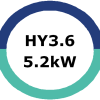
Pretty sure I will switch to this once my solar hits a nice 30kwh and then Intelligent during the winter months. Will be even better when I can get a second AC3 fitted!

M
#27 murrad

stevelewis Ah yes, that makes sense, thanks.

S
#28 stevelewis

THALL note that Octopus has introduced a 1-month standard tariff period between smart tariffs to prevent customers from cherry picking.

#29 THALL

stevelewis Did not notice that! Previously I could switch instantly if I phoned them. If I did it online it took a few days.

W
#30 wilfleek

I qm going to hold off changing tariffs for a while - my expectation is that around mid year, leccy costs will go down a lot. Yes, I know they will go up April 1st, but wait and see.......the wholesale gas price has come down a lot recently.

#31 THALL

wilfleek See I am hoping for that, but the companies who extract the oil and gas are making it pretty clear they have no intention to drop their prices even with their huge profits as of late. While I beleive prices should drop I can not help thinking 30p/kwh will be the new base line. Greed!

@stevelewis do you have a link for that 1 month standard tariff cooling off period? Because on my account switch it just says up to 14 days to adjust my smart meter etc. I can not see where it says about being moved to standard tariff apart from the bit for new customers switching to octopus.

#32 Cdent

stevelewis are you sure about this? They've always had it in their T&Cs that you would stay on a tariff for a minimum of 1 month before being able to move to another one, but not that it would be their standard tariff.

So you could swap to Go for example for winter, then in spring move to something different, then back to Go next winter.

Z
#33 Zaz

I found some info about moving tariffs here:
https://octopus.energy/blog/terms-conditions-agile-go/
It says about if you move off a smart tariff onto a standard tariff you can't go back to a smart tariff for 30 days but I don't see anything about moving between smart tariffs but I've read about people doing it I presume it works fine.

S
#34 stevelewis

THALL octopus Go Ts and Cs on the website today:
"You can switch away from our Octopus Go tariff to one of our standard tariffs any time without financial penalty, but you can’t move back to one of our smart tariffs (Agile Octopus or Octopus Go) within 30 days.

We’ve recently made a change to how often you can switch between our Agile Octopus and either Octopus Go or other smart tariffs. These tariffs offer customers the ability to unlock cheaper (and greener) electricity prices by using energy at particular times. They work best with that change in behaviour, and are designed for the long term.

We’ve retained the ability to leave smart tariffs at any time - if they’re not for you we don’t want you locked into them. We’ve just added the 30 day restriction to prevent the “back and forth” which can undermine the way they’re designed to work.

M
#35 Martyn

Zaz I have moved between smart tariffs without a 30 day standard tariff requirement.

I think the actual position is that you can't move from a tariff for 30days after you joined that tariff, but doesn't actually mean you have to move to a non smart tariff.

S
#36 stevelewis

Martyn recent rule change - see my post. How rigidly it gets enforced is an entirely different matter!

#37 THALL

stevelewis Oh I knew when you switch you are locked to whatever smart tariff for 30 days, but you were able to swap every 30 days without cost :-) Though the shortest actual time is around 44 days including meter changes blah blah

B
#38 Baychattan

Perhaps it is worth noting that Economy 7 is a "standard tariff" and not a "smart tariff". So no issues in moving from say Agile to Eco7.

M
#39 Martyn

stevelewis The t's & c's text you posted actually states:

"We’ve recently made a change to how often you can switch between our Agile Octopus and either Octopus Go or other smart tariffs."

My reading of this is that you can switch between smart tariffs but that there is a minimum amount of time that you have to stay on a smart tariff once you have switched.

A
#40 alan_johnston

Could work for me. I have a PHV so a 3 hour overnight charge will be fine and also get some juice into the GivEnergy battery to power through the peak period later in the day. I have registered interest.