
Adding a battery

25 comments started 2022-01-22 last 2022-02-04
GivEnergy Products
B
#1 BarbaraG

You know how it is…. system only been in 2 weeks and I wish I’d got a bigger battery. I have 3.9kWp panels, a 3.6 hybrid inverter and 5.2 battery.

How much work is involved in adding a second? Is it a couple of hours, a day, what? I know (I think) it has to be done by a registered installer to get warranty and all that.

Also, if I got a second 5.2 battery would it still be limited to 2.6kW charge/discharge, or would it go up to the 3.6kW of the inverter?

C
#2 c_squared

As far as I’m aware, you’d still be limited with discharge. It’s the addition of a battery and inverter that increases the discharge.

M
#3 makse

The charge/discharge rate is the same regardless of how many batteries you have on a single hybrid or ac coupler.

To add an extra battery should take about 2-3 hours in total but all depends on where its located etc.
screw the mounting bracket to the wall
mount the battery on the bracket
run the 3 wires (Live, Earth & Comms) from the first battery to the next
set the dip switches on the 2nd battery to be Slave 1
Make sure its registered on your account and the app, with Givenergy support.

Yes it does need to be done by a registered installer for the warranty.

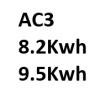
If you do go for an extra battery then look at the 8.2Kw. It has better DOD and warranty over the 5.2Kw. But ultimately it all depends on your daily usage.

B
#4 BarbaraG

makse thank you, that’s really helpful.

If I did go for the 8.2, would there be any advantage in making that the master and the 5.2 the slave? Is that even possible?

At the moment I am charging the 5.2 on Octopus Go. I’ve only had one day when it’s lasted all the way through to the next cheap window. Mostly it runs out at some point in the evening, the worst case being lunchtime.

A big contributor to this is temperature - although our heating is gas, we have loft- lunged PIV units which draw a constant trickle of air from the loft into the house. When the temp in the loft is below 10 degrees they start to preheat it. Our normal usage is 7-9 kWh per day not including car charging, but it has been as much as 16 when it’s been freezing.

But obviously this is only an issue in the winter. I expect in the summer we won’t need to charge the battery overnight, sunlight and the 5.2 will cope most of the time.

M
#5 makse

If you go for a 8.2 then it would have to be put as the master. This is required and doable by changing the dip switches for each battery.

Based on your normal usage then another 5.2 would do but a 8.2 would give you a bit more headroom. the difference is around £800, so you would need to decide on what suits best.
The other thing is on when you want to install that extra battery. 5.2 due in shortly, 8.2 will be April.

If you want to know more then please reach out as I am a registered installer for GivEnergy products

A
#6 anabanet

makse Hi, I dont think that is correct. Discharge ( or charge ) is related to the size of the battery. If you have a5.2 battery you have effectively 4.6kwh to charge/discharge and the BMS limits the power you can draw because of the limitation of the battery meaning it ends up limiting to below the power that the inverter can handle. If you add a second battery ( 8.2 ) you now end up with 13 something kwh, and the BMS limits are now greater than the capability of the inverter. so your inverter can push 3.3kw

Larger battery first.

The wiring is a little confusing. the dip switches are clear...

A
#7 anabanet

BarbaraG For a number of reasons you should make the larger battery primary, and other sized batteries the slave. Remember the battery packs are DC. So Positive and Negative, Remember also if you do it yourself - you loose the warranty. Remember 52volts DC kills just as well as mains AC does...

A
#8 anabanet

BarbaraG very roughly: 5.2 battery = 2.6kw from a 3.6 inverter add a second 5.2 and you will get 2.9kw. add an 8.2 and you will get 3.3kw a string of 8.2 will give you full power on the inverter. Adding an 8.2 ( for the 900 pounds more money ) is sortof doubling your actual capacity. 5.2 = 4.6? 8.2 = 8.3? you cant regret that investment.

Y
#9 yandards

anabanet arguably worse for DC as once you get a hold of it you might not be able to let go of it!

AC at least has the decency to throw you off.

#10 Woodstock

anabanet Is it not the case that the power limiting factor here is the maximum 50A battery charging/discharging current that the Hybrid inverter can handle (60A for the AC coupled inverter)? A single 5.2kWh battery can charge/discharge at up to 60A. Adding more batteries would certainly increase capacity (kWh) but I cannot see how they would produce more power (kW) from a single inverter.

B
#11 BarbaraG

For those warning about electric shock - I would not be doing it myself, I would get an installer. Most likely the one who did my original system, as I was very happy with both workmanship and price.

A
#12 anglefire

Only people that are qualified should work on any electrical system. And yes dc is worse due to the clamping effect. Apparently when my dad was in national service someone wired up the dc radar kit incorrectly and the case was live. Dad grabbed the handle for what ever reason and got a shock which threw him across the room - which pulled the kit off the wall and disconnected the supply. I believe he had a few words with the guy that did it 🤣

A
#13 anabanet

Woodstock internally givenergy does restrict the power. this is per battery size. So one 5.2 has less power than a 5.2+8.2 and even more can be obtained from a double 8.2. I think a double 8.2 meets the maximum that they restrict. This is measurable (and clearly evident if you have over time built up teh number and type of battery for the same single inverter ) You can see the change immediately you add the new battery.

#14 Woodstock

anabanet Agreed; adding batteries would allow more (>60A) current to be passed when considering just the batteries but I am not clear on how this gets around the GivEnergy hybrid inverter limit of 50A DC (roughly 2.5 kW) for battery charging/discharging?

P
#15 pjb904

Woodstock we had a 5.3 added to our 8.2 yesterday. The system sees it as one bigger battery, and the inverter limits to 2.5kWish in and out . A 4 hour Go charge gets us 10kWh stored into the 13.5 combined battery.

#16 Woodstock

pjb904 Thanks for sharing your experience. This agrees with what I would have expected from the equipment specifications.

A
#17 adamdoran

We had a single 8.2kWh battery installed along with our PV late last year, and the second one went in today.

I don't think the commissioning process has completed yet, but the physical install didn't seem to take long. The electrician was here most of the day though, as they had to install a sub-board to house a type-C fuse (long story, but it turns out Schneider don't make a 20 amp type-C fuse for our Easy9 consumer unit).

I had hoped two batteries would mean a higher charge/discharge rate, but it doesn't appear to be the case from what I'm told. I'm curious if this would be a reason to upgrade to the 5kW hybrid inverter, but have been dissuaded from that by the installer, as it would raise the activation energy needed by the inverter, potentially affecting our ability to generate as well in the winter.

M
#18 makse

adamdoran

Max charge / discharge rate of the batteries is the same whether you have a 3 or 5 Hybrid. The only difference would discharge rate through the inverter during the day when the solar is generating

Y
#19 yandards

HY 5.0 inverter can handle 6.5kwp of PV generation, the PV inversion side can output 5kw but the battery transformer rectifier component in the inverter can only output 2.6kw max.

If you want more peak power from 2 batteries you need a 2nd inverter to bring it up to 5.2kw instead.

Having an inverter matched to the PV is good in terms of peak output from what I understand, ie the quoted output of the panels combined is close to the inverter maximums. That said it'll make little difference in winter as you won't get anywhere near maximum panel output due to the reduced solar radiation values at this time of year. That all comes down to the efficiency of the inverter etc.

P
#20 pjb904

Woodstock no problem. This exchange of ideas and shared experiences is so good!

C
#21 CARLMW

Hi all just had a 6kw panel 5kw inverter and 8.2kw battery installed. Overall I am really happy so far (considering its January!) I think the 2.5 kw limit on battery import / export is a limit I did not expect, but on the other hand, faster charging probably is not desirable considering the damage it does to batteries cell chemistry

What I wonder though is If I get greater than 5kw solar generation will the energy going to the battery not break the inverter limit of 5kw as this is DC / DC and no inversion is required?

#22 THALL

CARLMW Firstly, Welcome! Secondly the Hybrid 5kw inverter can take up to 6.5kw of solar panels so it will be fine, and the charge can get to 2.6kw which is less than the AC3 3kw so less damage.

C
#23 CARLMW

THALL thanks for the information. Today hit 5.2 kWh so can verify it works at over 5kw as long as the battery is not full. Another benefit of a hybrid inverter I guess!

H
#24 hwextreme

there will be a 5kwh AC coupled inverter/charger released at some point this year, so this would be a great benefit with multiple AC batteries, I plan to replace my inverter with this and add a second 8.2 battery

B
#25 Baychattan

The AC inverters can be run in parallel, so rather than changing to a 5kWh AC inverter and two batteries, you could add a second 3kWh AC inverter with a second battery - each inverter having one battery.