Need for timed export/discharge with Octopus Flux

140 comments started 2023-02-26 last 2023-05-01
Mobile AppCloud Portal
B
#1 BarleyRiser

I know this has been dealt with before but with the introduction of Octopus Flux I'm sure more will want to sort out forcing export from the battery to the grid from 1600-1900.
Old posts seem to end with set to timed charge and eco and leave everything else. That had been fine for me so far, but back to the problem.
The instructions say:
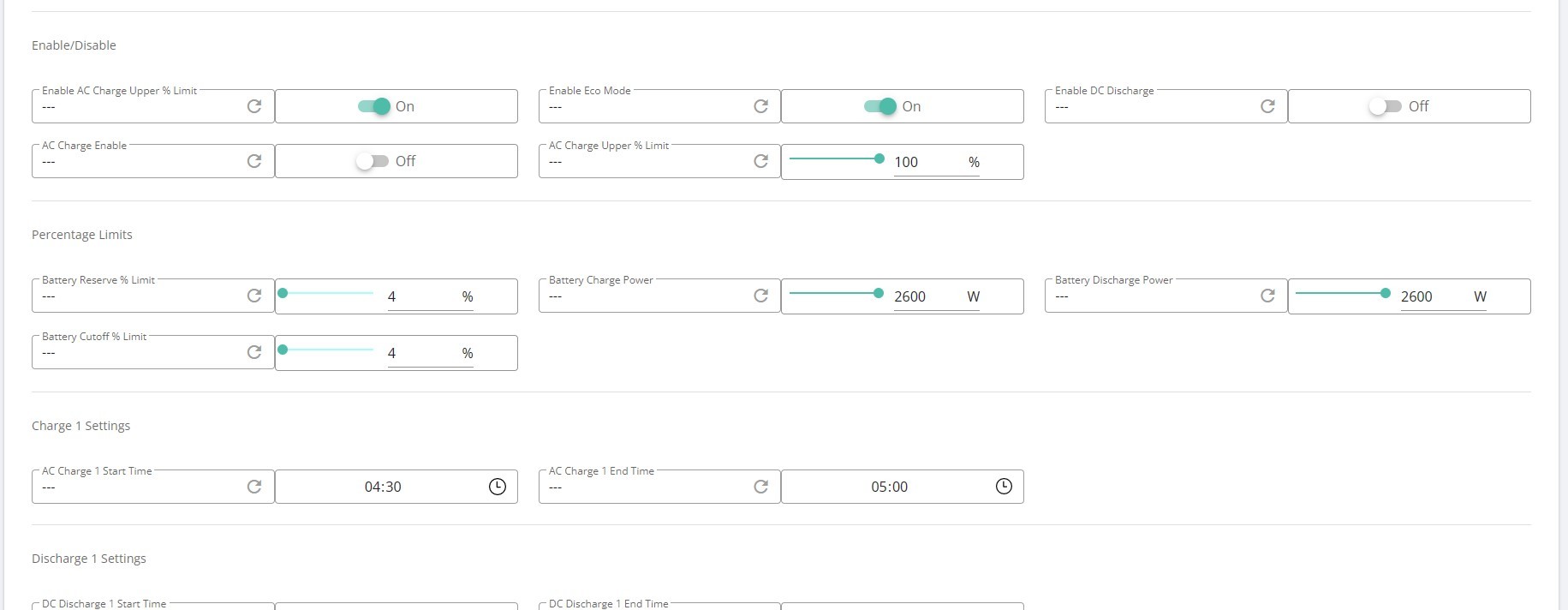
"Timed Charge
This mode will force charge your battery from the grid during a period you define.
Timed Discharge
This mode will discharge your batteries to your home during a period you define.
Timed Export
This mode will hold your battery power and discharge it at full power during a period you define."
I want
-battery fully charged from 0200-0500
-house run on battery and solar from 0500-1600 and 1900-0200
-house run on solar and battery, and as much go to the grid as possible, from solar and battery, from 1600-1900
Is that "Timed Discharge", "Timed Export" or something else?

S
#2 stevelewis

BarleyRiser presumably Timed Export. But you'd also want to vary your reserve throughout the day so you have some charge left for the expensive period on a cloudy day. You'll be looking at some separate automation to do all this. Question: as the cheap Flux period and high priced evening peak are the same duration, where are you getting the extra energy from to discharge your battery throughout the day with this scheme?

B
#3 BarleyRiser

I'm generating more than I use, even now. I want to export from the full battery from 1600-1900, rather than just using it for the house . It can then be topped up with solar or cheap overnight. Even if it runs out during the evening the import is cheaper than sold during 1600-1900.

S
#4 stevelewis

BarleyRiser agree that forced export for 3 hours makes sense. Unless you are severely export limited during the day and potential generation is going to waste, charging the battery from solar is of no real benefit with Flux.

K
#5 Karen

Hi, not an expert, as I've only exported to grid over the winter with little sun at the time of export. I've always used timed export. I know this covers the house base load if there is no sun, as well as exporting the residual amount (dependent on your inverter capacity) to the grid at a rate you determine. I've been told that the battery cannot charge and discharge simultaneously, so presumably any solar power would power the house first and if that covers the base load the remainder would also be exported. With timed discharge you have no control over how much is discharged - just for how long. So you would need to be really careful, because if the battery fully discharged in say 2 hours and there wasn't enough sun to cover your base load you would end up importing from the grid at peak rate. I would definitely start with timed export - at least until you get a feel for how quickly your battery discharges and how much your house will use as base load over that time and until the sun is powering the solar over the full discharge period.

S
#6 SteveCook

Karen
Is Flux actually up and running.
I registered an interest and the Octo page says "we will contact you when we roll it out"
2 weeks on and all silent

R
#7 Roberto

SteveCook same here.

#8 THALL

SteveCook Flux import is available now. import/export is not

B
#9 BarleyRiser

THALL what do you mean? You can get the worse import rates than Economy 7 but you have to keep your current export tariff? I haven't seen anything online. Do you have to ring them? Any ideas when export will be ready?

#10 THALL

BarleyRiser I mean you can call and get Flux Import now. Though no idea why anyone would. No idea on when the export will be ready, I am wondering if it could be April 1st and all the prices go up a bit. But flux import is on the available tariffs list when I search.

S
#11 SteveCook

I phoned Octo metering team again today and it was like talking to the wall. The guy had no idea about Flux and why my ECO7 readings are all wrong. He just said "I see you email of 2 weeks ago is open, I will try to get someone onto it"

T
#12 ToothyChris

SteveCook I finally got my Octopus Economy 7 bill issue sorted, when 'Alex' in the CEO's office finally got hold of my complain. I believe his full name is Alex Roberts, but I cannot be 100% certain. But worth calling and asking for him, and seeing what happens. He said he had never seen this issue before, but I assured him there were others, like you.

Good luck,

L
#13 L174559

It looks as if Octopus is replacing its Eco7 and Go tariffs by the new Flux but there are less advantages for customers. The main worry is the reduction in the cheap night rate to 3 hrs and the introduction of a premium rate from 16:00 to 19:00. It looks like the Flux tariff will be your only choice from when the new cap rates are introduced???
Has anyone more detailed info?
With my 9.6 kW battery and inverter charge/discharge rate of 2.6 kW I would only be able to export a max of 27 kW at 38.76p export rate that's only £3.48. But you'll only be able to charge your battery on cheap rate for 3 hrs from 02:00 to 05:00 at 20.54p costing £1.85 profit will be £1.63. The daily export rate is 24.39p. So I'm just wondering how best to set up my system to make the most of any surplus PV once battery charged and car charged and house base load covered to my set limits? ATM not able to dump to water heating.

#14 THALL

L174559 I don't think ECO7 and Go are being replaced by Flux. Flux is to target customers with Solar and batteries like Cosy targets those with heat pumps. Go/Intelligent for EV owners.

Why do you think Octopus is going to drop ECO7 and Go?

L
#15 L174559

I hope that you are right. I've just joined and will have to wait a fortnight before they offer me a tariff other than their standard rate.

S
#16 Smk82

What I would like to see is a tariff for eV/solar/battery owners. Solar/battery owners are getting improved export rates, so why not those of us with all 3? Granted I’m not expecting a 25pexport tariff if I’m importing at 12p (if on go), but SEG could be improved to say 8.5p?

#17 THALL

Smk82 Because a lot of us with batteries would then charge at the 10p cheap rate and then dump it all back at the highest rate. £5 a day profit ish. But they allow you to instantly switch between their own tariffs so for me I will join Intelligent for 7 months a year and Flux for 5. Though not totally sure on that. I am currently using all of the 400kwh generation, need to look at the numbers once I hit 600kwh per month ish. I am lacking a full years worth of data with my EV to know exactly what is best.

S
#18 Smk82

THALL I understand their logic, but there we still wouldn’t be making a huge profit at 8p (for example). It’s just annoying that solar/battery (no eV ) users actually get a chance to be cost neutral or even make a small profit (if low user) whereas eV drivers who need larger imports (if can’t charge during the day) get left behind a bit.

I’m not asking for 30p export tariffs etc!

#19 THALL

Smk82 I am aiming to be cost neutral this year if Flux starts soon. My pv should generate around 8400kwh per year and the current estimate for my usage (100% electric home, ASHP, EV) is around 8300kwh. Providing I charge tariffs twice a year.

If i take my August 2022 data and apply Flux prices I would of made £63 credit, but I have double the battery space and double the PV so I expect £130+ credit which should offset winter. Worst bill was January, £111. Obviously this is guesses based on incomplete data. The increase to standing charge is really frustrating though, currently 37p a day which is bad enough, is going to 50p+ next month!

S
#20 Smk82

Depends how much you need to charge your eV.. I need about 30-40kw daily, and mine is projected at 4300kwh/year, 6700 was previous usage and that wasn’t doing as many miles!

#21 THALL

Smk82 30 - 40kw per day? WOW my daily drive is around 60 miles and I put in 16 - 18kw depending how much I use the heater. 12 - 14kw during the Summer. 14 - 16k miles per year

S
#22 Smk82

THALL 80mile per day round trip. And it’s all motorway/dual carriageway.

#23 THALL

Smk82 But that means only 2 - 2.6 miles pkwh? Thats not good :-(

S
#24 Smk82

THALL it’s all motorway/dual carriageway. I’m going to use this year as a benchmark and see how much I export as this is my first year with pV/batteries (September install). If it’s loads, then swapping to a different tariff might be beneficial. I’m only in my go faster till September anyway😢.

Yesterday’s was 52kwh, but that was charging eV, running house and charging batteries. 98% of my usage is off peak though

S
#25 Smk82

Mostly cruising at 70. I know I could get better at 60-65, but it’s already a 50min commute 😆

#26 THALL

Smk82 Well thats fair enough. My run is 19 miles dual and 6 miles single. But I keep the cruise to 60mph, heater only comes on to demist the screen. The 6 miles single is a mix of 20, 30 and 50mph. Takes me about 50 minutes as I drop the missus off too.

Are you seeing the value of an EV then for your use case? I am getting about 2.2p per mile since I got my Born back in October, but if you miles per kw are half mine you must be double that price???

S
#27 Smk82

THALL my commute if by petrol would be about £4300/year. EV cuts that to about £600.. it’s a personal lease, unfortunately I got it whilst at my old job (less miles), but the new job comes with a salary sacrifice eV scheme so hoping to get a new eV on that and wife can go on this one (she does far less miles).

#28 THALL

Smk82 Hmm my missus works for the nhs and I did look at their deals for cars. But if I recall it impacted her pension so just went the carwow route for a discount.

#29 dbt85

Smk82 Octopus works because they balance the Tariffs out based on the need. I'd love to get on one to import at 10p but I don't have an EV, so I'm "left behind" paying whatever the next best rate is I can get. I also only want to import 10kwh, not 20 or 40 or 50 like some with an EV might.

The flux cheap rate is expensive compared to their other cheap rates, the flip side is I can get something approaching a reasonable sum for export.

If they made a tariff specifically for EV/Solar/Battery you can be sure you'd not be paying 10 or 12p to import at night, nor getting the 24p or even 38p export.

Watching people min/max the flux tariff will be interesting. Do you import at 20p to sell at 38p in the better 5 months of the year, or not bother and just let it go where it goes? Maybe export but only enough to bring your daily bill down to £0 to save cycles on the battery.

S
#30 Smk82

dbt85 as I stated above, if they did do such a tariff I wouldn’t expect a 15p or more export tariff, but 8p or similar would certainly be doable I would think as even on the reduced eV rate, I would not be exporting for more than I import..

C
#31 CARLMW

BarleyRiser hi did you get a definite answer on this as no mode seems to fit the task. II think we are after the same thing, run as normal all day and dump the battery to the grid at 4pm till 7pm!

S
#32 stevelewis

CARLMW whilst not a forced discharge, setting to Eco with a timed charge from 0200 to 1600 does similar. Or do some home automation.

J
#33 Jim

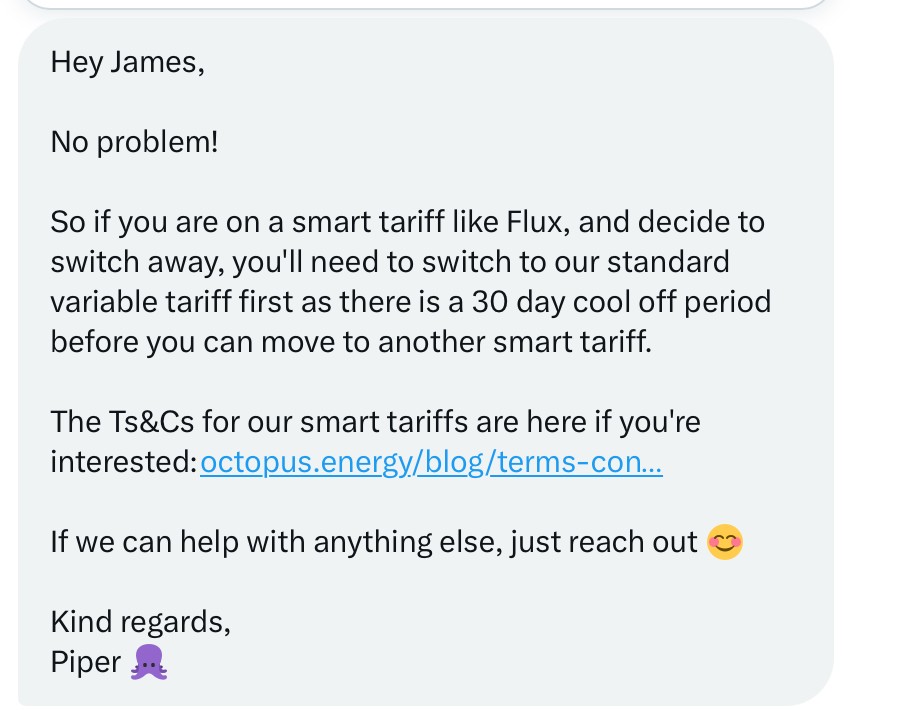
THALL You cannot switch straight between their smart products, you have to have a 30 day cooling off period on a standard product. For me Go in winter and Flux in summer would be the most financially beneficial, but switching twice yearly would mean two months being on a standard product. This is making me hesitate to switch to Flux as that will be costly for me in the winter compared to Go. I think March and September would be the best two months to sacrifice. So Flux April to August. Standard rate September. Go October to Feb. Standard rate March.

B
#34 Baychattan

Don't forget that Octopus Economy 7 is a 'standard' tariff, not a smart one. So changing between it and a 'smart' tariff has no one month constraint.

#35 positor1

Baychattan
actually it takes them a month to configure the smart meter correctly ( or more) and results in incorrect high charges that you have to look for.

#37 kai

What would really help with Flux is the option to discharge during a time slot, with a lower % limit set and then auto switch to eco once either the time slot ends or the lower % limit is reached.

It's something that can be done via HA or external scripting, but doesn't seem a hard thing for GE to implement.

S
#38 stevelewis

kai how hard it is depends on where you're starting from. I've prototyped a scheme which allows you to do whatever you want with the system in 30 minute time slots, including varying the reserve and setting an overnight target SoC based on solar forecast. However, for GE to do something like this would require a major rewrite of the portal and/or app. Continuing to focus on point solutions will result in repeated requests for enhancements every time a new form of tariff is released by one or other electricity supplier.

#39 THALL

Jim That is not my experience switching between Go and Agile and Go to Intelligent. The switch happened over night. Agile to Go was done on the phone, Go to Intelligent was online.

#40 kai

stevelewis True, and I'll almost certainly just knock up some python to handle the use case as Flux really isn't very complicated (much easier than Agile). It does exclude a fair chuck of the customer base though if the solution is a raspberry pi and scripting.

J
#41 Jim

THALL good news if that proves to be the case. This is what they told me though:[
](https://)

C
#42 cluelesscris

Jim I think the 'cooling off' period is misleading. I actually think they will not allow you to swap tariffs more than once in 30 days. Swap to one, wait 30 days, swap to another.... If you swap, immediately decide it's not for you and want to come off the new tariff immediately you can go straight on to a standard tariff and must then wait 30 days before trying another.

#43 THALL

What cluelesscris says. I know you can not switch more than every 30 days. I am going to try soon, pretty sure I am going to switch to flux at the end of the month an try my luck. want to avoid the increase in standing charge

J
#44 Jim

Excellent, thank you. I’m going to initiate my SEG switch to Octopus as that needs to be in place before I can get Flux

M
#45 mjkelly5a

Flux is great and very innovative but if you are on FITS be careful. You will have to give up your deemed export and octopus Flux is a Beta tariff. Just like Go Faster which they have now canned and it lasted 2 years.

My FITS tariff contract has 12 years to run. Octopus cannot guarantee that they will still have a tariff running for that long and once it's gone - it's gone! Too much of a risk for me so I walked away.

S
#46 SteveCook

All in Octo R&D
I set a charge time from 13:00 to 16:00 33p to make sure my battery was fully charged even if it was cloudy so I can avoid any peak import from16:00 to 19:00 46p.
I then set a discharge between 16:00 to 19:00 35p to a min battery of 50% so I have 5kWhr left to get me through to 02:00 for import charge again. 19p.

First problem was the discharge did not start because the import end at 16:00 clashed with the export start at 16:00.
I have moved my charge half an hour forwards from 12:30 to 15:30.

Second the Solar iBoost + then sees a big export and decided it needs to suck up the power, so I have 2.6kW going from the battery/inverter , but only 300W being exported (and paid for) as 1.6kW is going to iBoost and 600W to house (TV, Sky, Lights, Router etc)

I know it is good energy going to iBoost as it is saving me gas, but I now need to work out if it is better to sell at peak and buy gas, or push as much into iBoost as possible and reduce gas.

Is there a better way to control iBoost such that on programmed export time the iBoost is "off"

#47 kai

I've just gone from Go/SEG to Flux directly today. No questions about 30days on flexible. Had to bump them after a few hours as outgoing hadn't switched across and it was getting close to 4pm, but they did it very quickly via twitter.

S
#48 SteveCook

SteveCook
I guess I need an EDDI and a HARVI which will cost me about £500.

S
#49 stevelewis

SteveCook or get yourself a simple timeswitch for £20.

S
#50 SteveCook

stevelewis
Good idea.
The Solar iBoost+ is currently hard wired from a fuse spur. I will have to look to see if I can make the fuse spur into a socket, put a plug on the iBoost flex and get a 3kW rated time switch.

Hmm
Extract from iBoost manual

S
#51 stevelewis

SteveCook better to get a hard-wired timeswitch, designed for the job. Screwfix has several types.

S
#52 SteveCook

stevelewis
Thanks
I will take a look

G
#54 gnuss

SteveCook From what I have worked out an efficient condensing boiler (>90%) using an indirect cylinder is about 60-70% efficient at heating hot water due to heat loss through pipework etc. (https://www.bre.co.uk/filelibrary/SAP/2012/STP09-B07_DHW_Boiler_Tests_2009.pdf). The margin was roughly equal on the fixed 15p/kwh octopus export tariff as I was paying 10p/kwh for gas. Now exporting even at the flux standard rate (24p/kwh) is financially better than diverting to iBoost to save gas. I'm leaving the iBoost off now I'm on flux.

S
#55 SteveCook

gnuss
Thanks
Trip to Screwfix in order then

S
#57 SteveCook

pacemaker
Yes that is the one I have in the basket

G
#58 gnuss

Anyone else seeing that timed battery export seems to be limited 3kW total export (including any solar generation to grid) rather than 3kW battery discharge + surplus solar generation. Using it on flux for the first time today and a little frustrated by this limit as in the summer it likely won't allow me to discharge the battery if my solar generation is over 3kW.

G
#59 gnuss

#60 THALL

gnuss What is your DNO export agreed limit? Will be a G100 certificate.

G
#61 gnuss

7kw limit. Exports up to that throughout the day on solar alone.

#62 THALL

gnuss It looks like you are being capped at 3.6kw export. Check with your installer, on the engineer portal they can set the export limit and I bet they left it at 3.68kw rather than your allowed 7kw. I don't hear of many people getting dno approval for export over 3.68kw. I think you said in another post you have a 7kw pv array? I wonder why the DNO limited your export to 7kw rather than your total possible of 10kw.

G
#63 gnuss

THALL Array is 7.5 with 7kW string inverter. Left it to the installation company to request the DNO which they did and got approval for 7kW. I’ll ask the engineer to check the export limit! Thanks.

B
#64 BarleyRiser

CARLMW just got back home after a few days away, during which Flux started. We've had exports of £&+, £4+, £4+ and £1 by charging to 100% and setting my alarm for 4pm and 7pm to manually start and stop export. Why does timed discharge turn off eco?
I just want something to automate pressing the discharge button st 4pm and resetting it at 7pm.

B
#65 BarleyRiser

kai exactly!

B
#66 BarleyRiser

gnuss exactly my thoughts. Just dump the iBoost until gas prices increase, or export prices fall.

N
#67 naltsta

BarleyRiser Are you saying that if you manually start and stop export (using the app?) that eco mode stays on? I think I'm going to have to get going with Home Assistant...

C
#68 CARLMW

BarleyRiser yes it’s crazy 😜 if you set it for a specific export time it seems to stop exporting at all other times… as you say just want to export what’s in the battery then resume eco!

Odd because import usually does not do this (stopping all import would make no sense to meet demand I guess) although it gets stuck with eco turned off sometimes. Like I said on a previous post, this is a highly predictable tariff, please GE just give us an automation we can switch on!

K
#69 Karen

I agree with Carl. I would just be happy if setting a timed export didn't switch off ECO until the export actually started and then switched it back on after the period finished. It is a pain having to hover over the submit button until you want export to start and then remembering to switch ECO back on again when it has finished. Surely, that is what "timed" export should do. "Timed" charge can just be left set up and switches on and off as expected - so why can't timed export? Not all of us have the technical knowhow to program, set up APIs or even use HA

S
#70 SteveCook

The way I have set mine up with Octo R&D is
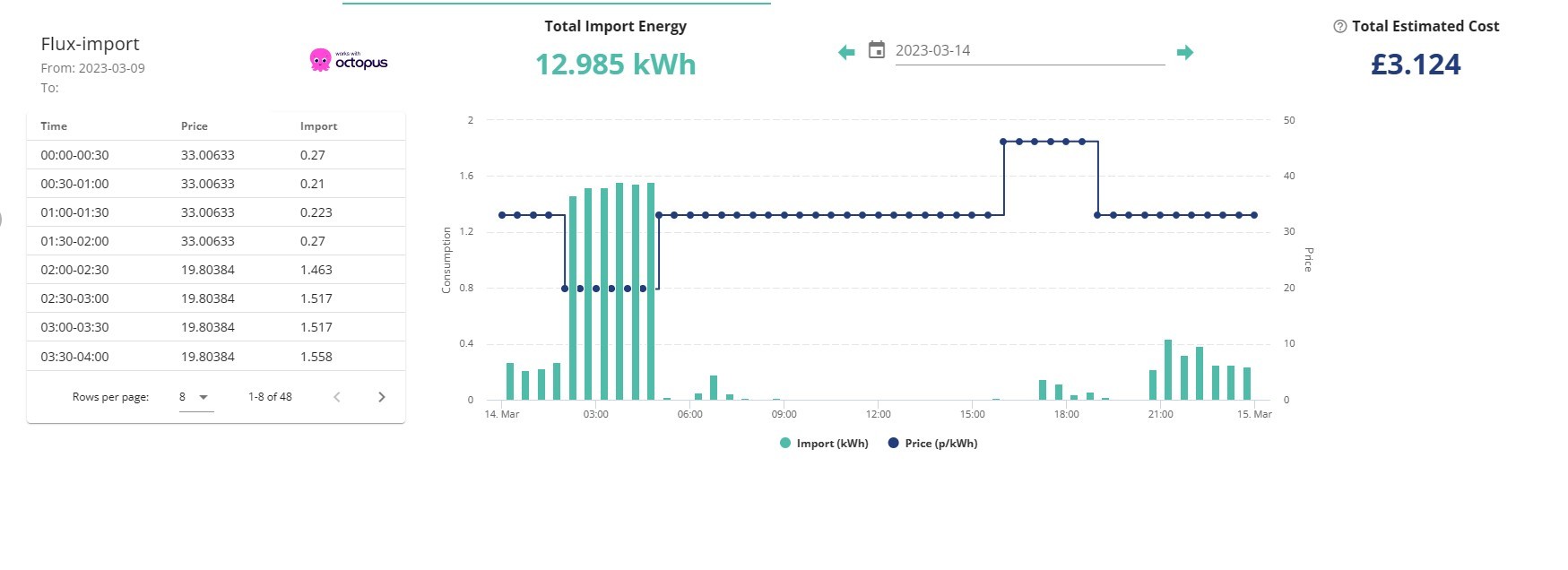
Cheap import 02:00 - 05:00 . When R&D ends at 05:00 it resets GE to Eco
Run during day on Eco
Normal import 12:30 -15:30 to make sure battery is full at 16:00. Note if there is solar about, not a lot gets imported. At 15:30 R&D resets GE to Eco.
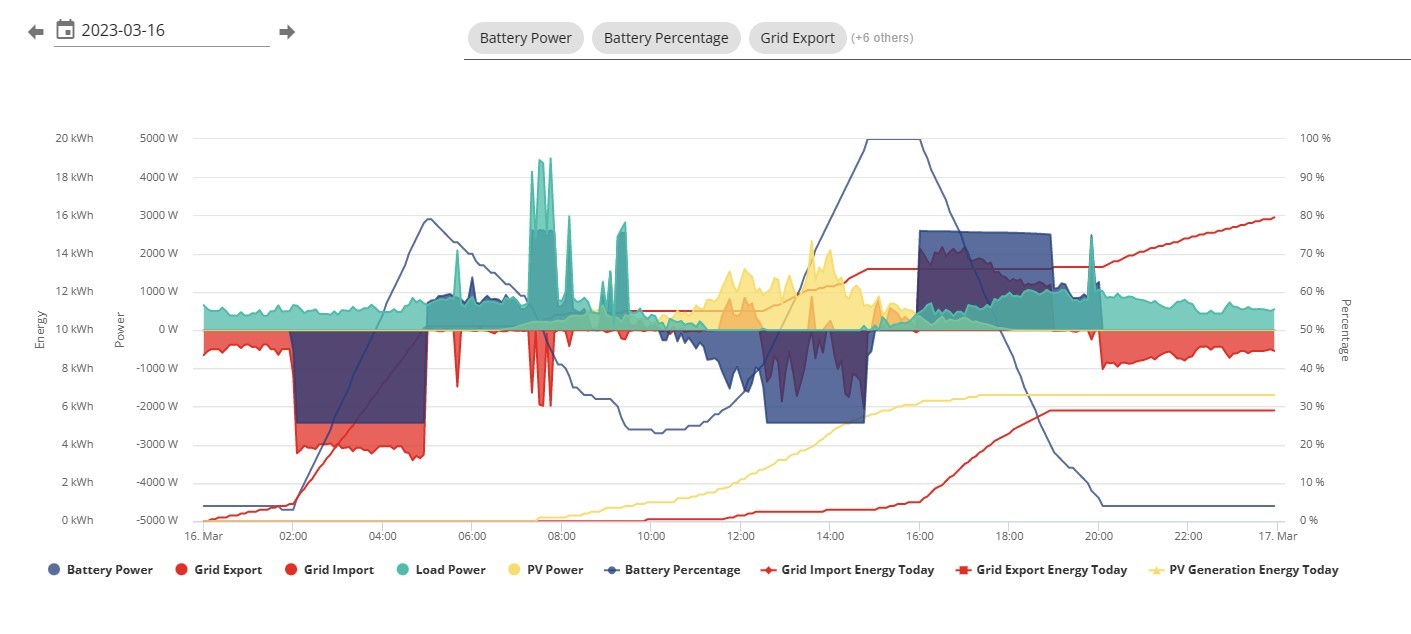
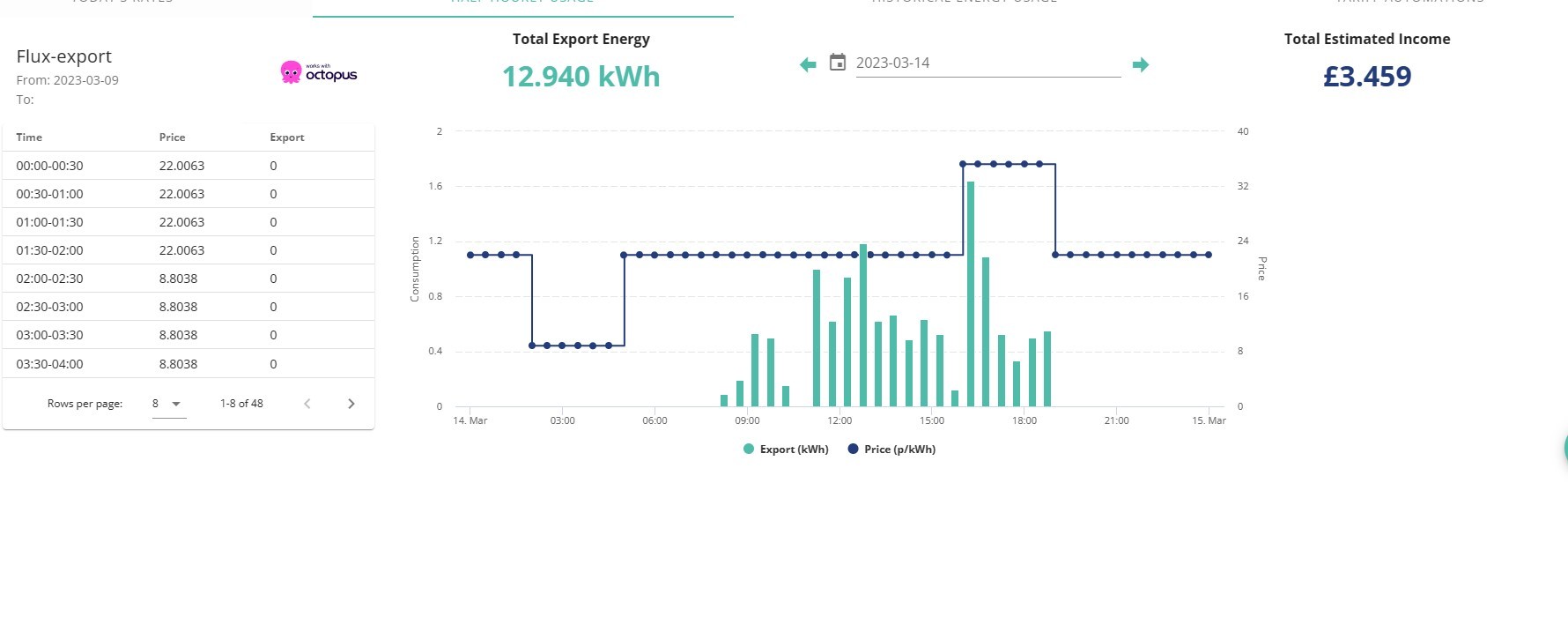
16:00 -19:00 Peak export. Note exporting makes sure I am doing NO importing, plus the higher rate export offsets the import from 12:30. I have not really set this up to make money, but to avoid importing at peak. I suspect if I ran on Eco after 16:00 I would not import but then would not have the benefit of selling any PV charge made during the day at peak.
After 19:00 R&D sets GE back to Eco and I switch back to import at 33p just to get through until 02:00 when the cheap import starts battery charging again.

I have watched the R&D history and GE logs to make sure it all works

I have had to make sure there is a 30min gap in R&D timeslots as the inverter takes time to switch modes (1 or 2 mins) and found (say) if charge end discharge start were at the same time (say) 16:00 the inverter would get in a pickle and things would fall over.

T
#71 TurnerSN13

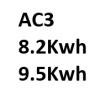
SteveCook A great example, thank you. Out of interest what was your net profit/loss for that day ? I'm guessing form the chart you have a single 8.2 battery?

S
#72 SteveCook

I have only just cracked the settings because the clash of timings was confusing me.
I have only been on Flux a week or so, and the most recent data GE can pull from Octo is 14th.

9.5 battery and Gen1 5.0


#73 THALL

So for the 14th you bill was zero if you factor in standing charge. Have other days been profit? Any days loss so far?

S
#74 SteveCook

Sorry
I have only been on Flux since 9th and only cracked the Octo R&D/GE profile times problem on Tuesday night 14th only so far have 1 or 2 days complete/useful data

#75 THALL

I'm just not keen on dumping my battery to the grid for the higher peak rate. I am toying with the idea of fully charging the battery and charge my EV during the 3 hour cheap period and then let all my ov go to the grid. But that still means higher grid usage.

I think flux is a great tariff to build some credit for winter. I am just not sure about 1 dumping my battery to the grid and using cycles. 2 the best time of year to switch to achieve a zero annual bill.

Mid april to mid august maybe. I need to stop looking. Its starting to frustrate me :-)

P
#76 pacemaker

SteveCook

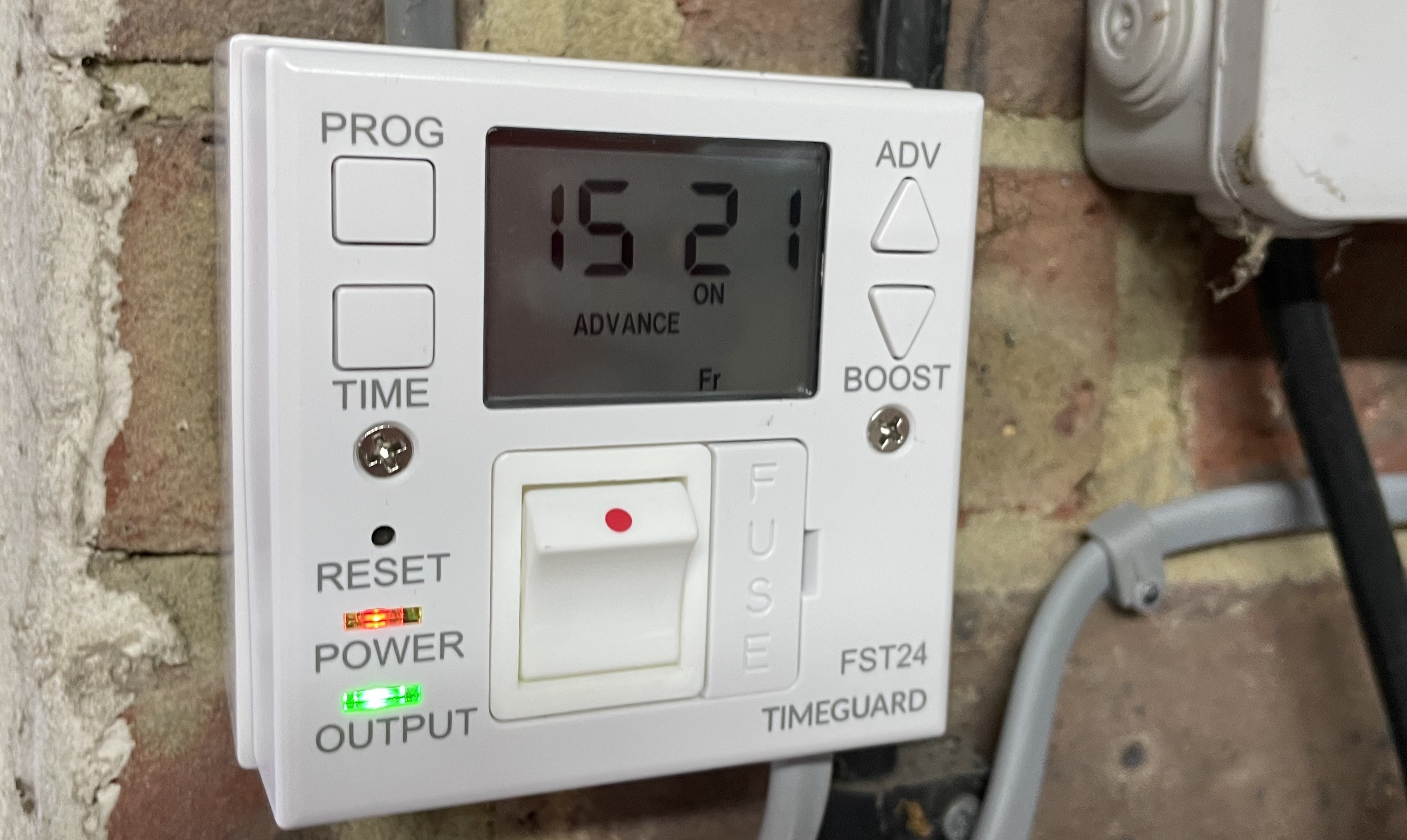
Just installed this on the iBoost+ and set the schedule to turn off 1600-1900

S
#77 SteveCook

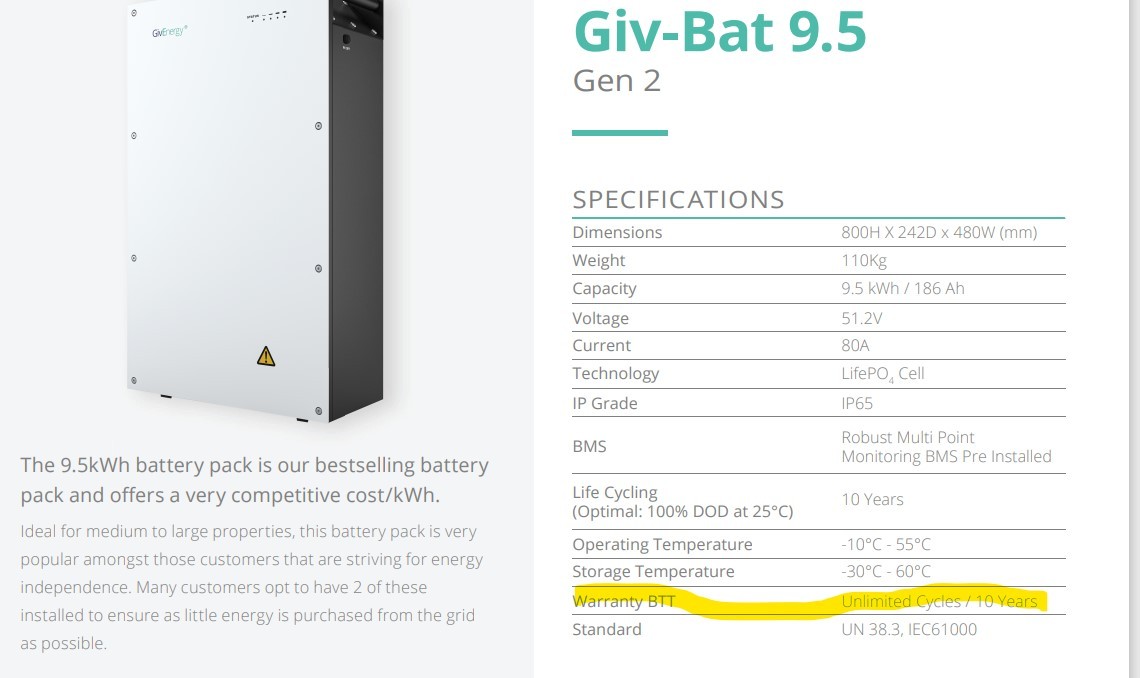
My 9.5 battery is unlimited cycles/10 years

R
#78 rogerarnett

BarleyRiser
Have just moved to Flux, but have no idea how to set up battery charge & discharge times. Where are ‘the instructions’ you refer to - Octopus or GivEnergy ? Are ‘smart plugs’ involved?

S
#79 SteveCook

No smart plugs.
Set schedule in Octo R&D https://smart-energy.octopushome.net
You will have to register ,wait a day or so and the page will start to populate down the left side with tabs
There is a good help guide

B
#80 BarleyRiser

SteveCook I've just set my times in R&D. Will these override what is set in the app/dashboard? If it does how do I stop it to use the app again?

B
#81 BarleyRiser

rogerarnett trial and error. But my mistake was that I assumed it did what it said!

S
#82 SteveCook

Hi
Yes
Leave GE settings in portal as Eco -enabled. All others disabled.
When R&D signals an action, GE Eco will be disabled.
When R&D signals action has ended, Eco will be re enabled.
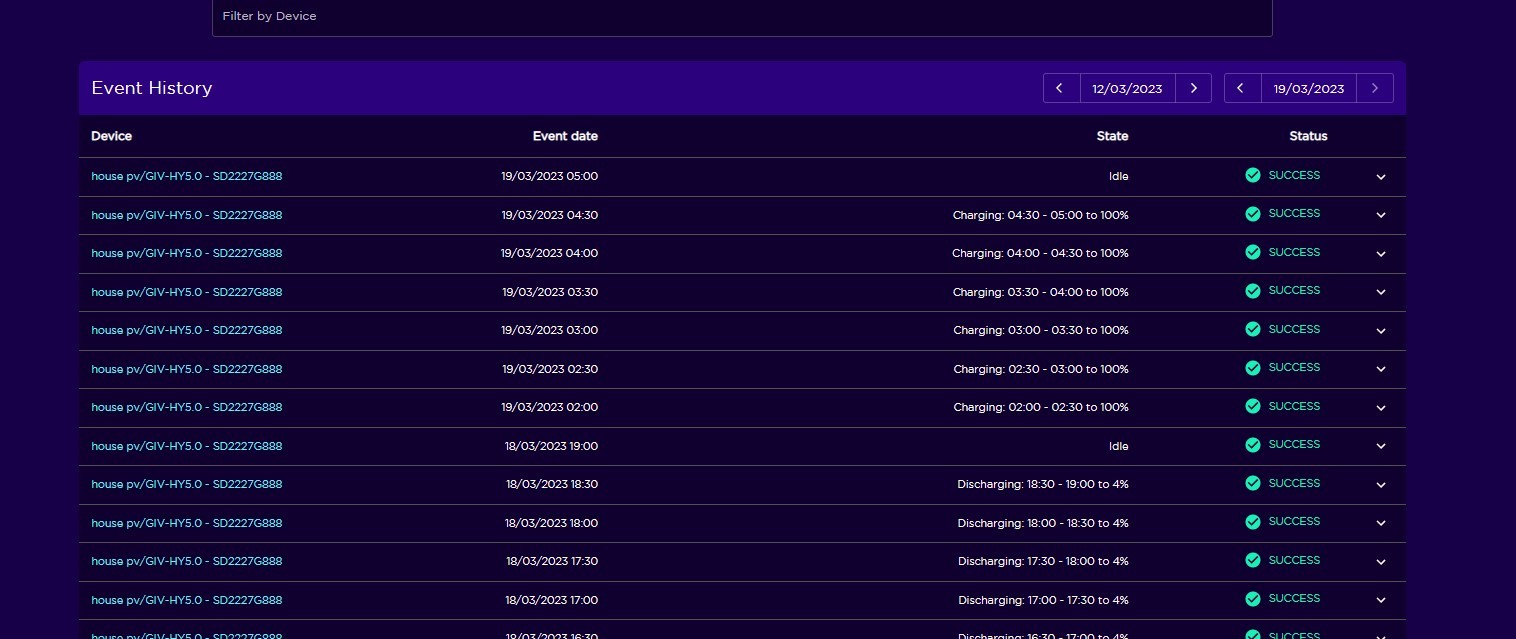
You can see this taking place in R&D history. Idle means R&D has returned control to GE.
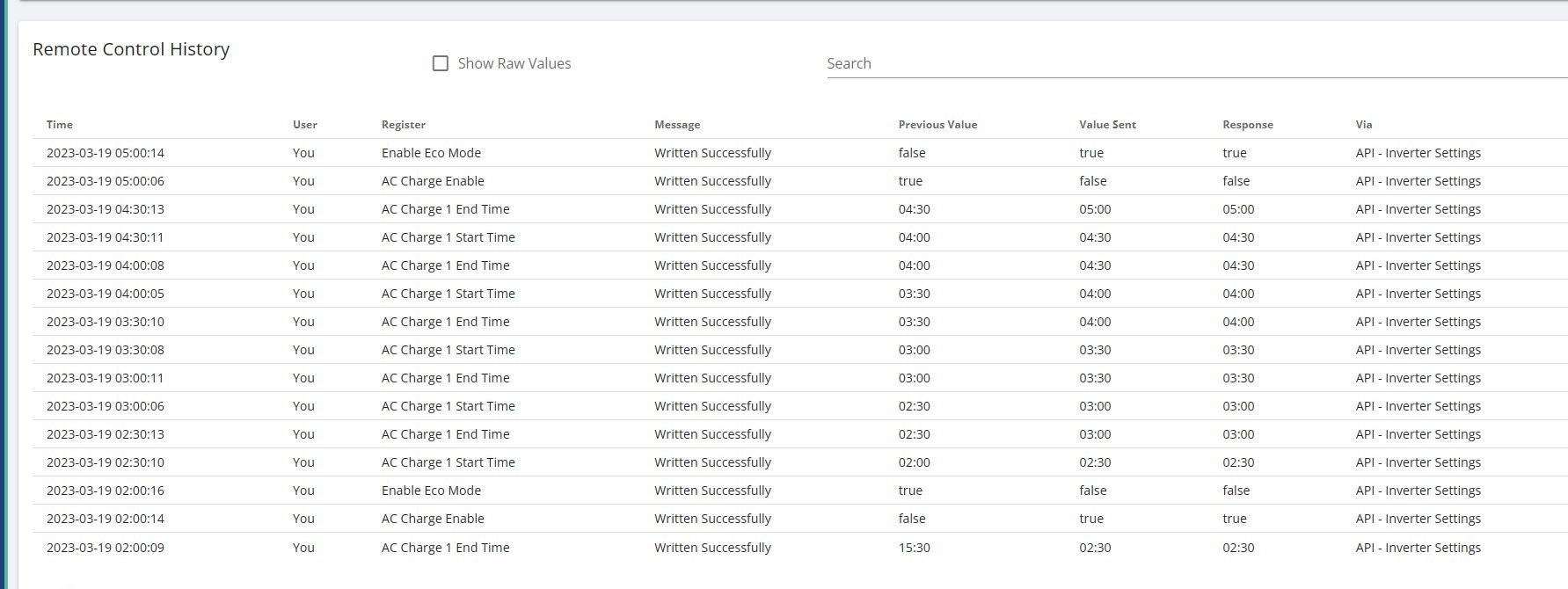
You can see the history of commands to the inverter in GE remote control on the portal. True=Yes. False=No
You can see the operational status of the inverter in GE remote control on the portal. The Eco slider will move and the time slots will change automatically
I only found out that a gap was needed between R&D actions (min 30 min is only available) as the inverter takes a couple of minutes to react and with event times coinciding, things were "hanging"


N
#83 netty

SteveCook Can I ask whether this is the starting point for everything?
I have joined Flux but when I try to change things on the dashboard (Inverter ... Settings) the system doesn't seem to remember what I've done. I don't have an app on my smart phone because it isn't smart enough. I'm starting to feel the same about myself, to be honest.
Do I have to register with Octopus R&D to be able to do these things (does R&D mean Research & Development) and is it possible for someone who never managed to get a Physics O level to get things up and running in a satisfactory way?

S
#84 SteveCook

I don't do any adjustments from phone app.
I have GE portal page set mode to Eco and just leave it. All other modes disabled.
Make sure battery is set to charge/discharge at the rate you want.
Octo R&D is a really easy tool, no coding or anything, but you need to register and it takes a day or two to go live.
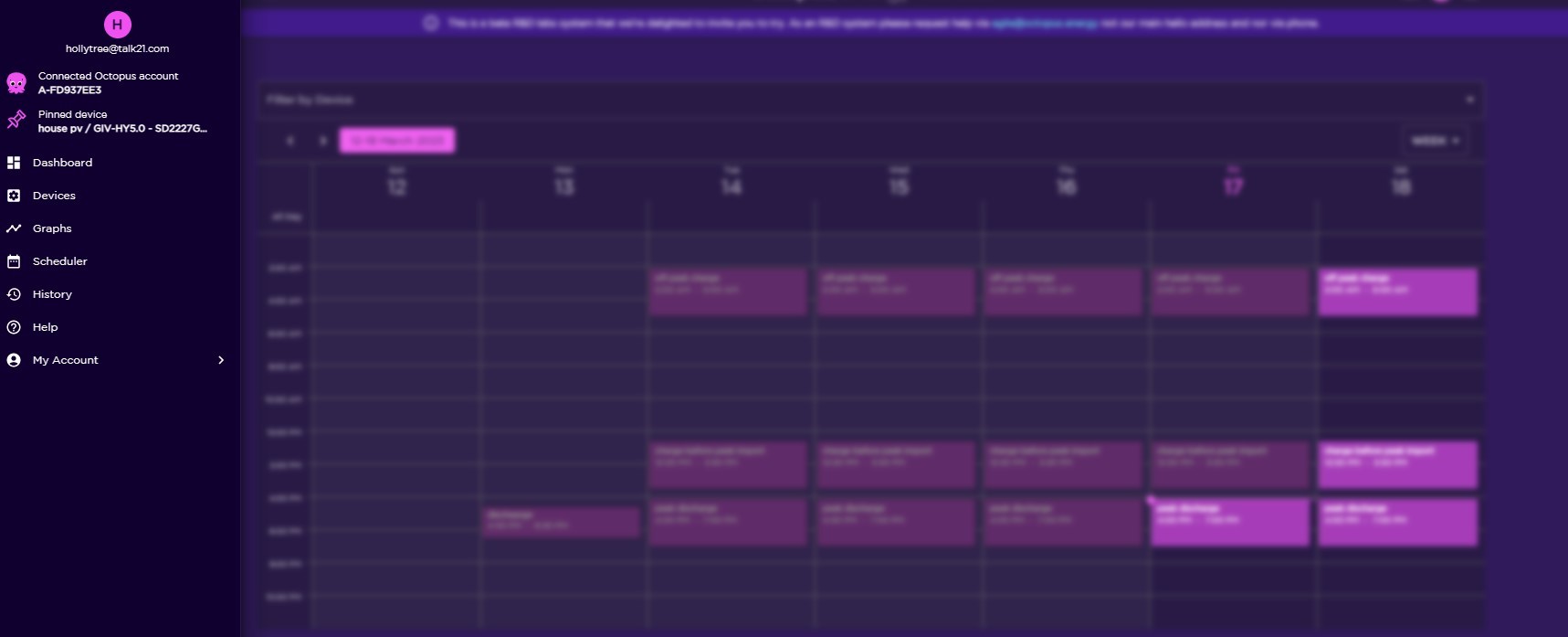
I then just use R&D scheduler like a glorified calendar.
https://smart-energy.octopushome.net/

N
#85 netty

Thanks for your help, Steve.
I will put my GE portal back in Eco mode and avoid the temptation to fiddle with import/export timings and wait for my Octo R&D to go live.
At the moment, I think I'm only on the Flux Import rate anyway ... that's what it says on my dashboard. So there's no point me trying to time anything.
I think I'm too impatient for everything to work perfectly, that's my issue.
Thanks again for taking the time to respond. I'll follow your link to the R&D scheduler once things move further forward (I guess Octopus will notify me when my import rate goes live).

S
#86 SteveCook

My Flux export took a couple of days to work after the import was showing and then GE smart tariff can only show what the Octo data is and that is normally a couple of days behind (well it is for me)

B
#87 BarleyRiser

SteveCook except that at the end of the discharge time it also refuses to switch back to eco mode. 45 minutes after the discharge stopped it was still running from the grid with no battery use.

One thought. When the discharge has been set to 20% what happens after the discharge. When the battery reaches 20% does it stop using the battery and start using the grid?

S
#88 SteveCook

BarleyRiser
yes I think so.
If you set 20% and battery has discharged to 20% ,it will start pulling from grid

N
#89 naltsta

SteveCook Yes, I had a timed discharge to 50% and was disappointed to see that it hit 50% and then was idle rather than being in eco mode.

B
#90 BarleyRiser

It actually stopped at 20% but was actually set to 15%. It has been running from the grid since. Can't stop it. Have cancelled all the settings in R&D. Reset numerous times on dashboard and app. All accepted. Have now deleted my R&D account.
It has now reached 15% and won't use the battery. Still don't know how to stop the 15% set in R&D if that is even the problem.
Really frustrating that something is still there that doesn't work. Not made any better by people telling me I shouldn't be using the app.
It appears I shouldn't Be using this system!

S
#91 SteveCook

Have a look at the R&D history tab.
Look for an event that has not completed- I think it marks it yellow but can't remember what it calls it.
I had 2 events clash when I had not spaced them 30 mins apart and everything was stuck at 50% for a day or so while I figured it out.
I deleted ALL my schedules in R&D, reset the inverter to default in GE and the restarted.
All been fine since then

L
#92 LordHippos

I'm considering moving from Go to Flux in a month or so, I'm on cheap rate Go at the moment (7.5p off-peak/40p peak).

Go is great but I just want an easy life, so rather than trying to predict generation with Solcast, Flux takes a lot of the hassle out.

My battery charges to 100% in about 3.5 hours, as it's the 8.2kWh one, and the G1 inverter caps the rate at 2.4kW from the grid. So in 3 hours I reckon I can get to about 7.2 of the 8.2kWh capacity, or 87%.

My question is, is it worth exporting at peak rates, if it means importing at standard rates to do so?

I am considering that perhaps something like this would give a low hassle approach:

02:00 - 05:00 - Charge to 90%
05:00 - 16:00 - Hold charge at 90%
16:00 - 19:00 - Dump the battery to grid
19:00 - 02:00 - No specific behaviour assume battery is empty

This means in the 05:00 - 16:00 time slot, the battery will play about in the 90-100% range if the sun is shining, and any excess goes to export at standard rate, which isn't terrible.

If the sun dips behind the clouds for a bit, house load can come from battery down to 90%, so should cover some spikes up or down, with minimal grid usage. On a poor day with low solar, then it will just sit at 90%, using house load from the grid at 34p/kWh, later exporting at 38p/kWh so not much of a delta.

Export rate should sort of mirror import rate, with the exception that exported energy with no sun shining will first cover house load, and then go to export. So if it's dark outside, and exporting at 2.4kW, with a house load of 400W, the export would only be at 2kW.

Thoughts? The behaviour above is easy to control as you just set charge to 90% from 02:00 - 16:00 and then discharge 16:00 - 19:00, no need for any additional 3rd party control such as Octopus R&D or Home Assistant. These techs can/do work but they are also subject to inverter availability, and I know from experience that the WiFi dongle isn't perfect, if it's temporarily unavailable API calls can fail.

This also gives roughly one battery cycle per day, which is typical fair use. I've actually cycled mine a lot more on Go over the winter. 267 times since 01/09/2022 (200~ days).

B
#93 BarleyRiser

SteveCook I went to bed with it still running from the grid but after the charge from 2am until 5am it did sort itself out.

B
#94 BarleyRiser

LordHippos you can export, at the highest prices, the same amount as you import, at the lowest prices. That is 7.8kWh, buying at 20.54p and selling at 36.92p, making a profit of £1.27 per day.

#95 dbt85

You have to assume that with Octopus having the ability to control your battery that at some point they are going to roll out some kind of load balancing option to automatically dump grid into your battery at a cheaper rate, simply because it needs to go somewhere?

#96 hoggy

dbt85 That'll be what's coming given they already have the system in the Octopus Kraken API and looking at ways to integrate it similar to Intelligent Octopus.

L
#97 LordHippos

BarleyRiser I am aware but I guess it's more about a "what if there is no sun" query?

Today my generation is about 2.4kWh, with the battery coming off-peak at 04:30 at 100%, and currently down to 38% remaining, on a day like today there really isn't much scope for exporting anything at all.

If I let the battery drain to house then by the time 16:00 comes along, it's not impossible to be forced to take from the grid, which seems like it's the one thing you really, really want to avoid doing.

To maintain my proposed 90% charge, I would basically be taking from the grid all day at £0.34, then exporting after 16:00 only nets you £0.38 for those units you were paying £0.34 for throughout the day, not much in it, certainly not really any profit there (you do lose some energy in the conversion from AC grid into the battery as well).

To make the best of Flux I think always charge off-peak no matter what, and then either hold the charge to the level that works for the peak rate, or on a bad day, you'd want a 2nd charge slot just before the 16:00 peak time, to ensure battery didn't run out until after 19:00.

Always have to imagine possible worst case scenarios.

L
#98 LordHippos

hoggy I don't mind if Octopus can control my battery so long as it's worth my while, I'd want to be paying sensible prices for any energy used or exported, probably at a premium to what I can do myself because I lose all control of the system if they own it.

Hoping they come up with this Givenergy tariff sometime.

S
#99 Shatch

First time trying the timed charges out. I set a charge to 70% 15:00-16:00 just to make sure I had plenty for the peak period. The issue I had was that even though my battery was over 90% I was pulling power from the grid rather than the battery!

I thought it would just top up if required but otherwise behave as normal. I set it up using Octopus R&D, would it be better using the GE portal or is this normal behaviour?

#100 hoggy

LordHippos I’m guessing with the demise of Tesla Tariff we may be quite fortunate to get something similar to their net meting at the cost of having less control over everything by creating a VPP fleet.

S
#101 SteveCook

Are all modes on GE set to disabled except Eco which should be set to enabled.
When an R&D time slot kicks in, it will disable Eco and at the end of the slot will re enable it.
Make sure no smart automations are set on phone app.

Watch R&D history to see events taking place. When it says idle, it means control has gone back to GE.
Watch events and status on GE remote control history and you should also see the Eco slider has moved across at the right times

S
#102 SteveCook

Just found this on another post - thanks to the author - check you don't have something going on in the GE portal

On the "Smart Tariff" card the left most tab marked "Tariff Automation" make sure the 00:30-04:30 automation is switched off.

B
#103 BarleyRiser

BarleyRiser spoke too soon. When the battery reaches 15% it wouldn't use it but took from the grid. It looks like 15% is looked in somewhere, but hour to I find where? Or it is still not in eco mode, so how do I put it back in eco mode? But eco mode is still set on the dashboard. Anybody with any thoughts?
How would I reset the whole system?

S
#104 SteveCook

I deleted my R&D 16:00-19:00 discharge schedule about 18:15. That all went well R&D end and I hoped it would go to Eco mode.
GE remote control was showing Eco, but system was importing.
it has taken me 30 mins to find and
reset phone app to defaults
go through all time settings in GE remote control and overtype them with 00:00
set default to Eco and hit send
set others to disabled and hit send
restart inverter

That cleared it all and everything started in correct mode around 18:50

PITA but it seems settings can be saved in various places saying different things

#105 dbt85

LordHippos To make the best of Flux I think always charge off-peak no matter what, and then either hold the charge to the level that works for the peak rate, or on a bad day, you'd want a 2nd charge slot just before the 16:00 peak time, to ensure battery didn't run out until after 19:00.

This is my feeling too, with the off peak import being a couple of pence less than daytime export. Once losses are included its basically net zero whether you use your own generation or charge with it. So might as well fill it up and know that you won;t be using much if any daytime or peak import, and you're also covered whether its a great day or a crappy one. I'd set a routine to make sure that the battery had say 50% in it by 4pm, just to help make sure there is no peak import.

N
#106 netty

LordHippos I'm going to set this up now and see what happens tomorrow!

N
#107 netty

netty ... well, I was going to but now my inverter says it's offline. It's 22:20 and so I'm not sure what I'm supposed to do about it. I realise that that the 6 hour gap on yesterday's graph was down to the same reason.
Everything about WiFi is rubbish in this house when the weather is overcast so it's probably that (and there's probably a scientific reason for it but I don't know what that could be).

#108 Hook

I think it’s too soon to move to Flux for me at the moment.

I’m on the Tracker tariff and todays price is 20.16p all day. Until significant over generation occurs, I may as well use all the solar I get.

N
#109 netty

Hook I think this may be a wise decision.
I remember one March it was like the summer for the whole time but this month the forecast is a blanket of grey.

T
#110 TurnerSN13

LordHippos Is your solar array over-spec'd for your inverter like most array's are? I've 6.7KWp solar and a Gen1 5.0 Hybrid. If I have a full battery (charged off-peak in your scenario) then once it's covered the morning and tops back up again, if there is sun, then my solar production will be clipped to 5KWh with export (max) 5 KWh minus Houseload. If however, my batteries are charged from solar and with sufficient solar, then the export formula remains the same except, my solar production is not clipped as the batteries are charged with DC above 5KWh. This charges my batteries for "free" maximises production, maximises export and minimises import.

N
#111 netty

TurnerSN13 groan I knew it would be more complicated ....
So what are your settings then?

T
#112 TurnerSN13

netty Haha - I guess it's easy to make things more complicated!
I can see that LH is doing a set-and-forget and I don't want to make it more complicated than it needs to be (for myself) I just want to "maximise" the capability of my system - especially as we move to into prime solar production period.
Simple settings are ECO mode all day and night with TIMED EXPORT 1600-1700.
If sufficient solar is forecast (not so far this year) then I will limit the charge rate to maximise Export as close to 5 KWh as possible whilst still aiming to fill the battery to cover the Peak Rate, to Maximise Peak export.
If not sufficient solar then I'll calculate a charge level (as one does during winter) to charge off peak to cover house load and especially to minimise import at Peak Time.
Giv 1 Hyb 5.0. 2 x 8.2 Batt

#113 dbt85

I have a spreadsheet in the works that can help you see what outcomes you'd get from importing or discharging at certain times, I'm just working on it taking the efficiency into consideration and then I think its probably done. You can put some real world hourly data in for both generation and usage and see what happens if you force charge or discharge and the financial benefits/downsides. It'll be a few more days as its an evening project and some of the formulae are getting silly.

Personally I would import just before peak time for the sole purpose of surviving peak. I would never force a charge at 3-4 just to force discharge it again as the rates simply make it pointless. I would however consider setting a force discharge from 4-7 to get a little of that peak rate export, but only down to however much SOC I need to get back to 2 am. That might be 40% for me and 20% for someone else.

This sheet hopefully will let you play with it with a few days data to see what effects it all has and whether its even worth it based on what you'd set. The only thing I think it can't take into account is you using so much power at a given time that it's having to import from grid AND use the battery/solar. Because we don't know that.

N
#114 netty

Simple he says!!
Okay, I think my battery is too small to copy your ideas here ... I think my battery (5.2 kw) doesn't always cover my house load 4-7pm if everyone is at home and it's grey outside. I don't think I'm going to be able to maximise Export at all really (maybe in the middle of summer perhaps?) during March.
I now live in fear of having to import anything from the grid between 16:00 and 19:00.
One more thing, you wrote TIMED EXPORT 16:00-17:00 in your above post. Why that one particular hour or was that a typo?

#115 THALL

netty You do not need to set a timed export, that is purely to export your battery to the grid. But if you are running out of battery during that time frame you might be best to leave the settings alone and just get paid for any exported solar. Excess solar, what you can not use during the day.

#116 THALL

THALL This is why I might flux this month

Not at home monday to friday, single ac3 can not handle it. Just wish the weather was a bit more consistent and I would just do it! Not fussed about dumping my battery into the grid. But pennies excess solar would be nice, currently get 4.1p on seg, so flux at 25p is so much better.

T
#117 TurnerSN13

netty Sorry Typo! 1600-1900 to cover peak period

L
#119 LordHippos

TurnerSN13 No in this case it's not, I have 4.8kWp and 5kW G1 hybrid inverter, so I won't face the same kind of issue. Anything I can't use or charge battery with will get exported without clipping (I have a G99 DNO for above 3.6kW).

I would have liked more panels but it wasn't really feasible, system was made big enough to be useful but I'd have enjoyed a good 7-8kWp system if I could.

L
#120 LordHippos

I've moved myself over to Flux as of yesterday, wondered how people are finding it and how the control aspect works for them?

After some back and forth on behaviour, I think this is what I want to do:

  • 02:00 - 05:00 - Timed Charge to 100% SOC
  • 05:00 - 14;00 - No specific behaviour
  • 14:00 - 16:00 - Timed Charge to 50% SOC
  • 16:00 - 19:00 - Timed Discharge
  • 19:00 - 02:00 - No specific behaviour

Charge slot 2 shouldn't really be needed but acts as a reserve protection to ensure I have enough battery to not import for the peak 16:00 - 19:00 window.

Rather than Exporting, I want to use Timed Discharge, this hopefully will prevent the solar charging the battery in the peak window, and will allow the battery + solar to power the home or export excess.

I need to see how Eco mode and Timed Discharge works here, as I've seen some people saying it exports at max speed which is not what I want.

I have considered importing heavily just before the peak window and then exporting heavily, but it seems like this will be a little lossy due to conversion from AC via the inverter. Adding cycles to the battery and not gaining anything financially as a result of doing so. Instead I just want to halt battery charging and export any excess from the solar, with batter feeding home if the solar is short.

Any thoughts on the above are welcome!

J
#121 justpassing

LordHippos

You probably have this all set up by now, be good to hear what you decided.

My view:
If you are set up for external automation, then:
set to ECO, covers 24hrs, and leave it
Timed charge, you need to automate for second top up, as only one can be set.
For 16:00 - 19:00, just drop the max charge to minimum value ( 0 = 388 w on mine) , but leave on ECO if you don't want to dump the battery.

If you don't have automation, ECO and daytime OR cheap rate top up is probably best.
You could try Timed Discharge instead, it gives me ECO behaviour outside the timed window, and then PV + Battery go to AC during the window, either used or exported.

L
#122 LordHippos

I do have external automation via HA with GivenergyLocal but I worry that it's all based on the inverter being contactable, so as much as possible I want to configure stuff on the inverter itself because that WiFi dongle is a little... temperamental.

To meet my spec a couple of posts up I've done exactly what you said:

  • Timed Charge windows swap about via HA configuration.
  • Timed Discharge window is set/forget via Inverter options.
  • Eco Mode is on 24/7.

This is working well so far.

Overnight charge ensures I'll never run out of power no matter how poor the weather is without trying to forecast anything with Solcast.

2nd Charge window hasn't been needed in live yet, but I'm still adjusting it anyway just in case.

Timed Discharge sends all excess to the grid, and discharges battery to meet demand, but battery charge is halted, which is exactly what I wanted.

This is all working well. Once GE add this promised 2nd charge window, I could set all of this via inverter and not need HA to do anything. Currently I make HA issue the command 3 times for each charge slot across a few hours in case it fails on try #1.

The only real improvement I'd like is to dump some power to grid if the SOC is high enough in the peak window, but doing so throws out a lot of of other things like disabling Eco mode.

J
#123 justpassing

LordHippos

LordHippos Timed Discharge sends all excess to the grid, and discharges battery to meet demand, but battery charge is halted, which is exactly what I wanted.

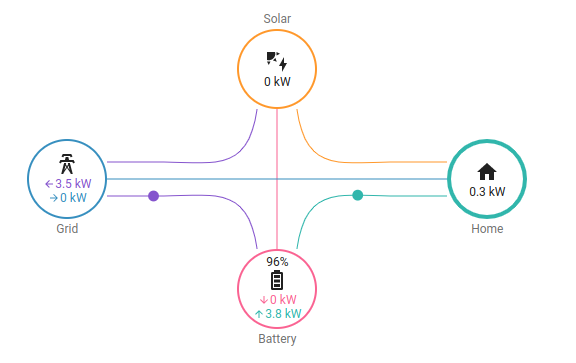
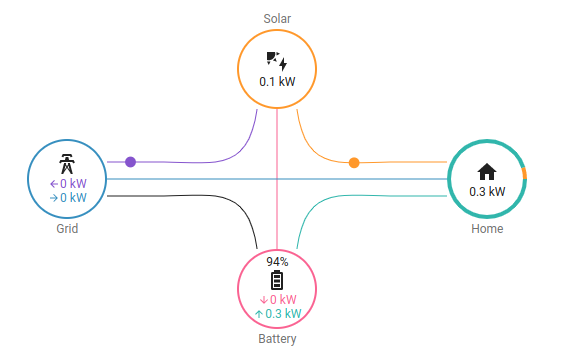
Intrigued by this. If I set Timed discharge, then the battery discharge is Dynamic/ (Eco like) outside the timed window, but in the timed window the battery discharge is not "only" used for the house.

During Timed Discharge window:

As soon as the timed discharge window ends, it reverts to Dynamic load supply to the home.

L
#124 LordHippos

justpassing I'm on G1 5kW Hybrid inverter, not seen a layout likes yours on my system. Different inverter?

J
#125 justpassing

Home assistant "power-flow" display card, but the behaviour is on a G2 5kW Hybrid :-)

L
#126 LordHippos

Interesting, this is from the other day, but you can see that even though battery wasn't 100% the excess solar was going to export instead of to battery, not that there was loads of it.

Checking Home Assistant history, despite having timed discharge enabled for 16:00 - 19:00, the actual mode it's sat in 24/7 is Eco mode.

L
#127 LordHippos

The plot thickens somewhat with some testing today.

To get my battery to operate like I mentioned, discharge only, no charge from solar in the peak window, it seems to work when I have it like this in the GUI.

  • Timed Export - Disabled (can be ignored for this state).
  • Timed Discharge - Enabled and set for 16:00 - 19:00.
  • Eco Mode - Enabled.

The important thing to note here is that Timed Discharge is enabled at the same time as Eco Mode, but the system considers itself in Eco Mode, at least as far as mine is concerned within HA.

If I force a timed Export using HA, then this immediately does three things:

  • Disables Eco Mode
  • Disables Timed Discharge
  • Enables Timed Export

If I want to restore myself back to the previous state I was operating in, where the battery won't charge in the peak time, then it's a little more tricky to manipulate.

Enabling Eco Mode disables Timed Discharge Mode. Without Timed Discharge mode being enabled it will freely charge the battery from solar.

Enabling Timed Discharge mode disables Eco Mode. Without Eco Mode it will freely charge the battery from solar.

If I enable Eco Mode, I can then go into the GUI and toggle the Timed Discharge option without adjusting the timeframe, this seems to then put me back into the desired state. I can't see a way of doing this via the Givenergy Local library (I'm using cdpuk / givenergy-local via HACS from github source).

The two service options with this, Activate Eco mode, or Activate Timed Discharge, seem to conflict and disable eachother.

Any ideas on how to toggle the Timed Discharge window back on after running the Eco Mode switch?

J
#128 justpassing

My experience, My inverter, Gen2 906-906. This seems to differ from Gen1, so I will be explicit about what I see.

[I use givenergy-local as well :-), but the behaviour I see can be seen from the APP. I actually find the APP more clearly reflects what the inverter will actually do, as it details all the options chosen on a single screen, whereas the portal is confusing in that you seem to be able to set eco /discharge/export all at the same time with separate entries, whereas that is logically a nonsense.]

For me, on Gen2

Either Timed Discharge or Timed Export sets a period in which the battery will discharge to AC at its max discharge. AC will feed house and export the rest to grid.

a) Outside of the timed window, Timed Export will hold the charge of the battery, not meeting house demand. PV is all converted DC/AC, hopefully meets in house demand and exporting any excess tpo grid. Any house demand not met by PV will be supplied by the grid. So Battery is basically in stasis outside timed window.

b) Outside of the timed window, Timed Discharge will charge with excess PV, and discharge to meet house demand, similar to the ECO mode behaviour.

So for me, the "timed window " shows the same behaviour whether Export or Discharge, outside the timed window is where the difference comes.

So if you want ECO BEHAVIOUR 19:00 to 16:00, and Discharge battery 16:00 to 19:00, then Timed Discharge set to 16:00 to 19:00 does exactly that on my system, set 24/7, no need to change anything.

It may well be that this is not Gen1 Firmware behaviour, as for my Gen2 I needed to fork givenergy-local, as both the service calls (Discharge and Export) set my SoC reserve to 100%, which then blocks and Battery discharge, whatever mode you are

Any ideas on how to toggle the Timed Discharge window back on after running the Eco Mode switch?

Running the timed discharge/ ECO / timed discharge services on givenergy-local should all work independently, so just run them again when you want to switch.

Anyway the new Firmware that is nearly ready may behave completely differently, and then we can all learn what that does :-)

L
#129 LordHippos

justpassing Our inverters must be working with this totally differently then!

Which is odd, I'd not expect major differences between Gen 1 and Gen 2.

Running the Timed Discharge/ECO/Timed Discharge services doesn't work as I want, as described Eco mode service disables Timed Discharge, Timed Discharge Mode services disables ECO, I need them both on for it to put the battery into charge stasis and export any excess solar to Grid.

The only way I can do this is via activating ECO mode, and then going into the GUI myself and enabling the Timed Discharge option, this then has both Eco and Timed Discharge running, and that does what I want.

To solve my problem, I think I'd need the ability to call a service which can just switch Timed Discharge option on, without modifying anything else. This is part of Modbus but not included as a built-in Service for the GE local control:

https://github.com/dewet22/givenergy-modbus/blob/9fc61b53f85f91a1bd16f0bfb6c9071d0090fc9e/givenergy_modbus/cli.py#L121

J
#130 justpassing

LordHippos

I thought as much ( inconsistency in behaviour) as I had a problem on the Gen2 which is not seen on the Gen1. The developers of the givenergy_modbus and givenergy-local have Gen1.

As a test, if you do this on the Givenergy APP, do you get a completely different result ?

As you can see, outside the timed period I have battery charging with excess PV, inside Battery +PV discharging 5Kw to AC Grid+House ( small House load).

The reason I say use the APP, is that givenergy-local call to givenergy-modbus sets the Reserve to 100% for me, which then blocks any battery discharge, and has a strange knock on that the battery will only charge at minimum, whereas setting SoC to 4%-99% it charges at full rate. Go figure :-). I forked and patched givenergy-local for my needs, but if the above doesn't work for you, its a different challenge.
As there is a chance that there is new firmware next week or so, probably worth waiting to try that before doing any more work on this.

L
#131 LordHippos

justpassing Mine seems to be the same as yours as far as the app sees it, sounds like a bug you have in the G2 inverter to me.

D
#132 DD

I'd be quite interested in seeing what happens if the house load increases during the test. Say, turning on a 3kW kettle, or something, so that the load changes from below to above PV + battery. (Eg if PV is 2kW, and battery discharge is set to 500W, but then house load increases to more than that, does battery discharge increase, or does it remain fixed ?)

Am I correct in thinking that the behaviour depends on how you configure the system - smartphone app vs the web portal vs HA via givenergy-local vs GivTCP ?

J
#133 justpassing

LordHippos Thanks for confirming Gen1/Gen2 or at least firmware versions are different. Not sure whether its a bug, as it does what I want on Gen2 :-). It depends what you expect Timed discharge to do in terms of "when" does it dynamically meet the house load. Inside the timed period, or outside.

As I said though, fingers crossed for the new firmware, and then I can run all the same tests and see what happens.

DD

Do you mean inside or outside the timed period ?
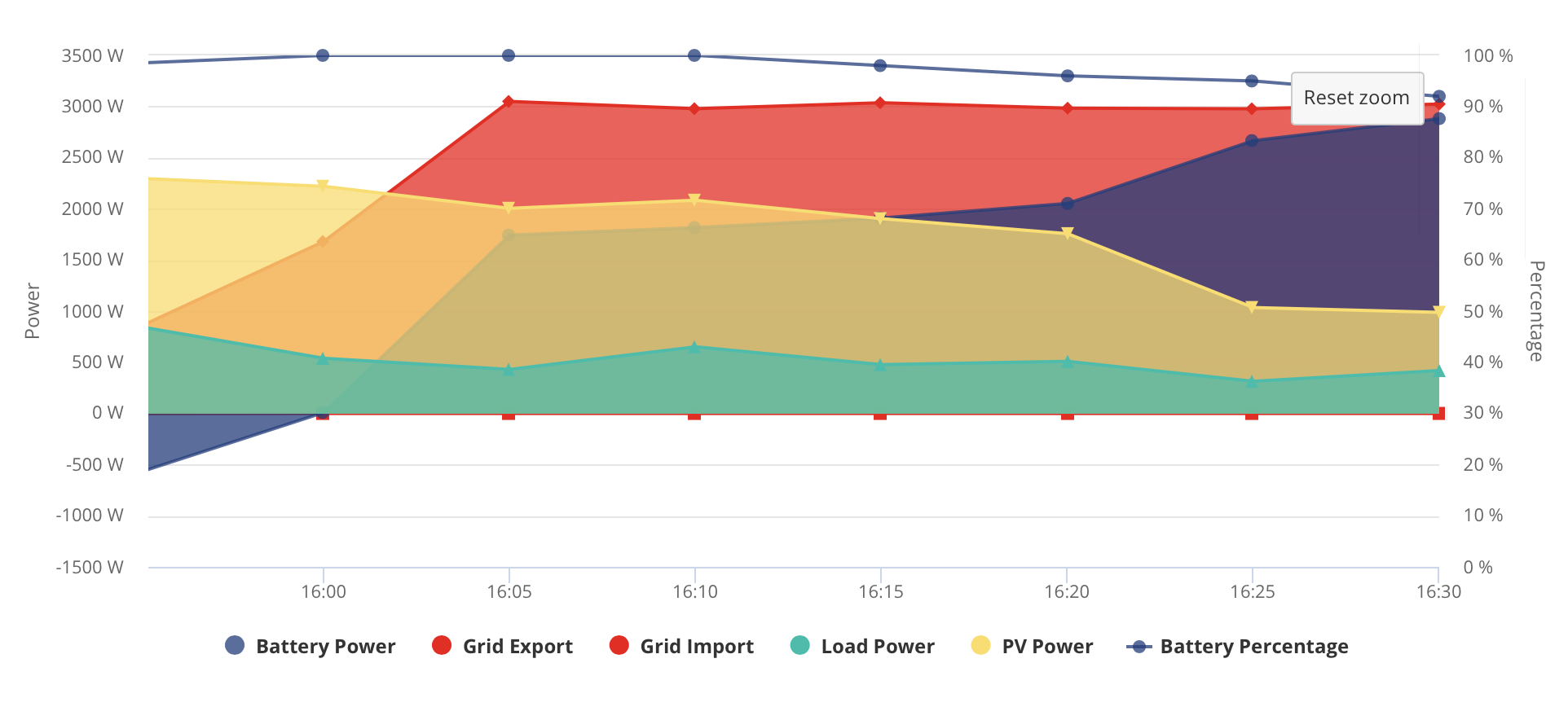
Inside if it has high load, and low PV, it is already attempting to discharge battery and PV to AC at max power, so house load only affects where the AC goes ( house then export).
Outside if it has high Load and Low PV, the battery is set to dynamic , and so acts as you see in eco. ( battery attempts to fill the gap, then import the rest if exceeds the max battery+PV ).

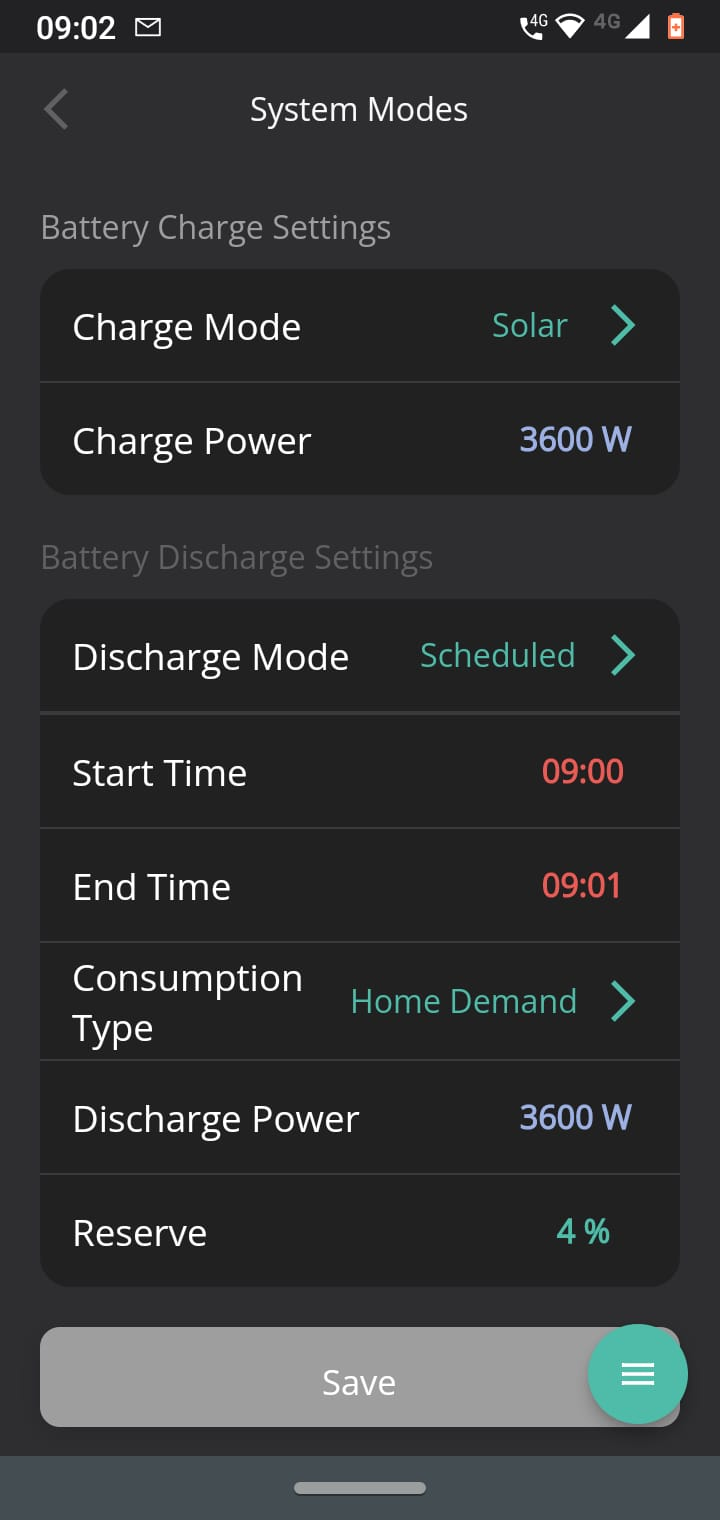
Battery Max discharge set to 3600w
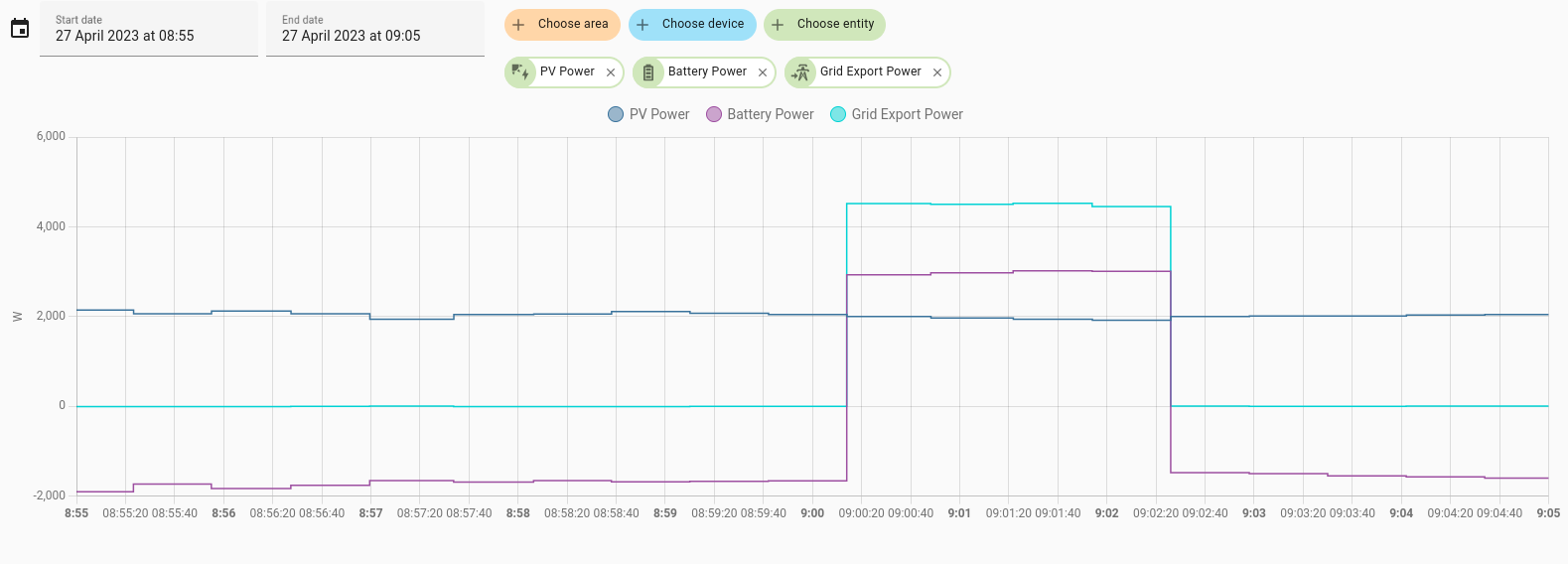
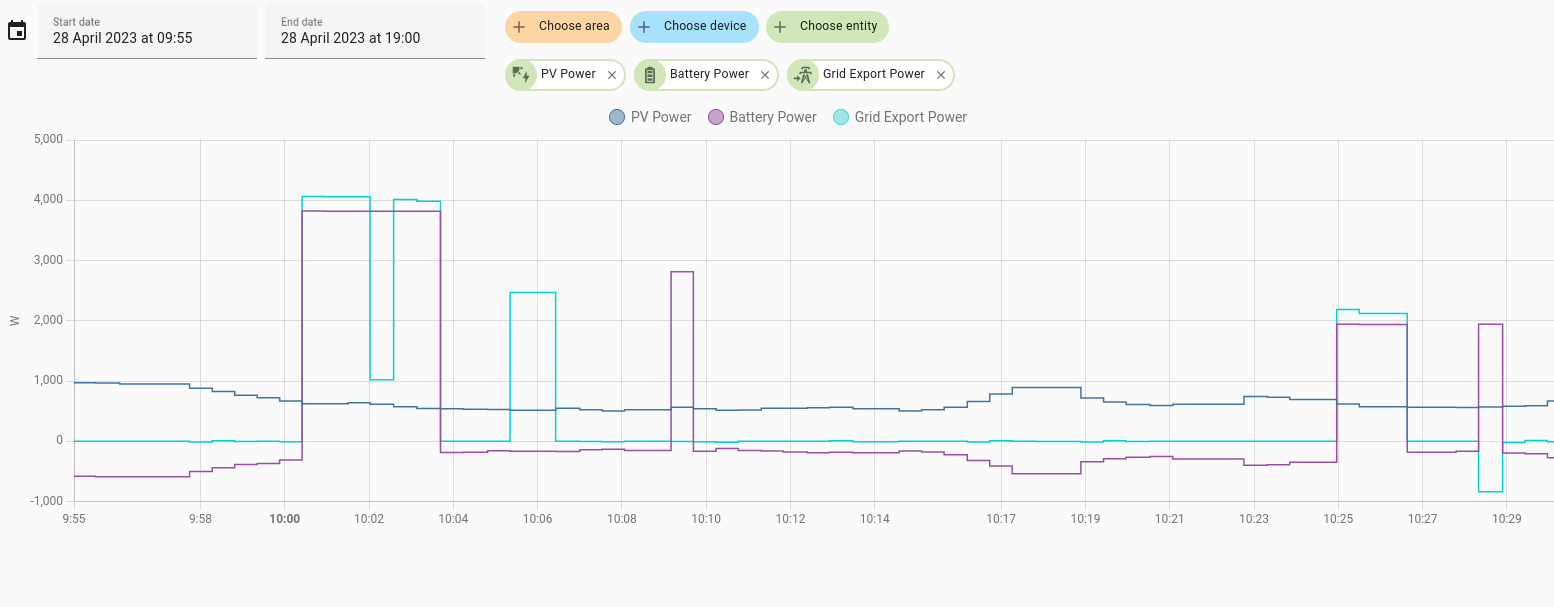
Timed period was 10:00 till 10:02, kettle at 10:02 10:05 and 10:09
You can see that the export dips by the Kettle load, and the battery (max) and PV Supply remain unchanges.
The 10:05 reading is an anomaly, looks like the maths somewhere abstracted the hous eload as export. ( as there is no way that the system could be exporting 2500 + running a 3Kw kettle. reran experiment at 10:09, and readings look more sensible, battery meeting excess load.

Battery Max discharge set to 3600w
Reset timed period to 10:25 - 10:26 with battery max discharge 2Kw.
Kettle at 10:28
Battery max discharge is applied inside and outside timed window.

As to the different routes to settings. I haven't run through all the options. I do get the impression that mixing and matching different methods is a mistake. They re all the same but different :-)
I found that the APP was more explicity/ logically displays the registers exposed by the firmware for quick tests, but I use givenergy-local day to day.
The portal has a layer of abstraction in Settings, the Remote Control is closer again to the registers.
givenergy-local and givetcp use the same "library" givetcp-modbus.
givenergy-local uses a layer of abstraction for the timed discharge and timed export that sets the battery soc reserve to 100% , which stops any discharge for me, inside or outside the timed period.
The important registers are set in different combinations to achieve the different modes.
Enable/Disable Charge
Enable/Disable discharge
Enable Charge target ( AC )
Charge Target SoC ( max AC fill)
Battery Power Mode ( dynamic or Export)
Battery soc reserve ( minimum for battery discharge)
Battery discharge min power reserve ( this and the one above apear to have different effects on Gen 1 and Gen2)

And all the start stop times for charge and discharge.

L
#134 LordHippos

justpassing Thanks for confirming Gen1/Gen2 or at least firmware versions are different. Not sure whether its a bug, as it does what I want on Gen2 :-). It depends what you expect Timed discharge to do in terms of "when" does it dynamically meet the house load. Inside the timed period, or outside.

My focus is really in the 16:00 - 19:00 timeframe, as outside of that just Eco mode takes care of most of it, charging or discharging as needed. Ignoring the timed charge slot anyway.

The combo of Eco + Timed Discharge within 16:00 - 19:00 does what I want, no battery charge, only feed to home or export solar, just what I pointed out above, cdpuk GE local is currently unable to activate eco mode and re-enable Timed Discharge if I happen to enable forced Export mode to dump excess.

D
#135 DD

justpassing Do you mean inside or outside the timed period ?
Inside if it has high load, and low PV, it is already attempting to discharge battery and PV to AC at max power, so house load only affects where the AC goes ( house then export).
Outside if it has high Load and Low PV, the battery is set to dynamic , and so acts as you see in eco. ( battery attempts to fill the gap, then import the rest if exceeds the max battery+PV ).

Battery Max discharge set to 3600w

I was thinking during the timed discharge period: I assume that outside of that, it's just normal eco mode.
I was also wondering what happens if the battery discharge power has been set to something other than its maximum.

Basically, I wanted to see whether the battery would increase its discharge rate to account for the extra house load due to the kettle, or whether the discharge power was fixed at the configured rate, regardless of any house demands. i.e. is there any ECO behaviour, or is it entirely overruled during the timed discharge window ?

The scenario I'm thinking is that I set discharge to 1kW during the flux peak rate - do I end up imorting 2kW from the grid when I put the kettle on (assuming there's no PV generation), or does the discharge rate increase above the configured 1kW.

L
#136 LordHippos

DD

Yes if you limit the battery discharge rate, and you need more power, it will get it from the grid.

J
#137 justpassing

DD Thats exactly what I did for you above, with graphs ...... your scenario.

L
#139 LordHippos

I'm querying this a bit more with the developer over at the HA forums but it looks like:

Activate Eco Mode - Disables Timed Discharge
Activate Timed Discharge - Doesn't disable Eco Mode but does update SOC reserve to 100% instead of 4% that Eco sets.

This is probably the crux of the issue, unfortunately editing state for Timed Discharge slot or editing SOC reserve independently doesn't appear possible in the current service options.

The addition of a toggle on/off for the Timed Discharge slot without adjusting anything else would solve a lot of my issues.

J
#140 justpassing

LordHippos Hi check the HA forum for my reply. Github is patched for setting SOC reserve independently.
Not in the HACS release yet, but you can just copy the files over to your HA and give it a go.

L
#141 LordHippos

justpassing Just put my reply into the HA forums as well about it.

If it works, it's simply not as good of a solution as my proposal to expose the client.enable_discharge() and client.disable_discharge() options which are part of the base modbus library, and are also configurable per the inverter options on the portal. I understand the ethos of the dev is to follow what the portal options do, and this is one of the missing ones that has a purpose imo.

Will check it anyway and see, and it's a workaround for now until a better solution comes along if it works 🙂

B
#142 billG

pacemaker Just bought 2, one for the Sunamp and another for a towel rail.