M
#1 matbarnard
I have two 5.2kwh batteries.
The app shows the overall state is 6%, but the individuals are at 37 and 21.
Is this to do with actual vs calibrated %age?
Odd though that I can’t use any of the 37%!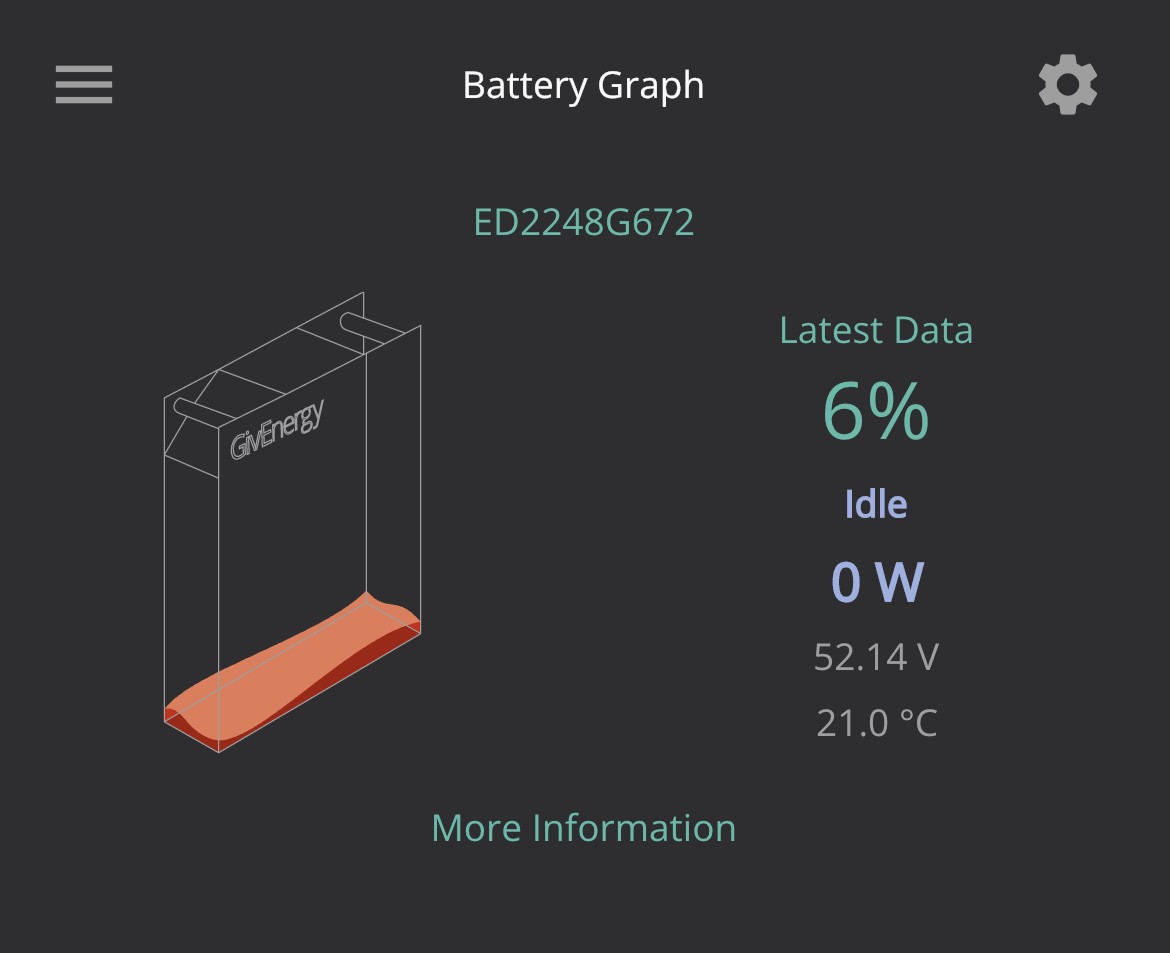
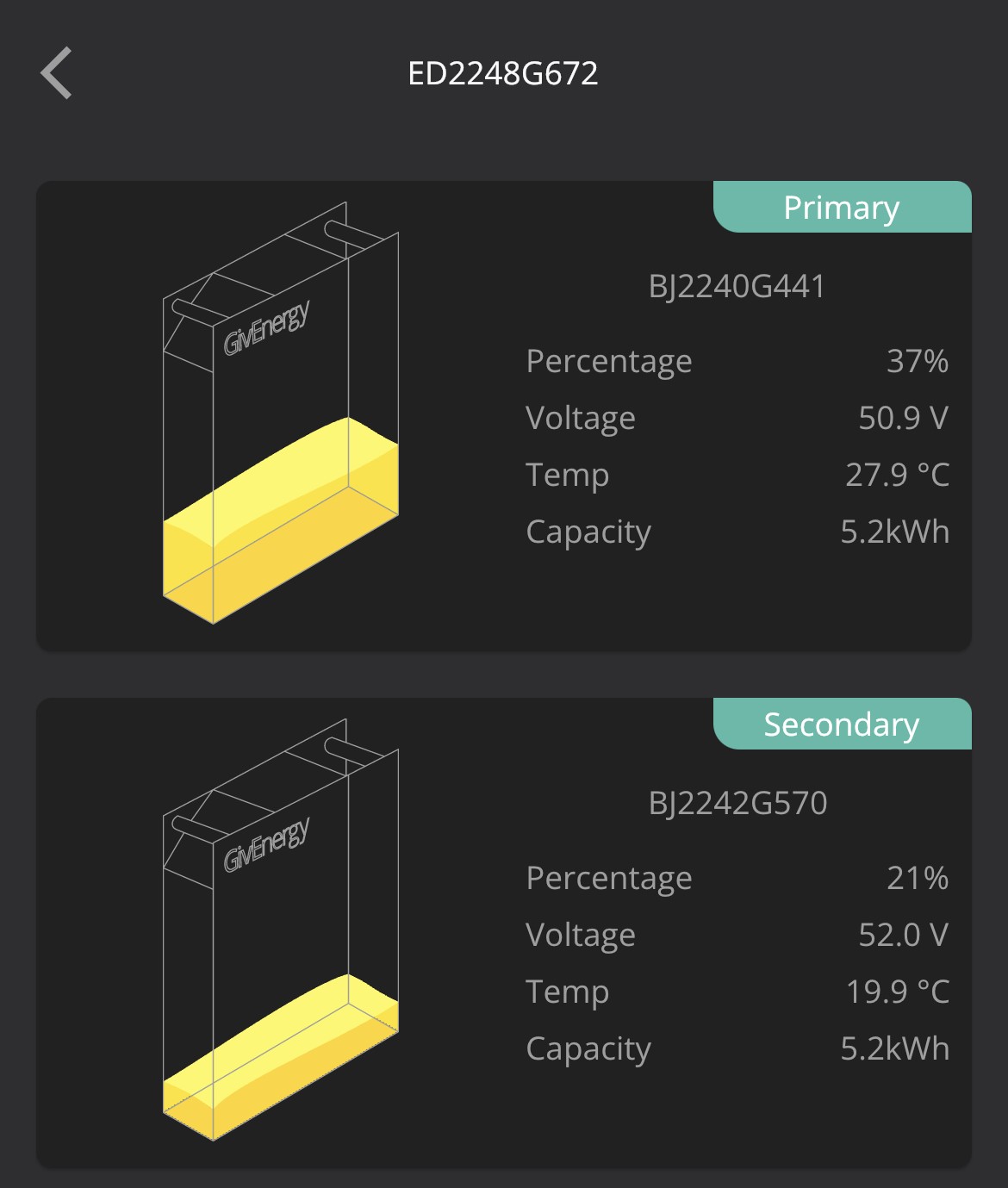

I have two 5.2kwh batteries.
The app shows the overall state is 6%, but the individuals are at 37 and 21.
Is this to do with actual vs calibrated %age?
Odd though that I can’t use any of the 37%!
I believe the percentages on the "more information" screen are the true percentages (well, as true as it can be given some bugs...)
The one on the main screen is the percentage the user sees after GivEnergy take away the top and bottom parts of the battery - to make a safe buffer and avoid damaging the battery by reducing the voltage too much too often and vice versa for the full state.
Thanks.
You’d think there would be a usable part of the 37% though? Unless there’s bugs doing their buggy business. :-)
matbarnard it might be it doesn't like the fact they are at different percentages, stopped draining both when one was deemed empty.
Not sure how to resolve that. Hopefully someone else can answer that question. Charging them both up to 100% might help, but might end up drifting again...
Are both batteries running the same firmware?
I am in the exact same position, however on mine the Voltages are very close (or same) between them. One though might be at 3% and the other at 22% for example and the overall SOC is reading 4%...System commissioned 3 weeks ago. 2x5.2KWh Batteries Firmware Version: 3009, Gen2 Hyb 5kW Inverter Software Version: D0.906-A0.906. They started being 10% apart from each other but now it seems that it keeps on drifting further...
Ditto. Commissioned in June 2022. Noticed lack of capacity, but not crucial over winter. Became aware of the 'More information' card and now know why. Only other symptom is Primary Battery has tripped on/off switch three times since installation, but reset without any further problem. I believe that the trip occurred when charging from the grid to 100% SoC. Hoping that this will be solved when the new firmware finally hits the streets.
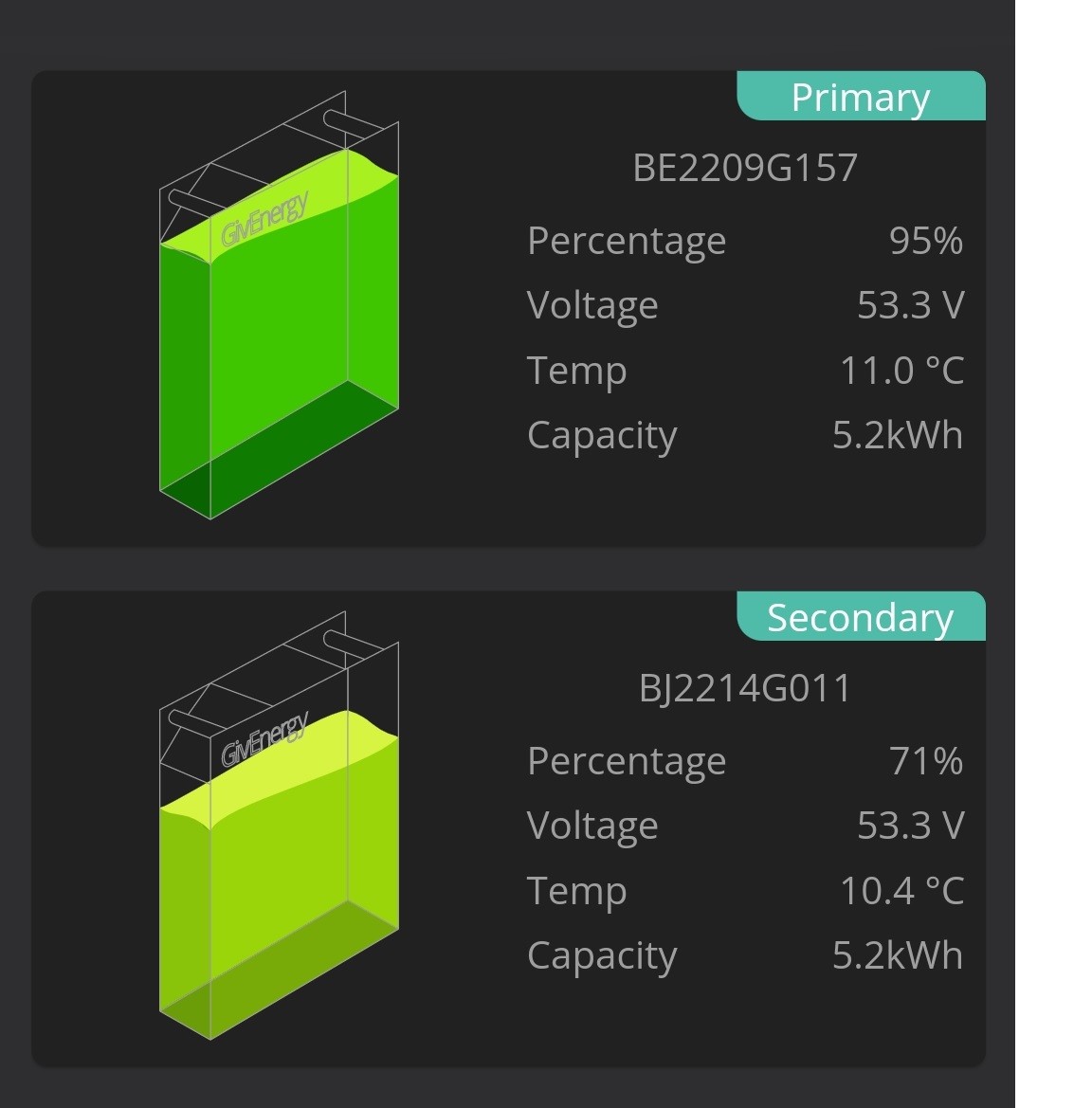
hhall Primary Battery has tripped on/off switch three times since installation, but reset without any further problem. I believe that the trip occurred when charging from the grid to 100%
Sounds like it trips when there's a heavy load being pushed through for several hours? If that's the case, it's probably overheating either because one or more of the terminals isn't fully clamped metal-to-metal (insulation in the way), or the contacts inside are overheating. Either way, it's the short end of the wedge. It will start tripping more frequently until it won't reset. A call to your installer asking for it to be swapped out when they get chance should fix it.
I find that if you fully charge/discharge the batteries a couple of times, their individual SOCs converge.
Tim Thanks for the reply, and you may well be right. I am giving it a chance to be cured by the new FW by sorting out the SoC of the two batteries. The trip seems to occur when the Primary has charged to 100% and the Secondary is way behind. The Primary is in effect being over charged - when I switch it back on the stated SoC on the Battery Graph page stays at 100% for nearly an hour before starting to drop.
I have been following the Beta program where others have the same problem (except for the tripping), and will get the installer to look at it if it happens again. I have reduced the rate of charge and do not charge above 98% from the grid. Excess solar is directed to the car, hot water, washing and tumbler dryer.
hhall The Primary is in effect being over charged
AFAIK the individual battery BMS will shut down the charge to avoid overcharging. I think charging from a low SoC is limited to constant current at 0.5C and when it gets towards a high SoC, it charges at constant voltage. As the charging voltage and cell voltage align, the current reduces to zero. Or at least that's my understanding of how a LiPo charger usually works. I'm happy to be corrected on this to add to the knowledge pool. If my assumption is correct, the second battery should continue to charge until all its cells reach the same state of charge. Where I think the Givenergy system differs is that it cuts off charge when the combined cell voltages of either battery reaches the upper cut off. Part of their changes would be to rely on the individual battery BMS to shut down charge to that battery's cells while the other battery continued to charge.
If there's anyone out there who has better facts to say this is all tosh, please correct me because I would like to understand how it actually works.