Octopus Agile or Flux

14 comments started 2023-03-26 last 2023-03-27
Home Automation
J
#1 jmccar23

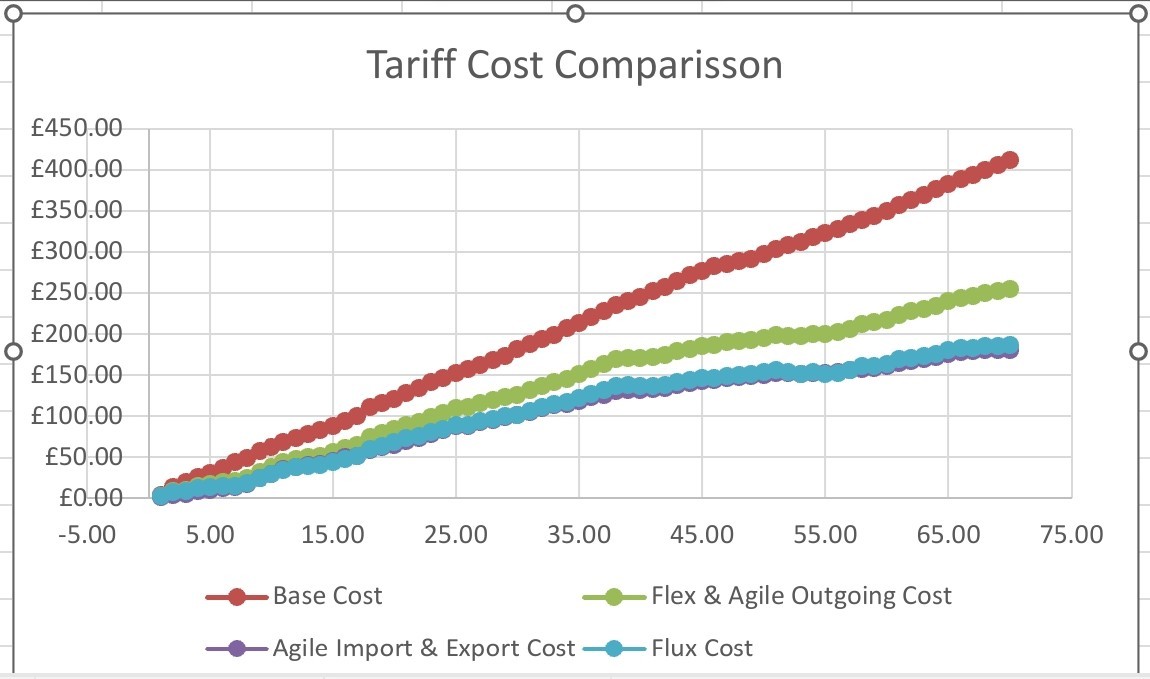
Thought I'd just share my analysis to date on whether my decision to switch to flux was a good one or not. To set the scene, I have a 5.6kW pv system with a gen 1 5kW inverter and 8.2kWh battery. Average daily household consumption is 16kWh. Analysis is based on 30min data extracted since mid Jan 2023. I generally charge battery in early hours and top up between 2 and 4 pm. Only 1 hour export from battery between 6 & 7 pm.
Base cost = what consumption on Octopus variable flex tariff would have been with no solar
Flex & Agile Outgoing = Cost with variable flex for import and outgoing agile for export
Agile Imp & Exp = Cost with Agile rates for both import & export.
Flux = Flux rates for import and export.
To date I'd be around £5 better off on Agile, but that might change as days get longer.

#2 dbt85

While perhaps useful for analysis, Flux is import and export as I recall, I dont believe you can have it for import and something else for export.

N
#3 naltsta

dbt85 For a low usage household flux has been great. It's only March and my bill for this week was negative.

It only makes sense because of the export rates though so will definitely need to find something else for the winter.

As of today with BST even more of that generation goes into the higher export rate too.

J
#4 James L

This is interesting. We're going to be away for the summer, with the house only occupied for about 3 weeks in the whole of May - August.

As a result, nearly everything we generate will be available for export over this period (house consumption will be something like 100W - 300W).

So that OctopusWatch report indicates that Flux will be well worth having.

Or am I missing something?

#5 kai

For my setup, 4.6kW array and 12kWh battery, Flux is cost neutral in March and I'm expecting to be £400 in credit by October (when I'll switch back to Go or similar).

J
#6 James L

kai We've got a 4.2kW array and 9.5kWh battery, so looks like Flux could be worth it.

#7 kai

James L So much depends on your usage profile that you really need to model it, even roughly. I have an EV, but don't use it to commute, so can charge during day. My colleague with a larger set of panels will be on Go or Intelligent all year as he has a 20mile daily commute.

I'm assuming I'm using 400kWh a month of my generation and can export 5kWh at peak every day. Rest of export is at the lower rate.

J
#8 jmccar23

Yep flux is import and export and that is how I calculated things. The intention is to show how much electricity would have cost me using various tariffs based on my actual data. I don't have an EV, so for smart tariffs I'm limited to Octopus Agile tariffs or Flux. Octopus Agile Outgoing rates are generally below the flux export rates and recently on average below the fixed Outgoing tariff of 15p (this Outgoing rate is not available to Go/intelligent tariff users). However on the flip side the agile import tariffs are generally below the flux import rate. To date all in all Agile and flux track each other almost identically in terms of how much electricity would cost me.

N
#9 naltsta

jmccar23 while this is a useful analysis it’s always going to be skewed to the tariff you are on. Changing tariff means changing your usage pattern (if you want to get the most out of it) so it’s not really a fair comparison.

J
#12 jmccar23

naltsta
Patterns for agile and flux are very similar. If you look at givenergy automation for agile incoming it is charge early hours at cheap rate and top up in afternoon if not enough sun. Try to put washing/dishwasher on in early hours. Agile outgoing automation is export between 4 and 6pm at highest rates. So you have to adjust usage in a similar manner for both agile and flux.

J
#13 jmccar23

The key thing at the moment is agile calcs by Octopus have a capping routine which means rate rarely goes above 33.5p and often there us a cheaper period in afternoon, so over winter you can keep battery topped up at lower rates. Octopus r&d can be used either to charge when rates drop below a threshold or at the best 30 min intervals. Although agile export rates are crap at the moment last summer I had times when I could export at over £1/kWh. Octopus aren't stupid so the flux rates will be calculated to make bothe agile & flux similar overall. The key advantage of flux being a simple life of knowing that rates have a fixed pattern.

N
#14 naltsta

jmccar23 When I was on agile I was charging a bit overnight to try and predict a full battery at sunset as agile export rarely peaks significantly above any import rate.

With flux I fully charge between 2-5am every day to maximise my export as its generous.

That's a very different pattern for me.