Battery Throughput

152 comments started 2022-02-03 last 2025-11-20
GivEnergy ProductsBattery
#1 hoggy

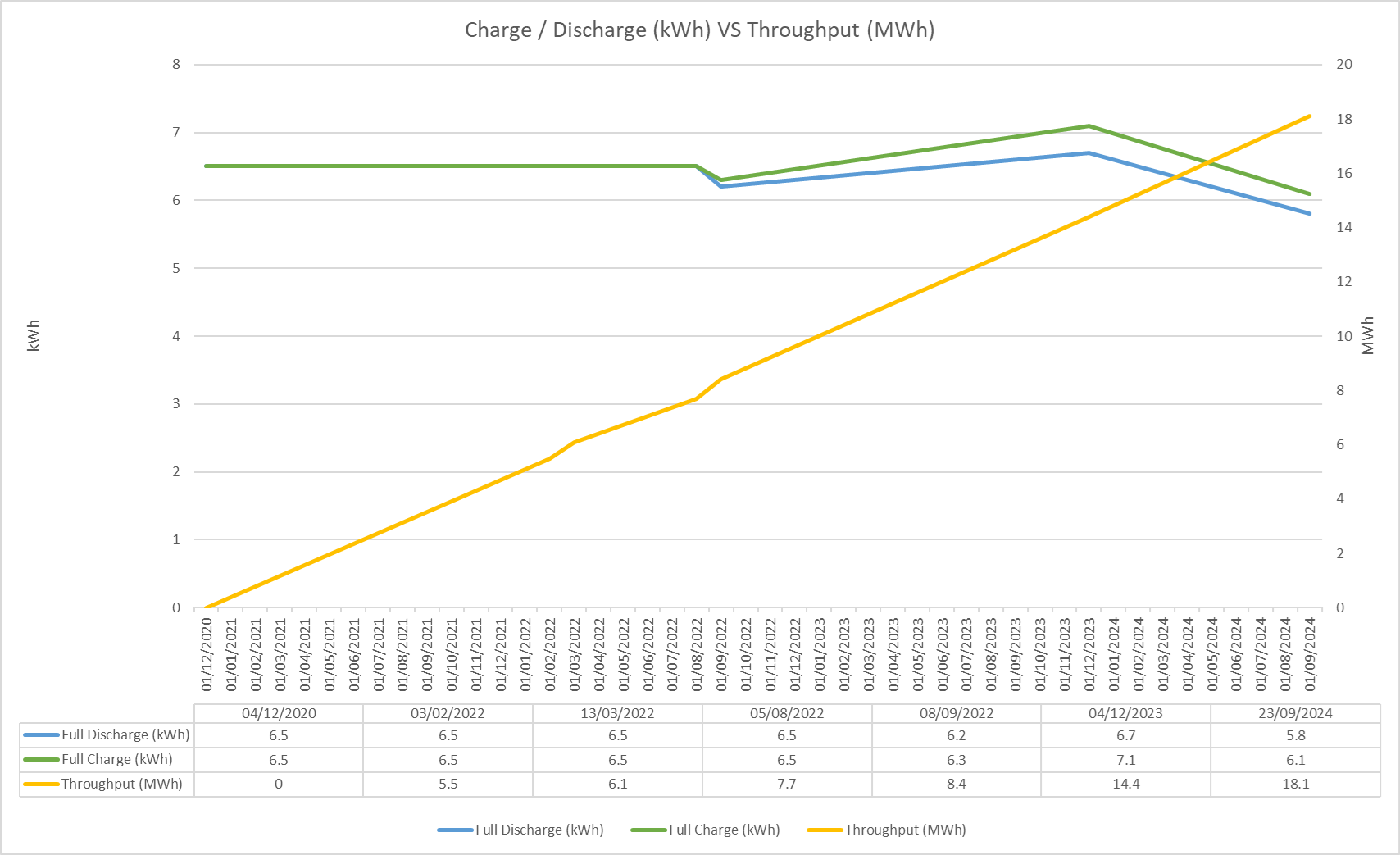
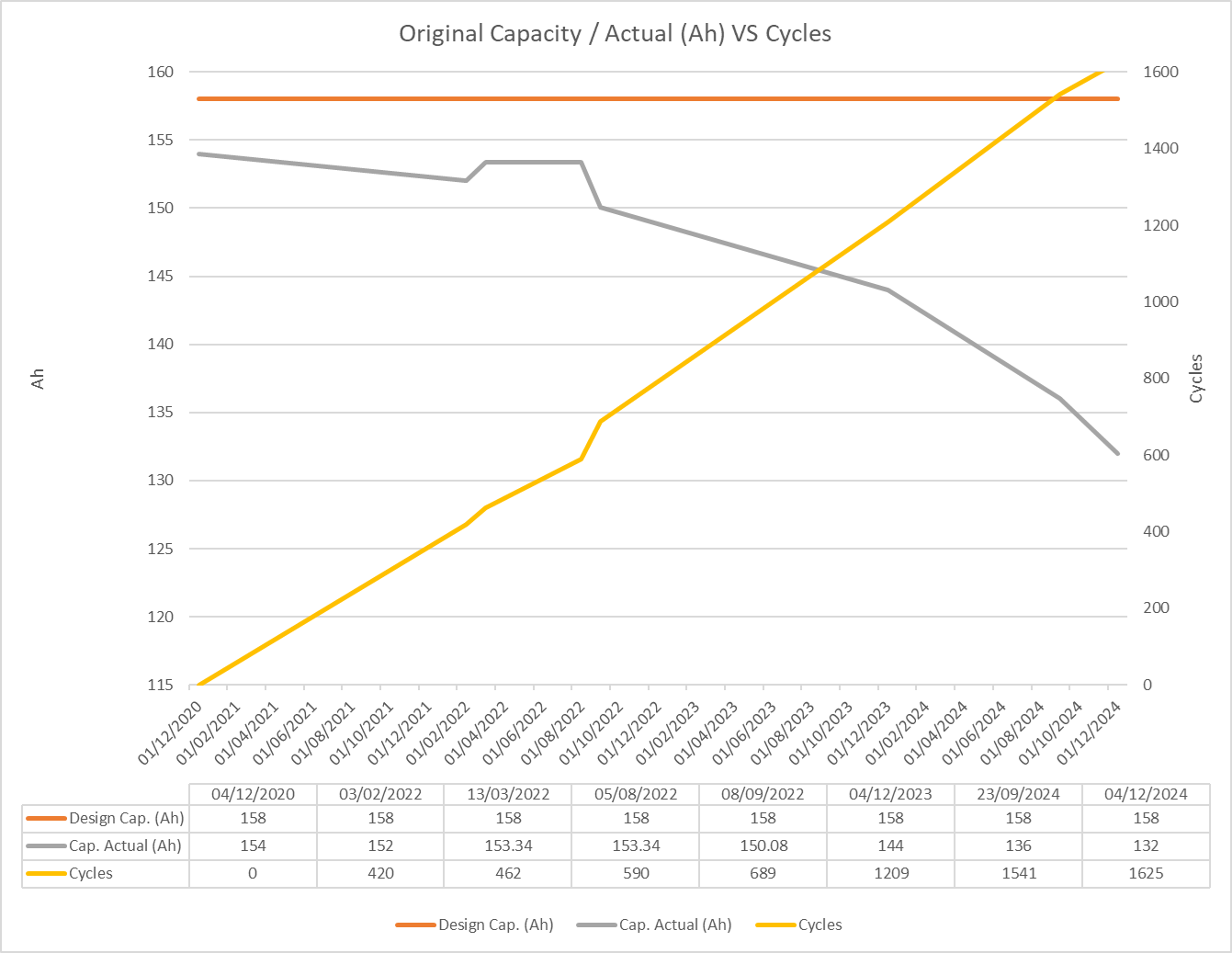
For some of the newer people on here I thought best to show some battery capacity data over long term use. Might be good to instil some confidence. I'll just update every now and then.
Not sure who has the most throughput / usage on their kit (I'm guessing multi-battery systems you would need to divide the figure by the No. of batteries to get an individual reading per pack?) but anyone with longer / more usage feel free to add.

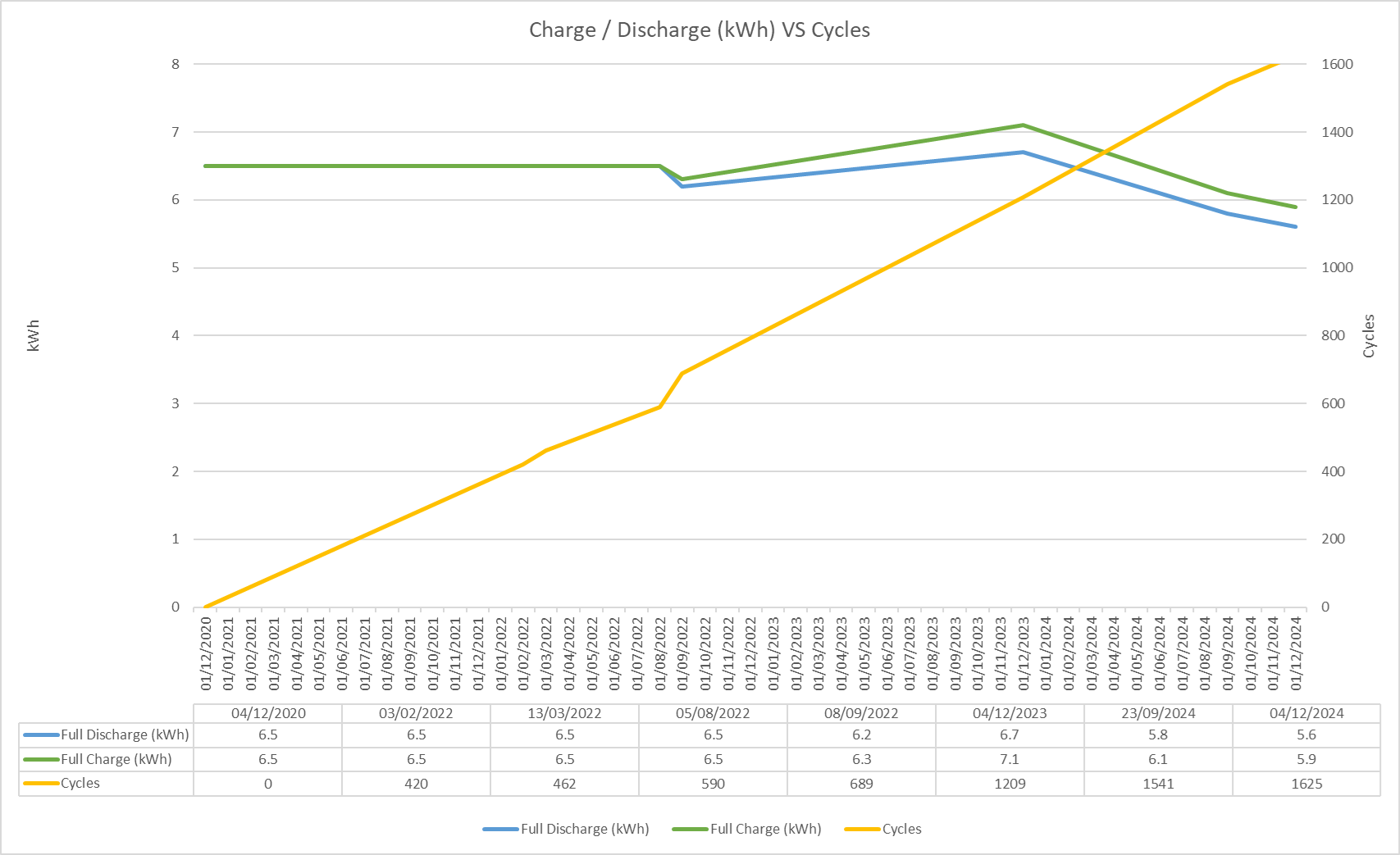
Install - 04/12/20
8.2kWh - Gen 1 - 80% DOD
Nameplate Usable Capacity - 6.5kWh
Nameplate Factory Cell AH - 160AH
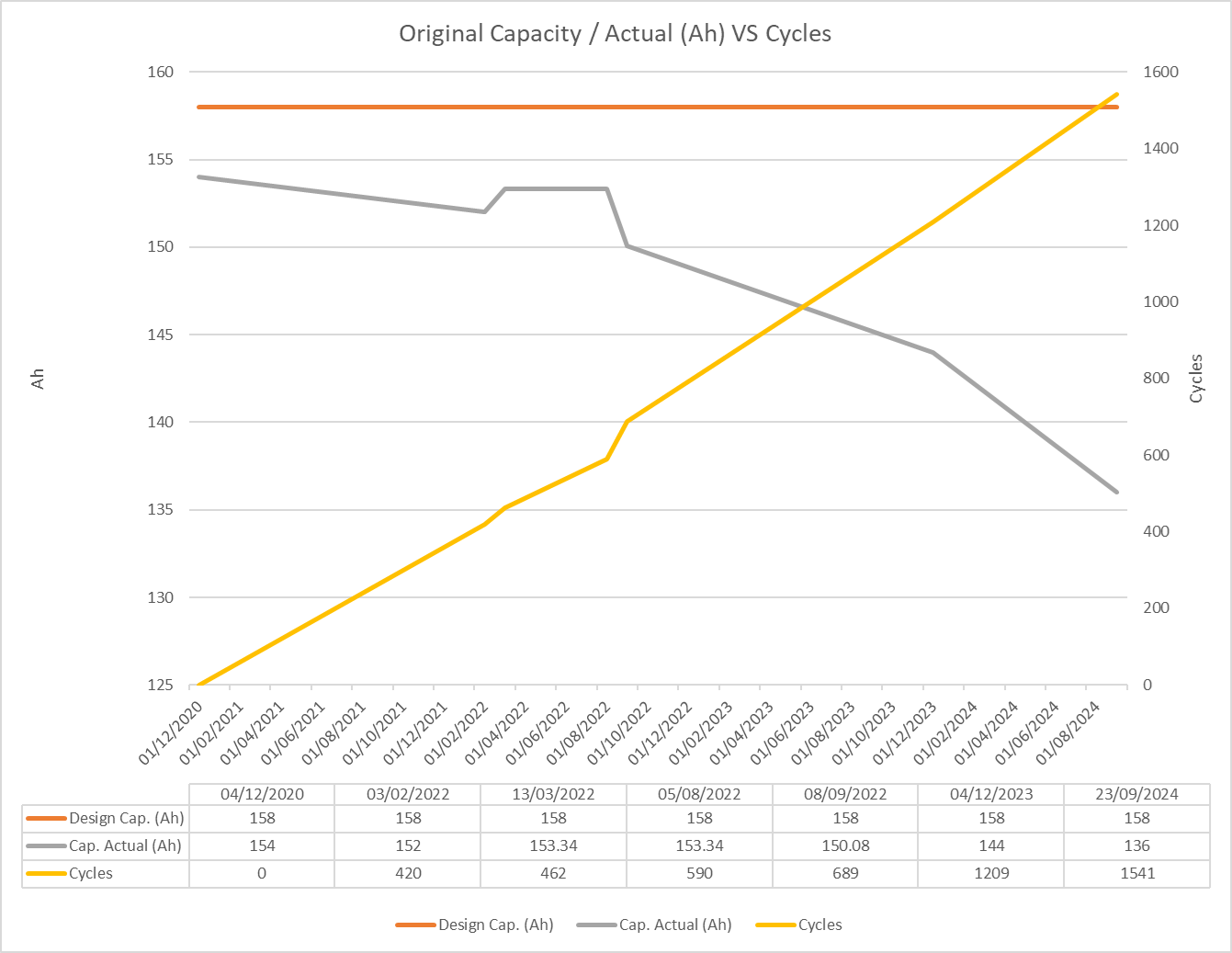
Actual Factory Cell AH - 154AH*
Actual Capacity ("Battery Charge Today" 0-100% overnight) - 6.5kWh
Battery In: 0kWh
Battery Out: 0kWh
*Not taken on install, roughly Feb 21 earliest I have.

Latest - 03/02/22
8.2kWh - Gen 1 - 80% DOD
Nameplate Usable Capacity - 6.5kWh
Nameplate Factory Cell AH - 160AH
Actual Factory Cell AH - 152AH
Actual Capacity ("Battery Charge Today" 0-100% overnight) - 6.5kWh
Battery In: 2803kWh
Battery Out: 2698kWh

Total Throughput To Date: 5,501kWh (5.5MWh)
#2 THALL

hoggy Where are you getting the actual factory cell AH data from?

#3 hoggy

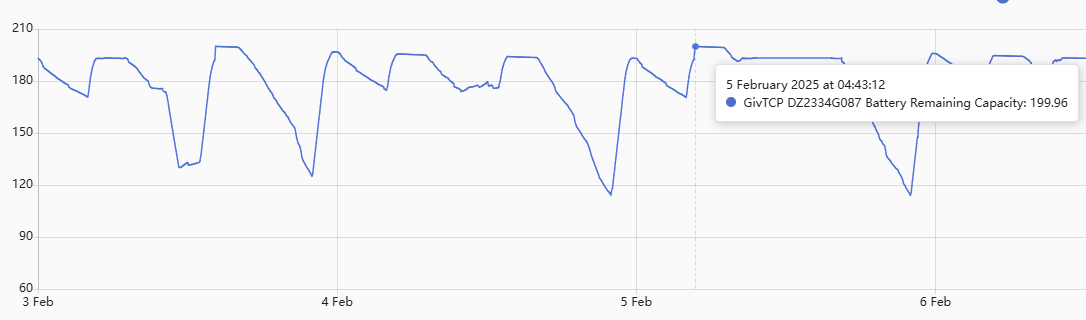
THALL It's gone from the portal now (soon to return in the new one) but for now the API still works so that's where mine has come from.
Battery Cell API

#4 THALL

hoggy Ahhh, ok I will wait for the gui to be updated. It was a handy screen on the old console. I still use the old console for the home display beta. I prefer that to the new power flow card.

Good post btw. Needs to pinned to the top of the forum!

#5 hoggy

THALL If you want I've just put together a little script to pull it from Windows. Just needs your OLD portal API key and Inverter Serial No. then spits out a text file with all the data you used to get.
Either Download as is (right click) or copy and paste into Windows PowerShell and change the values at the top.
Example Output:
{"success":true,"lost":false,"maxVoltModule":1,"minVoltModule":1,"modules":[{"cellVoltage8":3445,"cellVoltage9":3436,"cellVoltage4":3433,"moduleVoltage":550,"cellVoltage5":3432,"designCapText":"160.00","cellVoltage6":3435,"cellVoltage7":3432,"moduleSoc":72,"cellVoltage10":3436,"cellVoltage1":3441,"cellVoltage2":3435,"cellVoltage3":3435,"cellVoltage14":3436,"hasBmsCellModuleInfo":true,"cellVoltage13":3436,"cellVoltage12":3435,"cellTempreture2Text":"16.3","cellVoltage11":3436,"minVoltItem":5,"maxVoltDiffValue":13,"cellTempreture3Text":"15.4","module":1,"charging":1,"maxVoltItem":8,"cellTempreture4Text":"15.7","cellVoltage16":3438,"cellVoltage15":3438,"discharging":1,"moduleTempretureText":"18.7","fullCapText":"151.65","time":"2022-02-03 14:44:57","cellTempreture1Text":"15.8"}]}

#6 judgepd

THALL I much preferred the home display on the old portal too. I think on the new version there should be an option to keep all the info cards open rather than only when you hover over them.

#7 THALL

[unknown] Maybe if enough of us ask for it they will port the old one over even if it doesn't get updated anymore.

#8 THALL

judgepd Maybe if enough of us ask for it they will port the old one over even if it doesn't get updated anymore.

Y
#9 yandards

THALL I believe it's coming to the beta portal. Can't recall if I read that here or the weekly updates info on the portal or as feedback from a bug report though.

#10 hoggy

Can't edit the main post anymore so here's the latest:

Latest - 13/03/22
8.2kWh - Gen 1 - 80% DOD
Nameplate Usable Capacity - 6.5kWh
Nameplate Factory Cell AH - 160AH
Actual Factory Cell AH - 153.34AH
Actual Capacity ("Battery Charge Today" 0-100% overnight) - 6.5kWh
Battery In: 3109kWh
Battery Out: 2989kWh

Total Throughput To Date: 6,098kWh (6.0MWh)
#11 hoggy

Latest - 05/08/22
8.2kWh - Gen 1 - 80% DOD
Nameplate Usable Capacity - 6.5kWh
Nameplate Factory Cell AH - 160AH
Actual Factory Cell AH - 153.34AH
Actual Capacity ("Battery Charge Today" 0-100% overnight) - 6.5kWh
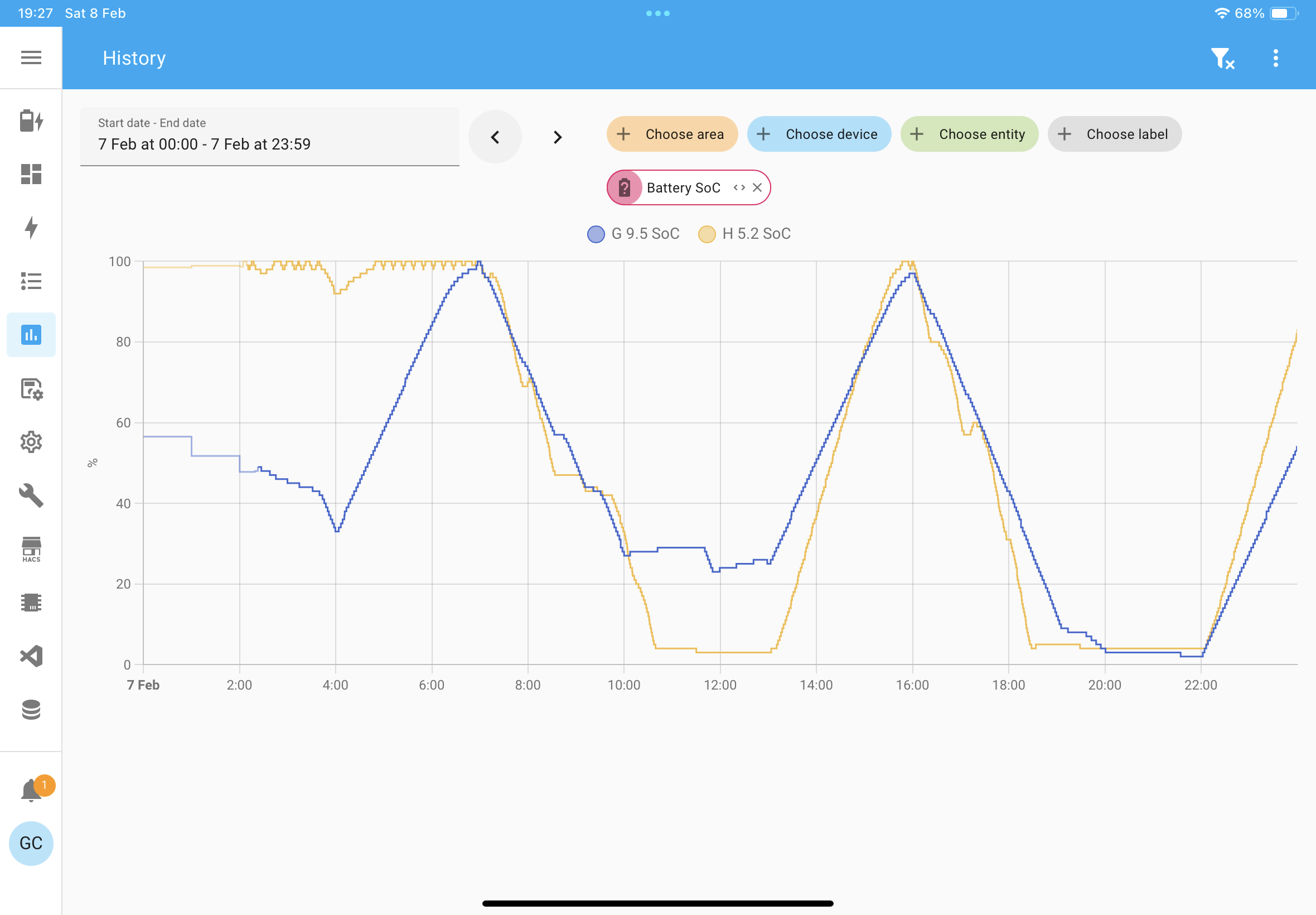
Battery In: 3874kWh
Battery Out: 3835kWh

Total Throughput To Date: 7,709kWh (7.7MWh)
No change in capacity. No battery calibration ran between 13/03/22 to FW 3007 upgrade ~ June 2021.

#12 hoggy

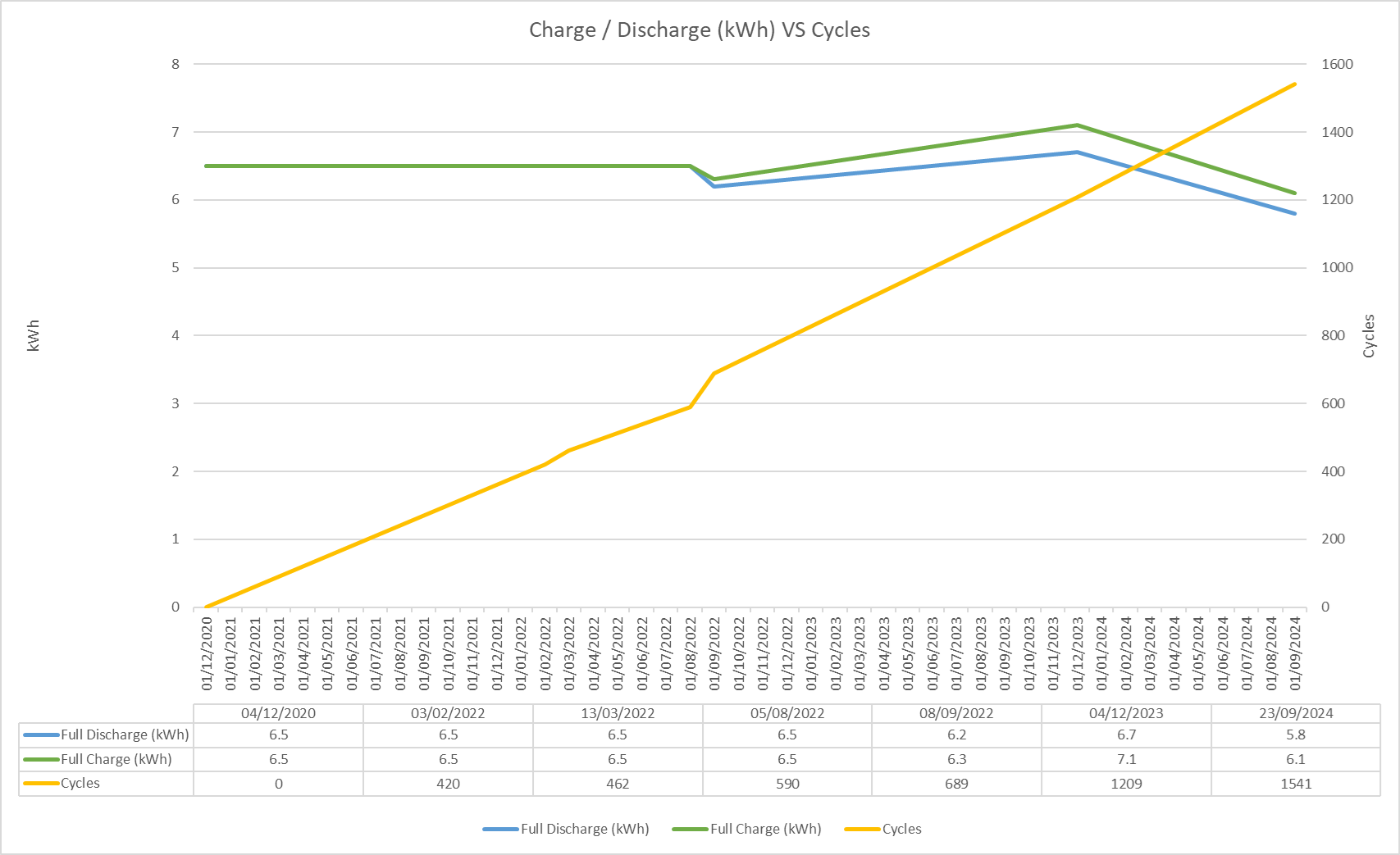
So recently I'd noticed a dip on overnight charge from "empty" from 6.5kWh to 6.3kWh.
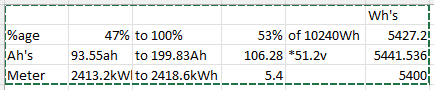
As such after a few weeks of this being repeatable I asked for a calibration to be run.
Usable cell AH rating has dipped now from 153.34AH to 150.08AH.
This is a bit disappointing but I'm yet to get a few full>empty>full cycles in to see if my full capacity has returned with the calibration or if I infact have even less than 6.3kWh left now!

I was rather hoping that the losses would get eaten up in the buffers and not come out of my side (atleast to a point) but I have a suspicion that the BMS just takes the 150AH value and then sets the goalpost at 80% of that. If so I'll likely be seeing a drop from `6.5 usable to 6.1kWh which although not a huge amount is a bit dissapointing from a 2 year old battery.

#13 THALL

hoggy 1.7kw does seem a lot to be reserved and then degredation come off the usable capacity. Sadly without setting up the tcp app I can not see my remaining capacity.

Though in 14 months my total battery throughput is 5364kwh

Do GE have a minimum capacity under their warranty? I know it is unlimited cycles / 10 years.

#14 hoggy

THALL Warranty states min 70% retention over 10 years although unclear if that's 70% of usable or 70% of true capacity....
I know batteries degrade so I was at some point expecting some drop and to be fair it's a bit to early for me to say one way or another without a lot more cycles.

FYI mine has done 8474kWh now but it's been now heading into it's 3rd Winter that's going to start to shoot up again as it'll be getting utilised a lot more.

#15 THALL

hoggy I have been hitting mine more now I finally have an EV! I might have to setup the tcp app and get my data. I am adding a 9.5kw to the system soon as so the load will spread a bit.

#16 hoggy

So Given it's sort of sunny & the chance to do this for "free" grows ever shorter as year goes on I've fully charged, held for an hour, run a full discharge at max rate from 100>4% then held for 30 mins before forced charge back to 100%.

Stats are (bearing in mind this is just 1 test):
Discharge 6.2kWH
Charge: 6.3kWh

I'm happy to take the 0.1 as rounding errors, not quite so enthusiastic about the loss of usable capacity so soon.

#17 THALL

As you said above, I would of hoped the first loss came from the 20% that is not available to you. Though is it 24% for you? 20% not available and 4% usage reserve?

S
#18 stevelewis

THALL If it's any consolation, take a look at the published battery degradation for the Nissan Leaf. The first year has the fastest degradation and it then tends to plateau. Hopefully the same is true here!

#19 hoggy

Hope so, splitting it down the middle (say it’s 6.25kWh available) vs 6.55kwh from new puts me at 95% capacity in 689 cycles (it’s 2 years old in Dec) Although I suppose even at that rate it’ll still not be warranty by year 10 (if they go on usable amount) so not much I can really do.

Anyone on here have the old Prime Hybrid Energy system?, if so how are they faring given they had the jump by a few years on GE and likely smaller (harder ran) packs?

#20 hoggy

On the plus side my misfortune (owing to an automation fail) has meant my considerably older Gen 1 Pylontech system did a full discharge from 100% until it hit its minimum 20%.
They were (way back in 2015/16) 1.9kWh usable.
There's 3 so 5.7kWh usable.
The full discharge run managed 5.2kWh so I think 0.5kWh loss in 7 years is pretty good going!

Goes to show its how they are treated - there was a video kicking about a few months back with one that had not had an easy life (single pack often running beyond its spec) and that only had about 0.5kWh capacity left in total...

I
#21 ispookie666

@hoggy very true single battery is likely to suffer more than multiple battery setups as the charge and discharge currents would be less than single. For me the maximum charge and discharge is 0.2C. I would be really pissed if the battery degraded with this

#23 hoggy

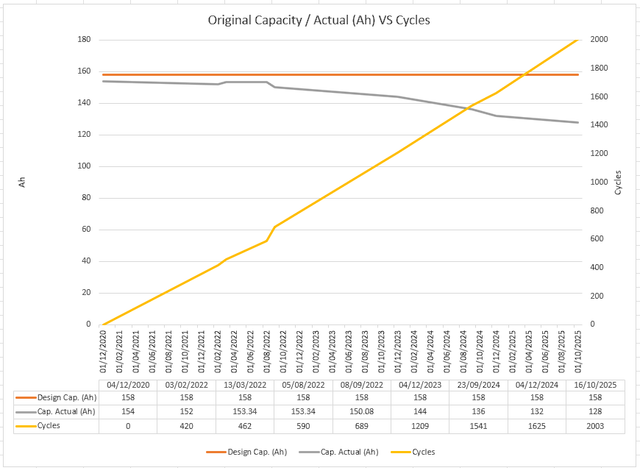
So it's the 3rd anniversary of my system today so as good as time as any for an update:
Hy5 Gen1 Installed 4th Dec 2020
Battery - 8.2kWh 80% DOD (old school pack 6.5kWh usable)
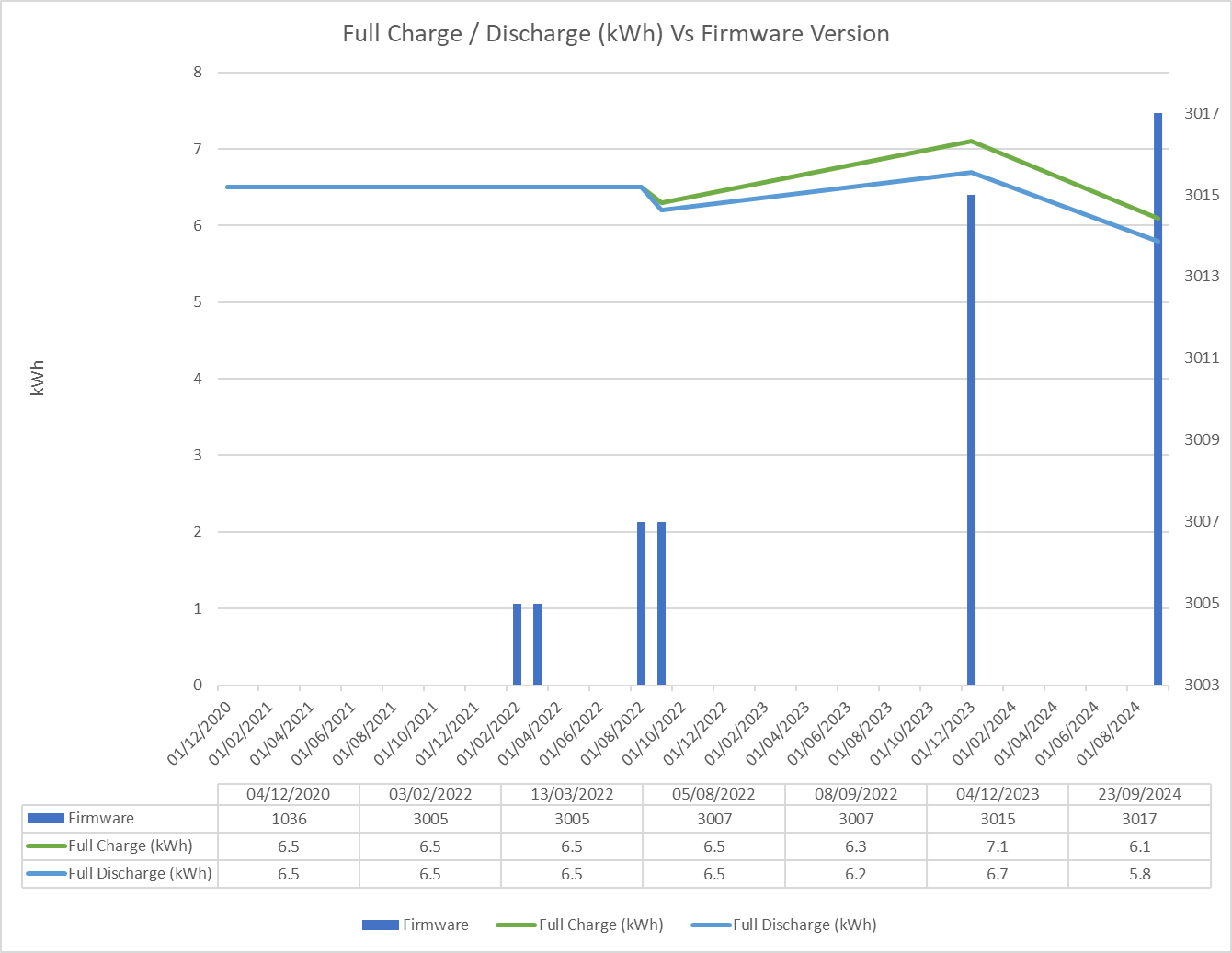
Current Firmware 3015
Cycles: 1209
Throughput to date: 14.4MWh
Inverter Output to date: 20.7MWh

Full capacity run result:
Discharge - 6.7kWh
Charge - 7.1kWh

So a boost in capacity, however, 3015 FW does take this pack WAY lower than it used to - 4% ACTUAL / 47V which I'm not convinced is going to be great for longevity.

#24 hoggy

Been a while but thought I'd update again. Fairly large drop since last December:
Current Firmware 3017
Cycles: 1541
Throughput to date: 18.1MWh
Inverter Output to date: 31.2MWh

Full capacity run result:
Discharge - 5.8kWh
Charge - 6.1kWh


V
#25 Vestas

hoggy Looks like a few months on 3015 "cost you" a couple of Ah.

Hard to tell really given your calibrations have been in winter, spring, summer and autumn so ambient temps are going to vary quite a bit (ISTR there's a different calibration table if its over 25C, but that might be different f/w).

I assume you ran some sort of overvoltage automation like me on 3015 with 450/451 f/w?

I'm going to run a cal on mine at an appropriate time. Fairly sure that after 3013 then 3015 (on 450/451) its not going to be pretty but we'll see....

#26 hoggy

Vestas yeah I did run something to try and reign it in a bit but mine seemed to run low/undervolt rather than OV 99 times out of 100.
Calibrations generally align with whenever I did a fw upgrade, other ones I ran I just kind of forgot to note down to be fair.

V
#27 Vestas

Done a remote calibration today so figures (f/w) from prior calibrations are:

Oct 23 (3013) 197Ah
Nov 23 (3013) 194Ah
Dec 23 (3015) 189Ah
Oct 24 (3015) 187Ah

I knew 3013 kicked the crap out of the battery on the low-end so was suspicious of 3015. Automations look like they helped prevent the worst of the overvoltage degredation.

Overall that's a 10Ah loss (4%) in capacity on a battery with "throughput"* of 9259kWh.

Worth noting that cell temperatures were probably a fair bit lower in Dec 23 when calibration was done.

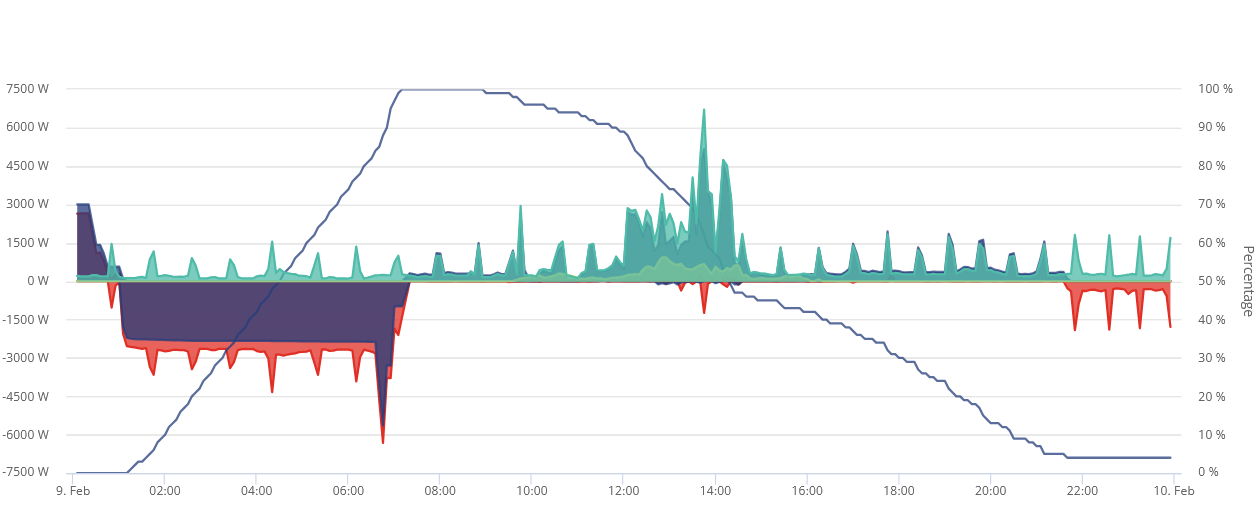
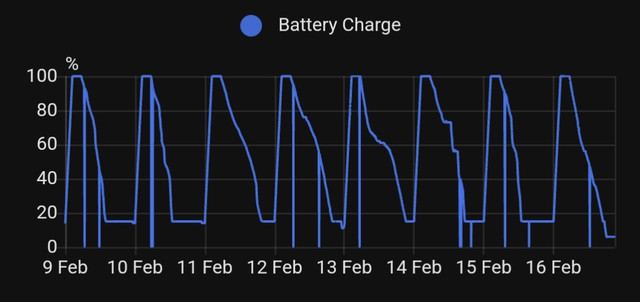
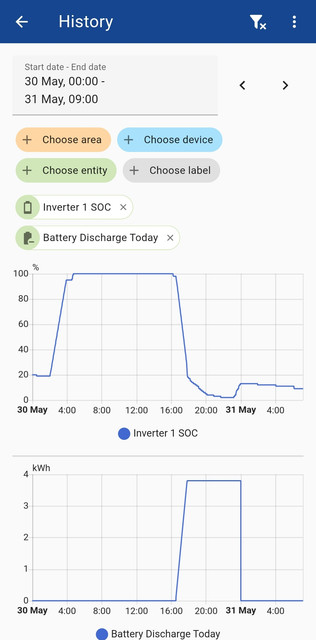
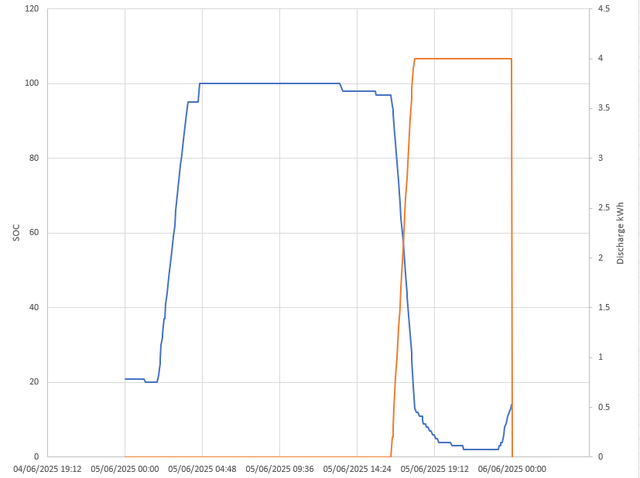
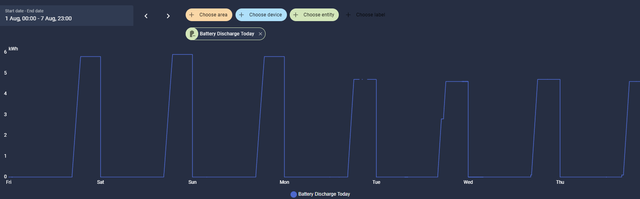
Also (for GivTCP/HA users), the new calibrated value is within 0.5Ah of the "blip" which occasionally appears on the "Battery Capacity" entity graph, so that's maybe a decent indicator of where capacity is heading?

*4742kWh charge; 4518kWh discharge (rounded up), 569 "cycles"

V
#28 Vestas

Also, apologies for thread hijack:

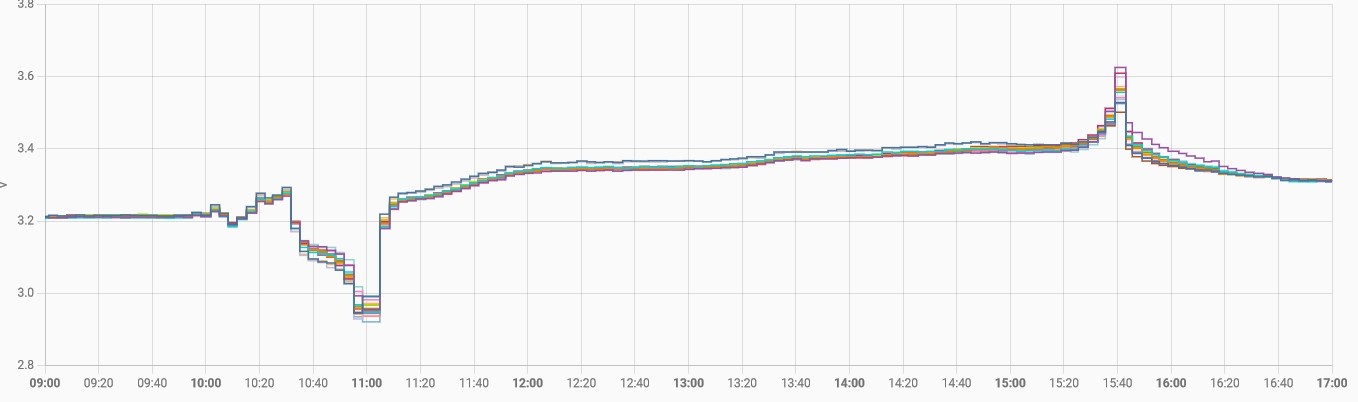
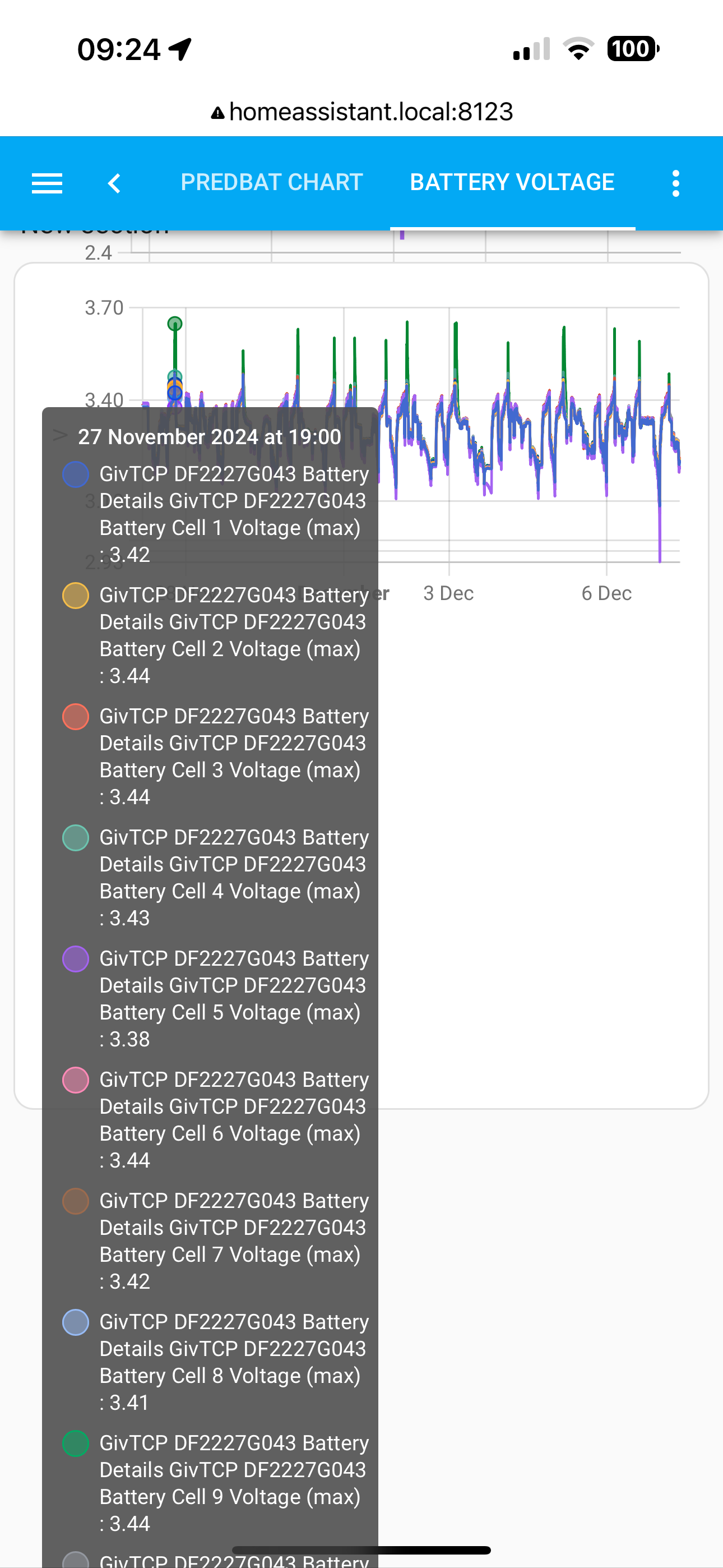
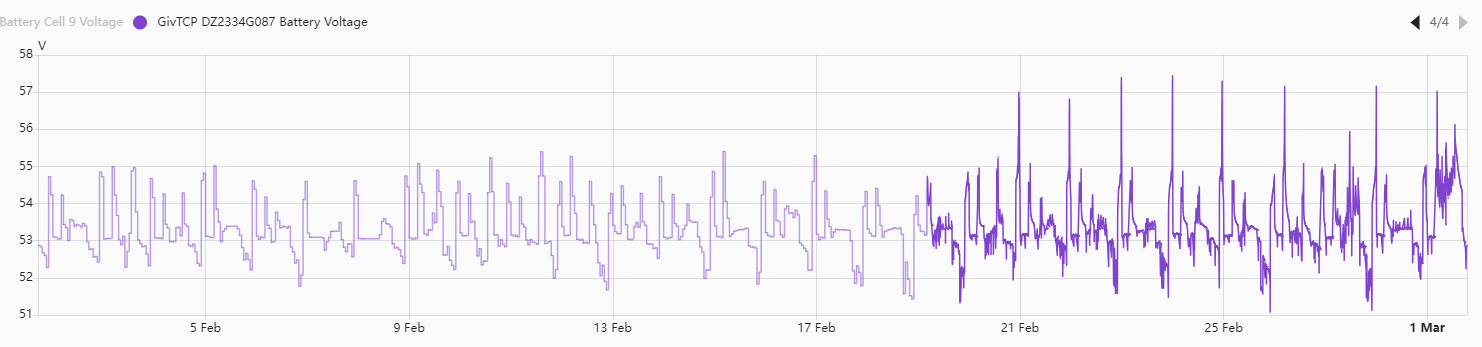
That's what a calibration on 191/193 and v3015 looks like today. That's a (near enough) 0-100% SoC voltage graph.
Its also what a standard charge on 450/451 looked like without intervention at the top end using automations. Bottom end of the graph is what 3013 was like every few days.

Wonder how many batteries that is....

#29 Judith

hoggy
Thanks for posting this figures “regularly”. From what I’ve read on battery chemistry degradation the hit isn’t linear but a drop at first then steadying out to linear.
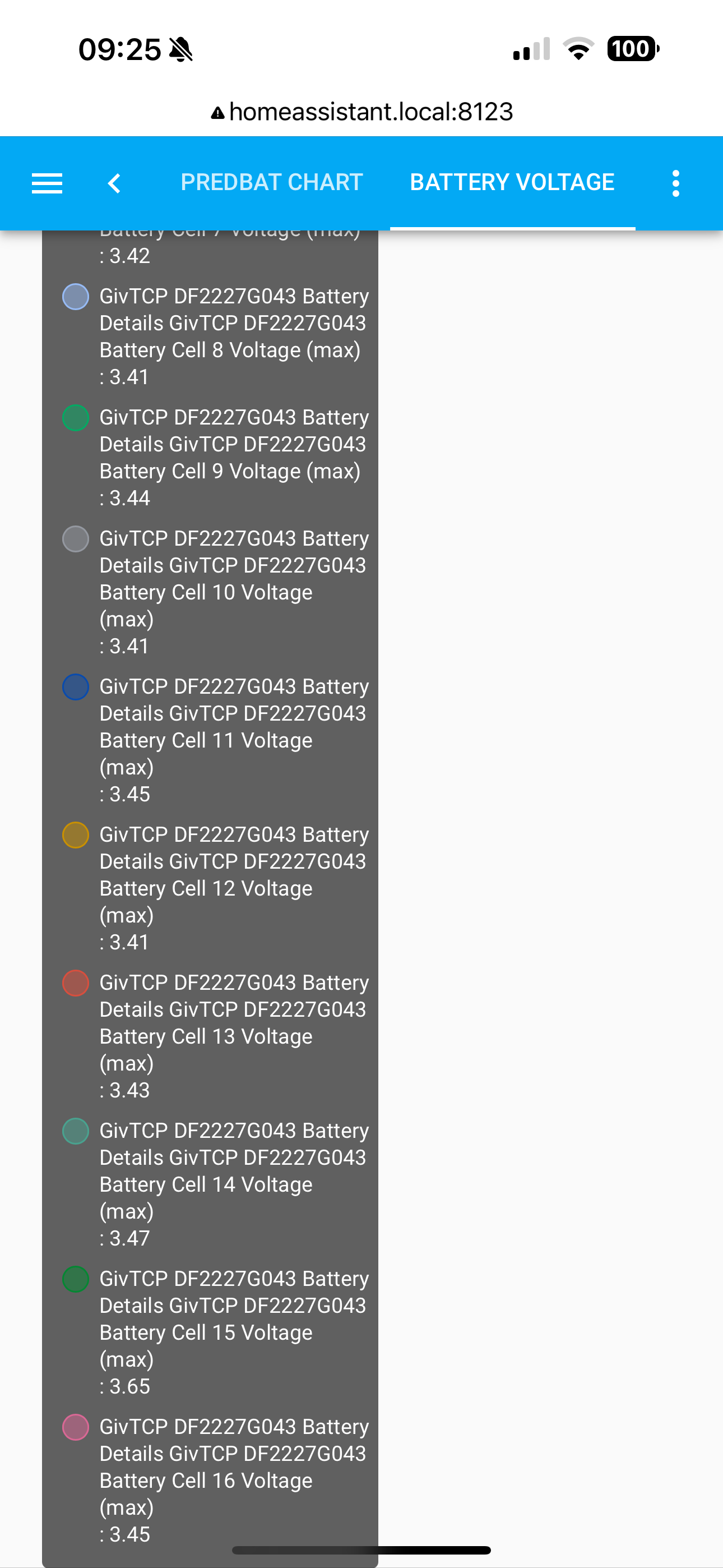
It’s a shame the different software issues have such different voltage settings (our upgrade from 30
09 to 3017 moved the operating range down about 3V) which must affect the degradation. Intermediate versions were different again so how much degradation is due to age/cycling history or voltage or temperature excursions will be tricky to consider.
The only reason to think about it is to know what best to do to maximise battery life. There’s no point earning £100 a year on export at the expense of say 3yrs of life.
Some us us only have the 5yr battery warranty since it needed the installer to register for 10years and ours was a “never answer the phone/email once you’ve got the money” version. So actual life matters!

#30 hoggy

As its the systems birthday (year 4) thought I'd update:

Current Firmware 3017
Cycles: 1625
Throughput to date: 19.06MWh
Inverter Output to date: 32.6MWh

Full capacity run result:
Discharge - 5.6kWh
Charge - 5.9kWh


#31 Windy Miller

So 85% drop after 4 years with just over 1 cycle per day. That seems reasonable although is the degradation speeding up?

A
#32 Al E.Gator

hoggy Should be right on for a small warranty claim!

A
#33 Al E.Gator

hoggy Also, how are you getting your charge/discharge total figures?

#34 hoggy

Al E.Gator the data is pulled directly from the inverter - charge today and discharge today but they also reflect the inverter meter data in the portal so you can do it that way.

Bear in mind I'm not massively consistent with when I've collected the data, but it doesn't show much sign of levelling off.

Would be interested if anyone has a similar 2020 pack with far less miles on the clock. That way I can estimate how much of this is calendar degradation on how much comes from wear.

A
#35 Al E.Gator

hoggy Yes that's a really interesting point. Mine are 2021 9.5kWh packs, and as you say, if a significant portion of the degradation is coming from ageing it completely changes the economics of the best way to use the battery... i.e. hammer it. It looks pretty consistent for me, though I am calculating it slightly different compared to you where I do a calibration and see what the new capacity is compared to the first calibration when new. I'm pretty consistently losing 4-5% every 300 cycles, which to me almost seems NMC battery levels of wear!

#36 Hook

Do I need to worry about cell 15?


B
#37 bRhFDKtjRMK9

Your battery is on warranty, why would you worry about it?

A
#38 Al E.Gator

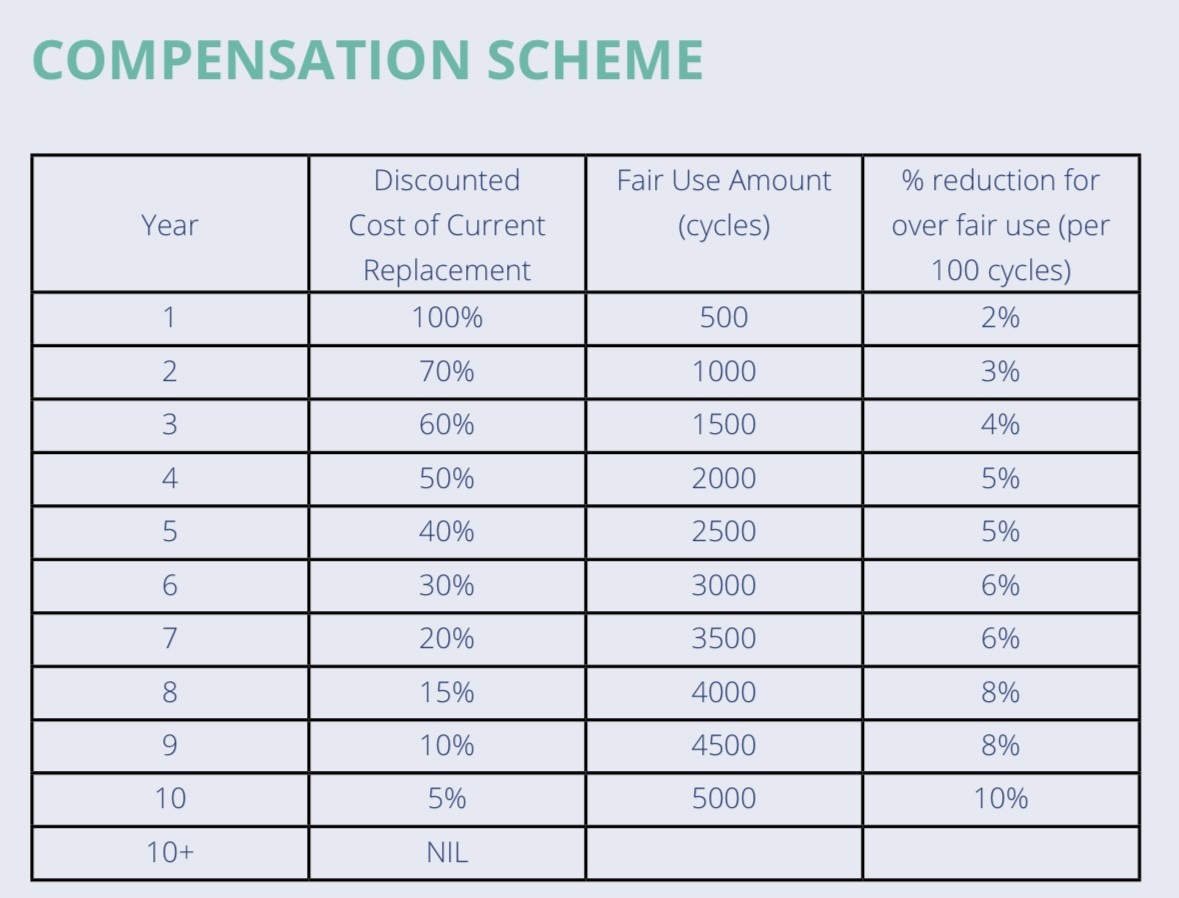
bRhFDKtjRMK9 Depends how old the battery is, sliding scale on warranty compensation means that even after just a few years you won’t get much back compared to the price you paid new. Bit of a dent in the payback to say the least!

A
#39 Al E.Gator

hoggy Just did a full discharge from full and got 7kWh out of the battery at roughly 20 degrees😬

B
#40 bRhFDKtjRMK9

Al E.Gator Depends how old the battery is, sliding scale on warranty compensation means that even after just a few years you won’t get much back compared to the price you paid new. Bit of a dent in the payback to say the least!

I never looked into warranty in great detail, can you please tell me, what you mean by "sliding scale on warranty compensation"? If product fails, we will be given partial monetary compensation, instead of warranty repair?

EDIT: I found warranty legal wording: https://kb.givenergy.cloud/article.php?id=135&oid=16
To my understanding, the Supplier (GivEnergy) will, at its discretion:

  • Repair the defective product.
  • Replace the defective product.
  • Refund the price of the defective product in full​

Doesn't sound too alarming to my eye. Faulty battery may just gets replaced and fixed, which is the best solution in case of a fault.

B
#41 bRhFDKtjRMK9

Al E.Gator Just did a full discharge from full and got 7kWh out of the battery at roughly 20 degrees😬

What battery do you have, 13.5, 9.5 or different? GE guarantees 70% of original usable capacity until warranty request can be triggered.

A
#42 Al E.Gator

bRhFDKtjRMK9 agreed that they may choose to repair it, but there’s always a risk if for example that battery isn’t available anymore or they don’t have any spares, in essence GE will choose the cheapest option for them under the warranty policy. Mine is a 9.5, see sliding scale attached

B
#43 bRhFDKtjRMK9

Can you provide a link to this document? Thank you.

A
#45 Al E.Gator

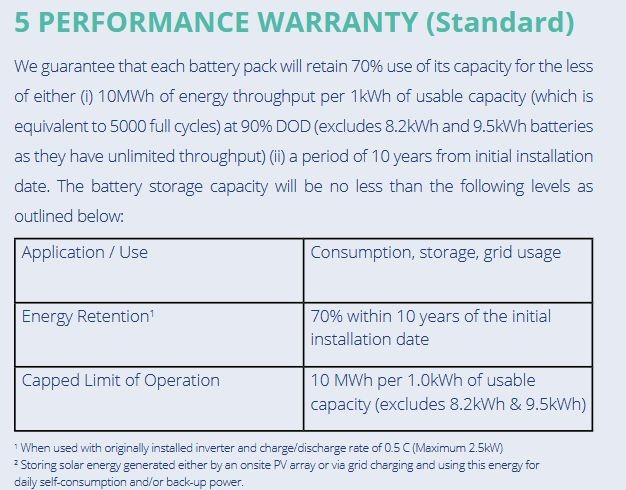
bRhFDKtjRMK9 Worth noting though that I think older batteries you could use as much as you liked (including for grid trading) and it still be covered under warranty. But new Gen 3 batteries are restricted regarding this in the warranty to 10MWh per 1kWh of storage

V
#46 Vestas

Al E.Gator The 2022 v3 warranty is "interesting" in a number of ways, amongst which are -

People might like to observe that if you EVER charged/discharged the battery at more than 2.5kW then GE can apparently deny your warranty claim, so G2/G3 inverter users who had their systems installed prior to Feb 24 (or possibly Sept 23) are affected. Edit - as are probably all G1 inverter owners as discharge is 2.6kW on production f/w and 2.9kW on "beta" f/w when exporting, making a total nonsense of the warranty document.

Also note 2 - which isn't actually valid as it references nothing in the document - is an attempt to deny warranty claims if you EVER exported from battery.

I suspect GE's "performance warranty" isn't worth the paper its written on unless you want to invoke the small claims track....

A
#47 Al E.Gator

Vestas Yes I noticed that one too. Personally I think the entire warranty is not worth the paper it's written on as there are too many exceptions that GE could wriggle out of.

V
#48 Vestas

Al E.Gator Unfair contract terms* (Consumer Act 2015) would mean they'd lose any legal action. Instantly.

*given the document appears to preclude anyone with a GE inverter (of any sort) claiming on the GE battery warranty if they ever use the inverter according to its specs.

A
#49 Al E.Gator

Vestas Yeah the weird thing I don't get is that the statement on the warranty doesn't even make sense. Like is it 0.5C or 2.5kW? Because 0.5 C on a 9.5kWh battery would give a discharge rate of approximately 4.75kW...

#50 nophead

Also with my 5.2kWh battery 0.5C is 2.6kW, which is what the charge and discharge limits are. Although now in winter it never charges at 2.6kW because it never gets to 20C.

V
#51 Vestas

Al E.Gator The C rating is variable dependent on battery capacity but the 2.5kW figure is specified as maximum so that's the absolute limit for the warranty.

My best guess is someone edited the previous warranty document (badly) to include the 9.5kWh battery, didn't run it past ANY solicitors and then published it.

Its either complete nonsense generated by an idiot or a wilful attempt to prevent any "performance warranty" claims. Take your pick.

M
#52 M_J

https://www.moneysavingexpert.com/news/2023/02/martin-lewis-faulty-tech-warranty/

If you've bought some tech that's gone faulty and you've had to take it back, don't let them fob you off with 'sorry you're out of warranty'. That's the message from MoneySavingExpert.com founder Martin Lewis' in his latest video. Watch Martin’s Warranty Schmaranty two-minute video, or carry on reading below.

V
#53 Vestas

M_J Yeah but the problem is that you have to go after the installer if you go his way, which I don't really think is fair in this case.

Unfair contract terms on the warranty would move it up the legal "chain" where it belongs.

I mean nobody in their right mind would buy a battery from a "manufacturer" whose warranty terms effectively excluded use with their own inverters/apps would they?

Yet here we are 😃

M
#54 M_J

I just think anyone hoping that the warranty will cover them are potentially going to be very disappointed or good at using the small claims court.

If GivEnergy are still in business...

So I am taking the view better to try and avoid having to go down that road...

Each to their own...

A
#55 Al E.Gator

Update as of 1st February and 718 cycles through the battery. Maximum charge 92% of original capacity and standard charge to 100% gives 89% of the original capacity. Unbelievable how fast it's dropping, lost 4% just in the past few hundred cycles!

#56 hoggy

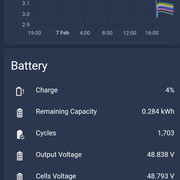
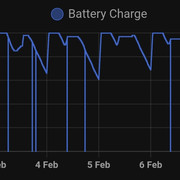
Well today was my first SOC soft crash since around November. 100% to 4% (actual battery raw SOC not inverter, it missed the usual 15% by a mile) with a total output of...drumroll..... 5.3kWh.
Admittedly I know why as I've been on holiday but despite being charged to 100% each night (something that in any other bms would be an easy known end stop) it has lost its way in less than 5 days. Its a good job this gets cycled daily at any other time really. System 2 takes the strain tonight instead.

Bonus cell rainbow though so atleast it's pretty to look at.

V
#57 Vestas

hoggy Sounds about right - a week or so of not doing full cycling and I'd see voltage excursions one way or another. Top end would be enough to trigger the (now mainly suppressed) overvoltage events in the portal. Still should IMHO if you've got cells at 3.7V but not now....

BMS is just a bag of shite really in terms of tracking SoC unless you cycle it every day, when it more or less behaves.

No other way of putting it which sums up how bad it is compared to others.

C
#58 CW

Vestas BMS is just a bag of shite really in terms of tracking SoC unless you cycle it every day, when it more or less behaves.

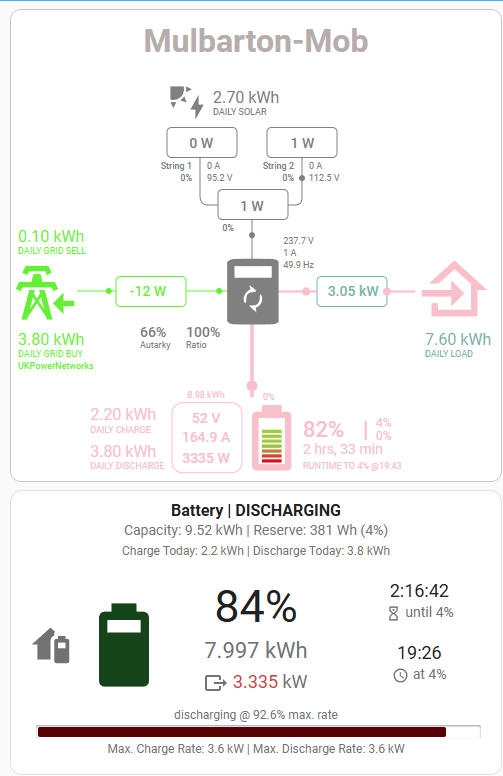
I'm not sure the cycling helps TBH - on my AIO which gets emptied regularly, today I went from 100% SOC to 4% discharging 7.9kWh (after a charge to 100% of 8.8kWh).
Not sure if there is a problem with half the pack not working, or something else - trying a recalibration tonight to see if things get better

V
#59 Vestas

CW AIO has different BMS so apples & oranges...

C
#60 CW

Vestas Or rotten pears to rotten apples 😆

V
#61 Vestas

CW TBH I just think the BMS in the G1/G2 batteries was designed for high current applications (full rate charge/discharge) and loses the plot when that doesn't happen. That error aggregates and then the SoC becomes nonsense.

I'm sort of resigned to having to let the battery go flat/hit cutoff & idle for a couple of hours to rebalance/etc in order to keep an accurate SoC - ideally daily. At least I know how it behaves now so I can see when the voltage is edging upwards on charge and do something about it. So its probably a better situation than some of you guys on AIOs anyway 🙂

G
#62 geoffreycoan

Vestas Its interesting, some people seem to have real trouble with SoC tracking and others don’t. Particularly the AIO owners.

My batteries get used well, particularly in winter they are getting charged and discharged fully each day. Today has been milder so the batteries didn’t discharge in the morning, but yesterday is a typical pattern for me now on Cosy:

Previously I was on Agile so less charge cycles, charge overnight, discharge a bit in the morning, charge back to 100% in the afternoon, discharge to empty in the peak.

But in neither case a, I engineering any specific time for rebalancing etc and to my knowledge I’ve never once seen a SoC drop or misbehaviour. I’m not getting the Ah that I did originally and do plan a slow calibration whenever rates or solar make that favourable, but other than that, it works as I’d expect it to

C
#63 CW

geoffreycoan

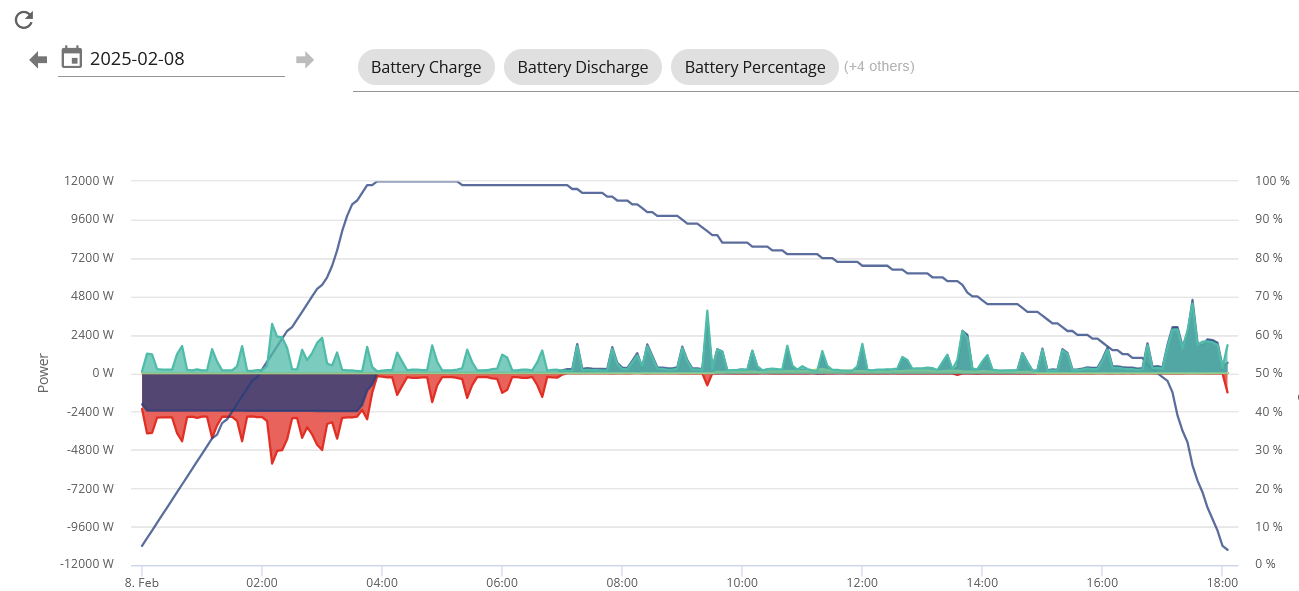
Here is my AIO SOC today, and as I mentioned earlier, 100% - 4% with 7.9 kWh - basically half! It seems the SOC drops quite rapidly once a load is applied during the latter SOC percentages

G
#64 geoffreycoan

CW interesting, this made me look at my own battery discharge today

my 9.5 it went from 97% to 5% when it stopped discharging and discharged 7.6kWh of charge

the 5.2 (4.2 usable) managed to discharge 0.2kWh without the SoC dropping at all from 100%, but then (net of cross charging a bit from the 9.5) it discharged 3.7kWh to 4% SoC

The measurement of power out won't take account of energy conversion losses or inverter overhead so if I add 7.5% on then I get 8.2kWh and 4kWh respectively

Does reinforce that the 9.5 needs a recalibration. SoC seems to trend in a fairly consistent line for both batteries and doesn't drop suddenly at all

R
#65 Rubikcube

hoggy charged to 100% each night

Do you mean you had Enable AC Charge Upper % Limit ON and the limit set to 100% or Enable AC Charge Upper % Limit OFF?

A
#66 Al E.Gator

I think really there's a much simpler way of looking at this on a day to day basis that I have started using. I just create a custom entity on HA that adds up all the batteries remaining capacity in Ah and calculates it as a percentage of the total nominal capacity the batteries came out of the factory with. The inverter seems to hide this to an extent but doing it this way shows you ACTUALLY how much capacity you have left out of the expected capacity on a day to day basis. Though I'm slightly regretting doing it as I never see higher than 92%! Maybe it would have been better to stay oblivious to the lost capacity.

#67 hoggy

Rubikcube Enable AC Charge Upper % Limit is OFF. (Ex Winter mode register)

W
#68 wrighar

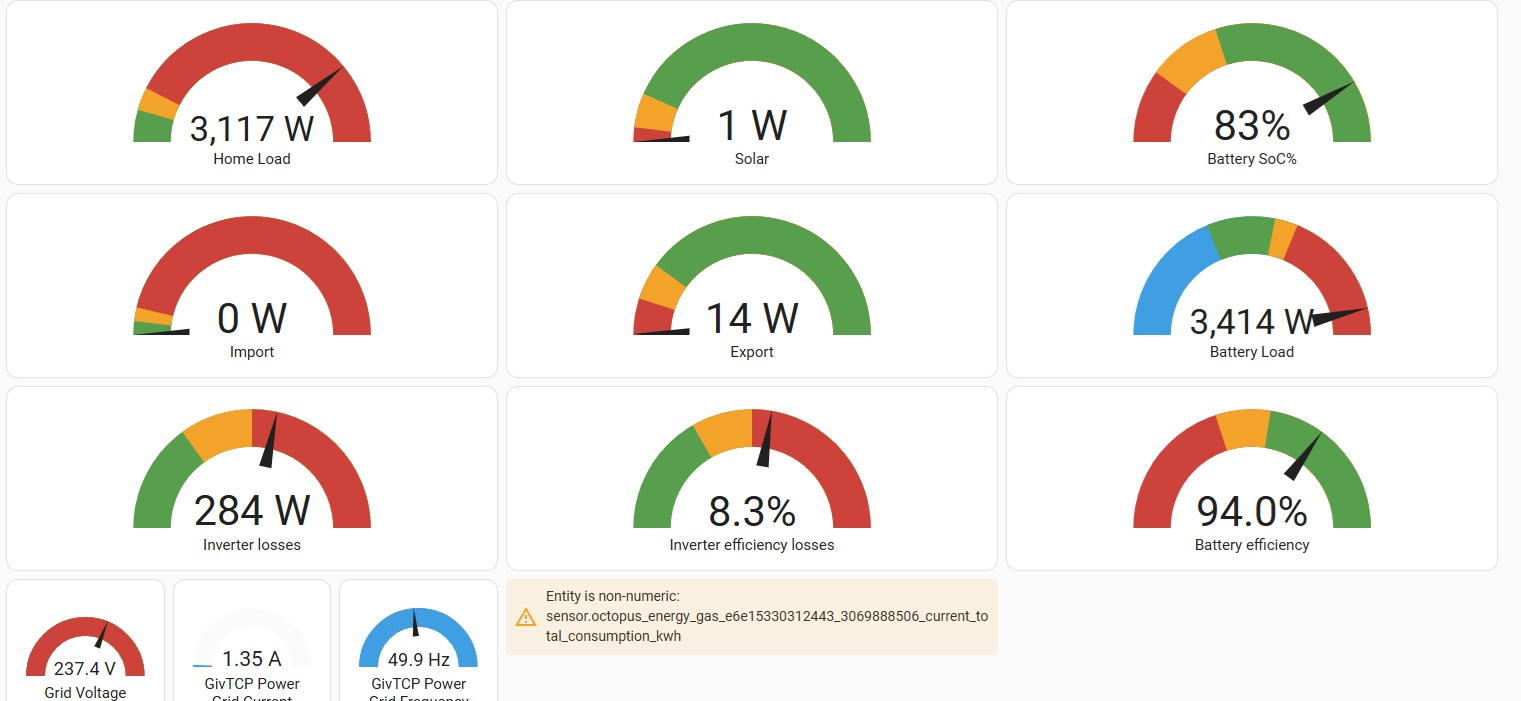
I'm running around 94% battery efficiency.
When I was doing full rate charge and discharge over the sunner it was around 89% efficient, since I've been doing a slightly slower chasrge, and just household discharge, the %age efficiency has come up to 94% (including the 6 months at 89%).

G
#69 geoffreycoan

Al E.Gator using. I just create a custom entity on HA that adds up all the batteries remaining capacity in Ah and calculates it as a percentage of the total nominal capacity the batteries came out of the factory with

I’ve just done the same, battery available % is 97.9% on my 9.5 and 95% on my 5.2 (which is much older so would expect more degradation).

However, I don’t think I am actually getting that Ah into and out of the battery, as described above. Will do more testing

W
#70 wrighar

Al E.Gator

Just remember, the 9.523kWh battery has a design capacity of 186Ah (@51.2V), but they come with 200Ah of cells (10.240kWh), 7.5% over provisioned.

A
#71 Al E.Gator

wrighar Agreed, but I don't think we ever actually get to see a true SOC of the whole battery. I do however think that using the Ah figure on the battery itself does give you the closest yet way of telling how much power you really have left. But open to other ideas.

A
#72 Al E.Gator

geoffreycoan Interesting on the 5.2, that's not doing badly at all, I assume you are using the battery_remaining_capacity entity for the calculation and not the battery_capacity as that only updates when a calibration is conducted. How many cycles has the 9.5 done?

G
#73 geoffreycoan

Al E.Gator My template {{ ((states('sensor.g_dx2327g139_battery_capacity',0)|float) / (states('sensor.g_dx2327g139_battery_design_capacity',0)|float)*100)|round(1) }}

Al E.Gator I assume you are using the battery_remaining_capacity entity for the calculation and not the battery_capacity as that only updates when a calibration is conducted

Ah ok, I was using battery_capacity:

{{ ((states('sensor.g_dxxxxx_battery_capacity',0)|float) / (states('sensor.g_dxxxxx_battery_design_capacity',0)|float)*100)|round(1) }}

battery_remaining_capacity was disabled (possibly from clearing out entities I didn’t use)

Have changed to use battery_remaining_capacity in the template entities and now get much lower figures (especially as one battery is empty and the other is almost empty). I’ll see how they trend over a day or so.
Might change them to time based trigger templates if they generate too much guff with miniscule changes in the HA database

The 9.5 has done 481 cycles in 11 months, the 5.2 1172 in 25 months

A
#74 Al E.Gator

geoffreycoan yeah so with battery_remaining_capacity you’ll see on the history what it charges up to at maximum, which I think is really interesting, and then as I say, the actual % of the purchased nominal capacity you have left. I think battery_capacity only updates during calibration as that is the actual theoretical maximum from the bottom to top voltage limits

C
#75 CW

CW And here is the SOC profile after an overnight recalibration (if I can ever get the image to upload)

A much more uniform profile of discharge

W
#76 wrighar

Al E.Gator
My 9.5 says it charges to close to 200Ah, sometimes, but more often than not it charges to about 194Ah (still 4.4% over design)

I tend to run it down to about 90-100Ah 2-3 times a day, and down to 35Ah ish one of twice a week.

A
#77 Al E.Gator

wrighar gosh you’ve won the battery lottery there! That’s a great full charge especially in cooler conditions!

V
#78 Vestas

Al E.Gator Mine was 197Ah when "new". New meaning sat around somewhere for 9 months before install 😃

97% of 197Ah = 191Ah "normal" charge.

It goes down fast enough though -

July 23 = 197Ah
Oct 23 = 194Ah
Dec 23 = 189.18Ah
Oct 24 = 186.74Ah

Big drop between Oct23/Dec23 was more than likely caused by the fairly catastrophic v3013 battery firmware, which got pulled.

W
#79 wrighar

I've just charged my battery to 100% on Cosy from 47%:

A
#80 Al E.Gator

wrighar how many cycles has it done?

A
#82 Al E.Gator

Vestas crikey my 9.5 only charges up to about 165Ah now shown at fully charged!

V
#83 Vestas

Al E.Gator So that'd be an actual capacity of 165/0.97=170.1Ah.

Means your battery is at 91.5% of the design capacity.

A
#84 Al E.Gator

Vestas Is the design capacity not actually 186Ah as the rest is not usable by you?

V
#85 Vestas

Al E.Gator Design capacity was 186Ah because that equals 9.5kWh. The cells they used meant a "9.5kWh" battery was actually 200Ah (or possibly 204Ah on some builds) which is about 10.2/10.4kWh.

The battery will charge to 97% of the maximum value its capable of - the inverter reports that as 100%. The "overcapacity" part is used as there's little to no point in not using it.

So for example my current "Battery Capacity" figure is 186.74Ah therefore on a normal "100%" charge I get 180/181Ah reported as the "Battery Remaing Capacity" figure. When I started out the "Battery Capacity" was 197Ah so a "100%" charge was 191Ah.

The battery should only ever charge to a true 100% capacity on a calibration. When it does this in normal operation it generates an overvoltage error - which of course you can't see now on the portal as GE hid it.

A
#86 Al E.Gator

Vestas Ahh that explains why the calibrated figure is a bit higher than the figure it charges up to daily! Is using 97% DOD (essentially) of the battery actually good long term? Given the deg myself and Hoggy are seeing maybe not. I'm aware it's LFP that is a little less sensitive but that's still VERY deep cycling.

#87 hoggy

Another drop from 4% inverter SOC to 2% (so 6% real battery SOC) today. Despite being cycled from 100% to 4% to 100% each night 7 days in a row - so that's a new one.

A
#88 Al E.Gator

Does anyone know what voltages represent actual 0% and actual 100% of the pack including any buffers? I've gone back to 3015 in the hope of finding some answers some weird performance but want to keep an eye on battery depth of usage as I know this was pretty heavy on them. @hoggy I remember you mentioning something about this before?

Edit: main reason I ask is when on 3019 as a test, the battery voltage quite often dropped down to around 45V

W
#89 wrighar

mine runs between 51V (30%ish) and 57V

#90 nophead

My 5.2kWh / 4.1kWh usable battery swings from 53V at 100% down to about 50.7V at 6%.

A
#91 Al E.Gator

nophead crikey, that makes the 45V sound very low.

#92 nophead

I found a point where mine crashed from 11% to 2% and that was as low as 44.6V. That was because it hadn't been that low for along time. Currently we charge to 100% at 5AM and run the house until 4PM and then discharge down to 43% around 5PM. Then it drops to around about 6% at 2AM. So we manage to swing the battery through its full range every day and it behaves very well. Of course it helps that the house is empty at this time of year and only uses about 100W plus the inverter 40W.

If it is a savings day we delay the discharge to match.

#93 hoggy

I only have the bms readouts for 3015 and 3017 as I don't have 3019. Although the values should only get hit during calibrations.
UV 45V and OV 57.5V (or 57V on 3015) are probably what your looking for?
These will be values measured by the BMS, and may not necessarily match what the inverter sees on its battery terminals (which will have volt drop across wiring, mcb etc...)

A
#94 Al E.Gator

hoggy brilliant, thanks! I’m surprised to hear that 3015 has a lower OV than the later revisions as I’d heard they were meant to be more gentle at each end of the battery.

#95 hoggy

[unknown] that's just what it says (whether the inverter takes notice is out my knowledge) they are alarms not hard cut offs (they are higher/lower) - the inverter probably just uses the alarms as a way of knowing its fully full or fully empty. (Hence why they get hidden in the portal?)
Plus the later inverter firmware does that gentle charge once the pack >90% anyway it wouldn't overshoot too much.

A
#96 Al E.Gator

hoggy that’s really interesting that you mention it’s the inverter that controls the slowing of the charge to maximum. I always thought it was a BMS issue that resulted in my discharge being limited but that’s made me wonder if it’s actually a bug in the inverter firmware that’s doing it.

#97 hoggy

[unknown] I actually got around to testing my old Gen1 could run the new fast fw - it was (which was a surprise) so I went from D451 to D191 (or whatever other is)
Anyway, the BMS remained on 3017 in both cases - and only on this newer inverter FW does it do this charge throttling down once over 90%. Conclusion being this is an inverter fw feature, not the BMS.

A
#98 Al E.Gator

hoggy Yeah I'm completely in agreement reflecting on it, as I say I reckon there is some bug somewhere in the EMS firmware code for the AC3 that is causing a restriction in the output power while discharging at lower SOC's.

Thanks very much for the info, you may have pointed me in the right direction here!

#99 hoggy

I'll have to plot it some other time but it's looking like 1800 cycles is enough to push mine into warranty criteria now. .
100%-4% gives me a repeatable 4.5kWh (and thats really not doing it any favours as its down at 46V after that so it's really not happy)
This is on IO Flux so it gets exercised lots and spends considerable time at 100%.

One for support to mull over but was hoping it would last a bit longer than that.
80% DOD 8.2 so warranty would be 70% of 6.5kWh so 4.55kWh.

D
#100 dragos.balaban

Is there any way I could check current capacity and number of cycles so I could see how close I am to a warranty claim?

V
#102 Vestas

hoggy What does the "Battery Capacity" figure look like?

#103 hoggy

Vestas did a calibration a few days ago and it came back with 137AH.
Not really sure I believe it given what I get out (and because I'm on IOF it's easy to work back into kW/time from when it dumps at 4pm which equally lands on the 4.5kWh figure)
I suspect I'll be put into the "well we have another fw just around the corner" pot to be honest before some sort of warranty claim is entertained.

#104 ChrisLav

[unknown] Try RubikCube's Inverter app. The basic version is free, very quick and can tell you the capacity and cycle count (as well as cell voltages and temperatures) by tapping on the battery percentage icon at the bottom of the screen

#105 ChrisLav

dragos.balaban Try RubikCube's Inverter app. The basic version is free, very quick and can tell you the capacity and cycle count (as well as cell voltages and temperatures) by tapping on the battery percentage icon at the bottom of the screen

V
#106 Vestas

hoggy GE will use the "Battery Capacity" divided by the "Battery Design Capacity" for warranties.

In your case that would appear to be 137/160=0.856, or 85.6% of designed capacity.

Odds on they turn down your warranty claim but I for one will be interested to hear their response.....

D
#107 dragos.balaban

[unknown] Is that really the official name? where can I find it?

D
#108 dragos.balaban

ChrisLav Is that really the official name? where can I find it?

D
#110 dragos.balaban

thank you very much

thought that's the one! I have installed it but still can't figure out how to get the capacity and cycle count info

R
#111 Rubikcube

Tap the battery percentage bar at the bottom of the screen.

D
#112 dragos.balaban

I was afraid you will say that
i get the "sorry, information is not available from your inverter. This may be because you have an AIO or 3p system which uses higher voltage batteries" message

I have a gen3 hybrid inverter, single phase and the low voltage batteries

R
#113 Rubikcube

dragos.balaban That's interesting. It may be fixed in version 3.6 coming out this week (if Google approves it). Version 3.5 displays that message based on the protocol it is using to communicate with the inverter. Version 3.6 displays a message if the battery voltage is over 100 volts.

#114 hoggy

as an update, after a few false starts with support (timing out from slow responses or just telling me "degradation is to be expected" - yes I'm aware, it's the amount of degradation I'm complaining about...) I went down the installer support route.

As expected they wanted to run a calibration so off it went until around 48V where everything stopped (but no portal error - this is a key point)
Was unsure if this was some sort of test procedure but after 6 hours begrudgingly (as I'd not like it after hours) asked Paul L if it would survive the night without going into LV shutdown & I'd have to mess around with a charger to wake it up again.
Turns out it was in error but one that isn't shown at customer level (so for future reference I'd suggest a reboot for any weird inverter halts as it appears the portal filters things - which is news) - a reboot got it going and completed the calibration.
As part of this my inverter also got update to the beta Gen1 FW that has the RTCL stuff in it but more importantly, talks to the BMS more and keeps trying to top the pack off constantly (until the BMS declares it's full, not the inverter)
I'm not going to celebrate yet until I've seen a few weeks of output but that does very much sound like the root cause of the sudden capacity loss on BMS 3020. the 4pm IO Flux dump will presumably show which direction this goes.

V
#115 Vestas

hoggy Someone who has beta access said v3020 required updated Gen1 inverter f/w to work properly.

No idea if that's actually true or not, but if it is then its another massive own goal in support terms given the portal offers 3020 to everyone, regardless of inverter generation or firmware version.

#116 hoggy

So, a run from 100% to 4% yesterday evening released 5.2kWh - not back to where we are but a marked improvement. I wasn’t convinced the last cal actually went through properly as the AH value didn’t move - so ran it again overnight and it’s now found a few extra AH (up to 140AH now) so let’s see how it gets on with its new inverter FW and if the balancers shuffling things around release any extra over time.

#117 hoggy

So, a run from 100% to 4% yesterday evening released 5.2kWh - not back to where we are but a marked improvement. I wasn’t convinced the last cal actually went through properly as the AH value didn’t move - so ran it again overnight and it’s now found a few extra AH (up to 140AH now) so let’s see how it gets on with its new inverter FW and if the balancers shuffling things around release any extra over time.

When I get a spare min I’ll see if I can pull out the BMS “feed me more” flags into the modbus library and see how often it’s doing that.

A
#118 Al E.Gator

[unknown] I’m assuming this slight extra capacity is due to different limits or the charge curve. Still quite a drop with relatively few cycles on the batteries.

A
#119 Al E.Gator

hoggy I’m assuming this slight extra capacity is due to different limits or the charge curve. Still quite a drop with relatively few cycles on the batteries.

#120 hoggy

It'll just be twiddling around with the voltage goalposts.
It's meaningless however as now the discharge capacity is worse than ever. Can't even manage 4kWh now from 100% to 4%.

V
#121 Vestas

hoggy Do keep us up to date with the warranty claim - and whether its fully honoured. I have no doubt we're ALL going to be in a similar situation long before respective warranties expire.

#122 hoggy

Got in touch today again about this. After (an expected) battle of "it's normal degradation" yet again, it's been kicked up the food chain for someone higher up to look into. What becomes of that I've no idea, but it's not getting better (4kWh from full to empty) so I'm intrigued as to what the answer will be...

A
#123 Al E.Gator

hoggy If that's normal degredation, I don't think GE will be around much longer with all the warranty replacements! What a ridiculous statement to make, curious to know what there reasoning is behind not just immediately issuing a warranty approval.

#124 hoggy

A non update, update - no further correspondence since 12th June. (Chaser sent on the 19th & again this morning)

V
#125 Vestas

hoggy No real surprise then. Ignore the customer & hope they go away seems to be the norm for this company now.

V
#126 Vestas

Just did a calibration on my 9.5, just over 2 years old. Result = 182.22Ah is the new capacity.

Rather depends which way you look at this as to whether it looks like the battery will last 10 years - design capacity (which GE will use) or original commissioned capacity.

If I use the design capacity then the battery capacity is now 182.22/186 = 98% of the "original capacity".

If I use the original commissioned capacity then the battery capacity is now 182.22/197 = 92.5% of the "original capacity".

Number of cycles (according to GE) is 913 and (again according to GE) battery "throughput" is 14.7MWh.

Personally I wouldn't bet on this battery lasting the warranty period, but we'll see.

V
#127 Vestas

...and a day later with lots of PV input I reckon the SoC level on the battery is 10-15% out (85% when its much nearer 95-97%).

At least its predictable. Minimal PV = good SoC tracking; maximum PV = SoC is probably only 10% out if you're lucky.

#128 hoggy

So, finally, after an awful lot of prodding I've been reverted off the "Fast Firmware" for Gen 1, and revert back to 3017 on the battery.
Lets see how it goes over the next week.

As an aside, the reason why it's taken so long was the fact the person originally dealing with it had left. Unsure why it's not in a pot for others to pick up rather than living & dying with a single contact - or maybe it is, and it's just whoever is most annoying gets attention - I went via WhatsApp route this time around.

V
#129 Vestas

hoggy Was 3017 the previous production release before 3020?

I'd look at kb.givenergy.cloud but the cert expired a week ago*. I'm not in the slightest bit surprised at that either, its a classic example of how shit GE is these days.

*its Let's Encrypt and obviously someone in GE went for their 6 day expiry certs but unsurprisingly didn't document it (and has probably buggered off like many others) so its been broken for a week and nobody at GE noticed. Amateur hour or what? Edit - nope its not a 6 day cert, its a standard 90 day cert so just total incompetence - as usual.

#130 hoggy

I lose track now as there's been a lot over the last 2 years. I think 3017 was the last stable one before 3020?
The KB stuff appears to have migrated (but the links to the KB or a redirect have not been updated)
https://givenergy.co.uk/firmware-revisions/g1-g2/

3022 is available from the installer resources page but no info on what that brings (not that I'll be able to try them as it sounds like I may have to make do with 3017 & no fast FW or Pause modes if it scrapes capacity back)

V
#131 Vestas

hoggy I think 3017 might be the last BMS f/w which doesn't require updated f/w on a G1 inverter but like yourself I can't remember 🙂

#132 hoggy

As an update, I appear to be back to 5.8kWh from a full discharge which is about where I was before. And this is without it doing anything silly with voltages top & bottom end.
Quite which thing was the culprit (the inverter fw or the bms) I'm unsure, but should I get the time (& be that bothered) I may revert one or the other and see how it goes.

You win this round Givenergy warranty fund.

M
#133 M_J

Makes me want to stay on 3015. Have been contemplating moving firmware, but this seems to be unwise for a Gen1 set of batteries.

A
#134 Al E.Gator

[unknown] yep 3015 has been the most stable of all for me too.

V
#135 Vestas

M_J Its not the battery generation which is the issue - its the inverter generation. G1 can't cope with anything past 3017 without beta firmware (which will never be released).

#136 Hook

I've lost track of firmware updates myself. I'm on the Fast firmware on my gen 1 and 3017 for my battery.

I can see 3020 is available, but I'm loathe to upgrade without knowing the results. 3017 is steady for me.

V
#137 Vestas

Hook I think you need the latest version of the fast f/w (there's at least two versions) for 3020 to work properly.

I'm sticking to 191/193 on the inverter and 3015 on the BMS. I've got automations to deal with most of the quirks, although I probably left the calibration a bit long (Oct24-Jul25) so got a few overvoltage events this summer.

S
#138 SimonClarke

I’m on 191/193 and 3020 and it’s been fine

V
#139 Vestas

SimonClarke It may appear so but its not. Paul Landregan said some time ago that there was no reason for anyone on G1 inverters to be using 3020 (and possibly 3018, can't remember)...

K
#140 Kit

Vestas Interesting!! I have a Gen1 inverter with 9.5 & 5.2 kWh batteries. However I do have the 3020 firmware as I was offered it and did not know about any Gen1 issue. I have noticed since the upgrade that the batteries SOCs have deviated alarmingly at times - up to 30% sometimes. What is the best advice - try and get GE to downgrade it to 3017?
The inverter firmware is DA-195-AO.195
Any guidance would be greatly appreciated!

S
#142 SimonClarke

[unknown] it does appear so, so I don’t know what it is I’m supposed to say noticing?

#144 Hook

Hmm, I’m on 190/193 so will leave alone.

S
#145 SimonClarke

[unknown] so as I said what problem am I supposed to be seeing?

S
#146 SimonClarke

Vestas so as I said what problem am I supposed to be seeing?

#147 hoggy

I had a spare 20mins over the weekend so as an experiment I shifted back from "slow" 450 FW to "Fast" 190 FW for my Gen 1.
The battery remained on it's reverted 3017.
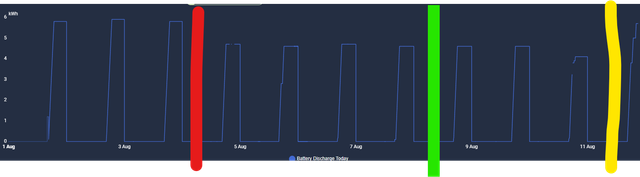
As you can see, there's an instant decrease in battery capacity of over 1kWh driven solely from Inverter FW changes only.
To drive the point home I even upped the battery to the very latest 3022 two days ago and still no change.

So it does look like I'm going to have to stick to slow FW for the rest of it's life.

R
#149 Rubikcube

hoggy Battery Discharge Today is just a value calculated by the firmware. It may be calculated differently by different firmware versions.

Did you check that less power was actually discharged? For example by checking that the discharge took less time (at presumably the same power).

#150 hoggy

@Rubikcube unfortunately it is correct.
I'm on IOF so it makes life real easy -
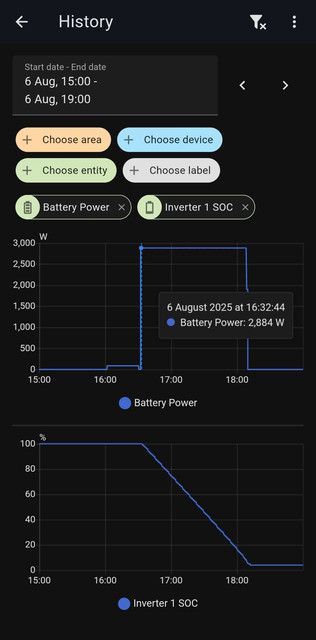
Discharge starts at 4pm for 30mins @85W (I don't know why flux does that but whatever)
4.30pm starts full discharge at 2884W
Battery is empty / 4% at 18:10pm.

On the old FW the battery does last as long as expected to produce 5.7kWh (its a slightly lower discharge rate but only runs out just before 7pm)

#151 hoggy

Of other note : night 1 (where I'd made the change to fast FW but the battery had previously been charged to 100% on the old FW produced the expected 5.7kWh.
After that was the immediate drop to 4.6kWh on subsequent charges no matter what the battery FW was.
I didn't think that the charge voltage or end voltages for the battery looked to be different, so this is a bit of a weird puzzle.
It is not lost on me that I have an 80% DOD battery, and the drop in capacity is 20% so whether this inverter FW is using the AH readings from the bms in some way, but not factoring in DOD correctly I've no idea. If I had a 9.5 instead I'd be intrigued as to whether I'd have this problem at all?

R
#153 Rubikcube

hoggy If the 190 FW discharged less, then presumably it charged less too and it's just calculating the battery capacity differently. Interesting result, and thank you for testing.

I will be sticking with the 450/451 FW on my Gen1, matched with 3017 on the battery. It seems to work acceptably.

#154 hoggy

So to round off, switching back to 449-449 FW (old fw) on the inverter but leaving battery on 3022 reverts discharge capacity back to 5.6kWh as before.
Rather odd but here we are. I've 90 cycles to go before I hit 2000 on this pack where I think I'll run another calibration.

Full timeline:
1: Switch Inverter from FW449 to FW191 with battery on 3020 - Red Line (Drop of 1kWh+ capacity)
2: Switch battery FW only to 3022 (inverter remains on FW191) - Green Line - No Change
3: Switch Inverter FW back to 449 - Yellow Line - Capacity instantly back to 5.6kWh.

R
#156 Rubikcube

hoggy Rather odd .....

Not at all, that's exactly how I would have done it, except I would have been more open and honest.

You will no doubt recall with the 400 series firmware the single major complaint was the "sudden drop to zero". Typically when the capacity got down to below 20% the BMS would alert that the battery was empty and suddenly the battery would be unexpectedly at 0%. Since the 190 series firmware the complaints have stopped, so clearly the problem has been fixed, but how?

In the words of a VW diesel engineer "To break the laws of physics you have to cheat".

The easiest way to fix the problem is to reduce the battery capacity by 20%. I always suspected they had done this, but I have never tried the 190 FW myself. I actually think it's a good solution, that should also have the benefit of extending the battery life. What is not so good, is that GE knew what had been done, but chose not to tell the customers (in the hope that nobody will notice?).

And then, like the diesel fiasco, somebody noticed.

#157 hoggy

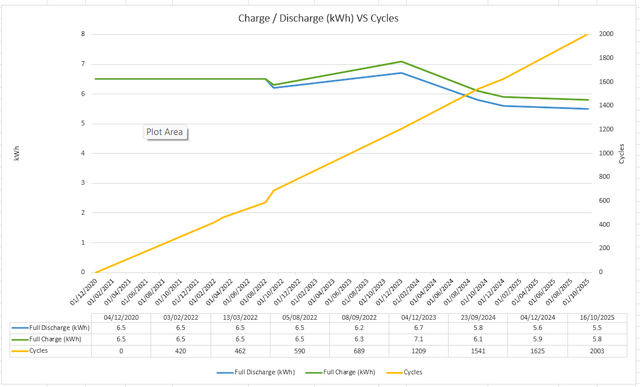
So, it seemed a fairly round milestone - 2000 cycles so here's the latest for October 2025:

Current Firmware 3022
Cycles: 2003
Throughput to date: 23MWh
Inverter Output to date: 38.6MWh

Full capacity run result:
Discharge - 5.6kWh
Charge - 5.8kWh

A
#158 Al E.Gator

Not strictly on the topic of degradation, but I got HA to calculate and create an entity to show what I'm actually getting out of my 38kWh of purchased battery storage and it made for quite depressing viewing. Looks like of the 38kWh, after degradation and losses discharging, and the 4% buffer at the bottom, I'm barely making it to 26kWh out of the batteries 🙁