Eco mode and what it actually DOES?

18 comments started 2023-03-31 last 2023-04-05
GivEnergy Products
A
#1 Adrian

Hi,
Just got my new solar and batteries. I really want to understand what Eco mode does and when it does it.

Is there any documentation (like a MANUAL - I like manuals) that explains Eco's "thought processes" anywhere? Especially, does Eco use information from the energy provider and adjust its workings based on that?

I'm not being lazy, I have looked - just not found anything much. I have found lots of post on here that sound authoritative about Eco but never any real detail.

#2 judgepd

Adrian Eco mode means:

  • If you have excess solar it will go to your battery (assuming it's not full).
  • If your house demand is higher than your solar generation the battery will discharge to cover the difference up to it's maximum discharge rate.

Essentially it tries to keep grid import and export as low as possible. Those are the only things it takes in to account, nothing to do with tariffs etc.

A
#4 Adrian

judgepd Okay, thanks. So its not a super duper clever thing then. Its just a function with "common sense".

Whatever does the system do when Eco is off? Nothing other than what you have said above makes any sense really. Does it just export excess generation rather than charging the battery and import if the house needs it rather than using the battery?

#5 judgepd

Yes, as far as I'm concerned 'Eco' is just the standard operation that you would expect.

If you have Eco off then you need to set discharge, charge and export timers instead, but Eco and timed charge can be both active at the same time to make use of a cheap overnight tariff.

T
#6 Tim

Adrian ECO mode minimises grid import and export, that's it. If there is no PV, house load is fed from battery. If there is PV, house load is fed from PV and battery. If there is surplus PV, house load is fed from PV and the battery starts to charge. If there is surplus PV and the battery is fully charged, the excess is exported to grid, up to your DNO limit (usually 3.68kW).

Don't switch ECO mode off unless you need to do something special. ECO mode works well with a timed charge. If the Charge to % is lower then the SoC at the start of the charge period, the house is supplied from battery (assuming no PV) until it gets down to the Charge to % when house load is supplied from grid and the battery/inverter sit quietly until the end of the charge period when ECO resumes. If the Charge to % is higher than SoC at the start of the timed charge period, house is supplied from grid and the battery is charged from grid until the Charge to % is reached. The battery and inverter then sit quietly while grid supplies the house until the end or the charge period.

Timed discharge and export don't work as most people might expect and enabling either will disable ECO and it isn't reinstated at the end of the timed discharge/export.

T
#7 TX200

Adrian check out the unofficial wiki too - should be a pinned thread on here, or search for it in the search feature.

A
#8 Adrian

Tim Many thanks Tim. Much obliged!

A
#9 Adrian

TX200 There's a wiki?? I shall find it! Thanks

#10 hoggy

It's not very good. As Jeff Goldblum says "life... err... finds a way" (to not let me have time to finish it)
Wiki.terravolt.co.uk

C
#11 Clive_Sherborne


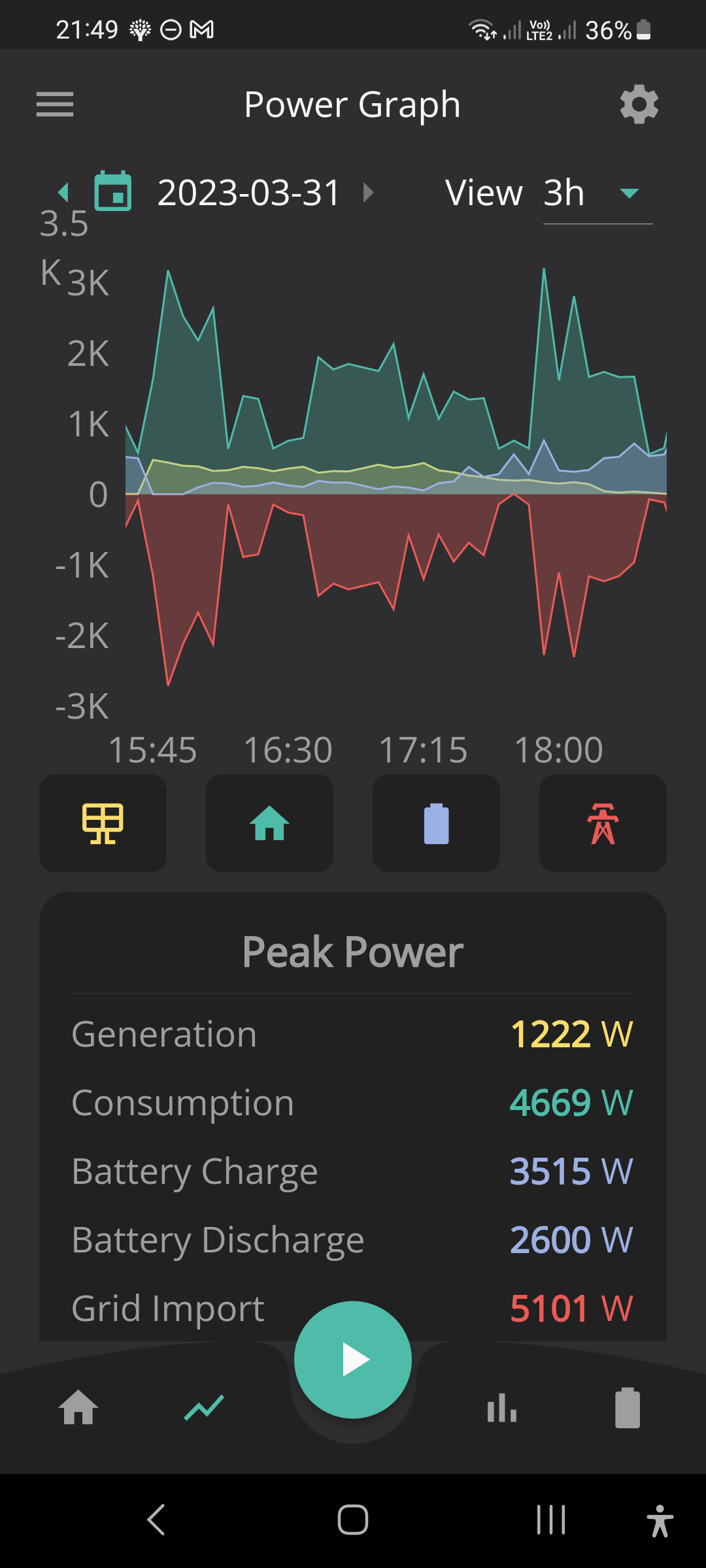
I find Eco mode is usually not very effective at keeping up with demand. Especially when I need it most, after 4pm, as this graph shows my import pretty much matches demand instead of the battery making much effort. How can I make it work better? Are there any hidden settings that GivEnergy support has access to?

S
#12 Steventon22

Hi Clive.
What battery do you have? Your picture show peak battery charge 3515W. My battery is a GivEnergy 9.5kwh, and the maximum charge is 2600W, as well as 2600W discharge max.

C
#13 Clive_Sherborne

Hi,
It's a 9.5 and I believe the maximum charge and discharge power is 3600W with the Gen2 Hybrid Inverter.
I have a suspicion as to why the battery is not keeping up with demand. Looking at the voltage, it does often go above 252V and I wonder if the inverter deliberately limits when that happens. Maybe I should report it to the DNO!

S
#14 Steventon22

Thanks for pointing this out. My inverter is gen 1 at 3.6kw, so I am stuck with 2.6kwh to and from battery. Not really a problem, I am just jealous!!!

#15 Maxwell

Had ours for almost a month and after falling into the timed discharge/export faff resorted to eco and all was looking good. Battery (9.5K) would keep the house going overnight (assuming it had had a good solar day before etc). And when you put the kettle on you could see it kick in and support that. But, over the last week or so i have started to notice that the battery won't kick in to support those higher demands. It now discharges at lower rates and the system imports from the grid to make up the shortfall, the battery has more than enough to fulfil the demand (or at least that what's the dashboards would sugest). Charge and discharge rates are set at 3600. Any ideas why this observed change in behaviour or what other settings i can check ?

C
#16 Clive_Sherborne

If my suspicion is correct, go to your Inverter, look at Inverter Data and check the Voltage. The regulation is 230 +10% = 252V and I wonder if the Inverter is programmed to avoid pushing it above that.

#17 Maxwell

Clive_Sherborne It's the other way. The voltage is down and has been as low as 230. If you look at the inverter voltage in the erarly days it was more swinging between 240 - 250. Now it is more 230 - 246, although for most of the time it is on the lower side of that range.

T
#18 Tim

Maxwell 230V is supposed to be the datum. It can be 10% higher or lower to be within spec. Most DNOs prefer to operate at the higher end as it results in lower current and therefore less loss due to heat. Anything down to 207v is still within spec but the DNO might be wanting to adjust the tapping on the distribution transformer if it’s continuously at one end or the other.