W
#1 wilfleek
I read that LifePO4 batteries should not be charged below 0C. But Givernergy say theirs are good for down to -20C.
How is that?

I read that LifePO4 batteries should not be charged below 0C. But Givernergy say theirs are good for down to -20C.
How is that?

Not sure where -20 is from. Mine won't.
As expected it won't charge below 0 but you can still pull from the pack at -10 (which I guess if you drag a high load you can pull the temp back up enough to charge it some more.)
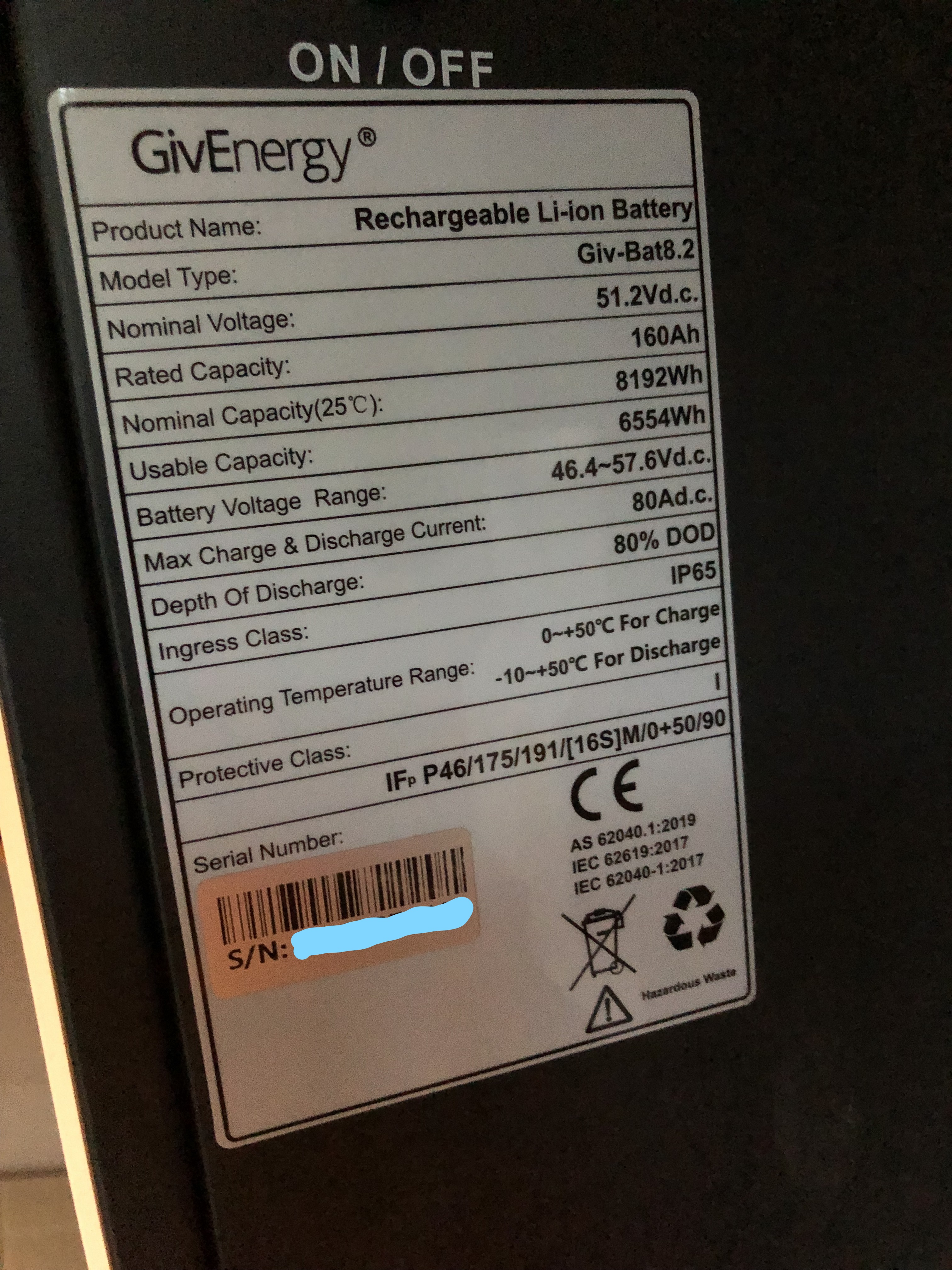
Think it was from an older data sheet I saw somewhere, although as you say, the current one on their main website does quote the figures you did, which makes more sense. Thanks.
I'm also guessing the temperature ranges are for the cells themselves as they have sensors fitted direct rather than general ambient temps of wherever its mounted.
The battery is not insulated as such but it is IP rated so its not got say cold breezes or anything blowing through it if fitted outside.
Wind chill doesn’t affect none organic objects as it’s the evaporation that makes us feel colder.
The 8.2 batt data sheet says operational to -10c and storage at to -30c. Not sure why it still works at this temp but my system is external on a north facing wall. Had a few -4 temps over the last few months but the battery has not really dropped below 7c.
it could be the fact that the battery produces enough heat itself to boost the base. My battery normally warms to 30 degrees when charging in a 15 degree garage over night (i also only pump 2kw into the battery so it may dissipate more is charging at 3kw)
The BMS should include some thermal management too.
Interesting factoid about windchill, one for the back of the head should it appear in a pub quiz.
What I was (probably poorly) trying to say was that if you ran two batteries side by side outdoors exactly the same but took the lid/cover off one, it wouldn't hold the temps in the cells like the 'sealed' one, so one would stop working before the other (if it got cold enough.)
Or is that not actually right?
Yes, its correct. If you opened the case, especially if both top and bottom were opened you'd then have convection currents taking the heat directly from the batteries, instead of from the outer case. Air is a good insulator, after all, so a closed case will retain more heat.
Wind chill actually would affect the temperature in some cases. If the outside of the battery was damp from rain, mist or dew then a passing breeze would cool it due to evaporation from the surface just as sweat cools our skin.
The Tesla M3 SR+ uses LiFePO4 battery chemistry. They have to have a wide operating envelope. As you imagine, these are sold worldwide including (especially) the Nordics. There's absolutely no question you can charge below 0C.
Its not really a solid comparison though. Tesla's have the ability to warm the battery pack up to the correct temperature before allowing a charge to happen. There is also a massive difference in physical mass, the Tesla battery would take a lot longer to cool to ambient than a GE battery.
Bjorn Nyland tested this and found that Supercharging was severely limited at low temperatures (bear in mind the ambient temperature was above freezing and the battery was significantly above freezing).
Zakalwe It's absolutely a solid comparison. The majority of charging is AC 7.2kW home charging, often when the battery is at ambient temperatures. DC Supercharging is a complete red herring.
You can't sell an EV in the Nordics and tell people is isn't chargeable at below 0C ambient. LOL, ridiculous.
Again, the Tesla has the ability to heat the battery.
Zakalwe Good lord, Mr. Chicken, meet Mr. Egg.
The red herring is you trying to compare a Tesla battery to the GE battery to maintain your position that LiFePo batteries can be charged at low temperatures even though the manufacturer of the GE batteries shows the charging temperatures as 0-50C.
The only similarity is that both uses a form of Lithium Iron Phosphate chemistry. The Tesla battery pack has an advanced thermal management system that can cool and heat the battery pack to the required temperature. The GE pack doesn't.
Crack on if you want to continue trying to make the comparison, but find someone else to debate it with as it is nonsensical position.