Limited output with optimisers

11 comments started 2023-04-20 last 2023-04-23
Commisioning
H
#1 Hugh

Sorry if this is the wrong place for this, but you guys seem to be incredibly helpful and knowledgeable. If there's a better forum then please let me know.

Have a 9.5kWh GE battery, and 16 panels each with SolarEdge optimisers and a SolarEdge inverter.

I've got 10 panels on the main house roof, facing SE. There is currently a scaffolding tent over the house so they aren't generating much. I've got 3 panels on SW facing roof of the garage, and 3 on NE facing roof. That's on the theory that any panel will generate some output. All panels are in a single string. Inverter is in the garage.

I've noticed that the SW facing panels on the garage are underperforming. Yesterday afternoon there was very bright sunlight at 4pm, virtually square on to the roof. However, the output of those 3 panels was low and they differed: 189W, 115W and 114W according to the SolarEdge playback (NE output was around 22W each). Total power was 680W.

However, earlier in the day at 1pm when there was sunshine on both sides of the garage roof, with the sun being at a rather acute angle on the NE facing side and also at quite an angle on the SW facing side, the SW power was 299W, 224W and 228W (NE power 156W, 145W and 121W). Peak total generation was 1752W on GE, 1450W on SE.

There was a good breeze and it was around 12 degrees so I don't think the panels are getting hot. Grid voltage was below 250V at all times. String 1 voltage was round 250V throughout, with current peaking at 7A.

I specified optimisers because I didn't want any effect from shadowed panels, but it does appear that something is going on here. The string is rather long as it goes around the main roof then the garage.

Any ideas?
#2 THALL

NE panels will never do very well and will always be a lot lower output due the angle the sun hits them. There some solar calculators available via a google search where you can plug your details in, location, pv size and angle to see suggested generation. If you treat the NE as a separate array you will see it is a lot lower.

Example energysavingstrust site. 2kw pv NE facing in my location estimate 1079kwh per year vs 1436kwh sw. Over 30% less. Id say those wattage numbers are correct given the direction of the panels.

H
#3 Hugh

Thanks. The problem is that despite using SolarEdge optimisers on every panel, the SW panels appear to have reduced output if the NE panels are shaded.

Compare the total power output for the SW panels: at 4pm, in full, perpendicular sunshine, it was 418W for three new and clean panels (and the levels differed even though all panels were unshadowed). At 1pm, with bright sunshine at 45 degrees to the panels, it was 751W.

The only difference I can see is that at 1pm, the NE panels have some sunshine (though it's very acute) but at 4pm, they are in shadow.

Does this indicate broken optimisers? They all report separate power levels in the SolarEdge monitoring site so appear to be working.

I took a look at https://knowledge-center.solaredge.com/sites/kc/files/se_application_fixed_string_voltage.pdf. I wonder whether optimisers will work with only 3 panels out of 16 illuminated strongly. Perhaps they can't get to right voltage level for the string?

Regarding having NE panels: I took the view that any power generation was a win, even if reduced. I've seen on cloudy days that the NE panels generate about the same as the SW panels so that helps. Adding three more panels was a small increment in the overall installation cost.

H
#4 Hugh

Found an article at https://www.cleanenergyreviews.info/blog/solaredge-inverter-optimiser-review which explains that a small system with excessive shading will suffer as the system voltage will drop. Seems like I've been caught by this.

When the scaffolding tent is removed the performance should be a lot better. The 10 panels on the main roof will have some illumination when the SW garage roof has full illumination so the voltage should be OK.

However, I'll need to do some more reading and see if I've been mis-sold the system. Obviously better to rectify while I have the scaffolding in place!

S
#5 SilverArt

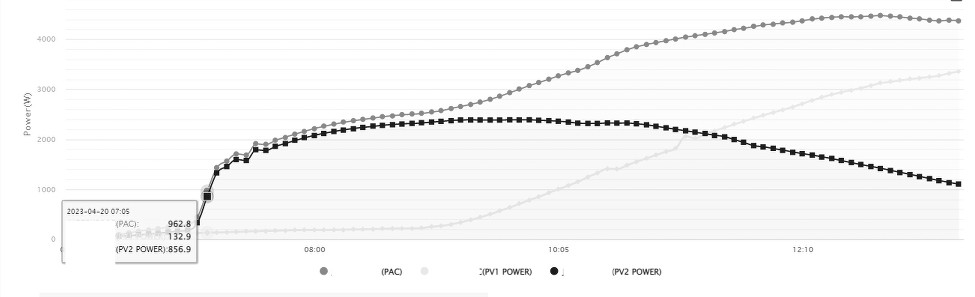
From your description your EW panels sit fairly close to mine and this is what I saw this morning which was quite clear.

This is a 10/10 split of 395w panels, there is a bit of early morning shading so they really kicked in at 07:00, the crossover point was at 11:20. It also shows the EW difference due to the sun's distance etc. I guess you should expect to see 30% of these numbers.

Sorry the PV1 (West String) is feint but the graph is from a non GE inverter.

H
#6 Hugh

Thanks SilverArt - that looks more like what I would expect with a split system.

In my case I'm certain now that it's due to having so few panels in full sunshine, out of the total set. Yesterday afternoon was bright, Australian-like (I'm from Oz but live in the UK) sunshine and there must have been a big difference between the panels.

This afternoon. there is some high-level white cloud as well as good sunshine and I'm seeing much better performance at 3pm - around 1400W vs 700W yesterday. So there must be enough extra generation on some panels to tip the system over into more efficient performance.

This is not what I was expecting from optimisers 😦 . It will certainly improve when the main roof is clear, but I was hoping for reasonable performance on long summer evenings. Maybe I could set up a mirror...

H
#7 Hugh

And an article that confirms that it's due to having just 3 panels in full sunshine: https://www.mcelectrical.com.au/solaredge-inverter-optimiser-review/.

SolarEdge optimisers is a product we were recommending for shaded situations. However, if we have a string with 6 or fewer panels in the sun, the system will suffer voltage blocking at best, or it will just shut down at worst.

They have a more detailed analysis that explains this, with shaded panels reducing output from illuminated panels.

One anomaly I can't explain: the String 1 voltage graph available in the GE dashboard shows the voltage at around 240V but the spec for the SE4000H is for 380V, also mentioned in the article above. Is that a setting?

If the performance doesn't improve when the scaffolding is off, then it might be possible to convert to use a shorter string of 10 on the main roof, all in the same orientation, with the SE optimisers and existing SE inverter; and change the 6 panels (3 on each side) on the garage to use microinverters. There is much easier access to those so wiring and modules can be changed.

Anyone have experience of microinverters vs SE optimisers?

D
#8 dragon2905

Hugh

I wasn't aware you could pair GE batteries with non GE Inverters?

I thought this video was gold.
https://www.youtube.com/watch?v=UQ9Szhl1ceQ&list=PLIoo_sp21F92tkxEDSRJH9SF3AyGpelwv&index=28&t=1s

From what I have seen SE Optimisers are generally over sold by specifiers/installers and often used in the wrong circumstances. They also like them as they limit the voltage to 1 Volt until they are connected into the system so less risk to the installer. However this shouldn't really be a consideration unless they don't know what they're doing.....

They add cost, complexity and higher potential maintenance cost down the line.

#10 hoggy

Hugh your AC coupled yes? In which case the PV voltage you see in the GE inverter portal is just the grid voltage. As it only has the CT to measure output from your other PV inverter it has no way of knowing what voltage your panels are - hence just uses AC line voltage.

H
#11 Hugh

hoggy

Yes, good call. The setup is AC-coupled. I had put grid voltage on the graph along with String 1 voltage, and they followed each other very closely which was suspicious - now confirmed, thanks.

It is getting a reading of PV power from somewhere as I can see that on the graph, and is calculating or deriving String 1 current based on that perhaps.

So it's likely that the string is 380V.

I have S500 optimisers installed. https://knowledge-center.solaredge.com/sites/kc/files/se-power-optimizer-s-series-datasheet-aus.pdf says they are 60V max, but the S500B will go up to 80V.

So, if I have 3 panels on the SW roof of the garage trying to push out 300W each, at 60V max, that is 5A. But that will get to 180V, and it will need another 200V from 13 other panels. That's 15.4V each, or 77W each. So my panels on the SW side of the garage will only work at their peak when the other panels have at least some sunshine, so not in the late afternoon.

If I use the S500Bs which can go to 80V, the current would be 3.75A (at 300W). That gets to 240V, and it needs another 140V from 13 other panels - or 10.8V each. That is around 40W each, which is a lot better. Might be an option; unfortunately though S500 and S500B cannot be mixed in a single string: https://knowledge-center.solaredge.com/sites/kc/files/application_note_intercompatibility_se_power_optimizers.pdf

I've started a dialog with the installer.