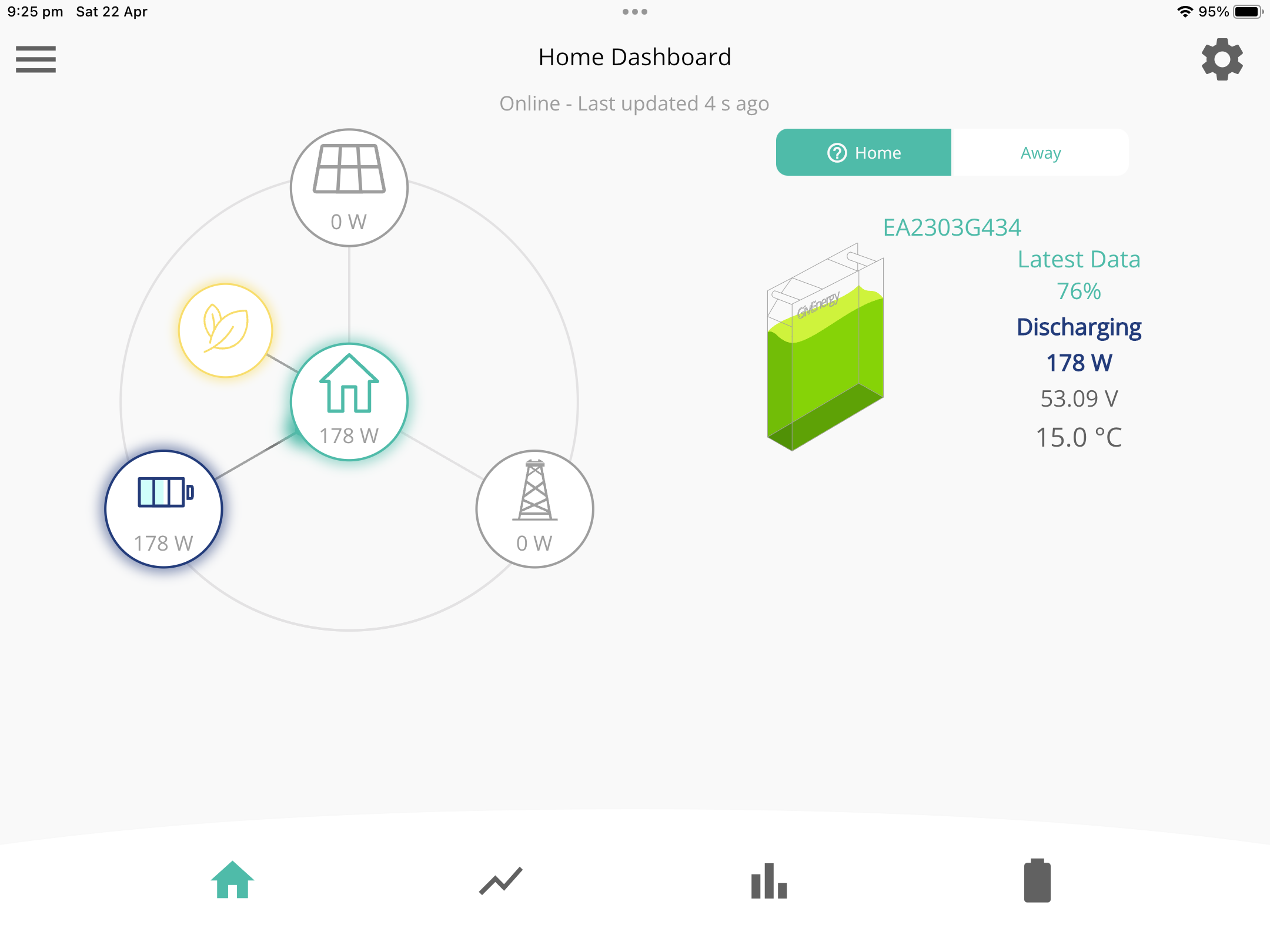
Is 386 watts the minimum discharge amount from the battery?

13 comments started 2023-04-21 last 2023-04-23
GivEnergy ProductsBattery
#1 FiferMG4

Hello fellow forum members, This is my first post after just having had a solar pv and battery storage system installed on Wednesday and I’m still coming to grips with the software of the GivEnergy app and cloud.

I have set my Giv-Bat 9.5 to discharge at 286 watts, but the lowest it seems to discharge at is 386 watts. I was wondering if this is typical for the system. I know it’s only 100 watts difference, but over ten hours at night that is a kWh of energy.

S
#2 SilverArt

It might help if you said exactly what you've had installed and what you are trying to achieve.. Why do you want to discharge, especially at such a low rate?

#3 hoggy

If your on Gen 2 it’s a (another) known issue where they don’t seem to want to go below about 4 notches (95W per step)
You can force a stop by setting reserve level above current SOC% but it’s not ideal.

#4 FiferMG4

SilverArt
Thank you for your reply. At night my house uses an average of 150200 watts of electricity, so as the battery is discharging 380 watts, at least 180 watts is going to the grid. The battery is great at saving money, but it’s just a shame I can’t lower it to around 200 watts for night time use. My house is very efficient and it’s basically the fridge/freezer and extractor fans that are working. I have the GivEnergy 3.6 kWh inverter, 9.5kWh GivEnergy battery and a 6.4kWh 15 solar panel system.

I think I just don’t want British Gas getting my excess for nothing. I’ll have to switch to Octopus when my current tariff expires. 😅

#5 FiferMG4

hoggy Thanks for letting me know Hoggy. It’s a first world problem and as I said to Silverart, when I’m with Octopus, it won’t be an issue. Speaking of which, I don’t suppose you can recommend an Octopus tariff. It’s quite perplexing the variety they have - Go, Agile, Go Faster, etc. I have an electric car, so that will affect my choice of tariff too. I want to maximize off grid use and get as much export payments as possible.

4
#6 4monks

FiferMG4 Are you correctly running in ECO mode? If so, you shouldn't need to set the output at all i.e you should be able to leave battery output at max and let the inverter to control the output avoiding the bug mentioned. That bug would typically happen when someone is trying to limit battery output for some reason and force PV + grid use when the house demand is > the export limit imposed on the battery, for some reason. In your case, it sounds like the opposite is true.

In ECO mode, the battery output should match the house demand fairly closely (overnight I do see my house demand go down to 160w and the battery output matches this).
You need to ensure
1) ECO is on
2) timed charge is on with an appropriate target SOC - assuming you have a suitable overnight tariff and
3) timed discharge and time export are both off for this to work correctly.

Other automations, such as GivTCP or Tariff automations, might be causing issues.

I run Intelligent Octopus (IO) with an EV, 5.5kW. on the roof and 2x9.5 batteries and that works great for me. Flux will be fairly decent over the summer. IO requires a bit more effort to make use of excess PV. Zappi's ECO+ mode (and similar for other brands of charger) is a must to harvest excess PV to the car.

Hope that helps.

S
#7 SilverArt

FiferMG4 It's easy to do... you are over thinking it. All you should need at present is ECO mode. To get there:
DO NOT rush this and check that you get a positive acknowledgement when you click "SUBMIT", if you do not, try again:
Go to "My Inverter" > "SETTINGS" - Go down to "RESET TO DEFAULTS" > Click "SUBMIT"
After the positive acknowledgement: Check result, just click each 'Title in turn,
Click on ECO - It should show "Enabled"
Click on "TIMED DISCHARGE" - It should say "Disabled
Click on "TIMED EXPORT" - It should also say "Disabled"
"BATTERY OPTIONS" - Will be approx Reserve 5-6% and the Charge & Discharge Power sliders should be at the right. If any different lets us know before you touch anything.
4monks Description is what you should end up with. Octopus... I'll leave the overs to comment on as I won't get that far until November.

#8 FiferMG4

4monks I thought I had it set to eco mode, but I’ve just gone onto the givenergy.cloud and resubmitted eco mode and then restarted my app and now the discharge of the battery is matching the house consumption. Thanks guys for your help! It seems to be matching the house pretty closely now.

#9 FiferMG4

SilverArt I see what you mean now SilverArt. With the battery properly running in eco mode it’s doing the charging and discharging automatically, whereas I was doing it manually, not knowing that it hadn’t been set in eco mode. Doh! 😅

Edited to say, it’s now fun to watch the battery/solar system do its thing and I can just sit back and relax. I wonder now what would be the point of having timed charges and discharges?

D
#10 DD

FiferMG4 I don’t suppose you can recommend an Octopus tariff. It’s quite perplexing the variety they have - Go, Agile, Go Faster, etc. I have an electric car, so that will affect my choice of tariff too. I want to maximize off grid use and get as much export payments as possible.

Factors to consider:

  • what sort of mileage do you do in the car ?
  • is car / charger compatible with Intelligent Octopus (Ohme charger, or a few specific cars)
  • is car typically at home during the day (so can charge from solar), or away ?

In the winter, when PV is mostly a bonus, you probably want Intelligent if you qualify, else Go, for the cheap import at night. You don't get much for export, but you probably won't have much excess anyway.

Agile hasn't been terribly attractive recently, but is starting to look a bit more interesting.

#11 FiferMG4

DD Thank you DD! You’ve given me much food for thought. I only had the system commissioned on Thursday, but I’ve already exported 83kWh and that’s all excess as the car, battery and all appliances have been run off the solar and battery charged by solar. This is great and the icing on the cake would be to be paid even a little for the export.

D
#12 DD

FiferMG4 If it's any help, I don't use EV much - in summer, PV generation should cover all my use, including car. My current plan is for Flux in the summer, filling car overnight, and then exporting everything I generate - earn more by exporting than it costs to import.

#13 FiferMG4

DD You know I’d never considered making more in the way you describe, but it makes financial sense and means the payback period for the system would be even shorter.