Voltage - what is normal? More accurate guide to SOC?

10 comments started 2023-05-03 last 2023-05-06
GivEnergy ProductsBattery
T
#1 Tim Adams

I have 3 x 8.2kw batteries and recently had the much discussed issue of batteries displaying significantly different charge levels (SOC) in aggregate and individually.

Knowledgeable & helpful Givenergy engineer visit today as pre-arranged. He was sent based on the log data as they thought there might be a faulty cell in one battery. Partly based on the voltage data that he said gave more reliable information than SOC. Sounded feasible?

However when stripping down offending battery discovered several connections were not tight by 2 or 3 full turns. Obviously not good! Cleaned up and remade connections. Checked other batteries (which were fine). Started a calibration.

I will monitor in coming days. His view was that the firmware update may not make a difference in this particular instance but will of course apply it once released.

I guess others with similar issue may consider its worth reviewing data for voltage as well as SOC in case there is anything to glean. I would've thought the loose connection issue is rare but perhaps not a one off? In my case I'm not sure what the voltage differences were or what range is considered "normal"?

If I understand correctly the normal voltage should be 51.2VDC - from the Features information in datasheet.

But will I be right to think it will be higher at peak charge and less at full discharge? As mentioned I don't know what range should be considered normal? I will be grateful for guidance so I can monitor in a meaningful way.

D
#2 dunklezhan

takes deep breath, shoves bitterness to one side for later

Yes it would be super to know what the voltage should be varying between so we can spot the problem brewing.

T
#3 Tim

Tim Adams The Beta Testing post has lots of examples where people are monitoring voltages and that could be a place for this information. There's a battery capacity explained page on the Givenergy KB. It'd be handy if the Battery % axis also had voltages on to indicate their operating range. I don't know if Paul @TheDragon (GivEnergy) could ask for this to be done?

That aside, loose connections wouldn't prevent the battery cell from charging and discharging, just create wasted heat energy and the cell voltage (at rest) would read right for the SoC. Charging and discharging would likely lag behind other cells in parallel but I'm not sure if this would be seen as an outlying voltage during operation. If you had access to cell voltages from your battery before the repair was made, it'd be interesting to know.

T
#4 Tim Adams

Tim I have access to the app and web https://givenergy.cloud/dashboard
looking at the battery info its not obvious to me that there have been any big discrepancies. But without knowing what is normal it is hard to interpret!

T
#5 Tim Adams

Tim talking to an electrician friend he suggested that the loose connections could cause false readings due to the resistance - perhaps same as your understanding?

is SOC in fact more correctly/accurately based on Ohm's law? Not "just" voltage.
i.e. a law in electricity that states that the current in a circuit is equal to the potential difference divided by the resistance of the circuit. ( from wikipedia!).

T
#7 ToothyChris

Hi Tim Adams

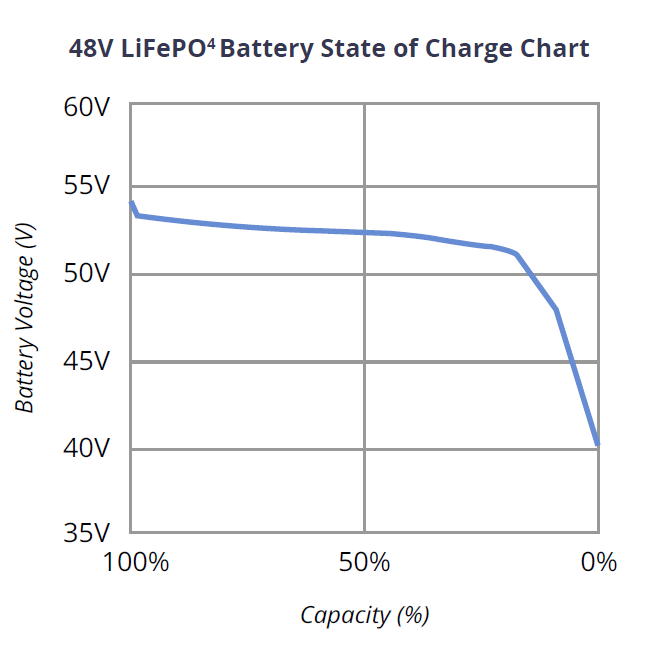
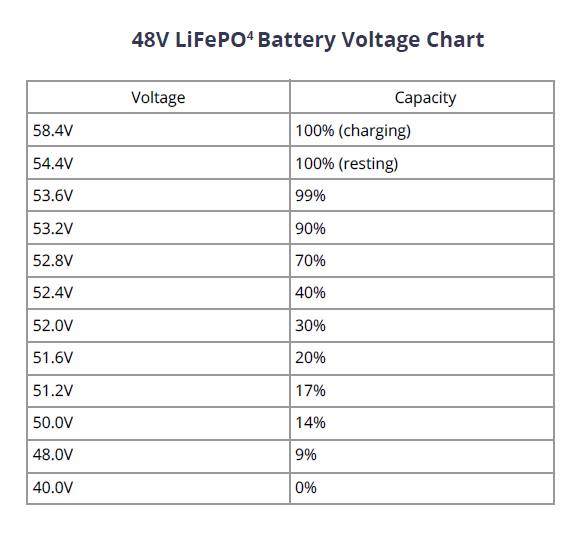
Here is a table which GE included in a statement issued on the 7th November 2022. This should give you a much better understanding of the voltages to expect. But be aware, that this is not as simple as it seems.

These voltages (apart from the very top one) are the voltages you would expect when there is no load on the battery (which reduces the voltage) or no charge going into the battery (which increases the voltage). Once a load or charge has finished, it also takes a little while for the battery voltage to settle. In addition, the temperature of the battery affects the voltage, as does the age/condition of the battery.

Also, remember that the percentages we see in the App/Portal are not the same as what is shown on this table. Our 0-100% is actually the same at 15-95% in this table - to give some safety margin at the top and bottom.

Having said that, the voltage can be a useful guide to what is going on. For instance, I noticed that my battery was showing an SOC of 80% this morning (with almost no load), but the voltage was showing as a rather low 51.3V. This suggested to me that the displayed SOC was far too high. As suspected after discharging a bit, the battery did indeed crash (because the voltage hit the low alarm at c.45V), at which point the system realised the battery was actually empty, and needed a recovery charge to bring it back up to the 4% minimum.

(Regarding your battery connection issues, it all depends on how well they were making contact. If they were making reasonable contact, they would still have allowed a good current to flow, with just a small voltage drop across the connection. This may have tricked the system into thinking that the battery was charged, when it was not completely charged.

But if it was quite bad, the current would have been significantly limited, and the voltage drop would have been quite high - so they may never have taken a full charge. However, because the batteries are not simply wired in series (I think hoggy has done some work on the exact cell configurations), these effects may have been masked by the other packs of well-connected cells).

T
#8 Tim Adams

ToothyChris really interesting... and helpful. Thanks!

I have run the firmware update today with great support by @TheDragon (GivEnergy)
hopefully the firmware update together with the tight connections will resolve the issues. I will monitor over coming days

T
#9 ToothyChris

And here is a graph from the same document - since pictures usually convey these things much better. This very nicely shows just how small the voltage range is, between the 15% and 95% limits that we operate within.

#10 hoggy

ToothyChris yes I did.
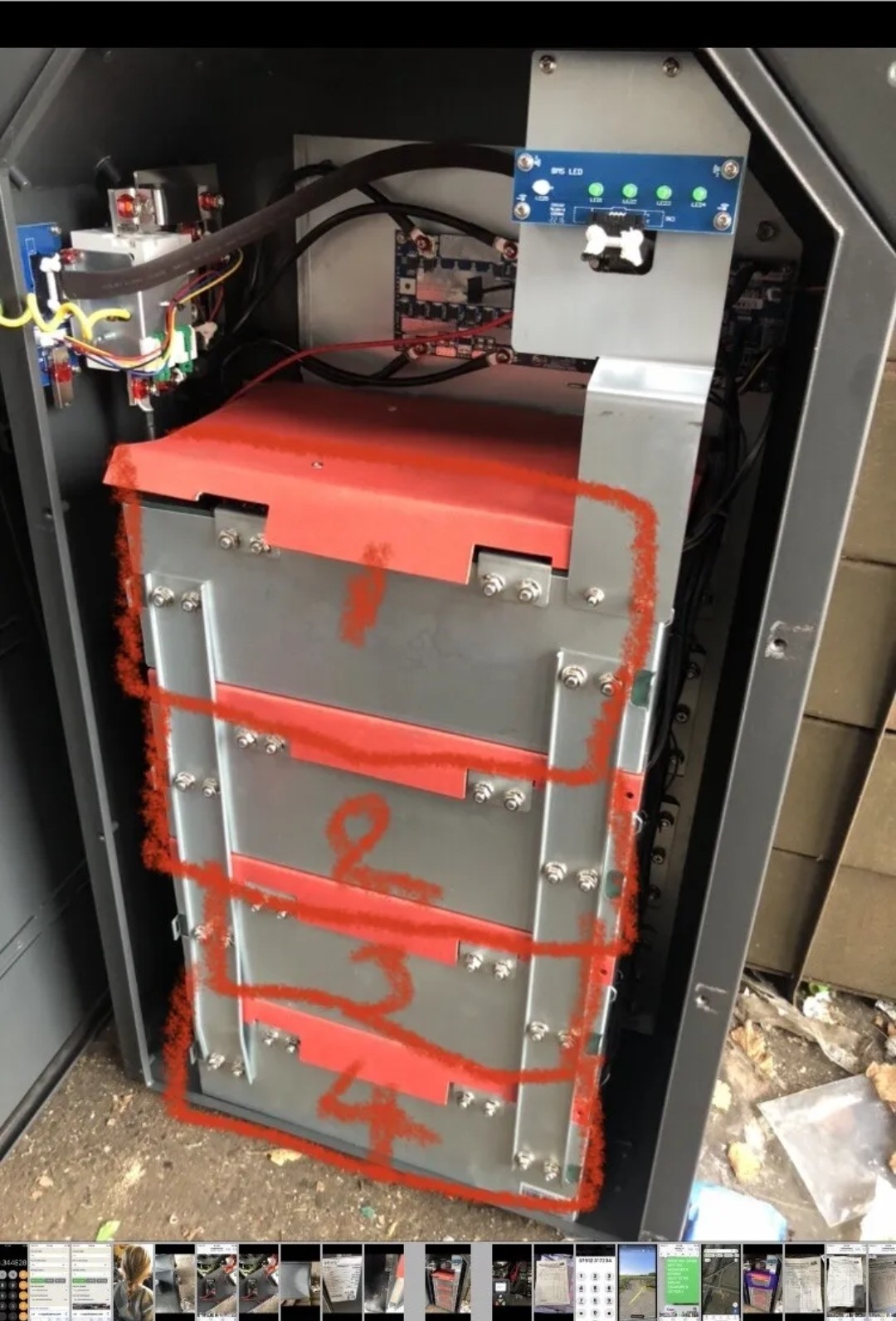
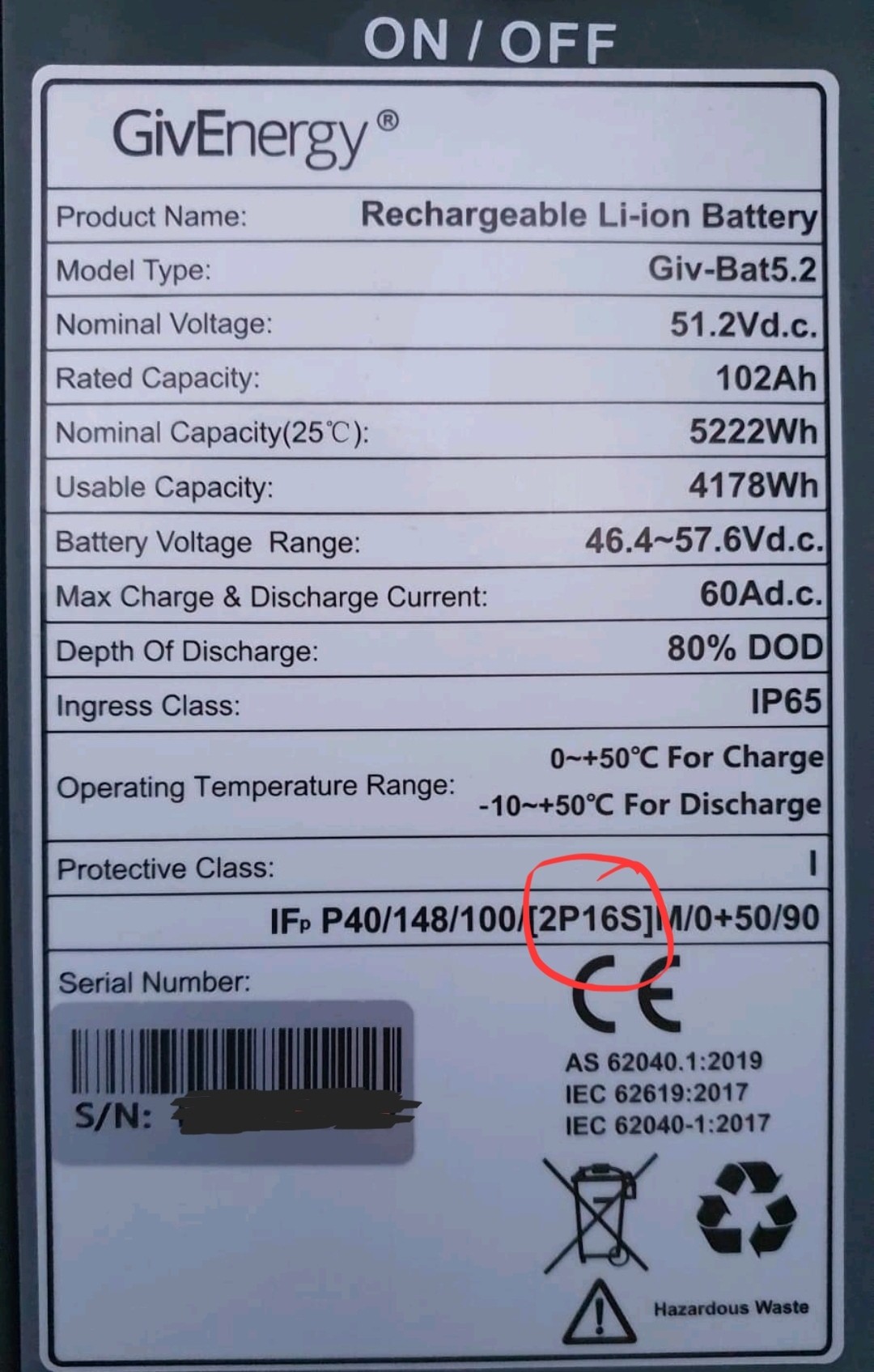
There's batteries with 16cells (as you'd expect - 16x3.2V = 51.2V) but most now seem to be 32cells wired in pairs (seen 5.2s, 8.2s and 9.5s like that)
Voltage is the same as they are just using smaller cells in pairs to get to the AH value they need.
Basically if your pack says 2P16S on the sticker on the side its a 32cell one. As far as I know all 9.5s are 32 cell aswell (although I can't quite work out the actual cell values inside as the full capacity ends up being 232.5AH based on 80% DOD - of which no one makes a .5 cell)
Ontop of that it appears that different cell manufacturers have gone into packs along the way, Anchi and Penghui are two of them, I'm sure GE made a big thing about making their own at one point, so that makes 3. I'm about 75% sure Gotion are in some based on the cell values (51AH and 102AH are odd values to come across and they make those) not sure how many more there are, I have 5+ in my head for some reason but forget why.
I have no idea who's mine are as I can't get to the QR code on them.
All will have slightly different characteristics hence why this has been such a headache.

I'll write something up eventually should anyone care enough about this kind of thing.
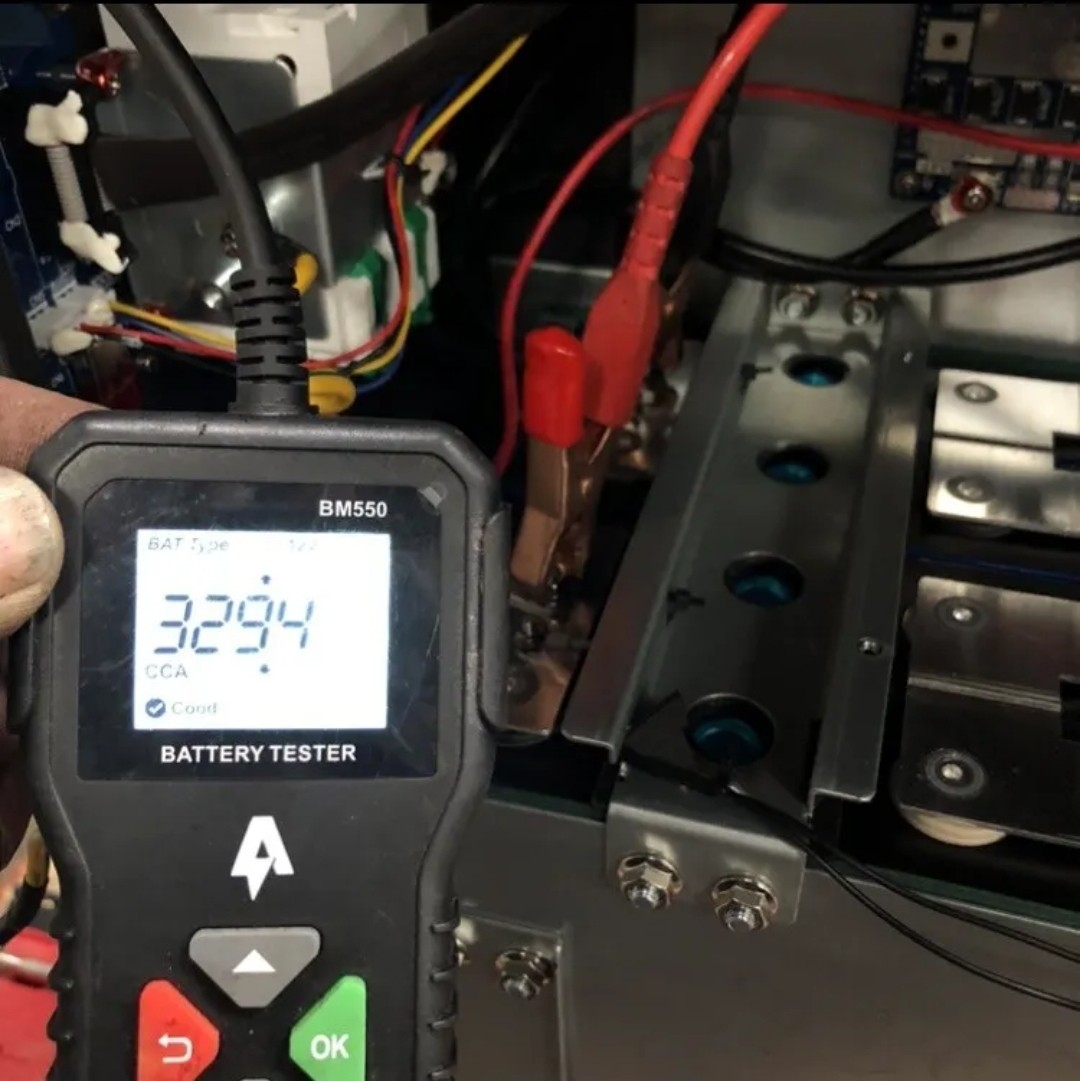
Anyway, some somewhat pointless pics from inside a 9.5 someone parted out in cell packs (4 lots of 8 cells) via eBay. I really wanted to get my hands on the BMS but it wasn't to be.