New to solar - set up options

13 comments started 2023-05-11 last 2023-05-13
GivEnergy Products
A
#1 anna

Hi,
New to solar, new to the forum!

After several weeks of reading and multiple quotes we are set on Givenergy inverter + battery.
Now, we have wildly different quotes (about 8) for wildly different systems - 3.6/5/2x3.6 hybrid inverter with battery sizes 5.2/ 8.2/9.5/10.4

We can fit a 7.5kW (18 panels) array on our (due) south facing roof - no shading, South England.
All electric property, family with 2 kids - electric UFH and immersion hot water tank. No EV. 6500kW annual usage.

Thought we would go with the 5kW inverter as there is nothing bigger but then one installer advised to have 2x3.6kW inverters.....which I thought might be interesting. If we opt for 2x3.6 inverters, would it be better to have a single or 2 batteries?

We were quoted £17k for a 7.5kW system (18 panels), 2x 3.6 hybrid inverter, 9.5kW battery, Eddi + bird proofing + complete install - is that reasonable? Thought was quiet hefty and more than we would like to spend.

I understand from GivEnergy that dual hybrid inverters are currently not supported but that that might change in the future and lots of people are running this system successfully.

Grateful for any advise/experiences!!


D
#2 Dougm11

A few thoughts- I’m sure others will pick up other aspects.
1) Aside from the technical aspects of two hybrid inverters together, you might be limited by your DNO as to the size of your inverter when you make your G99 application. They might be happy to approve a 5kW but not happy with a combined 7.2kW.
2) If you went down the 5kW inverter route with 7.4kW of panels then for much of the year you wouldn’t see much clipping. In summer though, you can minimise the effect of clipping by making sure you have spare capacity in your battery when it’s forecast to be very sunny which can soak up the excess.
3) I’ve seen some interesting discussions about Eddi recently- some say you would get a much quicker return by fitting a wifi switch to your existing immersion heater.
4) That quote does seem a bit steep. Were all the others in a similar ball park? Just had my install with 12 panels rather than 18, 3.6kW Gen 2 and 9.5kW battery (no Eddi) but came in at £9800. I am in the NW though.
FYI if you haven’t found it already, the MSE Green & Ethical MoneySaving Forum is another great hub for all things renewable.

A
#3 anna

Dougm11

Thanks for getting back to me, much appreciated.

1) yes, I am aware of the potential limitations
2) that makes sense, we should be able to fully charge a sizeable battery on sunny days I guess.
3) yes, this is on my radar…might not be worth the expense. It is currently on a timer…might leave it that way for now or go for the WiFi plug. Asked everyone to quote with the Eddi so it is easier to compare quotes.
4) yes, most are £14-17k (18 panels/Eddi/birth proofing but variable battery size). If I add 6 panels + Eddi to your quote that would pan out approx £11.5k….so yes, seems expensive!

N
#4 netty

Hi Anna
There are some hugely knowledgeable/ massively clever people on here (and I'm not one of them) but thought I'd chip in for what it's worth ...
We had a 5kw hybrid converter and a 5kwh battery and 14x410w panels installed in February. It was a ground-mounted system (the panels fitted on consul tubs) so we didn't have scaffolding to pay for and my husband laid the ground works (weed-proof matting, edged with wood, covered with tons of small stones) himself. The total came in under 10k.
Bearing in mind we haven't gone through a winter with it (although the lack of sunshine makes it feel like winter tbh) and when winter does come, we have oil-fired central heating plus wood-burners, I do now wish that we'd gone for a larger battery.
We are mostly out during the day but find that we use up the battery capacity between 4-7pm and then have to run off the grid in the later evening (two kids at home most of the time). So I do wish we had gone for a bigger battery.
We are going to simply get a timer put on our immersion heater so we can completely turn off the oil for half the year.
We are on Octopus Flux but still waiting for our export MPAN to be sorted out.
I put the dishwasher, washing machine and dryer on consecutively (on timers if I'm not here) through the day and have a little infra-red heater for the evenings. Because I'm not being paid for exporting yet (although I hope to see some compensation), this is how I maximise my own electricity production at the moment.
No electric vehicle (yet). Oh, and I've just bought a little 600w kettle to minimise pulling power from the grid.
I've learnt a lot from following the discussions on here. People are very helpful.
Good luck with it all.

H
#5 Hilditchhouse

Hi, the answer is- it's never enough.
I'm all electric with wood burner for primary heating, no wet system of radiators or boiler in the house, thermal store hot water tank on an eddi and immersion heater, electric thermostat controlled wall panel heaters and an oil aga for cooking and hot water, which is off in the summer. I have 3 x 8.2 kWh (24.6 kWh total) batteries and 35 x PV panels( South and East facing) giving 13kW peak, installed in 2020 so benefitted from cheaper installation and purchase costs rather than the immense price hikes experienced now. More battery is always worth the investment.
Went from import of 8209 kWh in 2019 to 3265 kWh in 2022, so thats where the real benefit comes from. The capital cost is like a seconhand car on your roof, so once its spent its spent. Its the running costs that make the difference. No one ever asks whats the pay back time for the cost of your new kitchen or your last big holiday, the payback is the smug smile ( that I have) that you aren't importing as much as before and that you are generating your own electricity, and with simple care and thought management , you can keep your import down. Its things like changing your kettle, down from 3 kW to less, so it takes seconds longer but you draw down less from the grid over the peak discharge of your battery. Use appliances on thier economy setting, operating during the day or when your import is on cheap rate, run time is longer, outcome is the same though.
I cannot advocate enough, joining the Solar PV gang. Warning though, Its addictive and you watch every app and gizmo and count every penny into the purse that you make exporting to the grid, to save up for the winter when you inevitably have to import. It is very satisfying.
One last thing, I highly recommend my installer NPES Solar 01902 248684 based in Wolverhampton excellent team, excellent after care, totally professional.
Good luck with your install

S
#6 SteveCook

anna
Hi
Price seems high.
We have just had 14 panels on the roof (6 east facing, 8 west facing), so 2 lots of scaffold and 2 lots of peeling york stone tiles off in order to get fixings in.
Hybrid 5kW Gen1 and 9.5kWhr battery.
All up £12k in Skipton area.
I then asked about additional 9.5kWhr battery to be added and was quoted £3,500

I got the quote just before Putin invaded and everything was finished in Oct (6 months to get battery and inverter), but I think now as energy prices have risen, so installers get busier and prices rise very quickly

#7 THALL

My recent installs are as follows, just to give a compare of prices

6x 425w panels, 2.5kw solis inverter, all linked back to my AC3 and batteries. £3250

Last October I had 11x 400w panels, 8kw inverter, 9.5kw battery. Connected back to my AC3. £7250. Included all wiring. Removing an older 2.5kw solis, and linking the orignal 8x 295w panels to string 1 and the 11 new 400's to string 2.

But to break your quote down. Lets go new so Gen 3 inverter with 9.5kw battery, £5800, 18 panels £2700, Eddi £429. Mounting kit and bird proofing say £700 top end? Scaffold £1000. Roofer and 2 sparkies 2 days £1800. £1000 for other wiring parts. Admin costs. I think that system should be £14 - 15k? Unless the cable runs are really complicated meaning more time, more parts etc. Then heading towards 16k max. So yeah 17k feels a tad high. I would be pushing for the 15k mark.

S
#8 SimonClarke

8 east, 8 west 405w panels, 5kw gen 1 , 9.5kw battery, manual eps, bird mesh, iboost all fitted just under 14k start of April. Ordered in March. Haven’t had to charge from the grid yet although today is pushing it! Car kept separate so just charges on Octopus Intelligent. Been exporting more than we expected. We haven’t changed anything except using things during the day rather than cheap rate at night. Used to be 3600 a year for the house (3 bed bungalow oil heating) so I guess the winter will tell…. Actually used the eps this week- had a cut for the whole 5 minutes but it worked. Seem to use a background of 400w from the grid every day. I haven’t changed anything from day one except the iBoost.

D
#9 dragon2905

anna

You need to look at what your peak load is if possible.

So the worst case when you have a tonne of things turned on. Lets say for argument its 7kw (which is probably not a million miles out for an all electric household, although yours sounds above average in size with the Peak PV you can install).

There are 2 different limitations of the equipment you will want consider.

How much AC can be provided at any one time by your setup.

The data sheets talk about Nominal AC Output Power

Hybrid 3.6kw Gen 2/Gen 3 both state 3.6kw and the Hybrid 5kw Gen 2/Gen 3 state 5kw.

So no single GE inverter can provide you enough energy at your peak requirement but a combination of 2 might do so. 2 x 3.6 perhaps only just and 2 x 5 probably more than enough.

However unless things have changed recently there are problems with running 2 hybrid inverters as they are not playing well together. There is a magic box due to arrive at some point that fixes this but it has been "coming soon" for some time now.

As to the G99 (or maybe its G100 now...?) you can easily side step DNO approval issues but EXPORT LIMITING your system to below 3.68kw. So what would happen is that if you were generating lets say 10kw from your panels and your battery(s) were full then the system would modulate the export down from 10kw to only send 3.68kw back to the grid.
Anything above 3.68kw export on your system requires the YES from your DNO.

EDDI vs WiFi Switch. You absolutely will not see a Return on Investment any time soon buying an EDDI. I think its something like 20 years.... You might not even need to as you have a Direct Electric Hot Water Cylinder (from what you say). Where an Eddi does come in versus using your system as normal or using, an pretty inconvenient to use WiFi switch (like a TimeGuard) is that it will automatically (no user intervention required) divert energy to your cylinder when you are producing excess electricity.

Pricing. I have seem slightly smaller systems but with slightly larger batteries towards £30k in Cambridgeshire

Here's an example using Midsummer Wholesale Prices

GivEnergy GEN3 3.6kW Hybrid £1748.50
GivEnergy 9.5kWh Battery £3885.70
Trina Vertex S 425W Black Framed Mono x 18 £2457
Eddi £400
Sub Total = £10239.70
Scaffolding, Rails, Bird Screen, Ancillary Equipment, Fitting = £6760.30

Increase to go up to Gen 3 5kw Hybrid = £130!!!!
GivEnergy GEN3 5kW Hybrid £1813.50
GivEnergy 9.5kWh Battery £3885.70

DECREASE to go to Gen 2 5kw Hybrid = £639.60!!!!
GivEnergy [GEN2] 5kW Hybrid £1428.70

Those are retail prices but excluding VAT as there is NO VAT payable on Solar PV installs (which includes batteries if installed at the same time).

My advice is that if you only went for a single 9.2 battery you would likely regret it. We have a 9.2 with a house hould of 3 at home all day and we don't make it through the day during winter on a single battery charged overnight at off peak rates with minimal solar. We would ideally want another 4.6 battery as a minimum. And we are gas central heating and hot water (except EDDI)

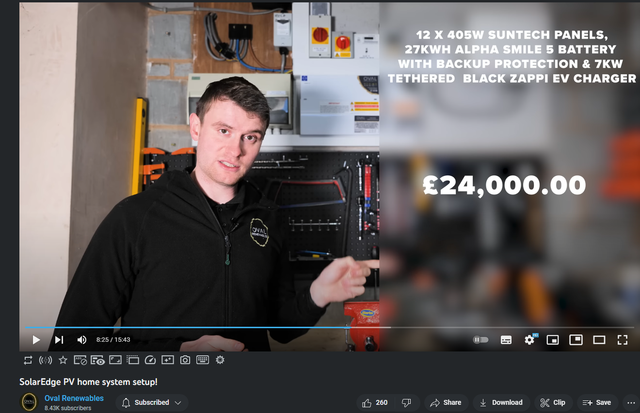
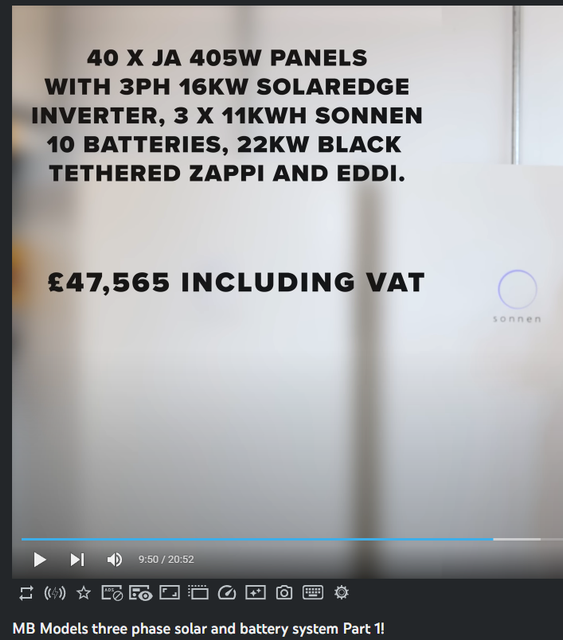
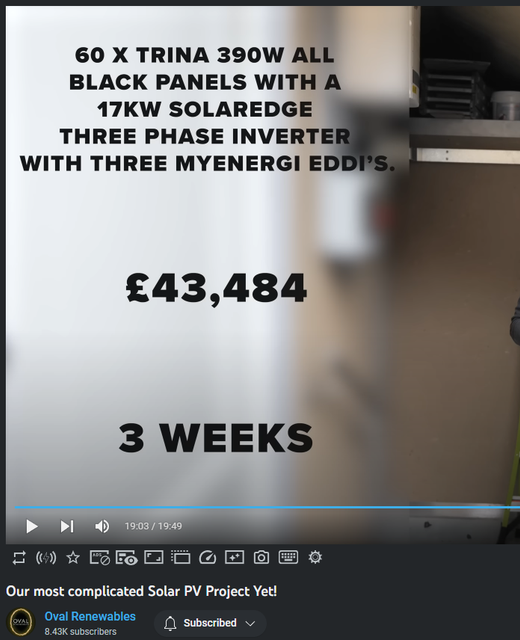
Here are some prices that Oval Renewables charged for different installs.

Whilst I like GE and the fact that they have offices in the UK and they have excellent warranties on the larger batteries the truth of the matter is that they are no better or worse than other manufacturers and the downside to using proprietary batteries is that you are locked into the ecosystem. Plus in the grand scheme of things they are relative newcomers into the market as can be evidenced by the various issues that are in constant flux.

MyEnergi again have some benefits being based in the UK and additionally having a entire ecosystem of products. As well as having the proprietary battery lock in they also seem to charge a premium just for the brand name. They are also new entrants into Inverter/Batteries and have decided to adapt K-Star products into their ecosystem (which appears to be via a magic box which looks remarkably like an EDDI - although its probably just the outward appearance and the kit inside is different)

I regularly came across SunSynk products in my research but they still remain a largely unknown brand in the UK, despite the fact that they have been in operation for 20+years across the world.

They have an interesting product line up of single phase inverters
https://www.sunsynk.org/batterystoragesolutions
3.68kw Output, 7kw Solar PV Input (11A max per string)
5.5kw Output, 6.5kw Solar PV Input (13A max per string)
8.8kw Output, 10.4kw Solar PV Input (26A max per string)
16kw Output, 18kw Solar PV Input (26A max per string)

Certain models I believe currently the 3.68 ECCO and 5.5 ECCO also allow for connection to Immersion Heaters directly (this is what specifically the products Eddi, Solar iBoost, Immersun and others usually at a cost of around £400)

They use BYD / CATL battery cells (acknowledged as the best in the market),

Here is a quick price comparison for GE v Sunsynk
GivEnergy GEN3 3.6kW Hybrid £1748.50
(1) SunSynk 3.68kw ECCO £950,
(3) SunSynk 3.68kw ECCO £1008.33
(5) SunSynk 3.68kw ECCO £850
GivEnergy [GEN2] 5kW Hybrid £1428.70
GivEnergy GEN3 5kW Hybrid £1813.50
(3) SunSynk 5.5kw ECCO £1208.33
(5) SunSynk 5.5kw ECCO £1162
(3) SunSynk 8.8kw ECCO £1758.33
(5) SunSynk 8.8kw ECCO £1725
(2) SunSynk 16kw ECCO £5015
GivEnergy 9.5kWh Battery £3885.70
(5) Sunsynk 5.32kWh Battery £1745.00

Alternate Example
(5) SunSynk 5.5kw ECCO £1162
(5) Sunsynk 5.32kWh Battery £1745.00
Trina Vertex S 425W Black Framed Mono x 18 £2457
Eddi £400
Sub Total = £10416.70
Scaffolding, Rails, Bird Screen, Ancillary Equipment, Fitting = £6583.0

So 2 x 5kw inverters that play nicely together PLUS 3 x 5,32kw (15kwh total) for £177 more...

(1) https://www.nationalelectricalwholesale.com/product/hybrid-inverter
(2) https://www.dragonsbreathsolar.co.uk/product/sunsynk-solar-inverters/
(3) https://infinite-solar.co.uk/brands/sunsynk/
(4) https://www.countyelec.co.uk/sunsynk-532kwh-battery?srsltid=AR57-fCP2aFaoZhuxR0xS3pvda85lZu36BDZj_uVfZSIN8x8NQZOsEKHD-k
(5) https://www.itstechnologies.shop/search?q=sunsynk

#10 hoggy

Pointless trivia but Sunsynk are essentially a variation of a Deye inverter with custom software layer ontop and EU support.
Similar to the myenergi / K Star method of getting product to market.

R
#11 Rogerbu

I have a 7.6kW system with a single 9.5kW GE Battery.
It has turned out to be an expensive mistake not to go for a second battery at the time of install.
I am now having to pay the VAT on a second 9.5 kW battery. The Octopus Flux tariff makes bigger batteries valuble.

T
#12 Tim

Rogerbu if you can squeeze another panel onto your roof, your installer may be able to swerve the VAT.

S
#13 SteveCook

Rogerbu have a 7.6kW system with a single 9.5kW GE Battery.
It has turned out to be an expensive mistake not to go for a second battery at the time of install.
I am now having to pay the VAT on a second 9.5 kW battery. The Octopus Flux tariff makes bigger batteries valuble.

Hi
But can you charge fast enough through the inverter in the off peak Flux slot to fill both batteries.
You might need to add another inverter as well

I have a 5kW Gen1 and a 9.5kWhr battery.
My installer was pushing me to install a second 9.5kWhr battery so I could probably run house in winter (very little sun) for 24hrs on off peak storage (so to speak).

I pointed out that a Gen1 charges at 2.6Kw, and 3 hour slot only gets me to 82%, so adding another battery without another inverter was a of no value to me.