
Battery went from 100% to 0% in 5 minutes with no load and now isn't charging

17 comments started 2023-07-21 last 2023-09-21
GivEnergy ProductsBattery
M
#1 MG

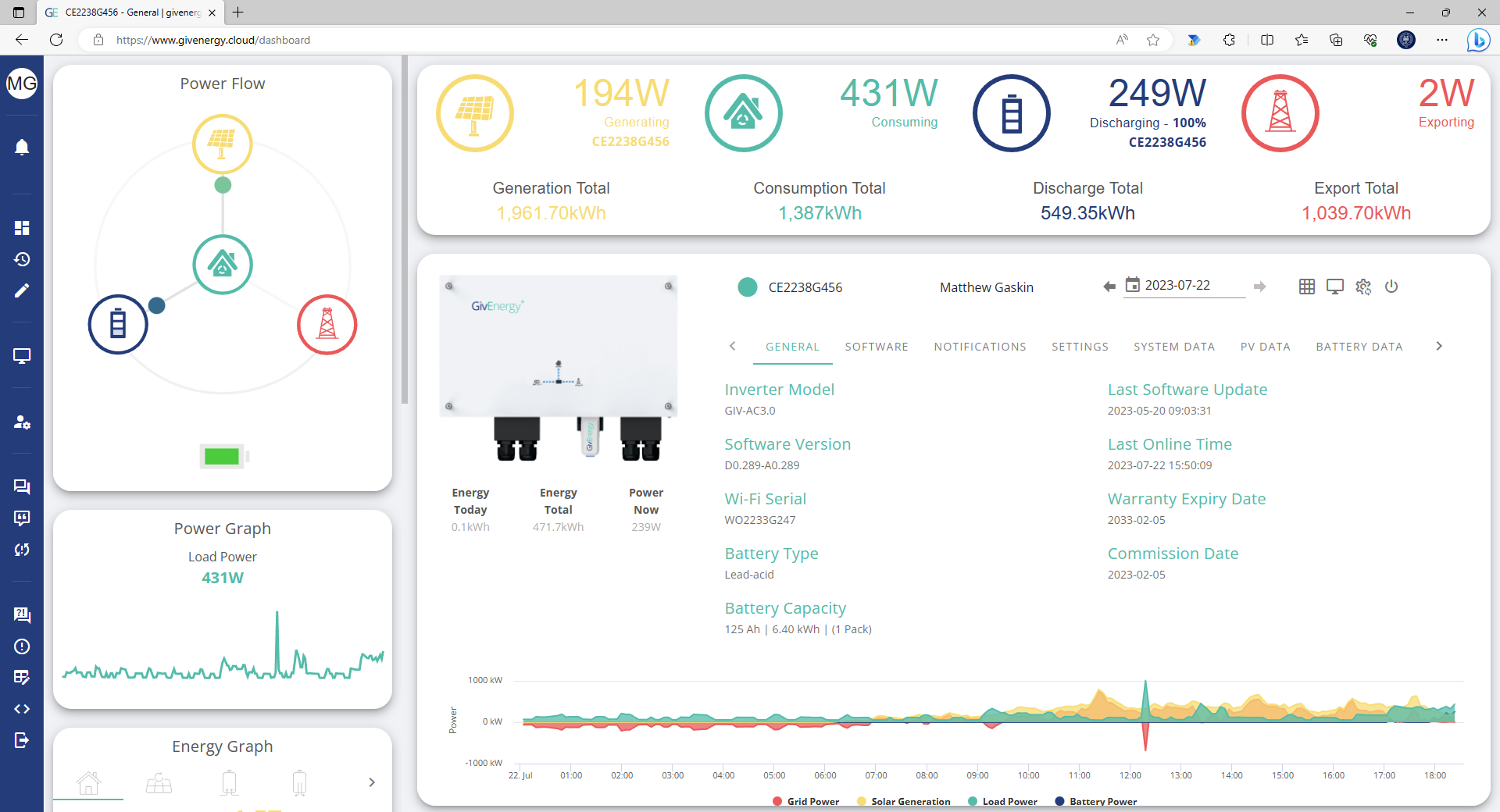
I'm on the Octopus tariff which allows me to charge the battery cheaply from the grid overnight. This happened and at 4:30am this morning the battery was full. There was no appreciable load before 8am (200w max) yet, at precisely 5am, my battery apparently discharged entirely, reaching zero percent at 5:05am. It's now not charging at all even though I'm generating enough solar power to export energy. Anyone know what's going on here and what I can do to fix it? I've already tried restarting the inverter.

T
#2 Tim

MG Give Givenergy a call or web chat. They'll be able to advise quite quickly, but post the outcome here?

M
#3 MG

I've asked the question in the webchat and am awaiting a response as I type this. I'm wondering if this relates to a software change as I've just noticed that the charge/discharge rate in the app now tops out at 256W, instead of 2.5kW.

M
#4 MG

Looks like this will need a site visit - the engineer in the webchat says the battery is communicating, and fully charged. But it's apparently choosing just to sit there idle. And it's not responding to a remote poke, nor to my restarting it (and resetting the breaker). I'll update further if I get any more useful info.

#5 ProximusAl

MG Iโ€™d bet one of the cells has overcharged and the BMS has taken it offline. I also bet it will fix itself when the voltage naturally creeps back down.

J
#6 Jellybaby

ProximusAl I bet it will work until the very moment they get knock on door to sort it ๐Ÿ˜ƒ

M
#7 MG

ProximusAl that could well be it.
I turned off the battery and switched off the trip this morning to see if some time offline made a difference. Putting it back on about an hour ago and, suddenly, the battery reappears in the energy mix, showing 100% charged (and is currently discharging as expected to minimise draw from the grid).

But there's still some ongoing weirdness. The battery chemistry has apparently changed from lithium to lead-acid (screenshot uploaded) and the battery firmware version is now apparently zero. Very strange. But as it's now working again I'm less concerned about that kind of oddness.

#8 ProximusAl

MG Yeah, thatโ€™s exactly what happened to mine. I however cannot remember how we fixed it back from Lead Acid to Lithium though. Maybe an inverter reboot from the portal now the battery is back in business?

T
#9 TX200

Lead acid tends to be a sign that the Comms cable is not properly connected.

The data cable between the inverter and battery may have become loose?

M
#10 MG

ProximusAl you were spot-on. An inverter restart did the trick.

D
#11 DaveCole

Mine did the 'lead acid' weirdness because the installer had slightly kinked the BMS cable (it's an outdoor battery) and moisture had found its way in, and battery comms failed. A new cable fixed it.

M
#12 MG

I now have a solution for this, after a site visit.
It transpires that the installers (no longer used by Eon, apparently) put three wires through a single grommet on the battery's trip switch, which allowed a small gap between them. Water got in and the internals of the switch were rusting and damp, hence the intermittent connectivity. It has taken all this time to get Eon to send someone out, but the switch has now been replaced and the battery has magically reappeared working as it should.

T
#13 TX200

MG outside install? GE install guide strongly recommends (or perhaps mandates?) a shelter being put over the kit.

V
#14 Vestas

TX200 Only to shade it from sunlight. Supposedly the batteries and inverters are IP65 - if installed properly - so don't need any shelter.

Edit - actually v14 of the guide says "When installing outdoors, systems must be
protected against direct sun, rain and snow." making me suspect that they're not in any way certified to IP65...

T
#15 TX200

Vestas "An IP65 Rating means the product has the highest level of dust protection, and is able to withstand low-pressure water jets from all directions."

Above from a random Google search.

Some of the rain we've had recently might be considered more than low pressure? ๐Ÿ˜

Plus if it's not installed correctly (e.g. incoming wires not properly sealed, drop/drip loops not put in place, etc.

To be fair if it's outside, you'll have issues in the winter. Some people have started wrapping their batteries (but NOT the inverter!!!) in things to keep them warmer, to ensure it doesn't stop discharging/charging cuz it is too cold.

I imagine if you wrap the battery in something, you'll probably also want to ensure that something doesn't get wet, hence having it in a wooden box with air vents or similar (plus ensuring the minimum gap between the inverter and anything else/the "shed" etc is adhered too).

V
#16 Vestas

TX200 IP65 is the rating you'll find for exterior electrical junction boxes/sockets and "low-pressure water jet" in this instance means something like a garden hose (as opposed to a pressure washer for paving/etc) so rain should have zero effect.

I can understand a "shelter" from direct sunlight but IF these units are actually IP65 then there should be no need whatsoever for a compulsory shelter from rain to meet the install/warranty conditions.

Snow may be a different matter because I guess enough of it accumulating around the battery could drop the temperature a fair bit, but the batteries already have issues with cold weather so that seems improbable as well.

Logical conclusion is the units were designed to meet IP65 but never actually certified/tested to IP65 (as is the norm for most Chinese kit).....

M
#17 MG

I have now built a shelter over the battery/inverter and associated cabling to ensure this can't happen again. Handily this means I also gain a log store for the winter.

This shouldn't be necesary though: the replacement tripswitch has been installed far more professionally than the original - the wires enter from the side, rather than the top, so rain would need to be horizontal to get in. And they used silicon sealant all around the areas where moisture could get in. It's clear that this is what should've been done from the start.