Why are the meter readings supplied by my supplier (from smart meter) so significantly different from the readings i get from the GivEnergy app. The export units being significantly less and the import units being significantly more! and by significantly i mean a difference greater than 20%!
Giv Energy readings vs Smart meter readings
The GE system relies on readings from CT clamp, which have an inbuilt error tolerance. plus the system only reads in snapshots rather than constantly in realtime. It really only shows an approximation.
The smart meter is designed to be much more accurate as it is used for billing and monitoring.
Depends on how you think of a big difference. At low readings the clamp is very error prone (that's just the way it is), my smart meter had 0.4kWh for Saturday, Giv app has 0.1kWh. Which in % terms is a huge error, but in reality it's not a problem.
Smart meter had July import at 3.8kWh, Giv had it at 0.8kWh. Again, big % difference but in actual numbers, it's 3kWh difference over a month on a total consumption of just over 200kWh. I don't see it as a problem.
The GE amounts are based on measurements that are, at best, taken every 10 seconds, so the "snapshot issue" will absolutely affect it.
Mine is about 10% low on the export side and about 7% low on the import side (just looked at the July numbers).
I don't fret about it as one system (the Smart Meter) is a calibrated device built for the purpose of measuring imported and exported electricity whilst the other (the GE system) is not.
There's plenty more important things to fret about.


Phil_H is a difficult one to pin down, flogas my supplier aren't providing me with a meter reading just a credit so i have to work it backwards using .24cents per unit(inc vat) . They only started reimbursing this year so haven't got it sorted properly. i've been asking for readings to definitively know. if i go by the givenergy cloud its very different indeed.
There were, if I remember correctly, some issues over here where people were on FIT payments. The recording of those went pear-shaped when the EM115 meters were fitted as part of a GE installation. I doubt if that would apply to your case though.
In addition to the EM115 in the consumer unit we also have an EML M23 meter which is wired in (ie not current clamps).
Installer fits those because the "MCS regs" they work to specify one should be fitted - no idea whether that's true or whether its just something they have as a company standard.
There's probably about 10% difference between the readings on the EML M23 and the EM115 - varies between maybe 7% and 15% but over a period of months averages about 10%. The EML M23 has the same readings for import/export as the smart meter give or take 0.1 units.

Or if it is clipped to the wrong wire.
Say it's measuring some of the electric, but not all of it (multiple CUs or house CU and car charger etc).
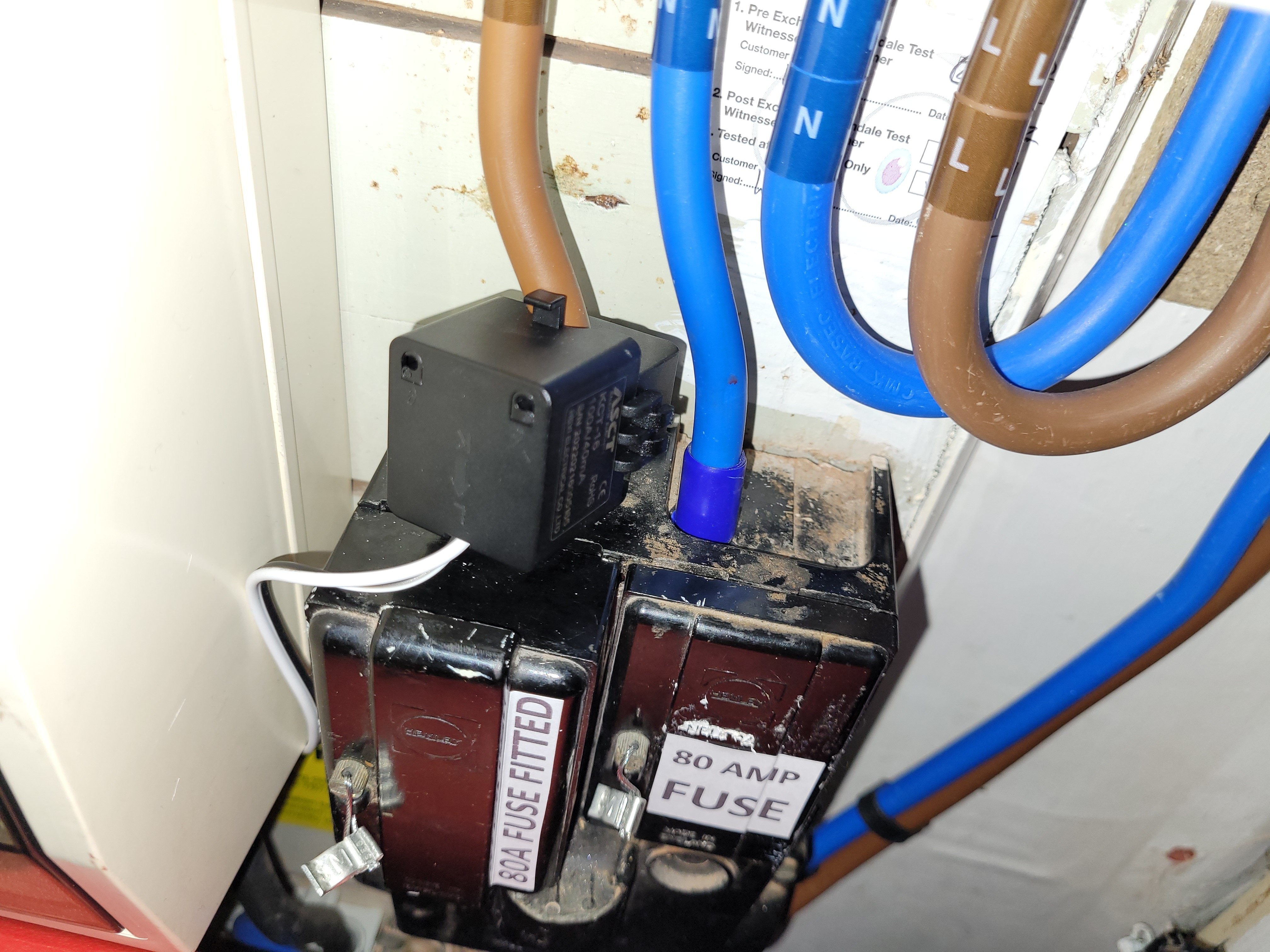
Cdent I know it was a file picture of the CT clamp above not the OP’s actual clamp, but the CT clamp should be installed on the consumer (output) side of the meter, not between the DNO fuse and the meter.
Otherwise the clamp is measuring the current consumed by the meter as well as the current going through the meter and it will always be less accurate in balancing house load to zero.
When I first got my GE system I was checking the app display against the smart meter readings and they were always off. The smart meter consumption reads was consistently under (smaller) than the GE consumption figures so after a while I gave up worrying about it and use the GE data as a ‘shape’ of what’s happened rather than specific numbers.
Last week I installed Home Assistant and that’s giving another different set of numbers, so back on the circle again !
Zakalwe The GE system relies on readings from CT clamp, which have an inbuilt error tolerance. plus the system only reads in snapshots rather than constantly in realtime. It really only shows an approximation.
The smart meter is designed to be much more accurate as it is used for billing and monitoring.
Sorry, but this isn't right. The EM115 is MID-certified, and is a proper bit of kit and can (with a solid core CT) be used as a billing meter. It shouldn't matter how often 'snapshots' are taken, because the meter can return the total kWh consumed to date, rather than instantaneous power readings.
AIUI the readings generated by the inverter itself are indeed snapshots, so I'd take Solar PV generation and House Load figures with a pinch of salt, but the Import/Export readings should be pretty close to the 'real' meter.
As mentioned, the CT clamp needs to be properly fitted. - but It won't make any realistic difference which side of the DNO meter it's fitted on.
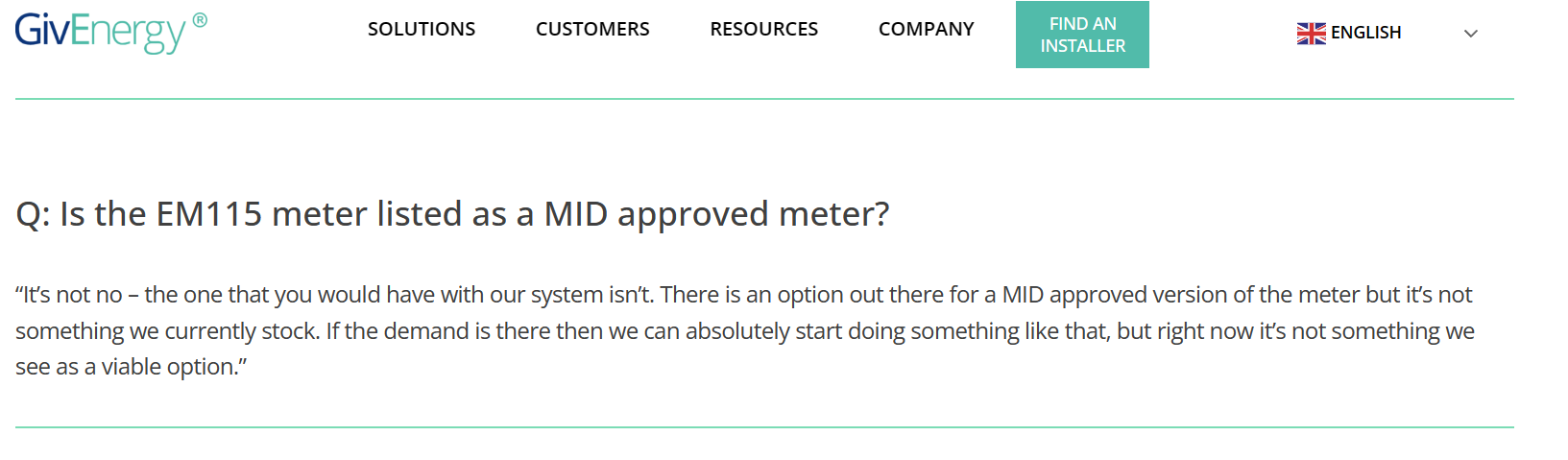
The EM115 can be inspected to view the import and export kWh figures, so you can easily correlate these with the smart meter. Press the button on the meter to cycle through the different readings. Don't mess with it's settings, though!
Zakalwe If that is the case then why are the GE numbers consistently at odds with the SM and billed numbers?
Does the GE system even use the EM115 to generate the numbers in the app/portal?
Well, that's a good question 🙂
I've made a note of my smart meter and EM115 readings and will revisit in a week to see what's changed. The "Import Total" and "Export Total" shown in the portal directly match my EM115 readings.

They don't directly match the smart meter readings as the EM115 was installed some time after.
Zakalwe Whatever metering is used, there is always an error. All certified metering is tested to make sure it is within tolerance. The "correct" meter is the energy supply meter as that's what is installed by your energy company for billing purposes. The EM115 is also certified for accuracy (as is your MCS meter) but is inherently less so because it is using a Current Transformer which needs a minimum current flow to detect energy flow. If the EM115 was the only meter installed, it would be correct.
We've got two inverters and a SMETS meter. Accepting that the SMETS meter is correct, since 28/2/22, one EM115 registers 11.9% low on import and 5.1% low on export and the other registers 16.8% low on import and 5.4% low on export. The two EM115, for the same period are 5.8% different between themselves on import and 0.3% on export.
What I take from this is that import is often a few watts or maybe tens of watts, all of which is registered by the SMETS meter. It's only when the EM115 can register a value (10+ watts?) can the inverter respond to the import and ramp up to reduce it. A simple way to nullify errors would be for Givenergy to be able to connect to the SMETS meter and use those actual data for inverter control and reporting; but that's not going to happen.
Some installations will have greater (or maybe lesser) errors due to the routing of the CT connection to the certified EM115 meter. Twisting the CT wires should reduce extraneous induced voltage but there's not much you can do with the CT itself other than ensure it is clipped together properly.
The EM115 data is used by Givenergy's portal.
So, in essence, we have closed the loop.
The SM is a certified device used to measure electricity flow and is deemed accurate enough to be used for billing. The GE system is none of those things and is much more inaccurate.
In the inevitable case of discrepancies between the systems the SM is the one that is to be used. Which is exactly what I said in the second post in this thread.
Zakalwe That's not quite my understanding of the EM115. The data reported by the EM115 to the Givenergy inverter is a snapshot of the EM115s register readings, and instantaneous power at that point. Instantaneous power is used by the inverter to modulate inverter output to meet home demand and limit export to the G99 register value and as such is probably the most important parameter. Meanwhile the EM115 is integrating the power flows continuously, the same as the smart meter, updating its registers and providing those data each time they are requested by the inverter. The EM115 will not be dropping any data, although it may not see all power flows detected by the smart meter due to the sensitivity of the CT.
If I was designing a control system for the inverter, I'd be asking for instantaneous power from the EM115 as often as I could process the control loop (every 1 second?) and then querying the full data set (import/export today/total etc) once every five minutes for the portal update. Writing the current export total to the inverter register every second would be a waste of time and bandwidth.
Zakalwe Co-incidentally I have been looking at my readings recently and trying to reconcile them.
My conclusion is that the numbers in the GiveEnergy app and portal are just wrong. I don’t know what they are measuring and how they are measuring, but consistently they are wrong.
Briefly my setup: 4kW FIT array with Growatt inverter and no batteries (so all excess solar will be exported), 2x Gen 1 5kW hybrid inverters, one with a 9.5kW battery and one with a 5.2kW battery.
I know that GivEnergy don’t recommend “plant” setups like mine and the two GivEnergy inverters act independently of each other with no cross-communication, and I know the Growatt FIT array will generate electricity straight into the house that the GivEnergy inverters won’t be aware of so that will distort the numbers as well.
However I would expect that the Solar Generation, Battery Charge and Battery Discharge will all be correct as they are things the inverter is measuring and controlling itself, and I’d expect Grid Import and Grid Export to also be correct as they are measured by the EM115.
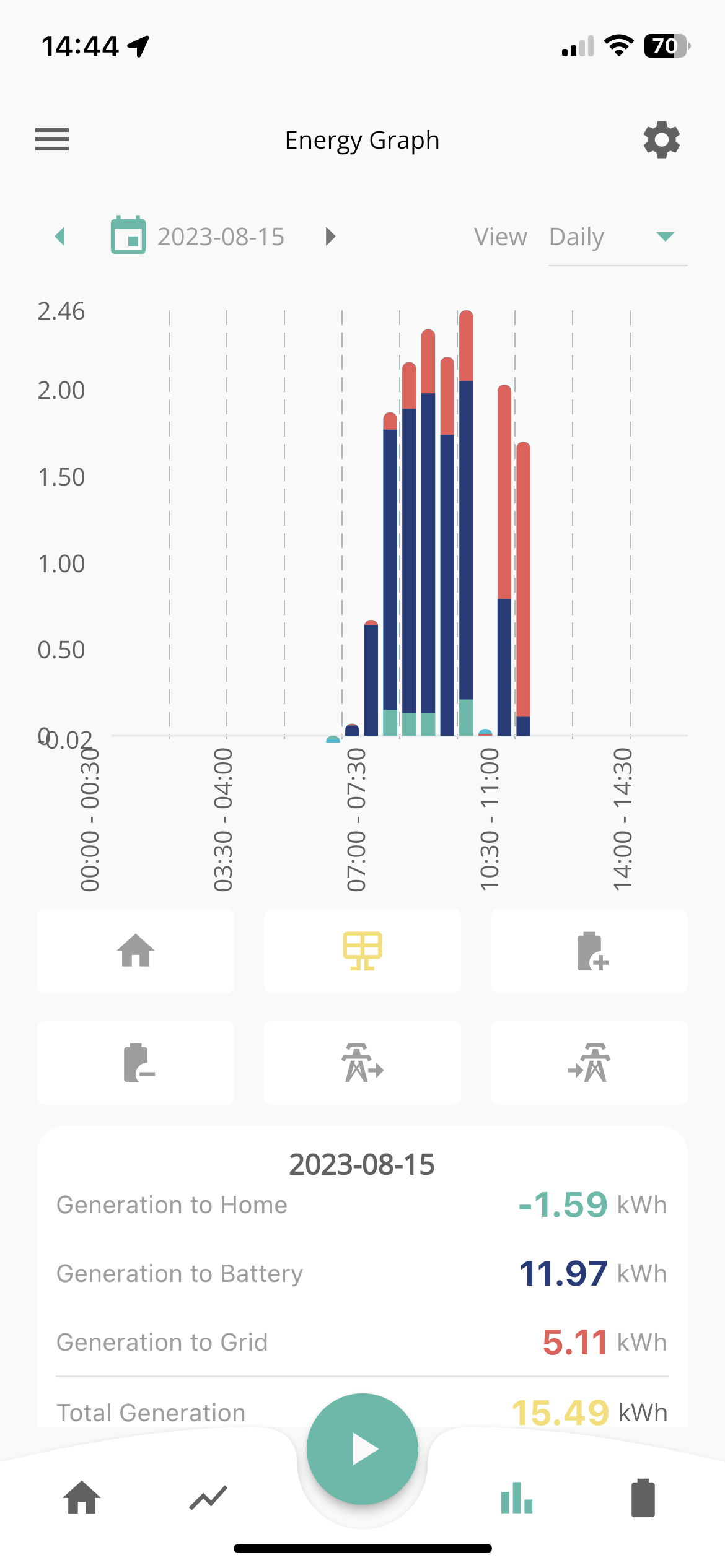
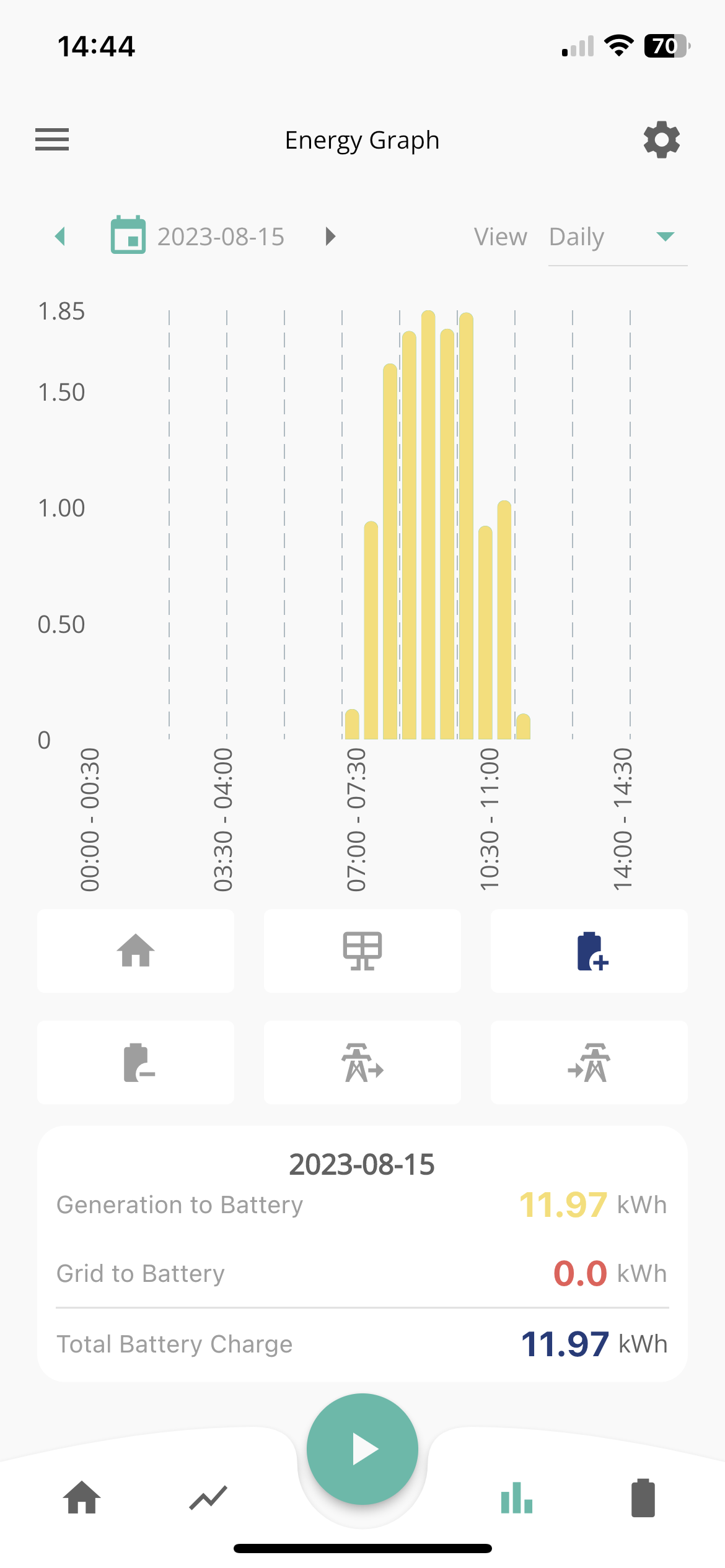
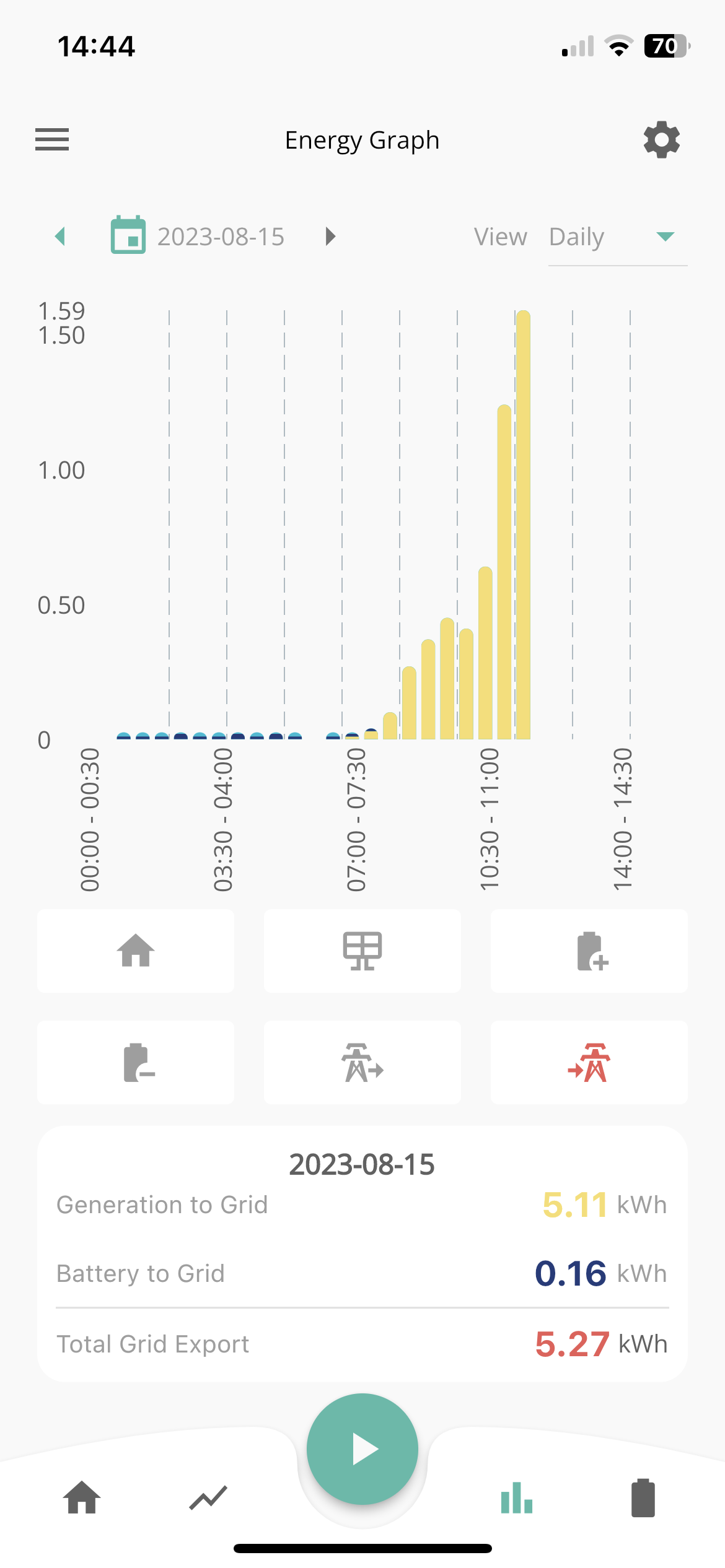
Using the GivEnergy app, the iOS Inverter app (which reads directly from the inverter’s data via its API) and my new Home Assistant with GivTCP, here’s a snapshot of graphs taken yesterday at 2:45pm:
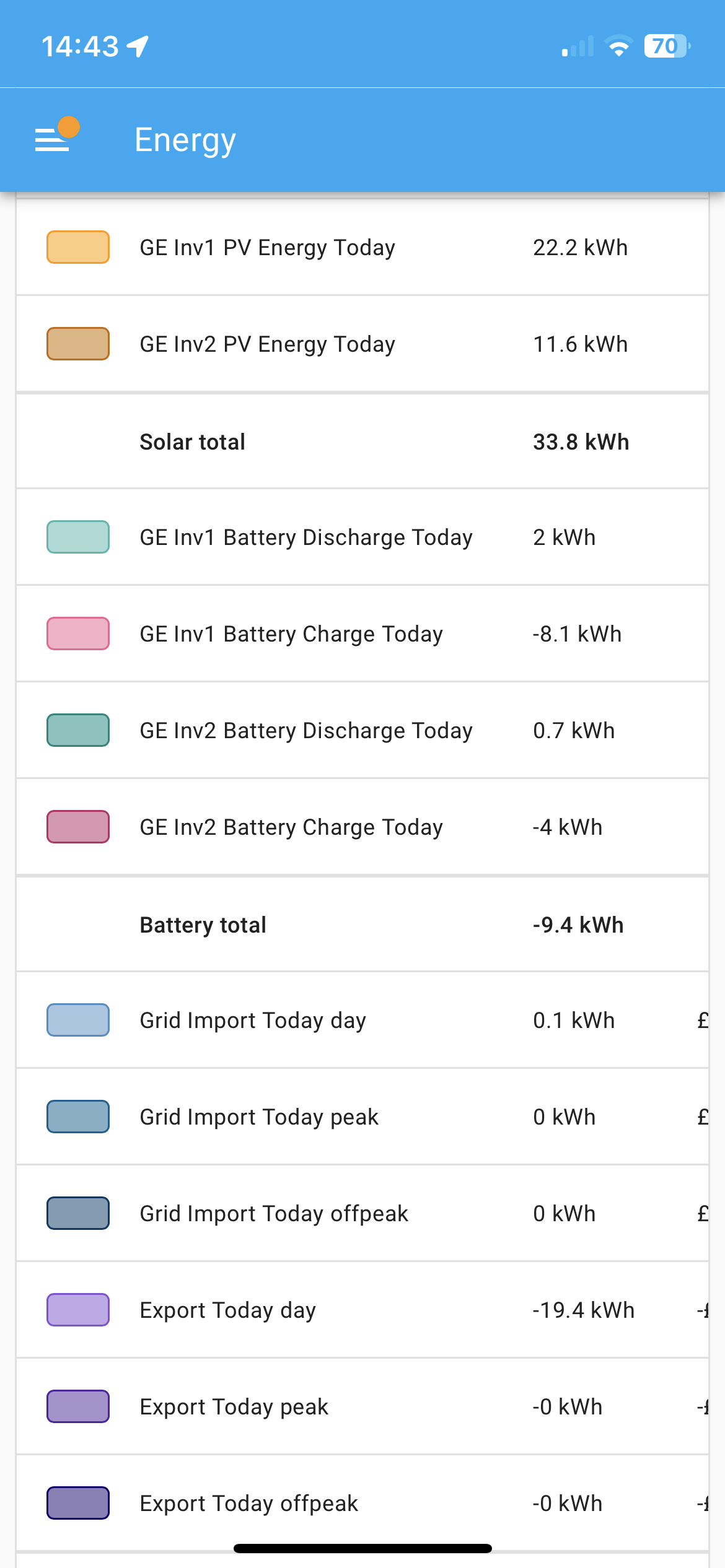
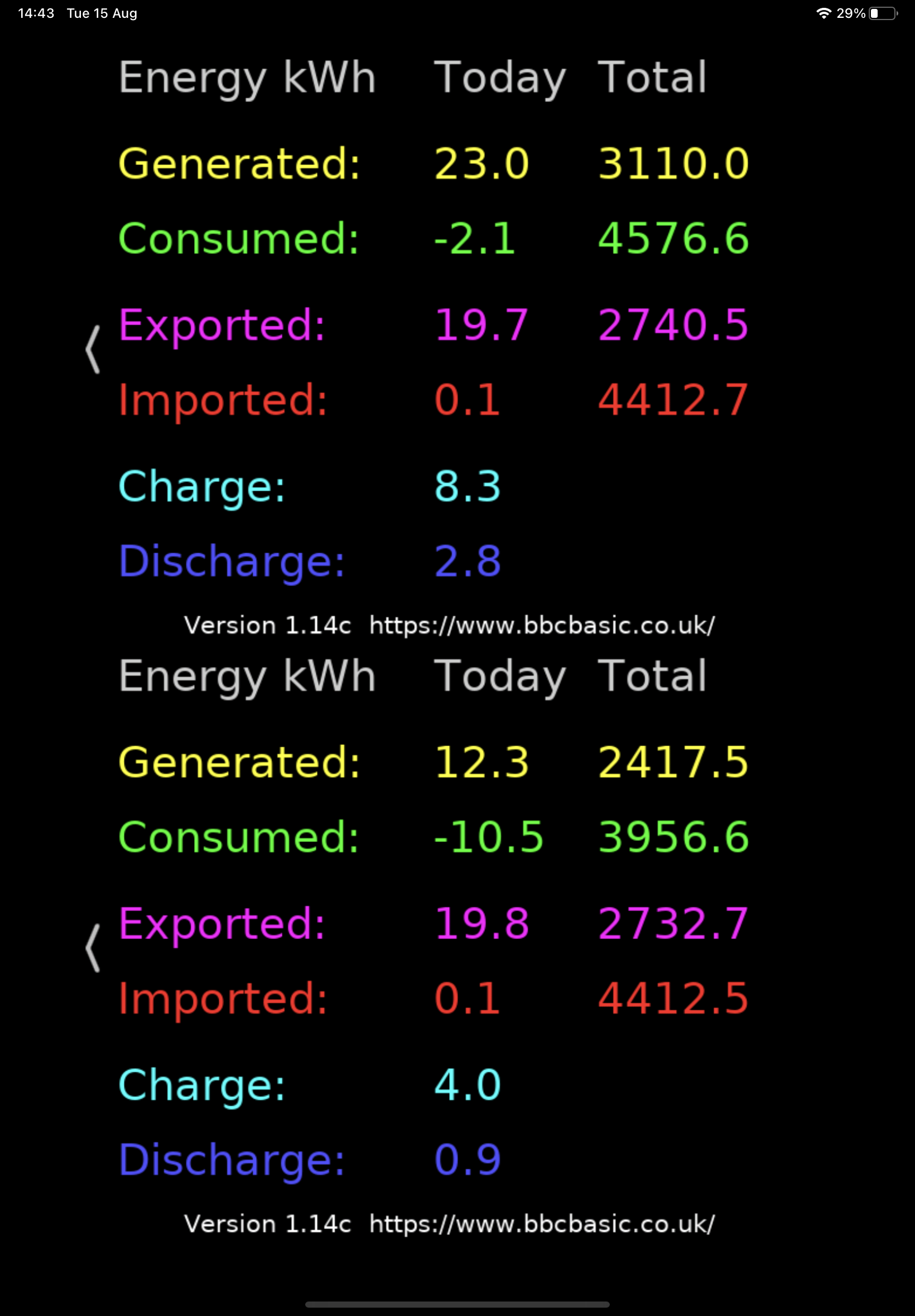
The Inverter app and HA GivTCP data match pretty closely for both inverters:
Generated 23.0 & 12.3 vs 22.2 & 11.6
Grid Import 0.1 vs 0.1
Grid Export 19.4 vs 19.8
Battery charge 8.3 & 4.0 vs 8.1 & 4
Battery discharge 2.8 & 0.9 vs 2 & 0.7
But the GivEnergy app shows quite different figures summed across the two GivEnergy inverters:
Generated 15.5
Grid Export 5.3
Battery charge 12
Some of the Generated figure being wrong is caused by the negative Generation to Home figure which I suspect is caused by the FIT array generating power into the house that the GE inverters don’t know about, but the Inverter app and Home Assistant manage to get the figures consistent and this doesn’t explain why the Exported figure is so different.
And when I check the day-end figures for yesterday (15/8) I again find that the GivEnergy figures are wrong:
Home Assistant total export: 24.7kW
GivEnergy iOS app & Portal Total Grid Export: 13.65kW
Octopus smart meter export 24.5kW

Zakalwe The SM is a certified device used to measure electricity flow and is deemed accurate enough to be used for billing. The GE system is none of those things and is much more inaccurate.
No, they're both certified to effectively the same standard of 1% accuracy. (However, that's at full load and unity power factor) The certification does allow some tolerance and as Tim says simple CT clamps can be less accurate at low current.
Tim If I was designing a control system for the inverter, I'd be asking for instantaneous power from the EM115 as often as I could process the control loop (every 1 second?) and then querying the full data set (import/export today/total etc) once every five minutes for the portal update.
Agreed. Judging by the blink rate on the EM115 LED it's possibly being read faster than 1Hz.
I'm surprised by the wide differences between your utility meter and the two EM115s - you're sure it's not just a zero offset issue?
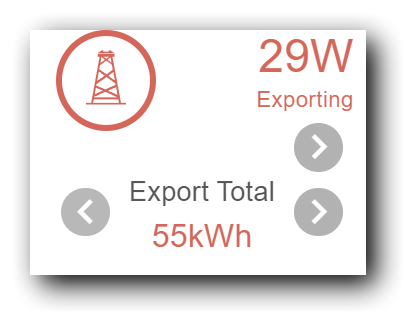
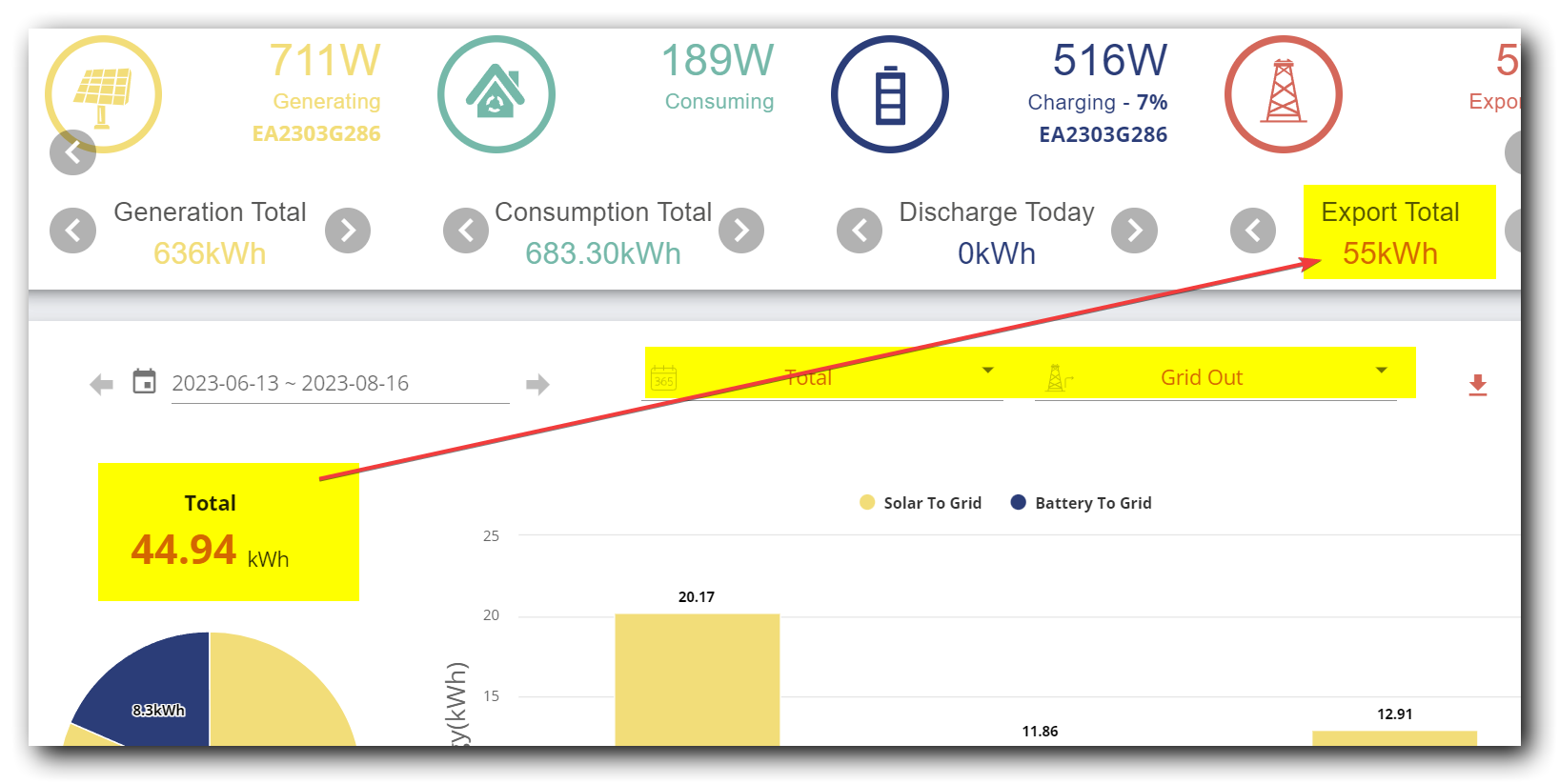
Re Portal data, it doesn't always use the EM115 totals. In the screenshot below, the "Grid Out" total is wildly wrong, while the "Export Total" is direct from the EM115. I think the Grid Out figures are being calculated/measure wrongly by the inverter.

Tim That's not quite my understanding of the EM115.
Thats as maybe, but I am talking about the overall GE system, not a specific part of that system. No matter how its sliced and diced the GE numbers as reported in the portal are at variance to the numbers used by the electricity supplier. Ergo, the GE system is not the system to be trusted when there is a variance.
Zakalwe GE system is not the system to be trusted when there is a variance.
I agree that the Givenergy Portal is an excellent user interface but should only be used for interest rather than planning your life.
rjp wide differences between your utility meter and the two EM115s
Those are the data logged in the cloud and my records of smart meter readings for specific dates (28/2/22 and 15/8/23). The EM115 CTs are sited next to each other on the same conductor. That's just how it is. Interesting to see that Grid out is different from Export. Maybe that's a source for all the conundrums? A calculated value based on error-prone inverter measurements. It would seem to be sensible to me to make use of the EM115 data which, as you say is certified, as a primary data source, adjusting the inverter measured values to compensate. If the inverter has dropped cloud updates then the cloud integration of power cannot be anything other than incorrect. Using daily totals, which are posted at the end of each day would work as an inverter-integrated value. This would suggest a "live" portal using 5 minute data, but overwriting the potentially flawed integrated values with daily totals from the last update of the day. The charts etc would still not align with the logged daily values, but it might close the gap on smart meter vs Givenergy portal.
geoffreycoan But the GivEnergy app shows quite different figures summed across the two GivEnergy inverters:
I've given up with the portal summations for out two inverters. The generation total for the two inverters used to work (it's over 17MWh now), but it's recently stopped. The portal summary has only ever shown the house consumption from one inverter. Battery SoC is averaged OK and grid import/export seems OK, but then there's only one grid connection, so data from one or other (but not both) inverters works fine.

Tim Interesting to see that Grid out is different from Export. Maybe that's a source for all the conundrums? A calculated value based on error-prone inverter measurements.
I think that's a big part of it. "Grid Out" is split between Battery and Solar, so as you say it must be coming from the seemingly error-prone inverter calculations. EM115 doesn't know the source...
Interestingly our installer put a 'dumb' meter inline with the inverter so I can actually read 'true' inverter output and input kWh. It seemed pointless given that the inverter should be able to measure all that itself., but might be useful.
(Now, if that was replaced with a modbus one, could we somehow use that to correct the values...?)
Tim Those are the data logged in the cloud
As above, I think the portal's "Inverter Data/Meter Data" "Import Total" and "Export Total" are the true EM115 readings - those are the ones you're looking at?

Oh, interesting. The new one's an Eastron device, possibly tweaked.
https://www.eastroneurope.com/products/view/sdm120ct-modbus
I suspect while it's not certified it has the same accuracy as the certified variant.
There are issues with all forms of electronic metering depending what design is used to integrate the current.
None of them are as accurate across the idle to full load range as the old Ferraris and some have "interesting" design flaws - https://www.theregister.com/2017/03/06/smart_meters_prove_dim/ links to a paper which some may find interesting. L&G still use the same Rogowski coil designs in their high amperage meters now AFAICT.
The tl;dr is that electronic meters are probably less accurate than the old mechanical meters they replaced when there's a lot of noise/fast transient currents present. Some read high, some read low, seems to depend on the design.
I can get a nice plot of the EM115 reading over time via Home Assistant, but I haven't found a way of getting similar readings from the SMETS meter into HA. The Octopus/Hildebrand integrations seems to just give "consumption so far today" rather than a rolling total covering several months, which would show the comparison properly. I just want the actual meter reading as a HA entity.
rjp The Hildebrand meter provides instantaneous power and also provides the total energy import value. My energy import value is currently 26,692 kWh and my average consumption is 20kWh per day and so the value is showing consumption for the past 3.6 year approximately. Here is an example MQTT message:
{
"electricitymeter": {
"timestamp": "2023-08-19T11:05:43Z",
"energy": {
"export": {
"cumulative": 0.000,
"units": "kWh"
},
"import": {
"cumulative": 26692.711,
"day": 24.677,
"week": 170.748,
"month": 530.281,
"units": "kWh",
"mpan": "***************",
"supplier": "Octopus Energy",
"price": {
"unitrate": 0.07500,
"standingcharge": 0.55390
}
}
},
"power": {
"value": 0.422,
"units": "kW"
}
}
}
That's their IHD, rather than the Bright app?
rjp Update to my incorrect answer. If you subscribe to your Hildebrand dongle MQTT stream from their cloud servers, you get much more data; including import and export meter readings (in Watts!). Its key values payload.elecMtr["0702"]["00"]["00"] (Import meter reading) and payload.elecMtr["0702"]["00"]["01"] (Export meter reading). They're in Hex, but shouldn't be difficult to convert to decimal and then divide by 1000 to get the meter reading as kWh.