M
#1 MikeJ
Does 3013 auto calibrate (if the soc / load conditions are met) or does it still require manual calibration?
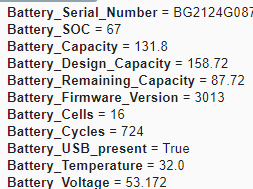
I've got a 8.2kwh battery which is showing a capacity of 131.8Ah out of a design capacity of 158.72.

Does 3013 auto calibrate (if the soc / load conditions are met) or does it still require manual calibration?
I've got a 8.2kwh battery which is showing a capacity of 131.8Ah out of a design capacity of 158.72.
AFAIK, there is no calibration needed when moving to 3013. Also, (again AFAIK) there is no way to manually do a calibration. The option was removed from the portal some time ago and only the GE helpdesk can perform a calibration.
Note: Charging to 100% and discharging to 0% is not the same as a calibration cycle.
Mine did an auto calibration when I updated to 3013 from the portal
My batteries are already on 3013 and have been calibrated before.
I was asking if the new firmware with its fancy SOC measurement was able to continuously calibrate over discharge/charge cycles. So my "missing" capacity might come back on its own rather than need an actual calibration cycle.
If I have understood what has been said on here by @TheDragon (GivEnergy) in the main, any battery firmware update carried out from the portal, instigates a calibration. However, if support are contacted, then they can update from say 3012 to 3013 without the calibration being done. Essentially its considered quite hard to code from where to where needs a calibration and what doesn't. Working on a KISS principle essentially I would suggest!
anglefire Thank you for the clarity you have brought to this issue. I've been waiting to be at home, with a sunny day promised, house batteries low in charge and an EV outside needing charge, when all I need to do is ask support to update my batteries from 3012 to 3013 without calibration. Simple!
Edit - Just called support. Apparently, the firmware upgrade will trigger a calibration but if I ask they can stop it.
Edit2 - (Same call). If I ask them to carry out a remote firmware update, it won't calibrate! That's the question I asked but the answer was to the situation if I initiated it. When I asked for the second inverter/battery to be updated by them, because I didn't have a firmware update button, I was told because it was initiated by them, it wouldn't carry out a calibration.
BTW we have two Givenergy inverters on one account and as such we will only ever get one firmware update notification (to the first inverter). The second inverter will never receive the update notification (apparently).
I was asking about ongoing calibration rather than at time of upgrade.
I wondered if the new firmware (which is much better at calculating soc) effectively calibrates the battery too.
MikeJ IMO Calibration resets the top and bottom end points, but they are only voltages anyway. If the firmware does an OCV check when the battery is idle, then the physics of the battery will always map a voltage to a SoC. The latest firmware (AIUI) allows for OCV check when idle at up to 80% SoC whereas the previous version wouldn't OCV above 50%. This means that at this time of year when many batteries don't drop below 50% SoC, the OCV can still take place, giving you confidence that whatever is being reported (between 4% and 80%) is more likely to be correct than before and a sudden SoC drop less likely.
The new firmware doesn't calibrate anything. However, it does carry out it's own off-line check when the battery is idle, to set the reported SoC to a value which most closely relates to the actual SoC.
Thanks for the explanation. I guess I need to get a calibration done to recover the 1.4kWh I've lost in one of the batteries - or get it repaired...
Tim BTW we have two Givenergy inverters on one account and as such we will only ever get one firmware update notification (to the first inverter). The second inverter will never receive the update notification (apparently).
That’s strange.
We have two inverters on our account, they both show up separately under ‘my inverters’ and for each I can look at the individual inverter details and upgrade the software separately on each. When the inverter firmware came out I upgraded each on different days.
I have two batteries, one on each inverter and again am getting the software upgrade button separately on each inverter.
geoffreycoan Perhaps we should create a dual hybrids club so we can compare the differences in our experiences. One update for one account is feasible, but yours just works!
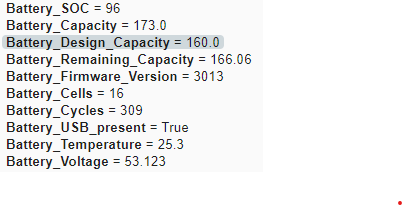
MikeJ The way I understand it (I think yours is an 8.2kWh, same as mine), the total (absolute) capacity is 200Ah. Take off the 15% (30Ah) at the bottom and 5% at the top (10Ah) and you have 160Ah which represents 4% to 100% (the Design_Capacity) available to the user. At a nominal voltage (from the data sheet) of 51.2V, that gives (51.2 x 160=) 8192Ah or 8.192kWh. You could ask Givenergy whether a calibration would reset the design capacity or if it is a firmware register constant, in which case an update of the register would work. Ours have always been 160.0. BTW, the shortfall looks to me like 1.28Ah, which would equate to about 65W.
The shortfall for mine is 160 - 131.8 which is about 1.4kWh.
It has read more in the past, and the other one on site has a battery capacity of 166.
MikeJ I think the issue is that we are using GivTCP from @Britkat and we don't know which register values he's using to provide this data (correlating your assumption to my example, my battery has an extra 0.67kWh capacity). Some may even be calculated values? I expect that if there's someone here who is motivated to pore over the Python in Mark's code, they'd be able to be more definitive. Consequently, we are making assumptions, unless you know different?
Tim givtcp gives two SOC values. One from the battery and one from the inverter.
They read slightly differently depending where you are in the soc curve.

I believe the capacity values bear no correlation to SOC anymore on the newer (30XX) firmware (uses pure voltage) hence why the only real way to see if you have actually lost 1.4kWh is to do a run from 100 to 4%, then wait for the OCV to make sure its happy that it really was 4% and seeing just how much it has discharged.
For ref mine says something like 132AH now but still discharges 6.5kWh same as it always has (very old 80% DOD 8.2)
I was trying to work out the best time to do my firmware 3013 upgrades. Upgrading in the Flux peak period sounded good as I’d get paid max rate for the full battery discharge, but then would have to pay for the battery to be fully charged from grid energy.
I decided instead to do the upgrade in the morning when at least the full charge would be off solar. Last night I accidentally ran the Flux peak export for too long and the batteries ran out overnight so at 7am this morning I kicked off the upgrade of the 5.2kW battery. The upgrade itself worked perfectly first time. Despite the battery being idle and on 4% charge it still spent ages discharging even more fully before starting filling itself up which took a few hours but all worked fine.
I’ll wait a week or so before doing the same on the 9.5kW battery