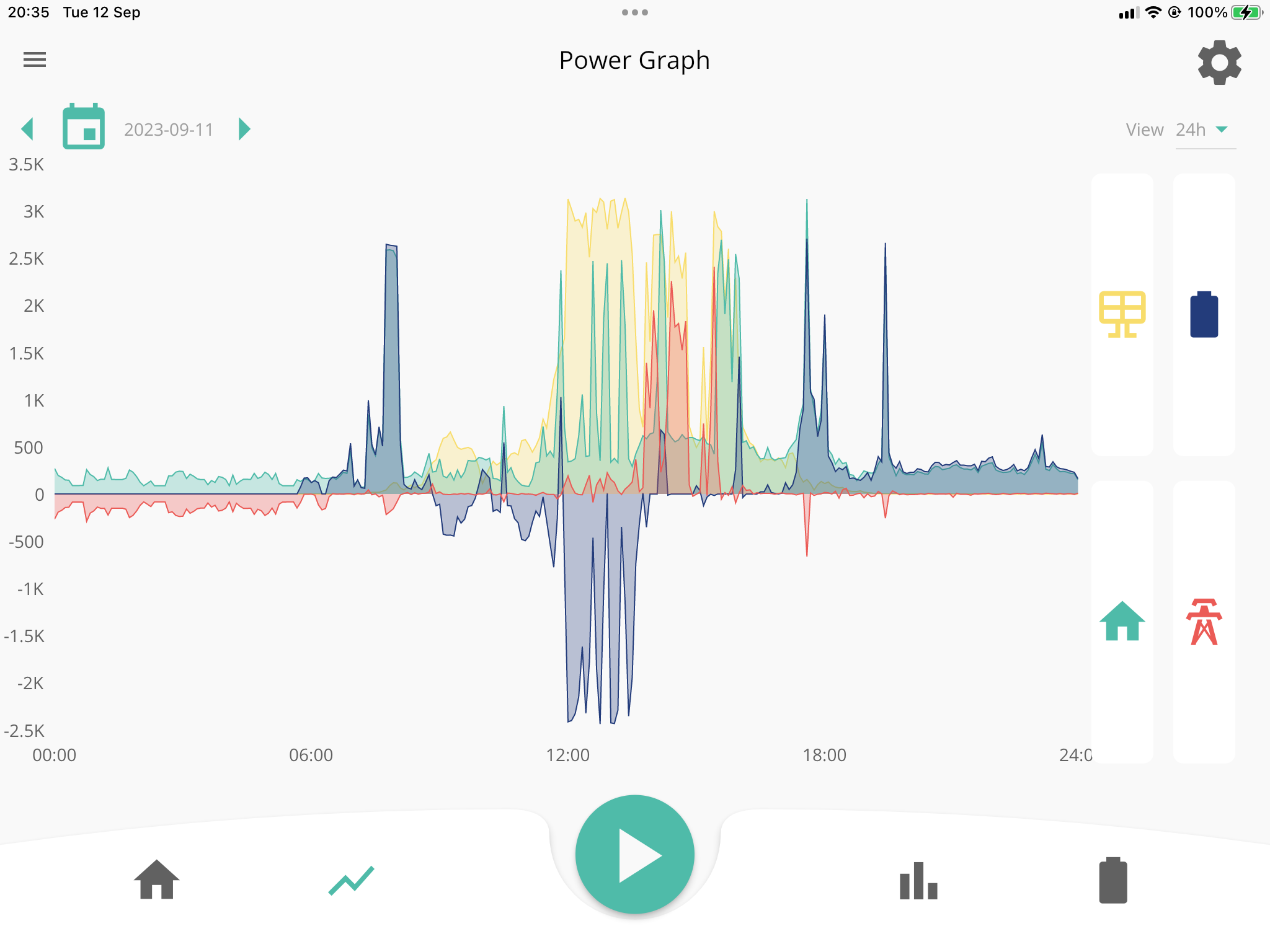
My system occasionally imports a small amount of grip power in the early hours of the morning, even when the batteries are very well charged.
It perhaps last 1-2 hours, is constituent on matching house load, then suddenly stops. The system is on "default Factory settings"
Anyone see this? Solutions or suggestions.
R
#2rjp
What's "very small"?
The house load can rise as devices (e.g. fridges) change their power requirements. The inverter monitors this via the EM115 CT Clamp and - where possible - increases the battery power output to match. Even if this only takes a second, you're importing during that time. Similarly when the load decreases, you're briefly exporting until the battery output is reduced.
Over a day these add up but usually only to a small fraction of a kWh.
T
#3TX200
Torphins_House is it still within your cheap rate electric (assuming you have peak and off peak)?
If it's still off peak, let it draw from the grid. It wouldn't make sense to start discharging the battery until the peak rate starts. Especially with round trip losses.
T
#4Torphins_House
rjp it was
As shown here, sometimes starts when solar panels go to NIL. Perhaps 200watt average draw from grid, even with batteries at 70%. Yet the next evening does not do it?
I’m on old Panels FIT since 7years (runs for 20), so not on smart meter. Batteries fitted in June 2023. Basically Just get paid 22p/ KWh on what I Generate. Import grid power is all one price.
But it’s the issue of sometimes pulling 1-2kw from the grid in a day, when batteries should be kicking in.
TX200
I do not have smart meter so power is all one rate. I have an old 2015? very good FIT deal for the original index linked Solar panels paying me 19p / KWh on what I generate, plus a further 5p for half the generated power as feed-in. GiveEnergy 10.4 KWh Batteries only fitted in June this year, and FIT unchanged.
The issue of this low GRID import happens overnight, but only sometimes. Most frequently in early hours (2am - 5am window), but sometimes all night as in this example. The solar panels output coming on /off-line appears to be linked (occasionally).
I thought perhaps there is might be some threshold value for the batteries kicking in? Perhaps 200watts or so, but never seen any documentation to suggest this.
Thanks for any advice or assistance.
T
#6Tim
Torphins_House You can ask for a Smart meter at any time. It won't affect your FIT payments as the MCS meter installed with the FIT system is the one you are using for FIT payments.
It looks like your inverter isn't in ECO mode, at least during the night. The battery "Average Percentage" isn't shown on the chart, but I wonder if there's a timed charge set with a low Charge to %?
AFAIK, your ideal settings this time of year are to set ECO mode on (Solar and Dynamic in the App) with all timed settings disabled.
G
#7geoffreycoan
Tim You can ask for a Smart meter at any time. It won't affect your FIT payments as the MCS meter installed with the FIT system is the one you are using for FIT payments.
The second sentence is unfortunately not correct, if you have a smart meter fitted you SHOULD lose your deemed export payments and move to actual measured export payments.
When I recently moved to Octopus Flux and gave up my FIT deemed export readings to be paid actual export amounts I saw this in the terms and conditions of the new FIT agreement letter I had to sign.
It presumably relies on you telling your FIT supplier of this change because I only found out about it some time after having my smart meter fitted
T
#8Tim
geoffreycoan There are others on the community who have exchanged their FIT solar inverter for a hybrid with battery attached. They were able to do this (after consultation with their FIT supplier) as long as the MCS meter installed between the house consumer unit and the inverter was able to either register both import (battery charge) and export (solar + battery discharge) to calculate the difference, or netted the value internally to provide the difference as a single register.
Maybe their FIT supplier hadn't read the small print, but it seemed like a sensible approach to me.
T
#9TX200
geoffreycoan there might be some complications around this.
Deemed fit export to measured export might not always be feasible.
For example if there are other things in the house that could export (batteries or other solar arrays for example).
How would they know what export came from what system?
Would the government want to pay your real export if it's not all coming from the FIT system?
Yeah clearly moving to SEG export gets around that, but don't think they can force you to do that. They might be able to force you to move to measured FIT export, but as above, maybe not for all scenarios!
Just to clarify, I was highlighting that the FIT scheme rules say on the OfGem website that if you have a smart meter fitted you have to move from deemed export payments to actual metered export payments. Eon’s FIT FAQ’s say the same https://www.eonnext.com/help/feed-in-tariffs as do other FIT suppliers if you google for ‘smart meter fit export’
My take on it is that deemed export was a fudge, designed when smart meters were not widespread and were a way of giving you a payment for electricity you exported when it wasn’t possible to measure that export. Once you have a meter that can measure the export the fudge isn’t necessary and you’ll get paid for what you actually exported.
If you have battery storage and use more solar generation in the home and don’t export it, its only right that you don’t get paid for electricity you don’t export.
Agree that others in the forum have changed to hybrid inverters (with FIT supplier approval) and added battery storage and continue with their deemed export payments as long as they can give meter readings for the net import amount, but it does say that if you have a smart meter fitted at the supply point you have to give up deemed export payments.
That was the situation I was in, I had two extra arrays fitted and I wanted to get payment for the export from those arrays. You can’t separate the where the export is coming from so to receive payment for the GivEnergy export I had to give up the FIT deemed export. In my case I lose about £100 a year but have gained that already in real export payments.
I realised afterwards that I should have given up the FIT deemed export earlier once I had a smart meter fitted
T
#11TX200
geoffreycoan my point was kinda the opposite angle. Some people might end up exporting more than 50% of what is generated by the FIT panels
Thus it would cost the government more if they forced that user onto metered export.
Not an issue for most, but something to be aware of.
G
#12geoffreycoan
TX200 That’s true that someone might be exporting more than the 50% deemed usage. I’m sure that during the day and without any battery storage we would have been regularly doing that on our FIT array. During the day, no-one at home, probably minimal power draw, certainly less than the 4kW peak FIT array output.
So yes, would cost the government more if you get a smart meter and they have to pay actual export meter readings which have been much more generous than SEG for example