
Maximum Export to grid

33 comments started 2022-03-10 last 2022-03-16
GivEnergy Products
B
#1 Burtonpe20

We were wondering if there is a maximum about of energy that can be exported to the grid at any on time. Dont ask me specifics of our system, although I believe it was a 6.1kw installation, but states we should get 4.55kw allowing for shade, but when the sun has been out previously we have had over 5kw of power coming into our solar panels when we had the sun out in February, some recharging battery and some exported into grid. But over the last week, sun is higher, and out all day, our batteries are fully charged, but the panels only seem to generate 3.75kw almost exactly all afternoon for the last week. (except for about 10minutes one day it went up to 5.3kw, when we switched the dishwasher on).

Does anyone know if there would normally be a limit on what you can export and if that will show on the power going into your solar panels? Or maybe this is the maximum it now thinks we can have based on the angle of the panels?
#2 THALL

The limit is set by your local DNO. As your installation is over 4kw then your installer would of made an application to the DNO to agree an export limit. The default "ok" amount is 3.68kw, but your local DNO may have agreed to more. For me my last install the application was made for 7kw solar and 3kw battery total export of 10kw and the DNO replied within a couple of days stating my max export allowed would be 3.68kw and my systems have been capped for that. I still get all the power inside the house but the max going out is limited to 3.68kw

S
#3 stevelewis

Sounds like your system is export limited in line with the G98/G99 rules... unless you have another written agreement with your DNO, 3.68kW is the usual export limit. If you're getting paid for export, you could configure your system to peak shave, rather than charging up earlier in the day when you could be exporting within the 3.68kW limit.

#4 THALL

Also as the sun is lower in the sky you wont see your peak power yet, angle is wrong blah blah.

T
#5 Tim

Burtonpe20 I had the same issue a few weeks ago. Max output was almost 7kW and we exported 16kWh one day and 19kWh the next. Apparently my installer had forgotten to set the export limit on the inverters but a quick call to Givenergy Tech support fixed that. Even now with export limited to 3.68kW, we are exporting up to 10kWh each day (after topping up our 16.4kWh of battery and putting the dishwasher/washing machine on). It's got to the point where I'm inviting our neighbours to plug their EV into our charger. Should be better in a few weeks time as my better-half is returning to her retirement status and so won't be out all day in our EV and two of our children will be visiting with their families and their EVs.

G
#6 GrahamRead

Just to pick up on this - I already have a DNO agreed 4kw export limit from the G83 (as it was at the time) submission for my solar system. I'm not bothered about exporting over this, am I right to assume that with the new batter system, as long as my AC coupled inverter is set to this limit, a new submission won't be needed, as I'm still honouring the DNO agreed export limit. I need to check if this was set.

#7 THALL

GrahamRead Not sure, I had 2.4kw initially then my installer added 4.6kw and the 3kw ac3 and did a G99 application. But at the end of the day if you have a document from the DNO saying 4kw limit then no I do not believe you will need another application if you add a battery system as long as the export stays capped at your 4kw limit. I am desperately trying to get another 3kw added and the company who has quoted did not mention I would need any kind of new application and they would cap the system to 3.68kw as per my G99. I am ok with the 3.68kw default limit even though I will hopefully end up with 10.25kw of panels and an 3kw ac3

S
#8 stevelewis

GrahamRead You need permission from your DNO for installing any new generation equipment, whether that's adding an inverter with a battery or adding a second PV inverter. There's a "Fast Track" process for adding an ac-coupled inverter to an existing installation, provided that the 3.68kW export limit is still respected. It's not a difficult form to fill in and took me about a week with WPD... best to give them a call. The DNOs is responsible for keeping track of what's being connected and where. Adding new generation without permission could place you in breach of contract with the DNO and not in a good place if problems arise.

Y
#9 yandards

Tim wow, that's worth going through a G99 process to get that generation limit lifted.

It's an easy option for installers to just stick to the 3.68kwh export limit as they are guaranteed to get DNO approval and can apply retrospectively post install.

It's not a massive faff to submit a G99 for higher export levels above that 3.68kwh limit but the installer can't start until the DNO has approved it. DNOs can take ages to approve or stick random conditions on like a site visit etc so you can see why installers want to avoid the process.

It is something you should be able to do yourself as its essentially all the drawings your installer should have provided, or circuit schematic, site overview and an image of the roof with the panels on it.

There is a charge for the G99 submission but I'm guessing your PV array must be around 7kwp so you are potentially loosing half your export.

Finally that power from the PV that isn't being exported still has to go somewhere, in this case it'll be through heat which will shorten your inverter life.

#10 THALL

If it helps my G99 was £100 (apparently according to EON who did it). What I never followed up on was if the G99 comes back as the 3.68kw limit if you can challenge it later to have it increased. As my installation is East West the 3.68kw limit has not been an issue however though might be if I can ever get this last 3kw added!

Y
#11 yandards

THALL I think it's a new application so you'll probably need to pay the 'investigation cost'.

I'd always chase as much PV as I could fit on the roof as it'll never be enough over winter, the offset obviously being in summer you have more than you can use. That summer excess via SEG helps offset the import costs over winter so the cost of the G99 application is eventually covered.

#12 THALL

yandards Oh I intend to use most of my generation and during the Summer any export will cover overnight EV charging. If Octopus ever fix my export meter readings! But I am considering a second battery as well now as timed charge does not work exactly how I want on the GE battery I am calculating how much extra a second battery might save. At the moment £240 per year on the house, but adding the EV into the mix that saving might double. £500 a year saving on a £3000 battery? Oh the options are endless!!

T
#13 Tim

yandards My installer did originally quote for a 6kWp system with one inverter and one battery. I did some rule of thumb calcs and found that at our latitude (51degrees) with a roof pitch of 42 degrees and orientation just west of south, we'd generate a little under 1MWh of energy annually per 1kWp of installed solar and that would just about match our annual consumption. We knew we wanted an EV, so asked for the installation to be doubled to 12kWp of PV with two hybrid inverters and two 8.2kWh batteries. The stumbling block, in my ignorance, was that I didn't want to agree a contract for installation before knowing that we would be allowed such a large installation or that we'd be charged for DNO infrastructure upgrades. We paid for the G99 submission which took a couple of weeks but basically came back saying it was OK as long as we didn't exceed 3.68kW export.

I can understand from a design point of view, that the DNO has to maintain the integrity of the network and while it might not be obvious, they were designed assuming that energy flows one way (from the transmission 400kV/275kV/132kV network to the distribution 33kV/11kV/415V network for local consumption) and the protection systems were designed to cut off as few connections as possible in the event of a fault. These days, since the DNO cannot prevent local microgeneration, they have to do something to protect the whole network in the event of a fault. One thing that has got me thinking is what would happen in the event of a power disconnection to a small area if there were several microgeneration schemes on that disconnected section? Would the inverters in the islanded microgeneration see the grid disconnection and shut down, or could you have a situation where a relatively large number of microgenerators are collectively supporting their own 50Hz mains frequency? That really would cause a headache for anyone wanting to carry out maintenance on the disconnected system.

I'm looking into an SEG tariff but we didn't make the investment with export in mind, it was the consideration that it was better to have the sum involved reducing our bills significantly by being on the roof rather than in the bank. As regards the inverters when output is limited by G99, my assumption is that they simply allow the PV string voltage to rise and reduce their throughput, so hopefully not reducing their operational life.

S
#14 stevelewis

THALL looks like that was an EON admin cost... no charge from WPD for my fast track application.

#15 THALL

stevelewis Why am I not shocked? :-)

G
#16 GrahamRead

"Would the inverters in the islanded microgeneration see the grid disconnection and shut down,"
As I understand it that's one of the mandatory requirements of grid connected generation equipment - if the Grid connection is detected as lost they must shut down (or at least island themselves from the grid connection, if there's a UPS involved)

T
#17 Tim

stevelewis I think my installer had included the DNO charge in his quote but when I asked for him to submit the proposal before we went into contract, he said he'd have to charge me. In retrospect, if I'd just pressed ahead, I don't think I would have seen a charge.

@GrahamRead Yes the inverters do disconnect from the grid when they see out-of-spec supply (Don't know if it's low frequency, low voltage or both). My point was that if there was enough microgeneration within the disconnected zone, could the inverters maintain the voltage/frequency high enough to miss the disconnection from the rest of the network? Imagine a housing development, fed from a 3-phase 11kV pole transformer where every property has 2-4kW PV on the roof. It's a sunny day, everybody's in the garden catching the rays and drinking beer and there's a nett export of energy from the whole development to the grid. Then the 11kV supply trips. Could you have a situation where the inverters miss the loss of grid supply and carry on generating?

I know someone who's wrestling with a practical problem of designing generic protection for multiple-input microgeneration systems of varying sizes, which can grow to tens of MW where there is no grid supply. In that scenario, you can define one of the inputs as the reference voltage/frequency source, but what happens when that generator falls over?

A
#18 anabanet

the inverters that are grid tied 'listen' to the grid. It listens at least 30 times a second, and then produces output to match the grid, with a slightly higher voltage than the grid ( else it could not export ) so in the case you specify the estate should shut down under 1 second.

K
#19 kram

I’m going to have fun with a g99 shortly.
Be interesting to understand at what point an east west array starts going over 3.68kW export. In theory I guess 6.5kWp split 50:50 might just go over on a bad day (lots on sun around noon but no use).

I guess the issue come if an AC battery decides to export when solar is exporting.

S
#20 stevelewis

kram Hopefully you've already found the various tables and software programs that predict generation based on latitude, azimuth and roof angle. The inverter limits peak generation to 3.68kW, not the panels. In fact, there's a rule of thumb to go +10% on kWp, more if you have split arrays. The limiting factor on the number of panels can then be the max string voltage for the inverter on cold startup.

The question for me is not what you can do, but what makes sense. Consider your usage and likely self consumption first as there's no point in spending money on a massive array if you won't be using the energy or getting a good export payment. Same with battery sizing, bigger isn't always better in a world of finite natural resources.

#21 THALL

kram My East West is split 2.4kw East and 4.6kw West and checking back through last Summers Data I hit 3.68kw export around 12:30 and started to drop from 2:30pm under 3.68kw export. Though in my data I can see export to grid of 4090w although not for very long. This is obviously just with PV and not setting the battery to export too. If I can find an installer with a free slot to put up these last 6 panels on my East roof my data will change. I am hoping to have a total of 5.6kw on the East roof.

K
#22 kram

We are going for 6.4kWp split evenly east/west due to a symmetrical roof. Could probably push it to 8.2-9kWp if we maxed out the roof space but I done see the return on that.

6.4 is based on filling a battery in the morning and a car in the afternoon, whilst providing a reasonable percentage through the winter months. ideally export will be minimal.

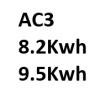
Battery wise it will be 8.2/9.5 ac coupled or a Powerwall (availability is they key driver).

The peak was ideal for the purpose of what I might need to control it, such as an eddi and zappi.

K
#23 kram

THALL

Thanks. That’s really useful.
Is the the max you put out or is it capped by the inverter etc?

S
#24 stevelewis

kram you might want to check availability of 2x 5.2kWh batteries as an alternative. It's what i went for last month when the lead times for the 8.2kWh batteries started pushing out.

#25 THALL

kram Both inverters were capped export. So I get the full wattage inside the home and export to grid is capped. To be honest I do not understand how it is done but they assured me I get max wattage. I have seen generation just under 6kw and export sub 4kw.

After having my system for a year I do want more panels, more the better. In the Summer I will be exporting too much but in the winter I want to grab as much as possible. Take Christmas day as an example, my 7kw system generated 1.9kw and my home used 21 so I want more generation.

Y
#26 yandards

@kram @THALL agree with Thall here, it's about getting generation to cover 6-12 weeks over the shortest days with the worst weather as that gets you less grid dependant.

PV panels are not the largest cost factor anymore if you are going for a battery and inverter setup alongside. For the cost of another £300 in panels for an extra 750w of peak generation or so versus deciding you want them later and paying a lot more than that for extra scaffold etc. versus the connect up as part of an install.

That all said I'd really like another inverter and battery as I saw 6.2kw of generation today from a 6kwp array (it's is possible as the peak value is at a fixed solar radiation value).

I've yet to find anyone who has 'enough' PV!

K
#27 kram

I do agree the panels are not the largest cost, but having to move a flu and extractor outlet would mean significant costs on roof work.

That’s why I say no more. If you have the usable space then sure, but spending a few thousand extra probably means I’m better off having a larger battery and off peak importing for bad winter days.

#28 THALL

I may end up looking at a second battery once I have the EV. Because the charging will not work exactly how I wanted I can benefit even more in the Summer with a second battery to top the car up. Another 8kw free vs grid at 5.5p. I have to actually get the EV and try it for 6 months then look at the numbers. But if I can get a second battery installed cheaper than EON quoted (£800 install cost) it might make sense. But first I want 6x 545watt panels added! Aiming for a nice 10250watts of generation 😃

K
#29 kram

That’s a very nice amount of generation…

#30 THALL

Would be even better if south facing! Or if I could actually get them installed. First installer has gone very quiet since sending the quote March 1st, my other installer is fully booked until October and my third option has a 3 week wait. Everyone after solar

T
#31 Tim

THALL I consider us very lucky to have asked for a quote at the beginning of December with a promised installation in January. I did tell the installer not to promise anything he couldn't deliver but we must have hit a sweet spot and we had just over 12kWp of just-west-of-south-facing PV with two 5kW inverters and two 8.2kWh batteries installed in the third week of January. It's fair to say that 32 panels on one roof has it pretty much covered. I'm wondering if the array will help keep the house cooler in summer because of the shade it casts on the roof tiles.

We did initially consider additional battery but it would take forever to pay for itself and wouldn't really benefit us except on the marginal autumn and spring days. We have been largely self-sufficient since early February, with our EV charging when the batteries are fully charged. There's currently 100% cloud cover but it's quite high and the day is bright outside, so about 4.5kW going to battery. Should be at 100% by early afternoon. I guess our bit for the environment is exporting all surplus at the rate of up to 3.6kW. We've had some days with export of 10-15kWh with no SEG.

#32 THALL

Tim Now thats some nice generation. My 7kw exported 16kw yesterday which I should get paid for on SEG, but Octopus have done something to my meter and now they struggle to get data off it. It has been a problem since December 31st but they assure me no data will be lost.

K
#33 kram

We’re having issues following a meter swap too, which seems to be taking a very long time to resolve.

That mega array is truly impressive, sadly we don’t have anywhere near enough roof space for that sort of thing.

On availability we are looking for a July install, with 6.4kWp of REC panels and now sadly non GE parts.

GivEnergy batteries were on a lead time of “just get the solar in and add it on 6-9 months later with every installer we spoke to. The inverters are better but no firm date or dates on the gen2 , with higher on battery output means that’s a long wait too.

The Huawei system was pretty impressive and had good output both from panels and the batteries.

The installer actually had a small number of newly delivered Powerwall and GW2 physically in stock, which means battery wise that’s what we are doing. Plus it has the grid limitations built in from what I understand.

Will keep an eye on the GE systems for another family member and probably hang around for that.

As mentioned though, people have gone mad for solar so parts/installation have a very long wait and I think July/August is pretty good currently.