
AC3 Over voltage errors

13 comments started 2023-08-23 last 2023-08-24
GivEnergy ProductsAC Coupled
S
#1 SilverArt

I'm suffering over voltage problems at present (AC3), needless to say I'm chasing the DNO, however:

Out of curiosity, what's the difference between a BMS Over Voltage Error '536870912' and a BMS Over Voltage Error '8192'. I've only ever seen the '536870912' one in the past but yesterday it reported as '8192' in the log.

The other challenge yesterday was that the AC3 stayed in error (batteries not charging) for a protracted period from 11:00 until 17:10 just after I reset it, despite some sub 253V grid voltages. My (Growatt) inverter appeared a little less fussy/recovered when needed during the day.

It has struck me before that if there is an over voltage problem the AC3 (Inverters as well?) should continue charging, or even go into maximum charge mode, (everything else being OK) as a default rather than just shutting down and effectively making the problem worse by reducing the load.

R
#2 rjp

I think there's some hysteresis involved. At over ~253V it starts to lower the solar generation, and it doesn't revert until the voltage drops to ~248V. (Figures are approximate 🙂 )

When the de-rate starts this increases the PV string voltage, and if that hits 500V then the inverter can effectively shut down entirely - no PV, no battery discharge. Fix for this issue is apparently in beta on AC3.

R
#3 Rubikcube

I recognise those numbers!
536,870,912 is 2 to the power 29.
8192 is 2 to the power 13.
No idea what they have to do with over voltage errors.

As far as I know, BMS over voltage relates a battery condition. I had two in May, one in June, and none since I upgraded my battery firmware from 3008 to 3013.

I have hybrid not AC3 so my experience of grid over voltage will be a little different. I had a few instances of grid voltage exceeding 253 volts in June (no correlation with the BMS errors). Nothing reported in the notifications, the inverter simply stopped outputting whilst the grid was over voltage. The battery continued to charge from solar, and generation was clipped. Not sure if the issue was fixed by the DNO or the Met Office 🙂

Agreed the logic doesn't work well for AC3, as shutting down makes things worse. Don't know if a hybrid will charge during over voltage as I only do timed charge during the night and over voltage only happens here during the day.

#4 Windy Miller

I have been plagued by this since our install late May. Our AC3 will back off at around 255v grid voltage and needs a reset if it rises above 257v. I get these voltages in early afternoon on a good sun day when our battery is full. Our Solar edge inverter can produce 6kw which lifts the supply by a few volts. Early afternoon seems to be light load in our neighbourhood so with others also generating we regularly go over the 253v top limit. Interesting that the Solar edge never backs off, just the AC3 which thinks there is something wrong.

DNO measures 248v at the substation and at our isolator switch so rightly it isn't their problem. GE have said they need to increase the tolerances on grid voltage but this needs new firmware so it's in the pipeline to do apparently.

As the Sun zenith lowers in the sky we are getting less (just 4 notifications in August as opposed to 30 in June) so we might be OK until next Spring.

S
#5 SilverArt

rjp Rubikcube Windy Miller

Thanks for the replies. In my case they all relate to the logs showing an ERROR status with a Grid Voltage of over 253V. As I've been monitoring this for the past couple of months I can safely say that as long as the dno keeps the average voltage down to 240 V everything rune fairly painlessly. However, if they let the average get up to 247V then all hell lets loose on a sunny day.
The challenge is that they set it at the substation to the tapping just below 253V. That's fine in the old days when it was pure sledgehammer supply. Today however is somewhat different. In my simple terms (I'm sure there is a much more complicated 'proper' version)... Once upon a time dno's could fix any voltage problem by just increasing the voltage, they just matched their generation to the absorption rate of the users making sure they presented the maximum allowed, that it turn made sure they met their minimum values by balancing out the load locally... Nowadays with all of us lovely PV generators two things happen: On a bright day the demand on the dno decreases due to self generation therefore their voltage effectively goes up as the overall load on them is decreased. If that isn't bad enough for them the PV customers who export effectively take some load off the local network, therefore increasing their voltage further.

The problem we then have as generators is that the only way we can export is by presenting a slightly higher voltage and if the dno's don't give enough headroom the over voltage errors will continue. One engineer... "We don't understand why we've got loads of these over voltage reports"

Back in June my average voltage was about 240 V and I had 3 over voltage errors, in July the average voltage was 246.4 Volts with 337 over voltage errors. I'll let you draw your own conclusions as to whether a (7 volt apparently) tapping change could have caused the problem. It could even have been a tapping change further up the network I suppose.

Fingers crossed for a quick GE solution to ease the problem.

R
#6 rjp

Rubikcube I recognise those numbers!
536,870,912 is 2 to the power 29.
8192 is 2 to the power 13.
No idea what they have to do with over voltage errors.

Bytes being dropped on a serial modbus connection...? 🙂
536,870,912 = 0x20 00 00 00
8192 = 0x20 00

R
#7 rjp

Windy Miller DNO measures 248v at the substation and at our isolator switch so rightly it isn't their problem. GE have said they need to increase the tolerances on grid voltage but this needs new firmware so it's in the pipeline to do apparently.

If you've got over 5V difference between the isolator and the inverter you need better/thicker cable! How long is that cable run?

R
#8 Rubikcube

Current engineering recommendations state (on page 31) that generation should stop when voltage exceeds V+14% (262.2V) for more than 1 second. Paragraph 10.1.2 explains why it is higher than DNO max limit. In my opinion, Givenergy equipment is wrong to stop generation at around 253V (ish).

S
#9 SilverArt

rjp DNO measures 248v at the substation

That's the problem.
As I understand it the transformer 'tapping' changes by 7V per tap and the transformer is set at the first tapping level that gives them a voltage below 253.
From what I can see with solar it only really works if the tapping level is down one more 'tap' giving the (solar) systems the overhead that is needed.

#10 Windy Miller

rjp

The 248v is a one off measurement without the Solar inverter running. So, as described in other posts, light loading and lots of generation in the street rises at least 5v. Also at times I can see more than 248v when my grid connection is balanced. Maybe other larger generation in the district?

R
#11 Rubikcube

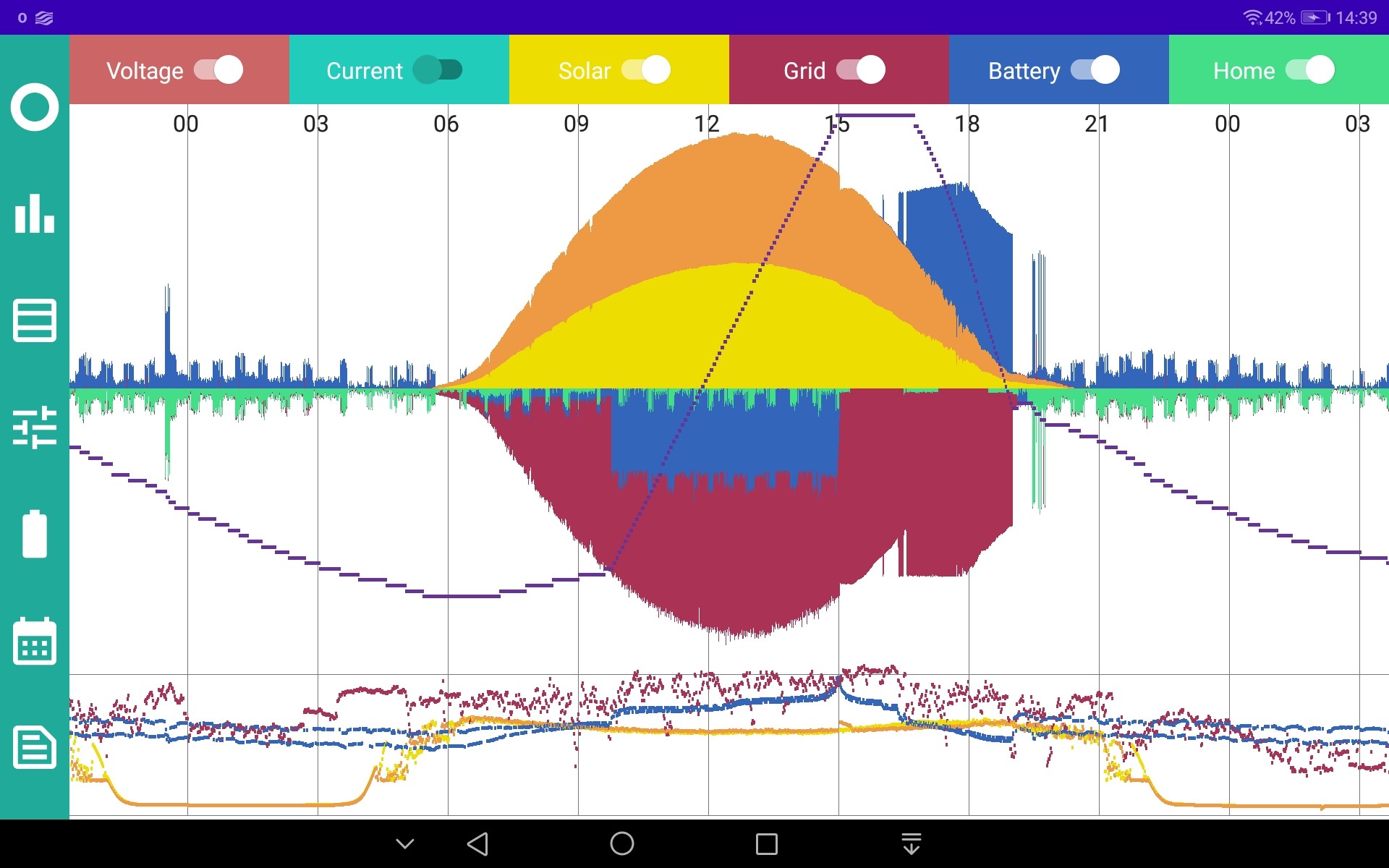
On my Hybrid Inverter, the voltage at which solar generation is curtailed is higher than the voltage at which battery output is curtailed. This image (from 29th May) shows that at 4pm solar export continued but battery discharge was curtailed whilst voltage was high.

S
#12 SilverArt

Rubikcube Is the horizontal line a fifth of the way up showing the 253V level?

R
#13 Rubikcube

SilverArt Yes. This isn't currently documented anywhere. The voltage ranges are:
Solar 0 - 440V (I guess on AC3 this is grid voltage)
Grid 207V - 253V
Battery 46V - 56V (probably won't work well with AIO)
For completeness, the current ranges are:
Solar 11A (only really applies to hybrid)
Grid 60A
Battery 80A