We have solar and battery but no electric car charger. We use about 10 to 12 kw per day during winter I'm currently on flux, which has been great at building some credit.
I have spoken to Octopus about the intelligent as that seems like the obvious choice. However, they informed me that its for EV owners only and you have to do a test charge through the app (or something) .
Seems like GO is my only other option?
What are others with home battery but no EV thinking on switching to?
K
#2Karen
You need an EV for Go as well (although a few people managed to bluff their way onto the tariff without one!
A
#3Arg0t
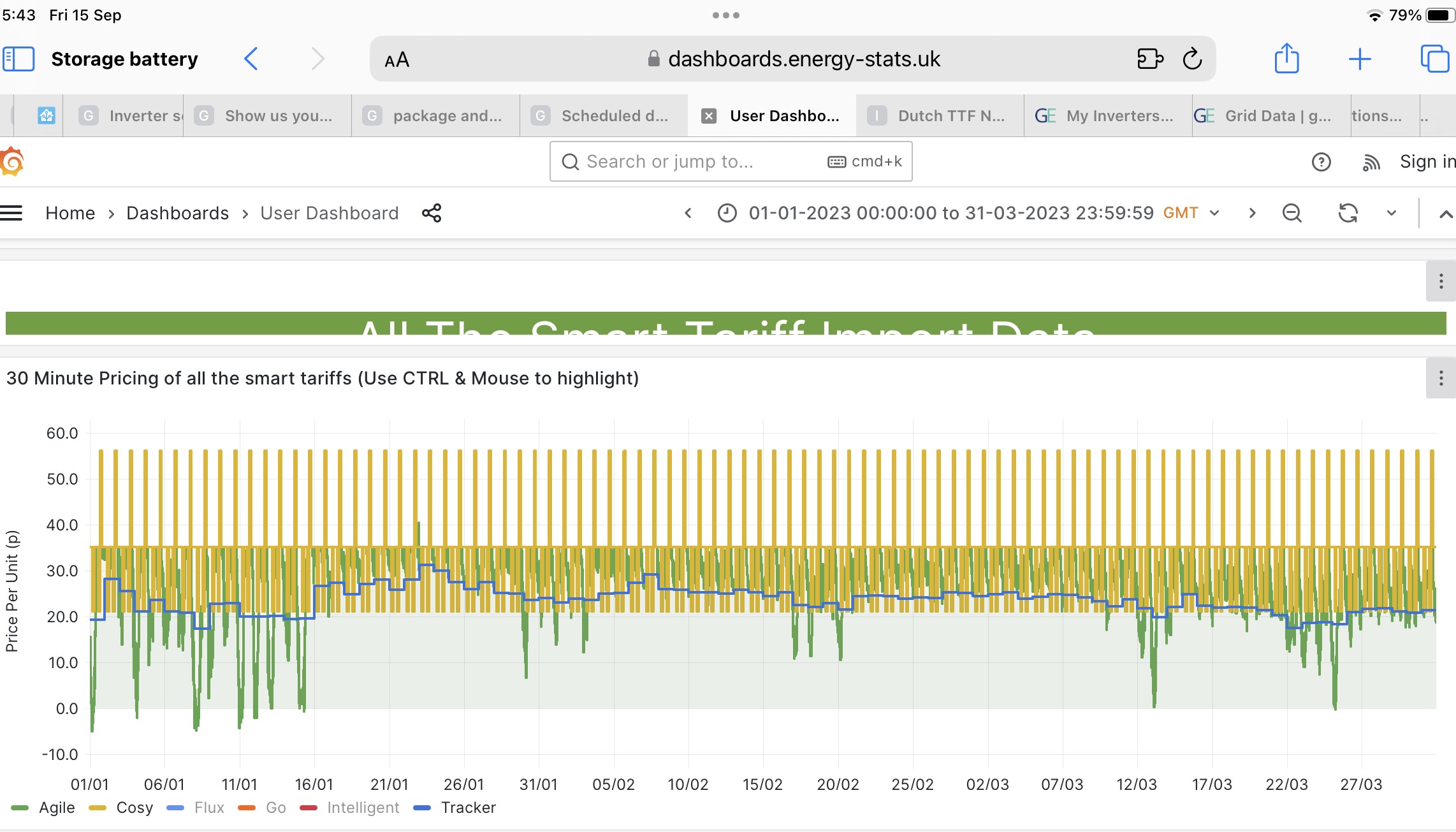
If you do not have an air source heat pump (ASHP), Tracker or Agile. Cosy if you do.
Tracker has a daily rate, generally trends a few pence a kWh higher than lowest Agile rates.
Agile has a 30 minute rate, you would need to automate battery charge at lowest rates windows.
For simplicity go with Tracker. You pay slightly above the very cheapest but avoid headaches of when to charge, conversion losses and reduce battery cycles.
I will go tracker, run from grid, setup a simple automation to charge if one day has an attractive rate.
U
#4Ulven
I was on go before I switched to flux. Although, my account was transferred from Bulb who had a similar product.
I'll have a look at agile and tracker as well.
T
#5TX200
Economy 7 is also an option.
Although not sure I’d recommend it. A few people having billing issues with it!
There is also Flux which has three different charging tariffs per day
And in testing, Octopus Intelligent Flux which has a three hour peak and the rest is off peak. Only works with GivEnergy systems at this time. And they take full control of your battery, charging and exporting when they want to. But they do sell any export at the same price as import. So you could make a bit of money back with a decent solar array.
A
#6Arg0t
Flux has three hours of low rate charging per day, if you have a Gen 2 inverter you can import, to battery, 10.8kWh a day at the low rate plus your load during that 3 hour window.
Cosy has 2 x 3 hours, so 21.6kWh potential, plus your load during those windows.
Agile has no guaranteed rates, you charge in the number of slots required to meet your demand, and ideally you chose slots with the lowest cost. There is automation for this utilising home assistant.
Tracker has a single daily rate with a simple formula.
Base your choice on your personal home energy usage, your expectations on PV generation to supplement and the amount of effort you want for negligible monetary amount.
You can switch Octopus tariff monthly, so back to flux in March/April is possible. For me flux is more beneficial in summer months (I use more than I can import in the low rate window). You can only switch to tracker every 9 months.
Our battery capacity is fine to last us through a night in the summer but won’t be anywhere near enough to run a full day with the ASHP on. Although we have a large solar array, my experience of last winter was that the batteries didn’t charge to 100% until somewhere around April, so I’m not going to rely on solar and will have to draw from the grid.
Only issue with Tracker is a 9 month freeze-out before you can go back onto it next winter. So hence thinking about going onto Tracker for just the really cold winter months. I may stay on Flux or go onto Cosy for the Autumn/Spring periods
R
#8Roberto
You haven't told us what rig you have but, why not go on E7. Charge your batteries on E7 then plan to never use the standard tariff. Now, that does assume you battery can run your home when on the standard tariff and that you don't want to pull 12Kw
J
#9Josie
We have a 5.81Kwp system with 17.7kwh battery and our usage is similar to yours on a wash day, a bit less otherwise. Flux has been amazing for us since we switched mid-March. We fill the battery as much as we can overnight at the cheap rate and export as much as we can between 4 and 7pm. Last year we were on Agile and as we don't have HA it was a faff and there were many days where there were no cheap slots to charge the battery. We're planning to stay with Flux and see how we get on. If we are at 75% by 4pm we can discharge for the whole 3 hours and still cover our needs until 2am. As the days draw in we will need to stop exporting earlier but the rate is so good that we're going to see how it goes.
G
#10geoffreycoan
Roberto For me personally E7 wouldn’t work because I would have peak draw. We have 14kW of batteries, a 10kW array and consumption of 13-18kW a day in the summer. In the winter its easily another 20-50kW a day more, sometimes up to 70kW if its really freezing cold outside. I’m hoping my usage will be lower this year as I’ve got more used to running the ASHP in an optimal manner but I simply couldn’t add enough battery storage to consistently run the house from. So hence my thinking on tracker to give the flexibility and not worry about different rates
R
#11Roberto
geoffreycoan didnt realise you had an ASHP. That does change things rather.
B
#12BarleyRiser
Ulven Not my understanding of Intelligent Flux. I've applied without EV. In fact I thought it wasn't allowed if you had an EV.
T
#13TX200
BarleyRiser there's two intelligent tariffs, some confusion maybe.
Intelligent Octopus came first, for EV charging - limited EVs and/or EV chargers that Octopus can control. It has a very cheap off peak rate (6 hours I think, plus some bonus hours that may change on a daily basis)
More recently Intelligent Octopus Flux came along - that doesn't require an EV. It does require a compatible home battery and requires Octopus take full control of that battery/inverter - Octopus decide when it charges/discharges/exports.
IOF has a three hour peak period (4-7) and the rest is off peak. Export rates are identical to Import rates. I think it's something like 20% cheaper than standard variable off peak and 10% more expensive than SV at peak (or maybe those percentages are the other way around).
M
#14mrand31
geoffreycoan For me personally E7 wouldn’t work because I would have peak draw. We have 14kWh of batteries, a 10kW array and consumption of 13-18kWh a day in the summer. In the winter its easily another 20-50kWh a day more, sometimes up to 70kWh if its really freezing cold outside. I’m hoping my usage will be lower this year as I’ve got more used to running the ASHP in an optimal manner but I simply couldn’t add enough battery storage to consistently run the house from. So hence my thinking on tracker to give the flexibility and not worry about different rates
FTFY 🙂
B
#15Brieanne
Ulven I have PV & battery and just switched to flux from flexible (I was a bulb transfer). I am waiting for the export side to be activated so for now just on flux import. Gives me chance to charge battery and run appliances on about 18p/kWh from 2 to 5AM. Seems OK so far.
G
#16geoffreycoan
Brieanne Yeah Flux is a good tariff particularly for export. There’s been different discussions here over whether its worth changing as we get into winter and theres less solar so less likely to be exporting. If you have an EV then Go will probably be better, and if its a heat pump then Cosy or tracker/agile.
For simple overnight cheap filling of the battery Flux is still good.
Its likely to take a couple of months to get your export setup. If you contact the DNO directly you might be able to speed up getting the export MPAN which is what I did as it got stuck in Octopus
B
#17Barns
geoffreycoan I've moved to Cosy for the heat pump over the winter. But I'm trying to figure out whether it's worth registering for export at whatever that rate would be (15p?) Vs staying on deemed export for our existing 4kW FIT array, where we get about 5.9p or something for half our total generation. Since I expect we will use most of our generation next summer now we have the AIO, I'm not convinced we'd export enough to make it worth the higher rates losing the deemed. Tricky calculation though!
G
#18geoffreycoan
Barns I would say its unlikely to be worth it until next summer as you won’t have a lot of excess solar soon and it’ll take 2 months to get the export setup.
We moved to measured export as part of out moving to Flux this summer and had to give up the FIT deemed export payments. I was giving up about £100 a year of deemed exports on the 4kW FIT array but our new arrays are 10.4kW and even though we only got our export setup on 10th August we have received £171 in a month.
Flux export is 19.7p during the day and 32p in the evening peak and you’ll only be able to get 15p with the standard octopus export.
But if you go onto flux next summer, definitely worth it