Non Solar PV install

9 comments started 2022-03-20 last 2022-03-21
CommisioningGivEnergy Products
R
#1 Rscanners

Hi all,

Been pointed towards GE & want to sanity check my aim and how it works in the real world of anybody here has the same set up? Most of the stuff I’m reading is going over my head so thought I’d ask the question.

No Solar - just intend to have a battery and inverter with the intention of charging using cheap electricity from the grid over night and using battery power during the day when electricity from the grid is at its most expensive.
Is it easy enough to achieve this?

Can you power the whole house from the battery - presumably the inverter is the weak link at 3kw (?) what if the power draw at any one time exceeded this - would it draw excess from the grid?

Also - would like the option to use battery power during any power cuts… get a couple of hours outage every 6 months or so… Eunice was 36 hours! (Overhead power lines).
Sounds like it needs to be wired to achieve this…. Would this be a manual switchover using GE solution?

Thank you for any input
K
#2 kram

If you want to support off grid for 36 hours without solar I think your looking at the wrong solution.

If you want to cover a couple of hours on basic loads then it should work.

If you look at the new v2 hybrid it’s more powerful than the v1 and I’m not sure if the AC will get a v2, perhaps in the 3.6-4 kW range.

My understanding is that the times charge/discharge is pretty simple though. If you pass the inverter limit on grid, then the rest should come from the grid.

When off grid, the inverter will trip if you pull too much and if happens too much you can damage the inverter/battery.

To work when the grid is down you’ll need your own earth (not grid) and to fully isolate from the grid before power is on. You’ll then need to get permission from the DNO in case it exports.

R
#3 Rscanners

Thanks for the reply, very useful.
Definitely not expecting 36 hours off grid - but a couple of hours here and there for the essentials. Main objective charging from lower price electricity and using during the day.
That said, without an EV I wonder how accessible those cheaper (circa 5p) off peak tariffs will be - just read that Octopus Go have now added a requirement for an EV to their terms - how they enforce it I don’t know but doesn’t seem as an attractive idea if I can’t access that rate.

K
#4 kwmc

Your idea is fine. An A/C coupled inverter and battery will do the job. In normal opeation, if you exceed its capacity then the rest will be drawn from the grid. You can potentially charge it at a cheap rate and use it at a ore expensive time. However you have correctly identified that the cheap EV rates are not really available to non-EV owners.
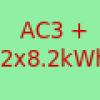
The A/C coupled inverter will supply enough for lights and an appliance reasonably well when connected to the grid. It will handle lights and a fridge/freezer in a powercut using its built in EPS circuit.
THe big problem will be getting a good charging tariff for a non-EV owner. I'm still trying to find such a tariff.

#5 THALL

Rscanners The EV thing is hard to enforce, it is more a clause that if you are found not to have an EV they can move you at their discretion to another tariff. Maybe in the future they will check against the DVLA or something but for now you should be fine.

R
#6 Rscanners

kwmc

Thanks for your input.
I’ve done the maths using what I believe to be correct figures and right now using Octopus Go it works out cost neutral. Perhaps I just don’t use enough energy to warrant it even though it sounded like a good idea in my head!

That’s based on 2.5KW charge rate per hour - taking the battery from near empty to full every night during the 4 hour window of 7.5p rate.

Then discharging 8KW during the day (is that achievable?)

With a current daily average usage of 16KWh.

So that would “move” half of my daily usage to “cheap rate” but the other half would be at a higher cost with a higher standing charge.

With a 50% uplift on electricity costs coming up (and the Go rates not changing at all in that time) it would take 8 years to recover the cost of installation!

#7 hoggy

It's a tough ROI on sole battery & time shifting. Far too many variables to consider and your making a lot of assumptions - the biggest of which is trying to predict the cheap / peak rate delta over the next decade.
With PV you are somewhat guaranteeing a portion of "free" energy into the mix which is really where the savings can be had combined with batteries and some degree of forecasting to top it off each day.

I'm sure that you have a very good reason for not going for PV aswell but even a small install can be quite effective over summer even without storage (even if it's say on a garden shed/garage roof.)

#8 Woodlands

hoggy I'm sure that you have a very good reason for not going for PV aswell but even a small install can be quite effective over summer even without storage (even if it's say on a garden shed/garage roof.)

That can also help you achieve the 5% VAT rate on the install.

K
#9 kram

Tbh, I’d say don’t bother without solar. If you can find space for 2.5 or more of solar go for it as it provides backup.

On their own batteries barely make financial sense and whilst I don’t be going GE for ours, I don’t think it will ever pay for itself. The battery is more about having bill predictability with solar and a bonus of backup power.

If you’re not adding solar, you might genuinely be better off buying a small generator for critical loads. It has the advantage that you can buy petrol/diesel to top it up for or during the longer power cuts.

If you can add solar then the battery option would do exactly what you need.