
Battery/Inverter Efficiency

17 comments started 2023-11-24 last 2023-11-25
GivEnergy ProductsAC CoupledBattery
6
#1 666tim666

I have an AC3.0 gen1 inverter and 9.5kWh battery. I have recently been using it with Octopus Agile to charge at cheap times, selected daily using their supplied half-hour tariff rate information, and then to discharge running the house at all other times. This works OK as our daily usage is usually less than 8kWh - frequently also offset by PV when the sun shines a bit.

I have been disappointed to find that my grid usage has increased significantly, and that seems to arise because the battery/inverter system uses more than 100 watts just to operate. Even setting aside the night battery charge time this adds more than 2kWh to my daily load which represents an increase of 25%. So maybe using the battery might be good for the planet, but not quite as good as I expected.

So the business of charging the battery at certain, usually night, times and then running my house from it still saves me money, but I am not sure about wasting this extra energy.

Do other people agree that the battery storage systems use a lot of power? Should I scrub this process and change back to a normal grid tariff and let the batteries stand idle when they are flat?

S
#2 SilverArt

If you are flat out charging at 3kWh it will be less efficient, probably from the inverter point of view as well as the battery. I've an AC3 on an E7 tariff And try to keep my charge rate below 2kWh if I can, it helps keep inverter and battery temperatures down
Views on 'efficiency' vary, my guestimate based on what I'd read was 7.5% loss in-bound & 7.5% out-bound and it's close enough to help me get through most days without daytime grid usage except for 'system noise'

6
#3 666tim666

Thanks Silverart
Yes I agree that charging at 3kW would be likely to be more inefficient. I think that it stresses the batteries and inverter, and as a rule I charge at 2kW, and to a level of about 80% SOC, and discharge daily to about 15% SOC, so as the avoid the endpoints. If the tariff looks useful over a longer night period then I use that advantage, limiting the charge rate to 1kW or 1.5kW.

However, that does not fix the fact that when I look at the dashboard on the givenergy portal, it shows that with a load of 150 watts and no grid import or export, at night (no PV activity), the battery is drawing 250watts. And I am using significantly more power from the grid than I normally do in November.

Yes, I can get through the day without material grid usage, but my concern is that overall, I am having to draw a significantly greater amount of grid power in at night than I am able to get out during the day.

R
#4 Rubikcube

666tim666 let the batteries stand idle when they are flat?

The short answer is NO.

My system is similar to yours except Hybrid. I also use about 8kWh per day and have to put in about 10kWh to get 8kWh back out. It is tempting to think that the charger and inverter are each 90% efficient, so 10kWh in results in 9kWh stored, and 8kWh back out. But it is not quite so simple.

With my panels disconnected and the battery turned off, I measured my inverter (with dongle) consuming 16 Watts. 16W times 24 hours means it consumes about 0.4kWh per day on it's own. Put simply, if you just had an inverter without a battery, the result would be a portal full of zeroes and about £40 extra on the annual electricity bill.

The battery has a BMS which consumes a surprising amount of power. Because it is powered by the battery, I haven't been able to quantify it's power consumption, but based on the heat it gives out it could be similar to the inverter. So that could be 0.8kWh per day for the system standing idle.

Like an energy bill the system has a "standing charge" that has to be taken into account as well as the conversion efficiencies. Letting the system stand idle without actually switching it off will still incur this energy consumption.

Finally, no energy is ever wasted, it is simply converted to heat. So if the inverter were installed in a room heated by a thermostatically-controlled electric panel heater, no extra electricity would be consumed.

S
#5 SilverArt

666tim666 The challenge is seeing exactly what the real difference actually is. Every reading you see on the portal is a millisecond in time snapshot, you don't know whether it is static, or moving and if it is moving in which direction. it could be at a higher or lower level for the next 5.01 minutes with perhaps even a 3kW period included and you'd never see it.
If I look at my differences between Battery Power and Load Power it ranges from 53w through to 1500w. during non-solar hours.

6
#6 666tim666

SilverArt Thank you for your reply.
I don't agree that the figures displayed on the portal are misleading because they are snapshots. They are genuine and I assume accurate reports of what the inverter and battery are doing at the time that they are issued. If the figures deviated in one direction and then another, then the average would be in between. However, when I check them at night, when the load is not changing much, and there is no solar PV activity, the numbers stay in one direction, and that direction is negative. I haven't calculated the average although I could, I have just looked at the portal graph and checked the difference between the battery output and the house load at a few points. 100 watts is a generous estimate. It takes no account of any loss with the charging process.

If you have a 1500w load period then something has been switched on. My reported load varies from more-or-less nothing to 300watts (if the fridge and freezer decide to operate). But that doesn't change the fact that most of the portal readings show a similar story. Readings taken by Home Assistant say the same thing.

The reported load power is a derived figure - there is no meter measuring the house load and all of the wires are just joined together in the consumer unit(s). So the inverter can only derive a figure for house load by measuring the power being output from the inverter, adding the figure for grid import and adding the figure for PV generation (this is an AC3 inverter, not hybrid). If there is no significant grid import or PV generation then the inverter is outputting what the house is using. So if a portal figure tells me that the house load is 200watts then that is what the inverter is measuring at its output. If at the same time it tells me that the battery draw is 300watts then 100 watts is going in heat.

6
#7 666tim666

Rubikcube Thank you for your reply.

Yes, I agree that the inverter uses power when it is doing nothing. I have noted this because, when the battery is flat, and therefore idle at the reserve SOC level, over a period the SOC level drops, and then at some point the system decides that it needs to recover the charge level and turns on charge for a short period. This suggests to me that when the system is idle it powers itself from the battery and not from the grid connection. I don't know what an AC3 system (and a battery pack) uses when idle - maybe somebody does. We do have PV generation (in excess of house load) even in winter which would help to offset the cost of idle batteries.

Last winter my system sat idle most of the time. I can look back and see how quickly it lost the reserve charge and how often it recharged from grid. This should give me an idea of the idle load.

My system is in a separate garage and so heat generated is lost. When operating the batteries warm up a bit which helps them as they are supposedly more efficient when warm. Early this morning the cell temperatures were about 17C.

The Octopus flex tariff was just below 27.1p/unit (inc VAT) when I switched to Agile and frequently I am charging the batteries at about 20p/unit, and so there isn't much room for inefficiency in the charge/discharge process. The savings arise on the exceptional days when the Agile half-hour rate drops to 5p, 3p or even -ve per unit but they are the exception. But nobody has convinced me yet that while saving some money, I am also helping with climate change.

#8 hoggy

Having taken one apart I do know that the battery current readings are taken from the HV DC side (before/after it drops down to 51.2V depending which way your going) rather than the battery itself, so there is some losses you don't see.
PV 1 and 2 are measured at the MPPT.
Everything else is monitored on the AC side (P inv, P EPS etc...)

6
#9 666tim666

Rubikcube Thanks for your reply. Please also see my previous reply.

I have reviewed the portal reported SOC state of my battery when it was idle last January. I have looked at the behaviour over several different periods, mostly at night.

The reserve was set at 4%. The system cycled, discharging the battery over a number of hours and then when it reached zero, charging it at about 2.8kW until it reached 4 or 5%. The period of discharge for 1% of SOC was between 3hr 20min and 4hr 45 with a few outliers when the BMS didn't know what it was doing. The average was conveniently about 4 hours. Discharging 1% of a 9,500Wh battery over a period of 4 hours works out at a rate of 24watts.

So it seems that my AC3.0 Gen1 inverter and 9.5kWh battery consumes about 24 watts when its idle.

So I can:

  1. Stay on the Agile Tariff and save myself some money but at the same time use an estimated 100watts from the grid to heat my garage.
  2. Scrub it and use Flex Tariff which will cost me more but at the same time will only heat my garage at a rate of 24watts from the grid.

So I will do 1. of course but I am disappointed by the losses. I don't trust the accuracy of the figures coming out of the inverter and recorded by the portal. Does anyone have a suggestion for an accurate bi-directional meter to put on the inverter interface that will feed figures to Home Assistant (preferably without going via a cloud)?

The manual process of selecting the specific Agile tariff half-hours for charging is a bit inconvenient. I am still looking for an automation for this, probably to run in or with Home Assistant.

6
#10 666tim666

hoggy Thanks for your reply.

Does the inverter use a similar EM115 CT meter that we see on the grid interface to measure the inverter power input and output?

#11 hoggy

666tim666 nothing that I could see, that side is external via the EM115 meter.
It uses Tamura 'L18P' series current sensors for the MPPTs and EPS stuff.
LEM 'LAH' Series for the battery DC measurements. So atleast you can now work out accuracy of those parts.

I did have a nice (& complimentary in regards to quality) teardown stuffed with pics but despite just using eyes and common sense it was viewed as being commercially sensitive so after the tap on the shoulder I had to pull it. It's screwed to the wall now doing something else anyway so that's that & found something/someone else's to play with.

6
#12 666tim666

hoggy Thank you for that information.

The LEM 'LAH' series look pretty accurate and as a packaged item with clamp and electronics together so it should be.

R
#13 Rubikcube

To choose the best tariff, you need accurate figures. The portal is great for pretty graphs, but not so clear when you want figures for calculations. That's why I wrote an app that gives you the figures you need.
https://play.google.com/store/apps/details?id=uk.rubikcube.invertermonitor

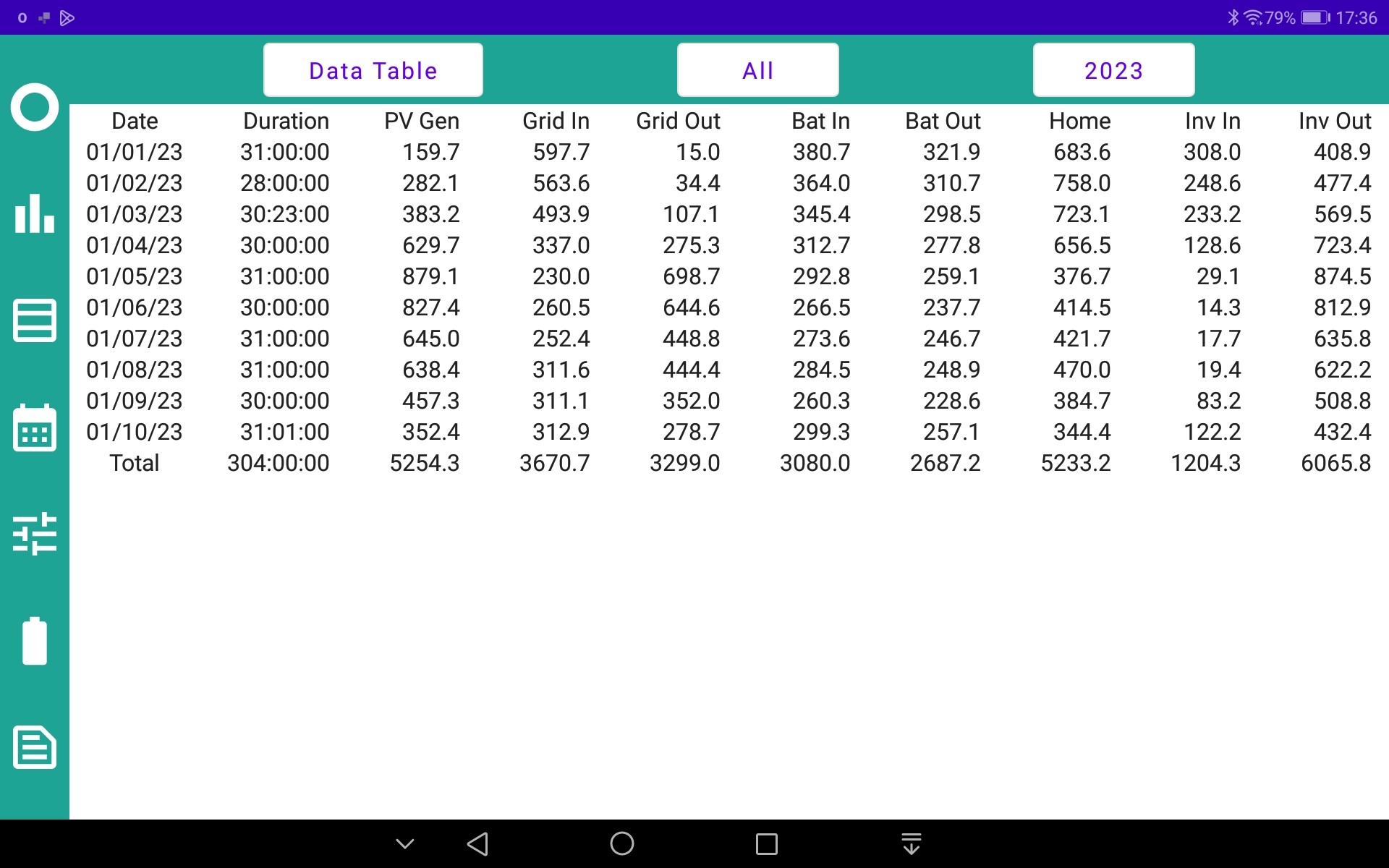
Here are some of my figures for the year so far:

The total "losses" are Bat In - Bat Out = 3080 - 2687 = 393kWh. Dividing by 304 days gives 1.29kWh / day. The losses on an AC3 will probably be higher because a hybrid can charge more efficiently from the panels.

The app derives the figures from the meter values recorded by the inverter. These are the more accurate than day figures or integrating samples. I have written a tutorial for how to get historic figures into the app.
https://givenergymonitor.wixsite.com/tutorials/portal-transfer

N
#14 naltsta

Rubikcube I’m interested in the different efficiencies of different processes. Is it more efficient to charge from panels than the grid because it’s DC DC?

In the summer when I was in flux I was charging overnight because the day export was slightly more than the cheap overnight import. Was that foolish if the grid charging was less efficient than the solar charging?..

R
#15 Rubikcube

naltsta As long as your day export price was more than 10% above the night import price, then what you did was sensible and efficient, unless it resulted in your generation being clipped due to a full battery.

I have written another article about clipping.
https://givenergymonitor.wixsite.com/tutorials/clipping

N
#16 naltsta

Rubikcube wasn’t as much as 10% - importing at 18p to charge my battery so I exported more during the day at 19p.

What made you say 10%? That sounds high to me as even if that’s the charging from grid efficiency, charging from solar can’t be 100% efficient either…

Maybe I shouldn’t worry about it as current flux rates look like the day export is always less than the cheap import anyway so doesn’t really matter for next summer.

R
#17 Rubikcube

naltsta I added a profit margin 🙂 The break-even point is probably around 6% maybe 7% so I don't think you really lost anything.

As you say, I think Octopus was a bit over generous this year with Flux because it was a new tariff.