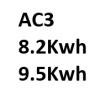
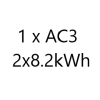
Hi there, I have 5 hours on Go.
The battery starts pumping in 3kw for a couple of hours then tapers off.
Is there an optimum efficiency to charge these? Even at 2kw I still have an hour to balance it if it’s completely flat.
I’m planning on getting 20 years out the battery so wondering what’s best.
#2THALL
If you have set timed charge the battery will not discharge until that time has passed, so once fully charged its charged. During the rest of the time any appliances will draw from the grid not the battery. I have just requested the change to go faster 5 hours 2130 to get some appliances running earlier. Sadly the 3 hour tariffs and 2030 start times are no longer available :-(
H
#3hamilton
I'm on go faster 8:30pm for 5 hours until July. I never knew how long the balance charging would take so opted for the full 5 hours.
As the price would increase if I did anything to change this tariff I will keep it for the year. During winter I will be importing 80% of my daily needs via the battery.
GivEnergy put a new option on last week to allow limiting the charge current into the battery. I know batteries wont last forever (my day role is an electronics assembly engineer) so i'm trying to punish the system as little as possible.
I've already added active cooling (fans) and I throttled it back charging rates to 2KW instead of 3KW in the effort to make the battery last forever.
Just wondering if anyone (givenergy staff) knows the optimal charging current to give the inverter and battery maximum efficiency?
I also maximize offpeak high loads to reduce round trip efficiencies etc.
#4judgepd
I wonder if it's possible for the charge rate to adapt to the required SOC and time allowed. For example I have 4 hours of Octopus Go and if I want to charge to 100% in that time it would reduce the charge rate automatically so it finishes on the 4 hour mark. If the battery was already 50% full it could automatically charge even slower. Not sure how you'd take account of the grid demand which might be fluctuating during the charging period (or do you not even need to take this in to account as the battery doesn't discharge to meet this demand, it comes direct from the grid during a charge period).
S
#5Sparta
judgepd That is correct, you do not need to taper charge rate and I don’t believe you can even influence that. There certainly is no setting other than the SOC %.
I’m currently on Go Faster 4hr (21:30-01:30) for the winter only, possibly end of Feb/ early Mar, dependent on panel generation. My system was installed on 29 Apr last year and therefore do not have previous data for Jan-Apr. Earlier this week my 5.84 kWp system (Hertfordshire) generated 12.5 kWh/day (Wed-Fri).
I typically charge battery to 100% SOC and run appliances during the price plunge period and with 100A meter tail fuse I have not experienced any problems. I’d expect to be able to draw in close to 24kW before battery charging rate being modulated down from what your inverter can push (as it happens when battery is charged by panels during the day). This week with the sunny weather I reduced the SOC to 75% to save on import and, as long as the charge period is set for the entire price plunge period, your battery will not start supporting the house load (regardless SOC setting and allowing for usual “chatter” between the battery and grid) and load will come from the grid. My battery setting is Mode 1 - Dynamic & Independent Smart charge for the price plunge window and selecting SOC.
#6hoggy
Personally cant see there is much to gain from setting it lower. Its not exactly a stressed battery even at the fastest charge rate on a 3KW inverter they are below 0.4C and only hit 0.5C rate at their max discharge rate of 80A(4KW) - which none of the current inverters can do anyway.
I see the point if your Grid constrained on your supply overnight however.
A
#7anabanet
The heat of the inverter?
Drop max charge rate to 2kw to lower the heat in the inverter by half.
Discharge is usually only a spike to 3.2kw for a few minutes ( kettle etc )
Charge is a long hard slog - so a lower temp for charge is best?
A
#8andrew_bond
anabanet I put some small fans underneath the inverter (on a timer) to aid cooling during charge periods. It was very effective at reducing the temperature, and I think this should prolong the life of the inverter.
A
#9anabanet
andrew_bond Where? Two each side of the 'block'? 80mm fans? 120mm fans? In place of a timer add a thermal switch like a KSD301?
A
#10andrew_bond
anabanet (sorry for the slow answer) I bought an aquarium fan from Amazon (B087LV89DF) and just rested it on top of the battery cables, blowing upwards (the battery is underneath the inverter). I'm using a mains timer socket (which I had lying around) to turn the fans on during my Go Faster charging period. I did think about using a temperature sensor, but my inverter doesn't seem to get too hot when charging from solar as it's a much slower charge rate.
A
#11anabanet
andrew_bond thanks. In the interim, I bought a KSD301 NO thermo switch rated at 45 degrees and a set of 5v cooling fans. I am going to rivet the thermo switch to a block aluminium heatsink, and wire it up to two 80mm fans clipped below the fins. that way when the sensor goes over 45 degrees, the fans will come on - I do have a heat issue when I charge ( I downrated the charge to 2000w to compensate but it still gets to 60 degrees. ) This way the thermo switch will control the fans and force cool the inverter. When they arrive I will build it, and try post a picture.