Battery export is not equal to outgoing grid and house usage.

13 comments started 2023-12-14 last 2023-12-15
Forums/Meta
R
#1 rblog

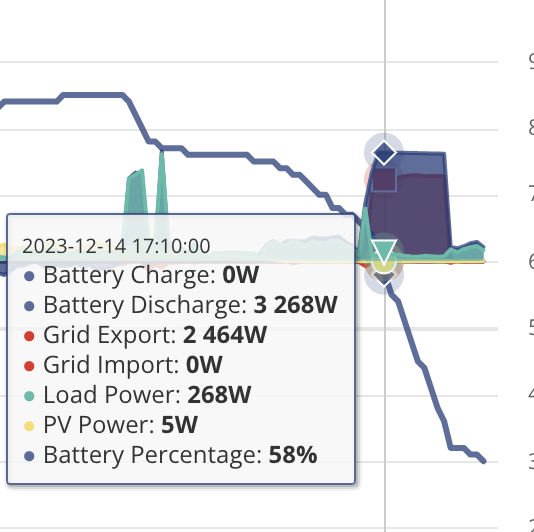
The last two Octopus Saving Sessions I've set my battery to export at full speed. It reports it is exporting at just over 3k, but only 2.3k is shown as going to the grid. This tallies with the figure reported by Octopus.

The house has a background load of around 300w, where is the other 700w going? I don't have any on demand devices, eg eddi/zappi.

System is a AC3.0 inverter, 9.5KW battery and a SolEdge Inverter. The outgoing CT clamp is connected to a Givenergy Energy meter.
D
#2 DD

Probably inverter consumption - inverter itself consumes power to generate AC from DC.

R
#3 rblog

20% loss? I would be very surprised!

D
#4 DD

rblog hmm... Yes. Interesting that you still have a little PV generation - does that affect things? Is the same losses later on?

S
#5 SilverArt

Yours: 3268-2464-268 = 536W
If it's any consolation my numbers are very similar to yours, (AC3, 9.5+5.2 batteries, Growatt inverter)
Battery Discharge: 3351W
Grid Export: 2620W
Load Power: 275W
PV Power: 7W
Mine: 3351-2620-275=456W
The AC3 got fairly warm, the cooling fans licked in and held it at 40C - 9.5 battery went from 13C to 26C, the 5.2 from 12.8 to 20C.

D
#6 DD

I hadn't realised that an AC inverter would be able to report PV generation - isn't that hidden behind the other inverter? Do both inverters connect independently to the meter (via house wiring), or does solar inverter plug directly into the GE inverter, making it a master? Or does the GE system add additional CT clamps around bits of the solar install?

S
#7 SilverArt

DD The AC3 'sees' the inverter as a single string solar array and reports it as such, well at least that is how mine appears to work. They just sit in parallel.
To see the separate solar string performance I need to look at the Growatt data, IMHO nowhere near as good as Giv's data, but rarely use it anyway,

R
#8 Rtidey

During forced battery export I get bizarre figures in the app where it shows significantly more power coming out of the battery (e.g. 3.5kw) then the inverter is capable of. During normal discharge of battery into a house load it maxes out at 2.9kW,

I suspect this is the app getting confused and doing some bizarre maths. When I look at the data in the portal logs then the numbers make sense

D
#9 DD

With two inverters pushing out power onto the AC, do they have to push the voltage up to try to "win" ?

R
#10 rblog

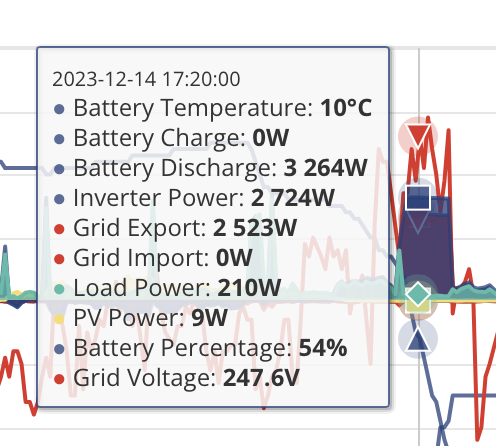
I enabled a few more statistics on the graph. It shows the battery is outputting 3.3k but inverter only 2.7k. I assume both of these are measured in the inverter and nothing external. With the house using 200w, the export of 2.5k sounds right. This matches our smart meter numbers.

Our inverter and battery is mounted on an external wall so shouldn't get hot. Battery temperature increased from 10 to 13 degrees throughout the hour. I cant find any logs of the inverter temperature.

Still the same question, why 3.3k out of batteries but only 2.7k from inverter? I understand <5% losses but not 20%.

R
#11 rblog

rblog
The inverter went from 23 to 33 degrees over the hour.

#12 Cdent

rblog is this from the portal taking 5 minute readings? If so, note that the readings are not at the exact same time, there could be a few seconds between each thing being measured. You'd need to look at live data through the app to get a better idea of the real time losses.

However, losses of 15% are common, especially if things are heating up, and the inverter & battery power for themselves are not included in any of these measures.

So 3264W - 2523 - 210 = 531.
510/3264 = 16.26%, not including the power to run the inverter and battery

T
#13 TimHutchings

You can see the losses in the app on the home page. The house consumption by default is set to include the calculated losses, so when exporting, you'll see your house consumption rise dramatically.
If you click on the cog under the Away button, the next screen shows a slider with the calculated load. If you switch it off, then go back to the main screen , you'll see what you house consumption really is, and the difference between the two are your inverter losses.