WINTER BATTERY CHARGING / DISCHARGING

46 comments started 2023-12-27 last 2023-12-29
GivEnergy ProductsBattery
P
#1 Paul F

I understand that I need to charge my batteries from the grid over the winter period to help maintain their efficiency ...... For the last 3 months the batteries have been down below 5% charge as next to no solar power has been generated. They have now been set up to change each night from 2.00am to 5.00am and in this period they reach 50% charge.... So now during the day I now power my property from the stored battery energy until the batteries drop to approx 4% and then it switches back to drawing from the grid.... MY QUESTION (1)... Am I loosing energy (Kw) and therefore money by this process and if so is it significant ? (at the moment as my smart meters are not able to connect to my supplier I mont have the option to go onto the cheaper night time tariff ) .. MY QUESTION (2) .. Should I try to get my batteries charged up to close to 100% from time to time... Yours Paul Faulkner

D
#2 DD

Paul F yes, there will be round-trip energy losses from charge/discharge cycle. You may still be able to access an economy-7 tariff, since that doesn't require smartmeter connectivity. It just records daytime and nighttime usage in different registers, and you'd have to provide two meter readings rather than one.
If it's just that you don't want the battery sitting near empty, perhaps charge to 50% and then hold the charge, rather than discharging then recharging. But if you want to cycle the battery to keep temperature up, then of course that's different

P
#3 Pete UK

1) Yes, conversion losses. Depending on your system and batteries between 6-12%+ (for charge and discharge).

  • if you’re not on a smart overnight tariff then maybe charge them 0-100% once a week or every 2 weeks instead of 0-50% every day. Which will save you money and help the batteries more.
    2) Yes.

More importantly - get your smart meters replaced ASAP and get on a decent tariff then you’ll be saving much much more.

P
#4 Pete UK

Just crossed with DD ‘s reply.

Holding them at 50% sounds more sensible than my reply, although the odd 0-100% cycle will help to keep them warm (if they are outside - if inside, maybe I wouldn’t bother !)

Certainly charging to 50% every day and discharging to zero will cost you a bit in efficiency loss. Probably not a huge amount but it all adds up. It really depends on your battery size.

I think leaving them at 0% or at 100% is supposed to be not good, although not certain about this for LFP batteries. Also GE batteries have a buffer at the top and bottom end (0% isn’t truly flat and 100% isn’t truly full!), to help with this and should prolong their life.

P
#5 Paul F

DD ..Thank you for responding so quickly to my post, very helpful .. Regards

paul

P
#6 pacemaker

When I had my solar installed in Jan it didn't work, the battery did but not the solar. It took me a couple of weeks to realise that actually there was still some benefit I could get out of the system while I waited for my solar to get fixed.

You also need to get your head around the batteries being a true energy store, whether that's solar or imported energy, not just solar and a bit of grid. Solar is free obviously but in winter it's almost useless in my experience anyway when it works (SE UK 5kW), so you now need to think strategically with importing, and import rates.

In winter, most people I would think will be charging their batteries as best they can overnight in the cheapest windows to use during the day to run their house (when the import prices are highest, so you're using less or none from grid at peak times). Any solar I get is a bonus meaning my battery might last that bit longer during the dark winter day.

I'm not worried about losses or battery depreciation. For me I want to utilise the system to save or generate the most money as soon as I can to break even. If by that point I've killed the battery, I'll get a new one, but at least the solar install outlay has been paid. Also by then technology should have hopefully have improved with batts and I can get one that lasts longer as well as powers the entire house! That said, I expect solar panels will be awesome by then too and I'll want those 🙂

P
#7 Paul F

Pete UK ... Hi thank you for your posts.. I am having a T3 smart meter antenna fitted on the 6th Jan .. the connection issue is because of signal difficulties, so with Octopus I could switch to their lower rate 2.00 to 5.00 tariff if I want .. but that only takes me to 50% overnight .. I am probably better off stopping doing this, keeping on a flat rate tariff and each week or two fully changing the batteries which could take around 6 hours. .. First time on the Community Hub and very please .. thank you again for your help

P
#8 Paul F

pacemaker .. thank you for your helpful comments ... all a bit of a learning curve .. my system was fitted early may .. and it will be interesting to see how it performs over 12 months... Best of luck with yours

P
#9 pacemaker

Paul F but that only takes me to 50% overnight

What size battery are you charging? My 9.5 kWh can charge from 4%-100% in 3 hours (almost!!). Do you have a charge limit set or just way more battery capacity?

D
#10 DD

Pete UK I think LFP chemistry is more tolerant than the NMC chemistry usually used in cars. There, the advice is to avoid sitting at 100% for longer than necessary, and stick between 20% and 80%, though as you say, with buffers, never really know where those are. I have read that small cycles around 50% are less harmful than a smaller number of deeper cycles. OTOH, do need to visit both extremes from time to time to allow BMS to calibrate/balance.
I have a friend who refuses to charge from AC because he wants to absolutely minimise number of battery cycles, but I'm not convinced that's necessarily best - tends to sit empty most of winter, and near 100% most of summer. He's missing out on a lot of potential savings by not importing cheap rate power overnight.

S
#11 SteveCook

Paul F Eco 7 is 00:30 to 07:30 15p/kWhr off peak charge.
I run the house and charge my 9.5 bat to 100% from a Gen1 Hy5.0 at 2.6kW in that time.
Battery just about gets me to 18:00 so I do have a little peak import if we have used the washing machine or dishwasher as there is no real solar at the moment

D
#12 DD

SteveCook can you run washing machine or dishwasher overnight, directly from grid, rather than from the battery?

K
#13 killythebid

DD Yup, it is what we do along with anything else we can delay and use during the nighttime tariff. We also always charge the car at night for example along with the breadmaker on a timer when we use it.

For the most part, as long as we generate above 500Wh during the day the batteries once charged will last during the daytime tariff period.

P
#14 Paul F

DD very helpful thank you

P
#15 Paul F

pacemaker Hi I have 2 x 9.5kWh batteries so thats why I am only getting to 50% .. I am very grateful to all that have posted messages I am getting a far better understanding of things

S
#16 SteveCook

DD Sure if I can get up at 00:30 and turn it on

D
#17 DD

Paul F sounds like E7 might be your best bet, to give enough hours to charge. I tend to reduce charging rate so that it takes full cheap period to charge, rather than going flat-out for shorter time - probably kinder to battery.

S
#18 SteveCook

SteveCook
I could buy a timer plug etc but when the dishwasher and washing machine are all built in , I would have to remove all the bleach bottles etc to program it. I know once it is done it would only come on at set time, but this week with family over for 3 days the dishwasher has been doing multiple cycles all day

D
#19 DD

SteveCook ah, you don't have a delay start?
Some contraptions will remember their state if power is cut. So might be able to use a time switch:
First manual override to turn on
Then set program and press start
Then turn off at timeswitch

When timeswitch then restores power, the contraption will resume.

Alternatively, I have heard of a mechanism that actually presses a button at a set time. I'll if I can find a reference.

D
#20 DD

SteveCook could use a WiFi smart plug rather than mechanical timeswitch, to save having to get physical with it.
Google switcbot or fingerbot for the WiFi mechanical button presser

S
#21 SilverArt

DD I tend to reduce charging rate......

I did the same until Wonder Watt [https://www.wonderwatt.com/](https://) added the feature , it's done me out of a job. It gets so close on its own it can just be left to get on with it. It needed a little tweak to start with, but that is due to the way my charge rate ramps down near the end of the charge period.

P
#22 Pete UK

Paul F

What inverter do you have? Gen2 or Gen3?
I presume if your install was in May it’s a Gen2. But might be one of the first Gen3’s(?)

Do you have an EV?

If you have an EV, look at the Intelligent Octopus GO tariff (7.5p import off peak/ 31p peak) and fixed export tariff at 15p. Charge the car overnight and charge the batteries to 100% every night (or as close as you can); Then you export all solar (in summer) at 15p and any left in battery in the eve (finishing discharge just before 23:30). Repeat.

If your inverter is a Gen2 (which I suspect) I think they charge at 2.6kW/hr whereas the Gen3’s charge at 3.5kW/hr.

With the Gen2’s you should be able to charge 2x 9.5kW batteries to ~ 87% (plus any reserve) in the 6hour off peak IOG window. If you don’t have an EV, economy 7 is likely your best bet until you do. You should be able to charge them both fully to 100% in 7 hours. Also, more importantly you only have to last 17 hours on battery in that case. Meaning your potential peak window is shorter and your off peak window is longer !

N
#23 netty

SilverArt Is this Wonderwatt a new thing? Does it replace Solcast? Would you recommend it?

S
#24 sponev

Pete UK this is exactly what we do with a gen 2 5kw and 19kwh of batteries. The gen 2 will charge at 3.6kw, well actually around 3.4, but sufficient to fully charge in the 6 hours. That runs our house and ASHP all day other than on very cold days - then we'll pop the gas boiler on for an hour or two as gas tracker is currently around 4p and cheaper than running ASHP on peak rates. Our winter bills are easily offset by summer export and we'll be a couple of hundred quid positive this year. We do have over 10kwp of solar which is an important part of the equation. OK, not cheap to install it all but zero utility bills, much lower carbon and (near) energy independence is great. Payback currently around 8-9 years on all of it.

P
#25 Pete UK

Oh that’s good then - didn’t realise the Gen 2’s charged that fast. Good news for the OP.

Yeah, I guess I’m in a similar position to you. Except without the heat pump. (Using gas for the CH with a bit of underfloor electric heating). Pondering a heat pump….

2x Gen3 hybrid inverters.
4x 9.5kW batteries.
11.34kW solar array (although in panels are in all sorts of strange directions!)

I’m 6 months in. Living 100% on off peak so far, but it’s been quite mild so far this winter. I should be positive on the electric side which might even go a fair way towards the gas bill. Jury is out for now on that one. It’s nice to think the days are getting longer now. 😀

S
#26 SilverArt

netty It's been around for a while, they also post on here from time to time.. Its results are pretty close to Solcasts,, sometimes better, sometimes worse. The most recent release brought in Charge Rate adjustment based on the state of the battery %. at the start of the charge period That I really do find useful at present as I aim to charge my battery during a cheap rate slot to 100%. Until recently I was managing it manually based on a spreadsheet forecast, that was a real PITA as I had to remember to reset it to max for daytime solar (when there is some! Now I just let WW do its own thing and its great. It saves unnecessary high rate charging so in my opinion is better for the inverter and the batteries.
Try it, it won't cost you anything and they are even promising multi slot capability before too long.

S
#27 sponev

Pete UK yes, main differences between gen 2 and gen 3 are aesthetics and the gen 3 able to support a bit more on the PV side I think. We're looking at another battery but it's marginal and will also need another inverter plus the long-promised EMS, so holding off for now. That would remove the remaining reliance on gas but to be honest, whilst heat pumps are great 95% of the time, when it gets really cold and COP drops off, the boiler on a cheap tariff is still handy! Plus the missus will not be happy if I hang even more stuff on the walls and roof 🙂

P
#28 Pete UK

sponev

Off topic and kind of hijacking the thread - but how much power do you find your heat pump uses at different times of the year?

Got a mate and he said his can use 100kW a day in very cold weather in mid winter. That sounds very high to me.

N
#29 netty

SilverArt as long as I don't have to do any sort of programming, I might give it a go.
I've just looked at their webpage and it says it's compatible with GivEnergy.
Seriously, is it easy to set up?

S
#30 SteveCook

Pete UK
100kWhr sounds a lot.
If running a heat pump with a CoP of say 2.5 that would be 250kWhr of heat to the house.
Take a small house with a 20kW boiler that would have to run full power for 24hrs = 240kWhr

S
#31 sponev

Pete UK Not had them long - we have two running five indoor A2A units. For us this was a lot less hassle than A2W. Also cooling in summer. Over autumn/winter so far, we've run between 5-15kwh per day. Without that small gas supplement I mentioned which we used on a couple of really cold days, I guess max would have been around 25kwh, maybe 30 at a push.

S
#32 SteveCook

SteveCook 100kWhr sounds a lot.
If running a heat pump with a CoP of say 2.5 that would be 250kWhr of heat to the house.
Take a small house with a 20kW boiler that would have to run full power for 24hrs = 240kWhr

Sorry half power for 24 hrs or full power for 12 hours - say 09:00-21:00 = 240kWhr

S
#33 SilverArt

netty Yes it is a doddle but you do need a gmail account to login.
They also have their own forum similar to this one...

G
#34 geoffreycoan

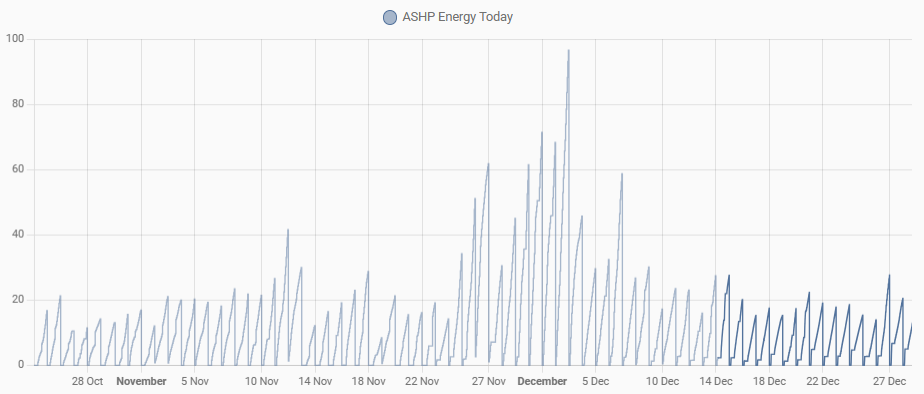
Pete UK Here's our ASHP daily consumption graph (from Home Assistant), figures from mid October:

We have 2x 9kW LG Therma heat pumps as there wasn't an MCS accredited 15kW ASHP available at the time for our house.

Summer load is between 1-2kW for hot water a day, and that's all heated during the day off solar generation.

In winter as you can see it varies a lot. 15-25kW is typical but when we had that very cold spell at the beginning of December it did peak at 97.6kW on 2nd December.
We run the heating 24x7, 48 degrees flow temperature (with weather compensation). The room stat is set to 17.5 degrees overnight and 18 rising to 20 degrees in the day/evening. The house is comfortably warm all the time.

We currently have a single 5.2kW battery which is of course nowhere near enough to last us through a whole day or anything like that. We're on Octopus Agile and the battery pretty much will see us through the peak evening period.

When I did all the calculations about whether to go to a heat pump or not when the oil tank started leaking I worked out that it'd be about the same to run annually as the oil boiler.

N
#35 netty

SilverArt thanks so much for that tip .... I think I'm going to try it!
I'll post once I'm up and running.

P
#36 Pete UK

geoffreycoan

Oh nice. Thanks very much for that. I’ve been looking to try and find out how much they actually use in the real world. Appreciate it.

S
#37 stevelewis

SilverArt what do you see as the benefits of reducing the charge rate to spread the overnight charge across the full off-peak period? On face value it seems like an unnecessary level of complexity, adding to the risk of registers that don't get properly reset when using the GivEnergy API for remote control.

#38 nophead

I do that to stop the battery getting hot and throttling back itself. I believe it is better for the life of the battery.

S
#39 SilverArt

stevelewis Temperature reduction, both for the inverter and the batteries, why cook the batteries & inverter when you don't need to. Excess heat is their biggest enemy.

P
#40 Pete UK

stevelewis

I’ve got 4 batteries on 2 inverters. I don’t bother reducing the charge rate because they probably charge at a reduced rate anyway, so that both fill up within the 6 hours. (But that’s just in dual battery cases).
As they get close to full or empty the rate drops off.
I do notice one “battery” gets much hotter than the other one (but that’s the temp of the BMS board that it’s displaying and not the individual cell temps).

The BMS will take care of the battery cells. It’s got buffers in it also to prolong the life and be kind to it. If something is gonna break I want it to be in the first year, when it’s a full free replacement, not discover it later.

Having said all that. It won’t hurt to charge at a reduced rate, if you have the time. And if they are somewhere cold like outside I understand the idea.

But what about discharging? Doesn’t it also get hot when it discharges to power the house/ kettle/ oven at full rate? so you’d be “being kinder” to the batteries when charging, but maybe not when discharging?

They are there to be used and if they have a 10 year performance guarantee then I’m sure they have thought about all this. (Maybe..?). Although the 10 year performance guarantee doesn’t seem to be that good on closer inspection! (The value given for a replacement tails off rapidly after year one!)

D
#41 DD

Pete UK The BMS will take care of the battery cells.

But what about discharging?

I think I read that the BMS prevents charging below 10 degrees, to protect battery, but allows discharge down to 0.

From https://batteryuniversity.com/article/bu-410-charging-at-high-and-low-temperatures
"The charging process is more delicate than discharging and special care must be taken. Extreme cold and high heat reduce charge acceptance and the battery should be brought to a moderate temperature before charging."

"Batteries can be discharged over a large temperature range, but the charge temperature is limited. For best results, charge between 10°C and 30°C (50°F and 86°F). Lower the charge current when cold."

P
#42 Pete UK

Yeah that’s a good article but it doesn’t have LiPo batteries in it. Closest is Lithium Ion. That 10-30c isn’t for LiPo batteries. They say 0-45c for the lithium ion ones. I think the LiPo might be even more generous.
LiPo I’d expect it to be what GivEnergy print as the safe operating range on the battery itself.
I’m not disagreeing. I just think it’s possible to be a bit paranoid though. If you can charge them gently, then why not, it probably is a bit kinder but I’m not too worried about it personally.

#43 nophead

Losses in electronics are often proportional to current squared, so charging slower is probably more efficient for the battery and the inverter.

V
#44 Vestas

Pete UK LiFePO4 IS a lithium-ion battery!

P
#45 Pete UK

Vestas

Yes.

Sorry, I should have said Lithium Ion Phosphate (LFP) vs Li-ion. ie GivEnergy chemistry LiFePO4 vs Tesla Li-ion.

The article refers to “Lithium ion” but not “Lithium ion Phosphate” specifically.

Point I was trying to make was the latter has slightly better characteristics. As far as I’m aware.

D
#46 downfield

LFP and NMC are two different sub-chemistries under Li-Ion batteries. LFP uses Lithium-phosphate as the cathode material. NMC uses Lithium, Manganese and Cobalt as cathode material. In short, these are not new technologies different from Li-ion batteries.

https://www.ev-bee.com/article/9-nmc-and-lfp-lithium-ion-batteries