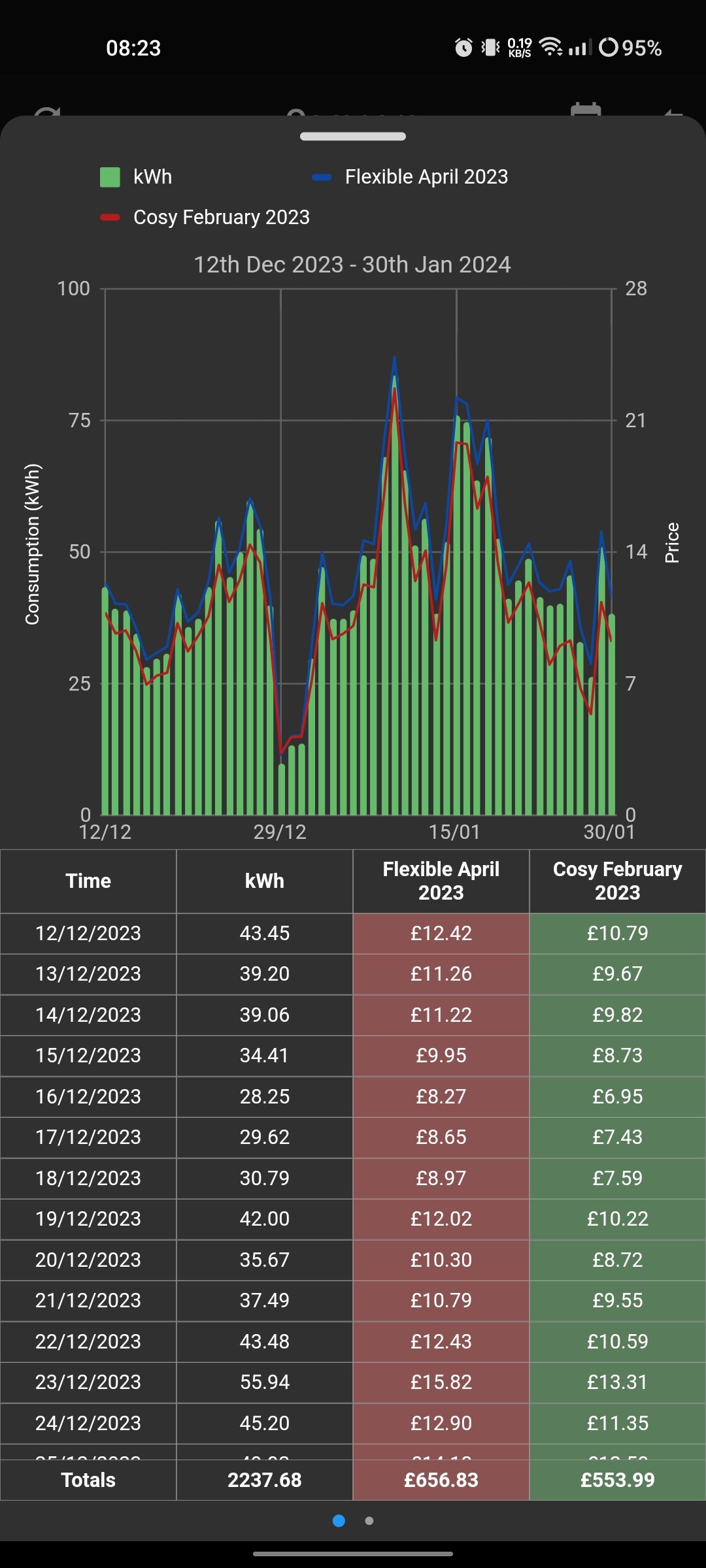
compare Octopus tariffs using own real world data

29 comments started 2024-01-23 last 2024-01-31
GivEnergy ProductsBattery
T
#1 Tim Adams

A great website to help compare Octopus tariffs using own real world data
https://octopriceuk.vercel.app/

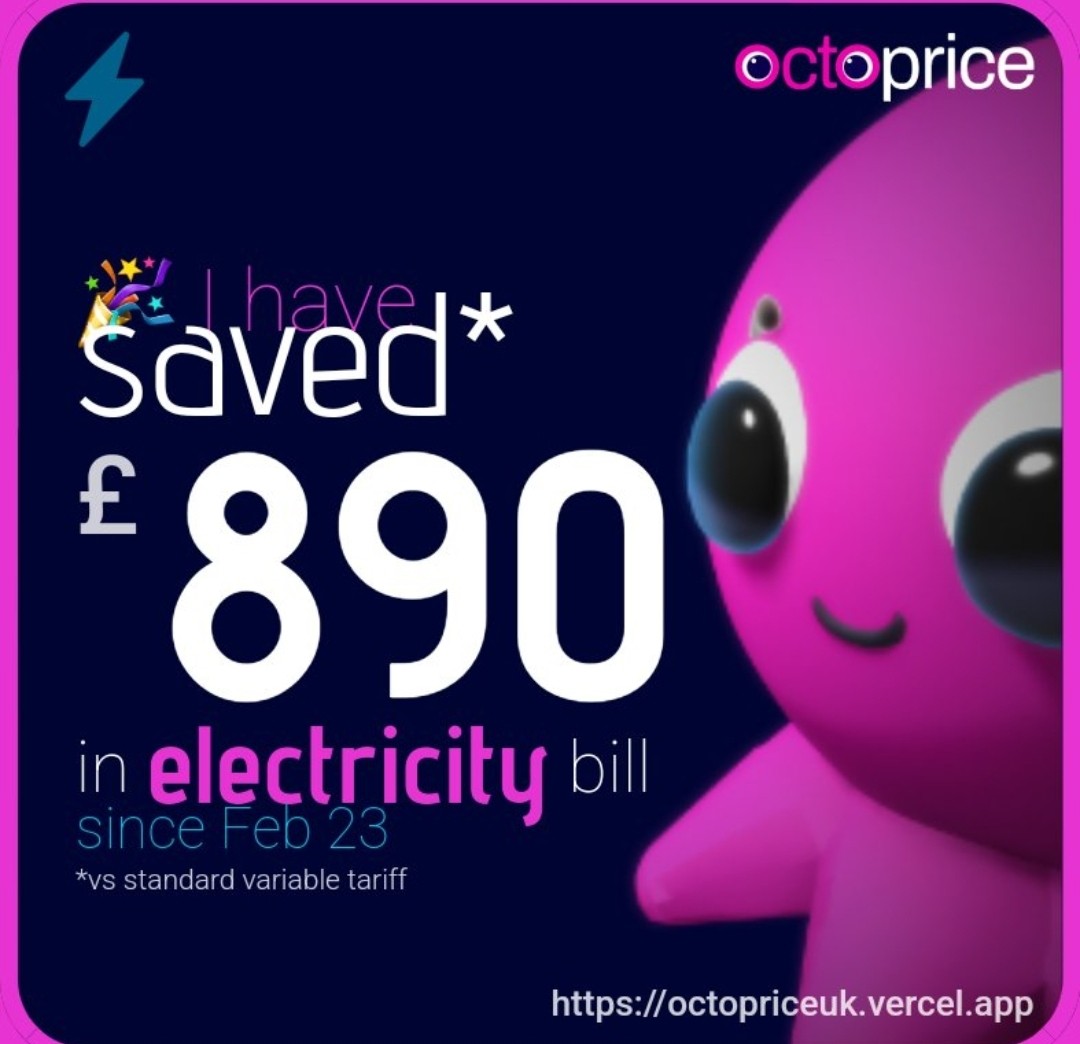
in my case @OctopusEnergy saves me £890 from Feb 23 - Jan 24 - helped by @Givenergy batteries

Tracker tariff suits us best with ashp - avoids need to juggle Time of Use.

ToU tariffs like Go Agile, Cosy, Intelligent offer great options as well if you can make use of cheap rates and avoid peaks.


G
#2 geoffreycoan

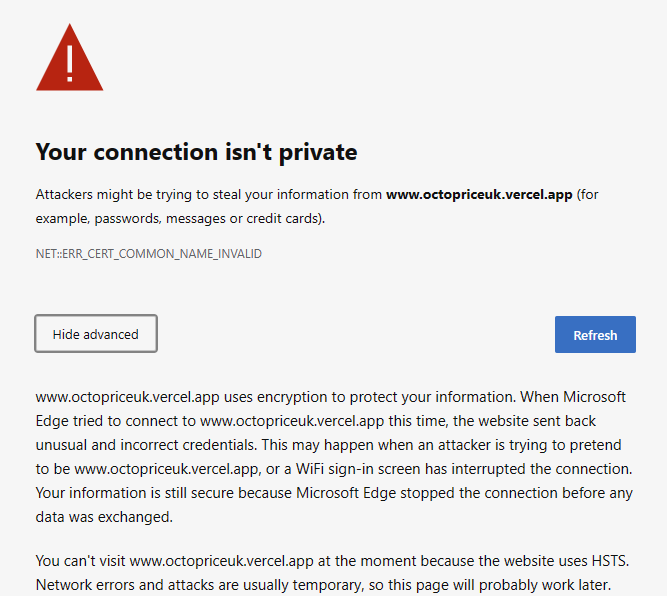
The website seems to have a security issue at the moment

T
#3 Tim Adams

it worked well for me on my phone

T
#4 Tim Adams

geoffreycoan it worked well for me on my phone

J
#5 Jellybaby

I must say I am surprised Agile was so much more than tracker as it has quite frequently been cheaper most of the day than tracker,

Right now Agile is still 4p cheaper than tracker for my region (eastern england) and Agile has been £94 cheaper compared to it for the past Month.

I tried that website and im not sure how you got info for so many tariffs as it only showed Agile and Variable for me.

How much storage do you have? Could you not just keep battery for peak and charge on the cheap?

J
#6 Jellybaby

geoffreycoan Didn't get that with Firefox or Chrome

T
#7 Tim Adams

Jellybaby
in my case we use an ASHP which is on 24x7 but with a setback overnight of 1deg in cold weather. So I don't think we would benefit fully from Agile cheaper rates.

We have 3 x 8.2kw batteries but with only a Gen1 hybrid inverter we can only charge at 2.6kwh. so again its hard to benefit fully from cheap rates or avoid peak rates.

On the savings page on that website if you click the + you can add other rates to compare.

J
#8 Jellybaby

Don't think id get much usable info myself tbh as I have an All-In-One and our daily consumption now thanks to the solar equipment is around 16kw (up from around 13/14) but I am still super shocked about how much more costly it was on Agile, have you tried the "Octopus Compare" app, it can do 1 day, week and month free.

What setbacks are you referring to?

T
#9 Tim Adams

Jellybaby our usage with ASHP means our daily usage in Jan has been around 45kwh/day due to cold weather. We have solar but of course production is minimal at this time of year - compared to usage.

setback is our thermostat - we drop target temp by one degree overnight to reduce usage. If we dropped more it would take too long to heat up again.

I think this website is using the exact data of usage that would be used by Octopus billing. Other compare sites are presumably using averages over the day/week/month? Our main usage is at the expensive Agile times of day!

G
#10 geoffreycoan

Tim Adams The Octopus compare app uses you real octopus consumption data for a similar compare.

We too have a heat pump, daily consumption is around 20-60kW depending on weather, 90 in extremis.

I would look at your overnight set back though, sometimes have been horrified in the morning about how much the heat pump has used overnight. It is a balance as to not turning it too far down as it takes too long to warm up, but we have the house on 18.5 degrees in the morning, 20 degrees afternoon and evening and (now because I've turned it down a bit), 16.5 overnight. For us the house stays pretty comfortable at the 18-19 range all the time.

I have looked via the Octopus compare app at my agile consumption vs tracker. On the Octopus compare app it seems there is two versions of tracker, one dated November 22 and one December 23. The '22 version has been similar to Agile for me, sometimes cheaper, sometimes more expensive, but the '23 version which I assume is all you can get now is more expensive.

e.g. my last month 23/12/23-22/1/24 is 1836kWh
Agile Nov 22 £288
Tracker Nov 22 £302
Tracker Nov 23 £365

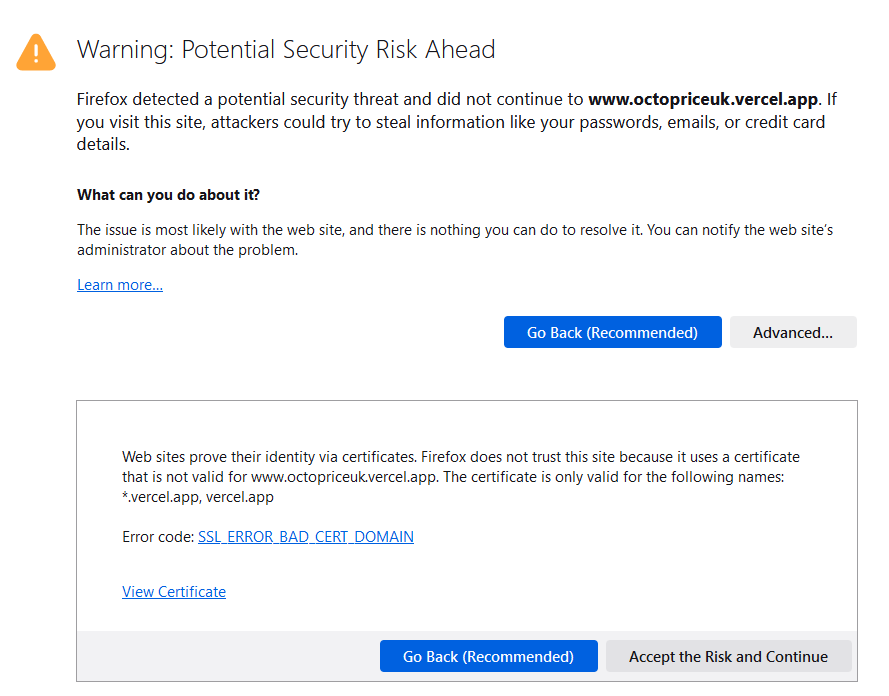
The website doesn't work on Microsoft Edge. I also get security errors from the HTTPS certificate in Firefox on Windows but it at least lets me continue:

T
#11 Tim Adams

geoffreycoan we have gradually adapted our ashp usage to make best use of weather compensation which means we have a day temp of near 21deg. with setback running from 9pm to 5am we have lower usage at night. But every property will be different according to heat loss, target temperatures, setback (or not!), weather comp used (or not!) etc.

I checked Octopus Compare:
WEEK
Agile Aug2022 £80.81
Tracker Nov2022 £70.84

MONTH
Agile Aug2022 £300.91
Tracker Nov2022 £269.12

I am sure Tracker is best for us but accept Agile or one of the other tariffs will be better for others!

Sadly all users of Agile Aug 2022 & Tracker Nov2022 will be moved by Octopus to the more expensive Dec2023 rates - but no date announced yet afaik. New users can only get Dec 2023 rates in both cases.

Saving Sessions have added nearly £150 saving this winter...

J
#12 Jellybaby

Tim Adams Could you not save your battery for the peak? Id think running under tracker costs for most of day would compensate for 3 hours.

Octopus Compare app is what I have on my phone to check upcoming rates as its a lot easier to navigate than the octopus app.

I have also compared the old + new agile tariff in the compare app and the only price difference is standing charge.

I am surprised that Tracker was cheapest for you.

N
#13 naltsta

Jellybaby these comparisons are great at telling you what your usage would have cost on various tariffs.

If you have a battery (and therefore the ability to do considerable load shifting) your usage patterns should vary a lot depending on what tariff you are on to maximise savings. None of these comparisons are able to allow for that in a meaningful way.

If I was on tracker I wouldn’t do any load shifting, like OP, so comparisons would make agile look very expensive due to peak use. As in actually on agile I do loads of load shifting so my cost is way less than the comparison would suggest.

OP says they don’t want the hassle of load shifting so tracker is a good choice. I’m pretty sure they could bring their costs down by picking a different tariff and utilising their battery more.

T
#14 Tim Adams

Jellybaby
as I can only charge and discharge batteries at 2.6kwh I cannot maximise the use of cheap Agile rates and cannot avoid peak rates.

I always felt Tracker was best for us with our particular usage but good to see it confirmed. I dont think we can shift enough ToU usage to make enough difference and would probably require inconvenience and not using our heating at peak times.

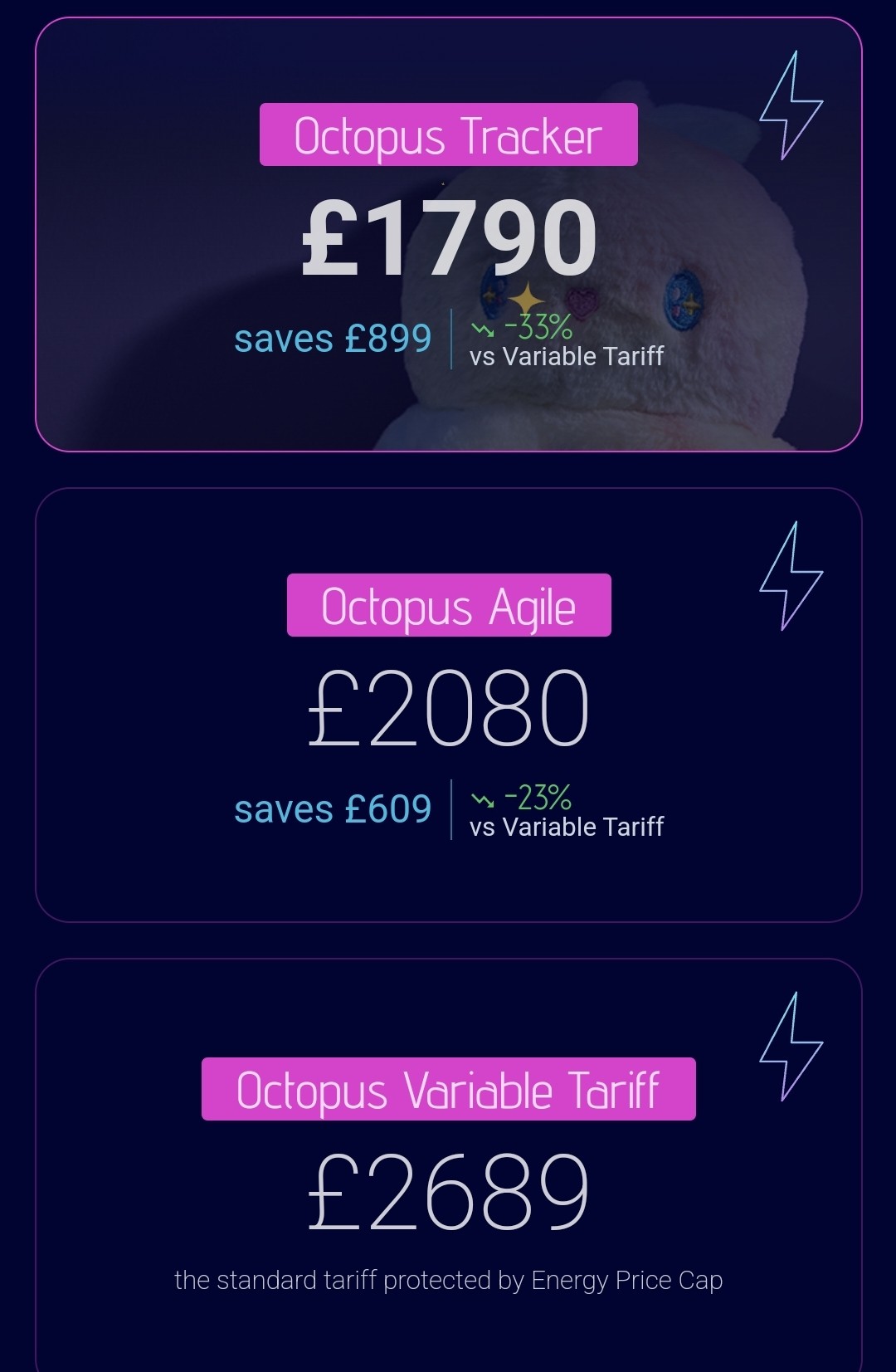
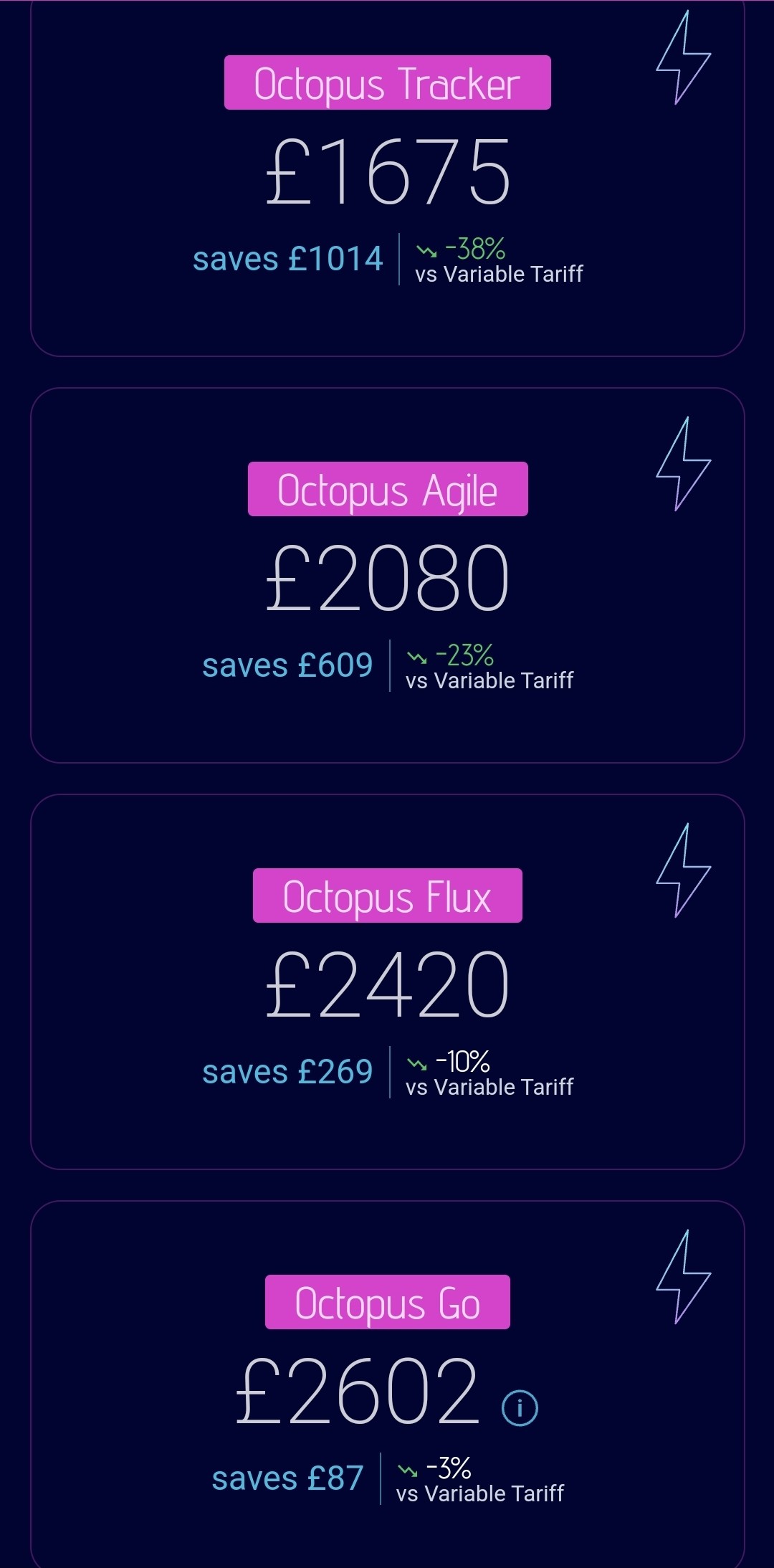
So far it would still be cheaper having Tracker even at the higher Dec2023 rates
Dec2023 £1790
Nov2022 £1675
vs
Agile £2080

Things might be different if I was on a different inverter but I don't think its worth upgrading

J
#15 Jellybaby

Tim Adams Indeed, I must say though still quite a surprise that its the best one for you.

G
#16 geoffreycoan

Its interesting, shows there is no one tariff for everyone.

Although Tracker 22 is showing as more expensive than Agile 22 at the moment for a 1 month comparison, for a lot of days Tracker is a touch cheaper than Agile for me, and for most of December it was showing that the 1 month comparison of Agile vs Tracker was Tracker cheaper.

I have the automation now and don't mind load shifting. Asking Mrs C to put the washing on overnight (actually its my job to programme the machine!) is not a problem. Tracker does make it easier in that you don't have to think about the complexities of ToU, but suggesting to leave the washing and dishwasher a day or two for the tracker rates to come down wouldn't be popular!

I did look seriously at Tracker, Agile I thought was slightly cheaper and the 'can't rejoin for 9 months' definitely put me off using Tracker as a winter tariff.

@Tim Adams bad news about forcing customers onto more expensive Agile & Tracker tariffs. Fortunately the Agile 23 is pretty much the same as Agile 22, £1.40 more a month for me which must be the standing charge as @Jellybaby says

T
#17 Tim Adams

Tracker is now a one year contract I believe. But based on the past year I'm comfortable with that.
Average unit rate was 18.84p (37% less than Variable tariff) for past year.

P
#18 pacemaker

I take these compare solutions with a pinch of salt. They are comparing to your historic usage, which would be based on your current/previous tariff and behaviour. They could be underselling, or overselling your potential as your behaviour will (or should) shift based on the new tariff (and cheap windows etc)

For example, on Flux I was charging 2-5am - a 3 hr full charge at a given cost. Then I use a compare app and compare against Agile, when the 2-5am slots are not always the cheapest (and different per day). So the comparison isn't like for like really as on agile I would change my charge behaviour to the cheapest half hour slots, whatever they were. I don't know what this new one above is doing but that at least is what Octopus Compare app is doing.

Now if I compare my Agile usage to others its all over the place... So you really need to model your import and how you would behave with a new tariff, and calculate if that is better than your current experience.

G
#19 geoffreycoan

pacemaker agree, the best solution is to your own model.
I downloaded my data from octopus for a month. Summed it by half hour slot, worked out a daily adjustment for the heat pump in winter, then profiled the different tariffs across the slots, trying additional load shift strategies to take advantage of the battery for the tariff.
I believe the pro version of the octopus compare app can let you do something similar.

From what I see with this new app it’s not much different from octopus compare, prettier certainly. Has an annual usage bullseye which I didn’t understand!

T
#20 Tim Adams

I've been in touch with the developer and he has added options to compare 
Week
Month
Year
Or even a custom period

might be useful if you want a more granular look or if you change tariff?

the app has got a new shorter domain name: https://octopriceuk.app (without the 'vercel' bit). The existing domain STILL works fine, but if you would use the new domain you will have to enter your API key again on the new domain once.

Not sure if there is anything else it would be nice to see?

T
#21 Tim Adams

Following changes to Tracker tariff increasing rate by approx 2.3p kwh
@edwebdeveloper has published a tool to compare how much more you pay on Tracker from 15th Feb vs old Tracker using recent data:
octopriceuk.app/compareTracker

May help decisions on potential switch Agile or other Octopus tariffs etc

J
#22 Josephiah

I've found it relatively easy to load shift with our ASHP (only) by boosting the temps in the cheap periods and coasting across the peak period in our Cosy tariff, effectively sacrificing some raw CoP in exchange for optimising on cost.

Saved 14% vs Flexible just by doing that. Then once battery was installed, this has jumped to a >30% saving.

Given that Agile prices seem to be routinely lower than Cosy, I'm now mulling over switching. And given that the Agile cost pattern is fairly similar (same peak time), I don't see why I can't employ a similar strategy as we're currently using with the ASHP and battery.

T
#23 Tim Adams

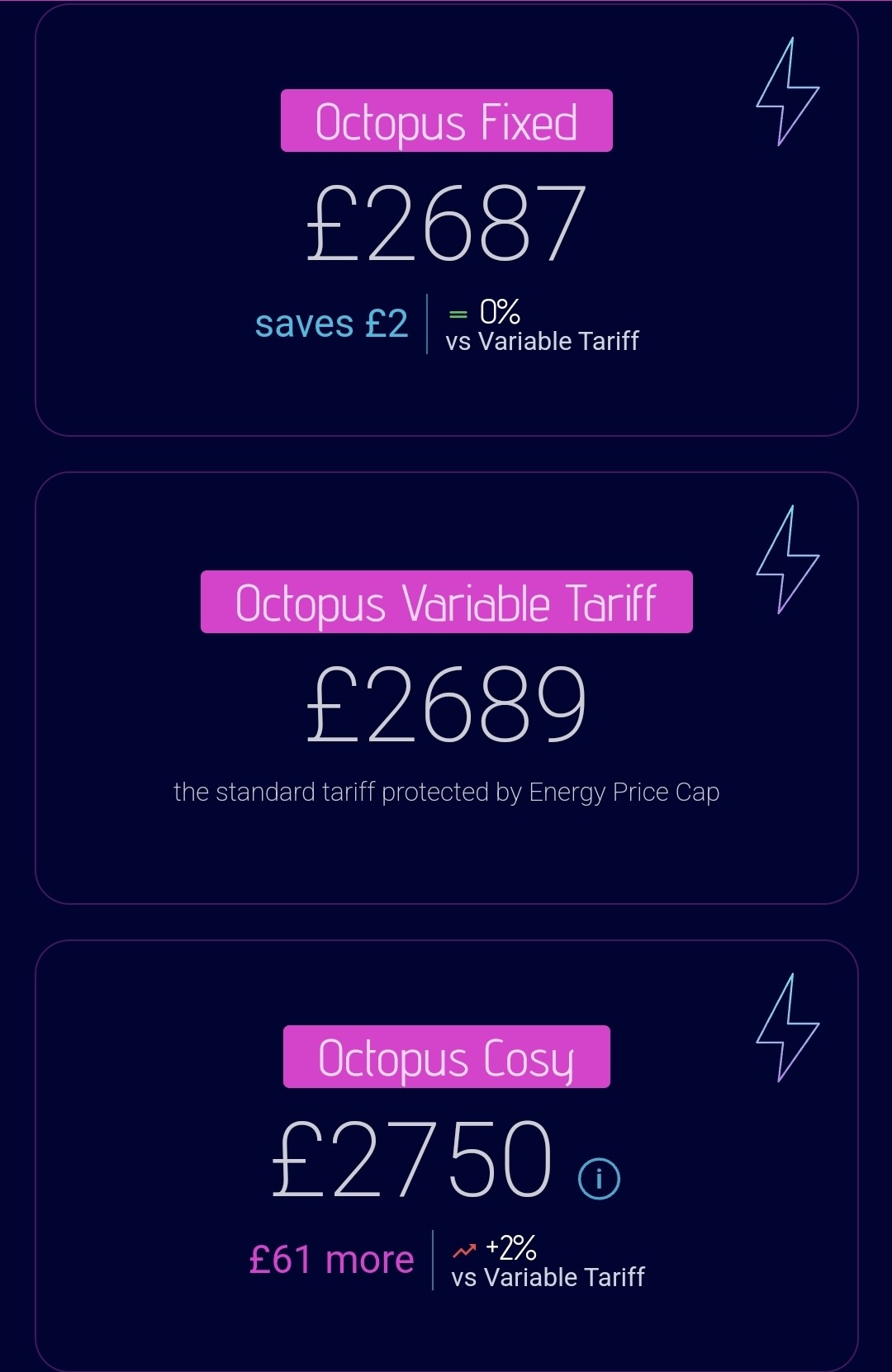
Josephiah https://www.octopriceuk.app/compare should help you make a basic comparison. Of course if you make further changes to usage via ToU strategy and batteries then different tariffs can have different savings.

Generally cannot think of any good reason why anyone would want to be on Standard tariff or Fixed...

G
#24 geoffreycoan

Josephiah I looked at all the (non EV) tariffs last autumn to decide what to move to from Flux. We have an ASHP so high consumption. Cosy was the obvious choice but I could see from the previous years data that I Just wouldn't have enough battery capacity to always be able to run the heat pump in the Cosy low rate periods.

So I chose Agile for 'best cheapest high consumption' tariff and the battery ensure that I avoid most of the import in the peak period. My average import price through the winter has been around 18, 19p, which is considerably down from the fixed/SVT rates I was on before.

I have tried boosting the ASHP during the Octopus Power up events we get in our area and its not at all easy. We run with weather compensation ('AI mode' LG call it) on so have to turn that on then set a manual flow temperature, then set it all back again afterwards. And it doesn't seem as if our heat pump responds that quickly, I've had it set to 60 degrees and a couple of hours later the flow temperature is only around 50 degrees.
In the saving sessions I do turn the heat pump off for the hour and that works fine. When the agile rates were really high in the cold period in early December I tried leaving the heating off for the peak period but found that the house temperature did drop quite a bit so now I Just leave the heat pump on through the peak period and yes, I do get a bit of peak import, but swings and roundabouts

J
#25 Josephiah

Tim Adams agreed, if you have the ability to demand shift, by whatever means, it's a no-brainer.

J
#26 Josephiah

geoffreycoan that all sounds surprisingly complicated. All we do with ours is schedule the target temps to be up a degree or two during the cheap periods, then relax it during the peak period. Ours has weather compensation too. Works a treat.

G
#27 geoffreycoan

Josephiah OK so you are not actually changing the heat pump settings, you’re just setting the home thermostat so the target temp of the house is up a couple of degrees.

Yes definitely a lot simpler, but for me I’m not sure it’d work …

My personal opinion but in short I think you have your flow temperature too high

Our system seems fairly conventional, it has TRVs on all the radiators and then a ‘master’ room thermostat that’s radio or whatever to the ASHP. Turn the thermostat on whole system on, turn it off (e.g. at temperature), whole system goes off. The thermostat is in the hallway, middle of the house.
Rightly or wrongly I have come to conclude that I don’t particularly want the master thermostat going off because that means that the whole system is turned off, the pump stops, and there’s no heat going to any of the radiators - all because the hallway temperature is too high.
I’ve progressively turned the flow temperature down (from the 55 design temperature the installers set it to!) down to 48-34 depending on outside temperature. This keeps the whole house reliably comfortably warm with gentle background heat and rooms at 18-20 degrees.
I prefer to balance the system heat with the pump running all/most of the time and use the TRVs to set the room temps. Its set so the hallway doesn’t often get to 20 degrees and the central thermostat doesn’t often switch off. If it does switch off the entire system then an hour or so later in the lounge you can notice that the room is getting colder.

I appreciate you are getting the most out of the cosy periods by boosting the house temp in the cheap slots, but if you are able to boost the room temperature so easily then from an ASHP efficiency perspective it suggests that the ASHP flow temperature is too high. The lower the ASHP flow temperature the better the efficiency of the ASHP.

As I said, my personal opinion, I am no expert on heating systems, its just the way we have ours set up and what I have learnt about getting the best efficiency out of our ASHP

D
#28 DD

geoffreycoan Rightly or wrongly I have come to conclude that I don’t particularly want the master thermostat going off because that means that the whole system is turned off, the pump stops, and there’s no heat going to any of the radiators - all because the hallway temperature is too high.
I’ve progressively turned the flow temperature down (from the 55 design temperature the installers set it to!) down to 48-34 depending on outside temperature. This keeps the whole house reliably comfortably warm with gentle background heat and rooms at 18-20 degrees.
I prefer to balance the system heat with the pump running all/most of the time and use the TRVs to set the room temps.

Have you watched any of the Heat Geek videos on youtube?

They are of the opinion that you want to use as few temperature controls as possible. To tune the system, turn all TRVs and thermostats up to max, and then use radiator balancing as a means to get all the room temperatures correct. Only then do you set the TRVs back down, but they should only ever operate as a last resort. You ideally want the heat pump running all the time, and all radiators live all the time.

It does seem that relying on a master thermostat is something you don't want to do, since you don't want to cycle the heatpump. [I can't speak from experience, since I don't yet have HP, but researching in hope of getting one soon.]

G
#29 geoffreycoan

DD I have seen a couple of their videos, but they seemed to be too full of promoting their own company ...

But agree, radiator balancing (and heat pump flow temp) should be the primary way you get the flow into the radiators correct to get the required heat output. My comment on (not) using the master thermostat seems to follow their advice