Charge/Discharge Strategy With IOG

38 comments started 2024-02-25 last 2024-08-02
GivEnergy ProductsBattery
S
#1 sixfoot2

I am trying to determine whether it would be more cost effective to:

1- fully charge my batteries with the cheap rate, then get as much solar export as possible and then discharge what I've not used back to the grid in the evening,

or

2- charge the batteries to a level where the solar the following day will charge the batteries to just 100%, and then discharge what I've not used.

I pay 7.5p cheap rate and get 15p per kWh for export.

Has anybody a definitive answer?

Z
#2 Zakalwe

Ignoring inverter losses, if you are on Intelligent, then every solar-generated kWh you put into the battery instead of exporting costs you £0.075.

D
#3 DD

1 will result in more total export, therefore gives a bigger gain.
The only thing to watch out for is solar clipping, if your solar array is bigger than AC limit, and (assuming hybrid inverter) there isn't space in the battery. But you could force export from the battery in the morning to create space.

G
#4 geoffreycoan

The other inverter thing to watch out for is any DNO export limit you may have that reduces your ability to export when its particularly sunny.

It is also of course worth thinking about what electricity you need to run the house in a typical day, whether that fits into your battery capacity, what happens if its not a sunny day and you’re relying more on the battery.

Inverter losses are typically in the range 10-20% round trip conversion in and out of the battery so that’ll reduce your profit, but a lot of people on Go are charging overnight and exporting daytime solar excess during the winter.
Potentially tariffs such as Flux are better value (generate more income) in the summer.

R
#5 Rogerbu

sixfoot2 Using Wonderwatt, I am operating your option 1.

  • Fully charge 23:30-05:30 (plus any IOG charging slots outside 23:30-05:30)
  • Discharge to 20% each evening

My simple calculation - Disregarding any Solar
I am importing overnight (80% of 19kWh) x 1.15(loss) @7.5p = £1.34 cost
Exporting during the day (80% of 19kWh) x 0.85(loss) @ 15p = £1.34 = £1.99 benefit
ie a relatively small gain of £0.65p per night or over £200 per year
PLUS an average of 5 to 10 kWh extra solar power exported at 15p per kWh (with no solar to battery to solar losses) = £0.75 to £1.5

Assuming this works for 250 days a year, then (£0.65 + £1.00) *250 = £330 better off than not using the full potential of the batteries and IOG tariff.

From actual records, I can clearly see that my net electricity costs (Import @ 7.5p less export @ 15p) are clearly lower than I was getting on Option 2. My simply calculation is working out to be about right.

#6 positor1

what is an IOG out of interest?

D
#7 DD

positor1 intelligent Octopus Go, an electricity tariff offering low overnight rates for some EV owners. (Octopus controls exactly when car gets charged.)

M
#8 MarkyG82

I like a set and forget option. Last winter (and this winter) I had it set to charge 100% overnight. Last summer I had it set to 20% as that would see my car preconditioning in the morning and then the sun would deal with the rest. We were often going to bed with 70-80% in the battery. That was with 4p/kw export. Now the export is worth more I think I'll leave it to 100% charge all year and just let the pennies come in to build credit for the winter.

M
#9 MarkyG82

In addition to the above I also have a solar iboost to put any extra into the water cylinder. With lots of excess in the summer this is fine but this time of year you are more financially better off by turning that function off.
I plan to change over to off peak immersion usage so I can wind down my boiler outlet temperature. This should make it more efficient as it will only be used for space heating instead of water heating.

C
#10 CW

I'm on Octopus Flex, so I currently fully charge overnight (regardless of expected next day solar).
I will export at peak times to take battery down to 50% SOC as long as there are 15KwH of solar expected for the next day.

My rationalle for this is:

Import costs overnight are about the same as day time export fees (which means that instead of charging battery from solar during the day I am exporting pretty much right away and recovering the import cost)
Forced export during peak hours generates approximately 6-7KwH (on the basis that there will be enough solar to recharge battery and pay for standing charge the following day)

I can just set this and ignore and I think this logic will work all year round so it should be a "set-and-forget" solution.

I currently use Wonderwatt to manage this - I particularly like the fact that it calculates the charge rate based on the SOC so only charging up at minimum rate needed

G
#11 geoffreycoan

CW Import costs overnight are about the same as day time export fees (which means that instead of charging battery from solar during the day I am exporting pretty much right away and recovering the import cost)

If you want simplicity over money then this is a solid strategy. You are actually loosing money on overnight import vs solar export during the day because of the inverter and battery losses. Its not a lot, 1-2p for each kWh, but just to point out that this isn’t absolutely the most cost effective strategy.

Forced export during peak hours generates approximately 6-7KwH (on the basis that there will be enough solar to recharge battery and pay for standing charge the following day)

I can just set this and ignore and I think this logic will work all year round so it should be a "set-and-forget" solution.

As you get to winter and have hardly any solar charging and your house demand goes up, just need to review this. Might need to conserve battery power in the day or reduce the peak discharge to ensure you never start importing at peak rate.

I currently use Wonderwatt to manage this - I particularly like the fact that it calculates the charge rate based on the SOC so only charging up at minimum rate needed

Lots of people are similarly positive about wonderwatt

P
#12 philipdawsonladds

Rogerbu
I'm doing the same with a smaller battery but ran into problems with ECO mode being disabled when timed export was turned on - this meant that the batteries would not supply the house during the day when solar was insufficient. I've read that enabling timed discharge rather than export means that ECO mode is re-enabled once discharge completed. I have found under REMOTE CONTROL the option to set discharge schedules (2) but are they actually different than export mode? Guess I have to try and see if ECO is re-enabled. What has your experience been?

D
#13 DD

philipdawsonladds I've read that enabling timed discharge rather than export means that ECO mode is re-enabled once discharge completed. I have found under REMOTE CONTROL the option to set discharge schedules (2) but are they actually different than export mode? Guess I have to try and see if ECO is re-enabled.

For a long time, timed-discharge behaved as a "better" timed-export for many of us, even though that didn't match the documented behaviour. But givenergy have reimplemented it, which means timed-discharge and timed-export are very different beasts.

Gen-1 inverters don't have all the features required to implement (the new) timed-discharge. And they can only export to grid when eco is turned off, so for those, the UI makes eco and timed-export mutually exclusive. On newer inverters, they can co-exist, though I'm not entirely sure the UI gets that right every time, and so might well still fiddle with eco mode when you enable timed-export.

If you have a gen-1 system, try wonderwatt.com - that's an external agent that can give you a timed export, and will re-enable eco mode afterwards.

C
#14 CW

geoffreycoan As you get to winter and have hardly any solar charging and your house demand goes up, just need to review this. Might need to conserve battery power in the day or reduce the peak discharge to ensure you never start importing at peak rate.

A fair point and I only had the system installed in April this year, so yet to see a winter generation. The Wonderwatt is set up to only export if there is 15kWh or generation expected the next day.

I'm hoping and think that even in winter the array is large enough (it's 8.9kWp) to at least cover base load during the day (approximately 300wh) and draw on battery for the bigger consumption items (cooking etc). I went with the AIO as the 13.5kWh capacity should cover 24 usage so my hope is that in the winter months I will effectively be running off cheap overnight electricity. Hopefully the summer excess export will provide enough credit to cover the winter months to provide a zero electric bill over 12 months..... time will tell 😃

C
#15 CW

philipdawsonladds These are the registers Wonderwatt set on my AIO to discharge...

P
#16 Pete UK

sixfoot2

1 definitely.

Also you could discharge a bit in the morning as well,
In summer to avoid clipping, if that’s an issue. Although, results will vary depending on amount of clipping and conversion losses involved.

G
#17 geoffreycoan

CW I'm hoping and think that even in winter the array is large enough (it's 8.9kWp) to at least cover base load during the day (approximately 300wh) and draw on battery for the bigger consumption items (cooking etc). I went with the AIO as the 13.5kWh capacity should cover 24 usage so my hope is that in the winter months I will effectively be running off cheap overnight electricity. Hopefully the summer excess export will provide enough credit to cover the winter months to provide a zero electric bill over 12 months..... time will tell

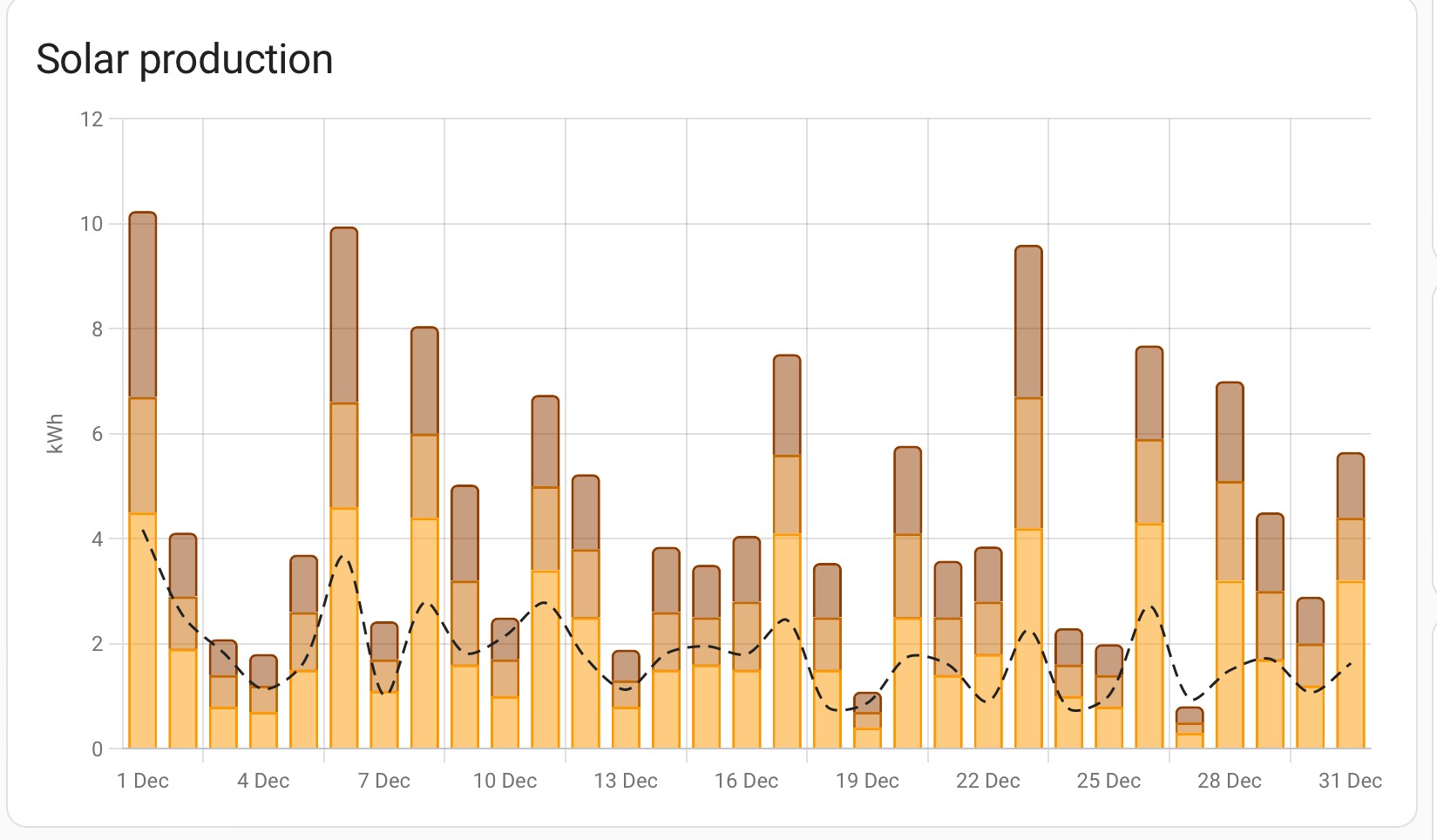
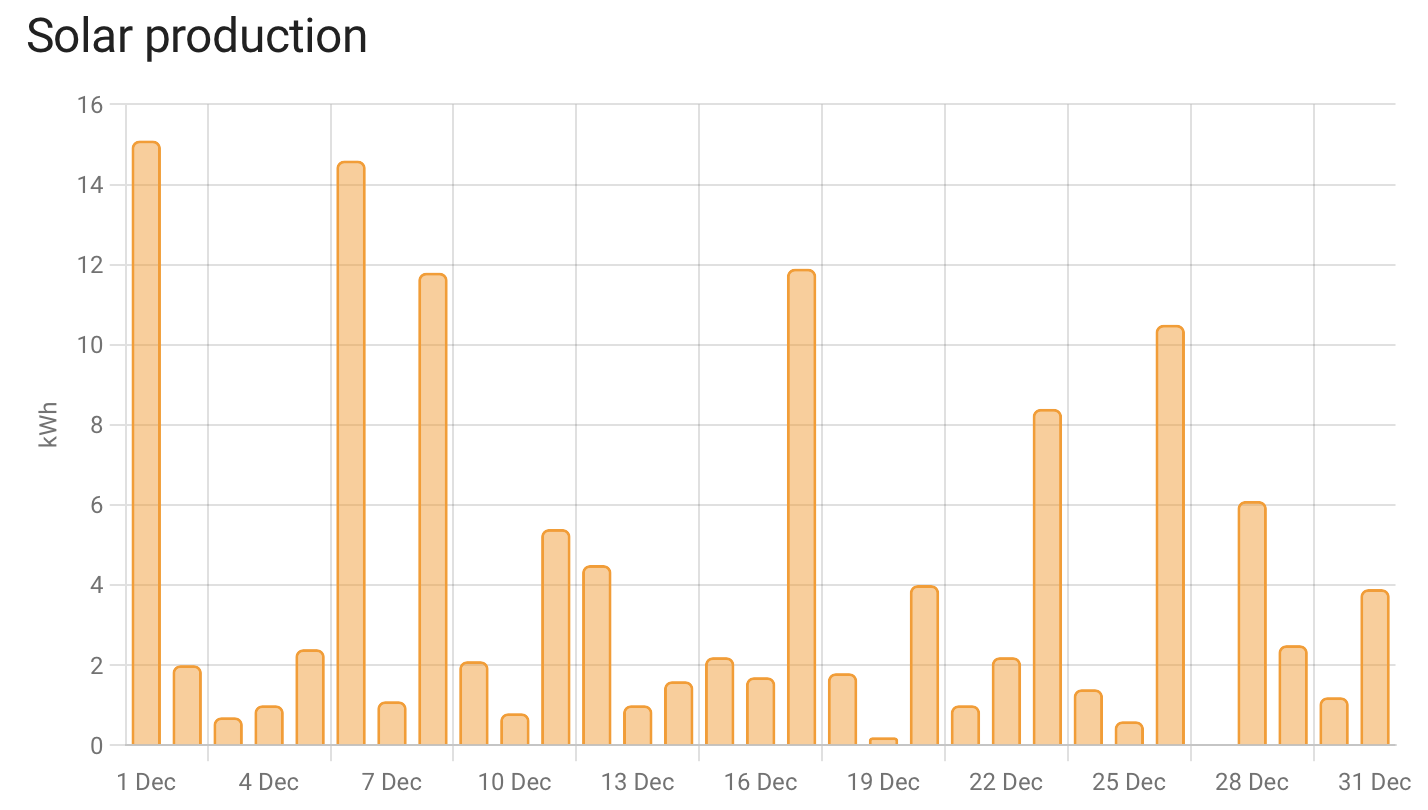
Sorry to break the bad news but winter generation is very variable. I’ve got 3 arrays totalling 14kW and here’s my December generation chart, as you can see most days it only gets to a few kW.

🤞for the net zero bill, I think I’m on track for the same this year

You can cut down the peak rate export or setup a timed battery pause (only via the portal, not currently an app option) if you look like you’ll not have enough winter battery to get through the peak period

#18 PianSom

CW
Just to concur with what geoffreycoan said, my experience is very similar.

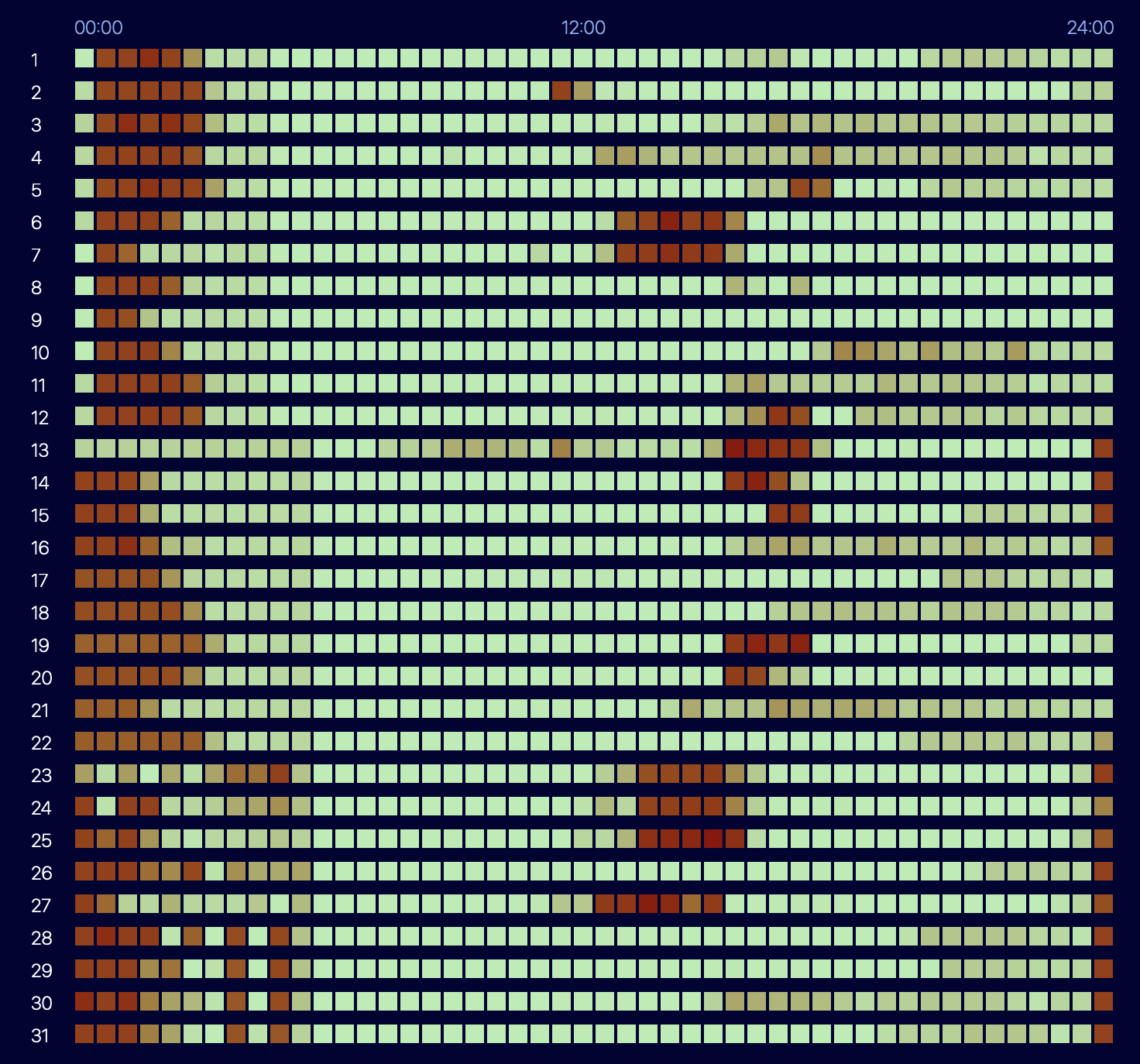
I have an 8.8kWhp SE facing panel. My background load is around 600W, and I use gas for hob cooking and heating. Last Dec I was on Octopus Go (before moving to IOG mid month). I was still coming to terms with my system at that point. Here is my generation graph (v similar to Geoffrey's) and my import stats (darkest red is 5kWh). Note that I am lucky enough to live somewhere with Octopus Power-ups, so the dark patches during the day will largely coincide with free power slots (or cooking Xmas lunch!). Towards the end of the month I started using Predbat, hence the funky charging patterns that appear then.

C
#19 CW

geoffreycoan Sorry to break the bad news but winter generation is very variable. I’ve got 3 arrays totalling 14kW and here’s my December generation chart, as you can see most days it only gets to a few kW.

Ouch! Looking at your and PianSom graphs, it looks like I'll just be running off battery during the day most days. I didn't have a smart meter prior to going solar so from my records, it looks like I consumre around 14kWh on average each day during December (of course that average can cover a multitude of sins!) - so with any luck, the overnight charge will take me through the following day.

I'll have to keep an eye on that though as I don't want to be importing during the peak rate - maybe a change to Agile may work where the could be cheap rates during the day to top-up the battery.

Good news on the net zero bill though - that is what I am hoping will occur for us

PianSom I have an 8.8kWhp SE facing panel. My background load is around 600W, and I use gas for hob cooking and heating

We are only gas for heating but have a similar array size although split 50/50 SE/NW - I am quite looking forward to getting winter figures to see how well the system holds up - I did a lot of playing around with PVGIS before going for that size/orientation, but I fully expect to net import during Nov-Feb and hoping as per geoffreycoan to have summer export excess cover those months.

P
#20 philipdawsonladds

I installed Wonder Watt and it now seems to initiate the timed export and revert to ECO mode, which is what I wanted. On my givenergy inverter I have timed charge set as well as on Wonder Watt. Should I have just one active schedule or might there be a conflict, even if the schedules are the same? I could switch off the timed charge on the inverter I guess and then rely on WW to kick off the charging. Would this work - maybe I'll just try it!

#21 Watcher

philipdawsonladds

I keep my inverter on ECO and rely on WW, it works well - it is still in beta but any issues are sorted very quickly.

If you use both I guess you are increasing the conflict risk?

G
#22 geoffreycoan

philipdawsonladds When planning a charge, Wonderwatt will over-write any existing charge settings on your inverter, and then your inverter will actually do the charge. So there isn’t really “two schedules”, there’s just the schedule on your inverter that Wonderwatt will program as and when it needs to.

If you’re using WW I would stick to programming everything through that rather than making changes on your inverter as WW may well overwrite them.

C
#23 CGoode

sixfoot2
I'm on IOG & I do option 1. i.e. Fully charge 2 x 9.5kWh batteries, charge the 64kWh EV to 80% (2-3 a week) & run as many appliances as possible over night at 7.5p. Sometimes I've seen as much as 18/19kW incoming over night. It's funny how DNO's don't have so much of a problem with how much you draw from the grid as they do with how much you can export to the grid?
I also have started to dump any remaining battery charge to the grid from 7pm to 11pm to gain extra export income before re-charging the batteries again from 11.30pm - 05.30am.
Then with batteries at 100% in the morning, export as much solar production as possible during the day except for any top up needed for the batteries or the house load if over what my 3.6kWh HY Gen 2 Inverter can handle. I've even stopped using my Eddi because it uses daytime solar which I can get 15p/kWh for.
This strategy seems to be working well during the summer months as I'm exporting more than I am using. I got a £99 electric credit in May so I'm looking forward to see what June & July bills look like.
I've no experience of how this will pan out in winter yet but obviously the exports will drop right off so I'll be relying on the batteries for most if not all of the daytime usage which for us should be plenty for what we need.

We've got a 4kW (output) air2air heat pump in our conservatory for winter heating & we also use it for occasional daytime cooling (for free if the sun is shining). We've still got gas for house heating / hot water & we are at home most days / evening) so all the electric credits we get during the summer will hopefully offset some gas use during the winter. Well that's the plan anyway. It's working for us at the moment.

A
#24 Ange

DD "timed-discharge and timed-export are very different beasts." - is there an explanation of how these two options differ? Thanks in advance - trying to get my settings right.

T
#25 TX200

Ange

It depends on what hardware you have (inverter gen) and what firmware it has on it.

I think it is supposed to be this, but older hardware e.g. gen1 and older firmware on any gen doesn't work as described in the original document

Timed discharge - only discharge the battery during the specific period. Discharge to meet home demand. Do not discharge outside of that window.

Timed export - discharge the battery at full speed during the timed window (or at whatever discharge rate limit has been set). Outside of the timed window, discharge to meet house demand aka eco mode.

D
#26 DD

TX200 Timed discharge - only discharge the battery during the specific period. Discharge to meet home demand. Do not discharge outside of that window.

It's currently implemented using the pause timer : if the timed-discharge is set for 4pm to 7pm, say, then it sets up the pause-timer to pause discharge from 7pm all the way through to 4pm. Normal eco mode operates from 4pm to 7pm. (I think you may still be able to have a timed-export, which will take predence, but I'd have to do the experiment to check.)

But gen-1 does not have a pause-timer, and so timed-discharge is not available on gen-1 systems. (Except with the very latest firmware, but the UI may not know about that, and still not offer it. So you'd have to go in at a lower level.)

Outside of the timed window, discharge to meet house demand aka eco mode.

Except, again, gen-1 seems to be lacking something, and can only force an export if eco mode is turned off. Which is why many people have an issue with eco mode not getting turned back on. I believe the UI turns off eco mode (immediately) when you configure a timed-export on a gen-1 system.

gen-2+ systems can leave just leave the eco flag on - timed-export will temporarily override that for the duration of the export only.

P
#27 philipdawsonladds

Thanks for all of the feedback - I'm getting smarter I think and everything is working as it should BUT I can't say that I understand how it's working! My setup is: 3.6Kw Givenergy hybrid inverter with an 8.19Kw battery and a solar array of 5.2Kw. Also ZAPPI EV charger installed along with an EDDI diverter. On the Octopus Intelligent GO tariff.

As above, I am running the battery down to 4% before the cheap period starts, then charging the battery (and EV if necessary) to 100% during the cheap period. I have turned EDDI off as gas is cheaper and I get 15p for all solar exports which I maximise during the day. I use Wonder Watt to manage the schedules on the inverter which has a max. charge and discharge rate of 2.6Kw.

A chart might help illustrate my "confusion"

KWh Home Solar Grid Battery
Consumption
Solar 5.37 -7.06 0.02 1.67
Battery 4.51 0.02 -4.53
Grid 5.61 -8.96 3.35

Total 15.49 -7.06 -8.92 0.49

00.00 SOC 40%
01:00 SOC 100%
Added 4.9KWh

Additional data:
OCTOPUS usage shows as 9.34KWh imported
0.13KWh exported

MyEnergi monitor 9.4KWh imported
(ZAPPI and EDDI) 0.2KWh exported
9.4KWh consumption

P
#28 philipdawsonladds

That didn't come out right! This is what I was trying to say:

At 00:00 the SOC was 40% and at 01:00 it was 100% so 4.9Kw had been added - if the max rate is 2.6Kw this should not be possible?
The data from the inverter/Octopus/Myenergi are all slightly different - not timing related as this data is for a few days ago:

Solar generation: Total 7.06Kw - Consumption 5.37Kw, Export 0.2Kw and Battery 1.67Kw
Import from Grid: 8.96Kw - Consumption 5.61Kw, Battery 3.35Kw
Battery - Solar 1.67, Grid 3.35Kw, discharge to consumption 4.51Kw and to the Grid 0.2Kw

Octopus shows 9.34KW from the grid and Myenergi shows 9.4Kw (close) - both a little higher than the inverter is showing.
Octopus shows 0.13 exported and Myenergi 0.2Kw so both close.
Myenergi shows total consumption at 9.4KWh whereas the inverter shows 15.49KWh consumed - Myenergi appears to show flows from the battery as well as solar but maybe not.

Should I expect all of this data to correlate or just focus on the inverter data even though my Octopus invoice is for more power than indicated. I suppose my niggling confusion is about how can the battery be charged so fast and where is the charge showing up - the cheap period top up was 4.9Kw but the total grid supply to the house, including consumption was 8.96Kw

If anyone has any insight it would be welcome! Otherwise I'll just keep looking

D
#29 Daveb01

sixfoot2

I thought IOG was all done by Octopus energy and you do not have a say?

D
#30 DD

Daveb01 IOF fully controls GE system, IOG only controls EV charging.

R
#31 Rubikcube

philipdawsonladds a solar array of 5.2Kw.

Look at the bigger picture, don't get bogged down in the details.

You generated 7 units, used 16 units, and had to buy 9 units (hopefully at a cheap rate). Which would be fine for January, but it's July, you should be generating over 20 units a day with that size array.

D
#33 DD

philipdawsonladds 00.00 SOC 40%
01:00 SOC 100%
Added 4.9KWh

GE doesn't seem terribly good at tracking the true SoC of batteries - the reported value is a guess, and the accuracy can drift over time, unless it regularly visits both ends of the range. You said that you typically run down to 4% before charging, yet started at 40% here ?

P
#34 philipdawsonladds

I've started to notice that GE inaccuracy - this morning it reported 4% then 10 minutes later 100% - I started at 40% above because the timed charge started at 23.30 - I just don't understand how SOC can be shown at 4% at 23.29 then 31 minutes later 40% if the charge rate is really 2.6KWh. Last night started at 4% then at 05.30 it was 100% having imported around 4KWh into an 8KWh battery. So yes, bigger picture is the answer. GE told me that PV generated yesterday was 8Kw but several hours later amended that to 28Kw.

D
#35 DD

philipdawsonladds GE told me that PV generated yesterday was 8Kw but several hours later amended that to 28Kw.

Which page were you getting that from? The energy tab on the (Android) app does seem to lag by a few hours - as I write at 09:40 it's only populated the graph as far as 06:30, so the total is correspingly lower.

4
#36 4monks

I follow method 1 with a minor tweak. As the last 10% of charging overnight takes longer because of the slower charge rate, it does not make optimal use of the full charge window. I therefore deliberately aim for 90% charge overnight. Doing this means I have spare charge time overnight towards the end of the charge window. I shift this spare time forward to the middle of the night, then split it between dump and recharge (about 1.7kWh). So I charge from 2330 to about 0300, dump about 1.7kWh, then continue charging to 90% which coincides with the 0530 cut off. Only a net small improvement, but as the maths above demonstrates, all these small tweaks help over the course of a full year.

C
#37 CGoode

Despite being set for 100% my 2 x Gen 2 9.5 batteries & 3.6 Gen 2 Hy Inv never charge to 100% overnight from the grid. 90% is the max they ever seem to get up to from the grid & the extra 10% top to 100% can only be achieved from solar. I put this down to new battery / inverter firmware to combat the overvoltage errors & was getting. Annoying because I'm missing out on some early morning export while waiting for the batts to get up to 100%.

S
#38 sponev

CGoode This is concerning for me too. Although we rarely charge overnight in summer (we have a big dual array) we do rely on IOG to top 19kwh of batteries in winter to run our A2A heat pumps. A full charge just about gets us through on the coldest days, helped with a bit of solar top up. However if we can't get to 100% charge on IOG now, it's going to cost more as the weather turns and the heating is required. I'm wondering if the Cosy tariff might be better with the new triple dip option.