Flux vs Tracker

12 comments started 2024-03-06 last 2024-03-06
GivEnergy ProductsBattery
K
#1 Karl340

Hi,

I'm currently on Octopus Flux Import and Export. With a solar system and battery of 5.2kwh. My house is all electric to explain the kWh usage.

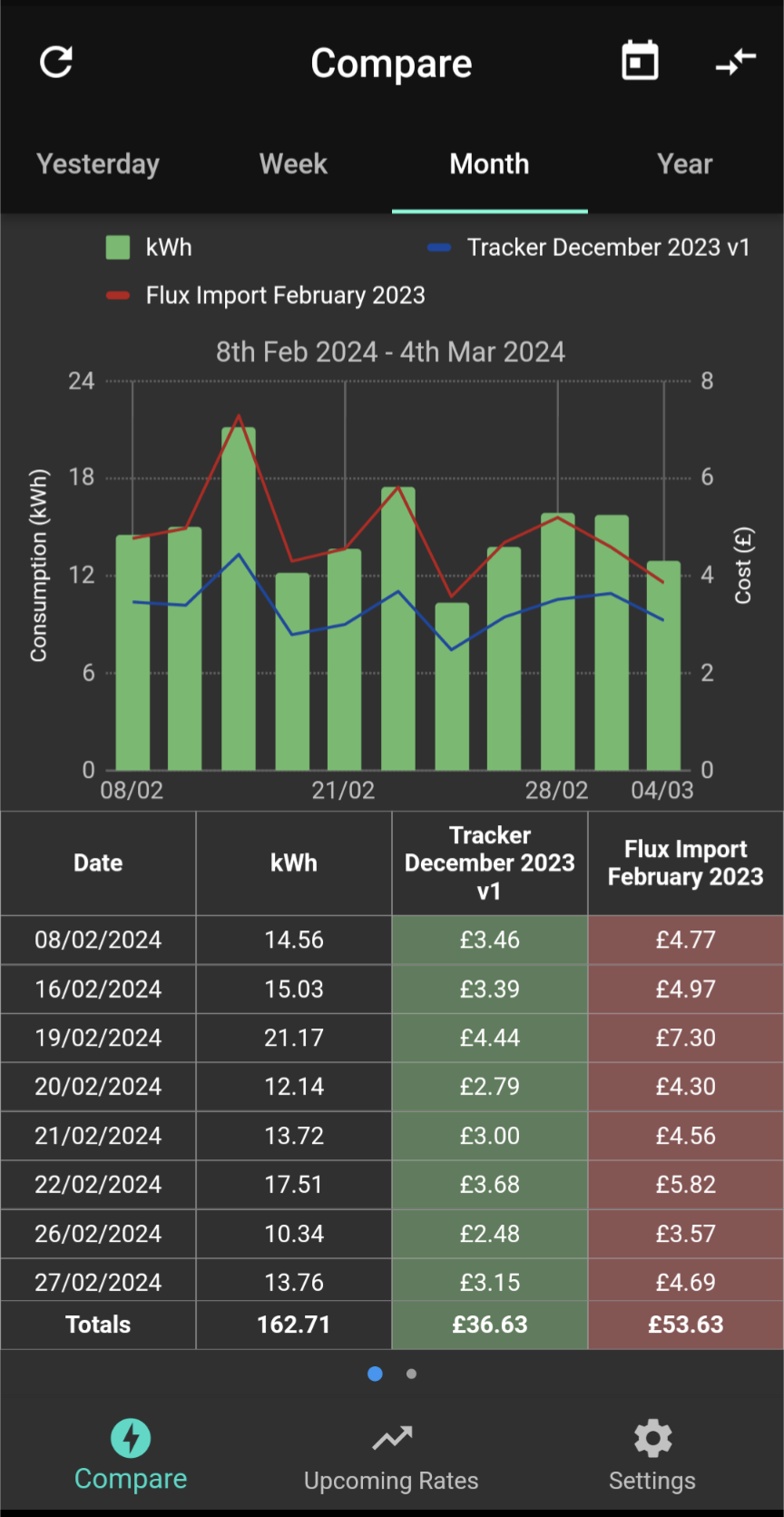
On checking the comparison app I could save a lot of money on the Tracker tariff. I know flux is said to be good for summer but I feel like my usage/battery capacity would be better on Tracker.

I have attached a comparison photo. Is the Tracker tariff worth it for my situation? Also do I need to switch to a different Export tariff? Not sure where I start really.

Any help is greatly appreciated!

#2 Cdent

Tracker can only get 15p export IIRC, so you need to balance your export from Flux at the different times taking into account the peak vs a flat 15p as the compare app doesn't look at export at all.

Ultimately, based on usage alone then yes you do seem to be better off on Tracker for your previous usage.

To throw another spanner in the works, check out Agile - that's better for me than both Flux and Tracker at the mo.

G
#3 geoffreycoan

Flux is great where you have lots of excess solar and you get a good income from the extra export. Its not so good when you’re having to import loads especially if your consumption exceeds your battery capacity.

The comparison app (in the non-Pro version) only shows a comparison of your current consumption pattern on different tariffs. If you went onto Tracker then you’d probably only want to charge the battery when the next day’s tracker price is going to be higher than today’s for example.

But anyway, its a good start point for a comparison. I would look at the 1 month view rather than the 1 week to give you a better picture.

I was on Flux last year and swapped to Agile for the winter - we have an ASHP so high daily consumption when the heating is on. I did seriously look at Tracker and it would have been the next-most cheapest for me. Its a lot simpler to understand and no active battery management is needed.

As we’re coming into the summer Flux will increasingly be a better option once home heating and night-time electricity demand falls. I’ll personally probably look to move back to Flux in April or so.

For you though, Tracker could be worth swapping to at least for the next 6 weeks or so. You will have to pair it with the 15p fixed export rate.

K
#4 Karl340

Cdent
I did look at Agile. However my smart meter 30 minute reads are hit and miss at the moment. So I'm concerned I'd get billed on the standard tariff a lot.

Whereas Tracker they'd bill me for the rate from the start and end of each days readings?

K
#5 Karl340

geoffreycoan
Yeah good point about the battery, pointless charging it if it's all the same rate for 24hrs.

I just see lots of posts about flux but people's systems have a lot more battery capacity and will be able to export more. Maybe I'll have to see towards the summer as the sun's out for longer, will be worth getting onto flux.

V
#6 Vestas

Karl340 Doesn't work like that - they don't pull an "end of day" figure, they just pull 30 minute consumption figures. If they're missing on tracker then you'll get billed the same as if they were missing on Agile - its the same T&C's (section 1.5) for all their "Smart Tariffs" - including the one you're on.

#7 Cdent

Karl340 yes they should just look at 24 hours consumption and bill that so the 30 mins shouldn't matter too much.

And as for your point about battery charging, maybe don't charge it up overnight but let solar top it up and set your inverter to eco mode to cover home demand until it runs out.

D
#8 DD

Vestas https://octopus.energy/tracker-faqs/

When we calculate your bill, we try to use your actual consumption for each day from your smart meter, in order to get a correctly weighted average price for the billing period.

If this isn't possible (for example, if we are missing some consumption data), we will use your total consumption over the billing period, and allocate it to days based on industry coefficients that reflect actual weather.

V
#9 Vestas

DD From the T&Cs specific to Tracker -

2.9.7 If we have not received half hourly meter readings from your Smart Meter at the point of billing, we may need to estimate what proportion of your usage should be allocated to each day, based on industry coefficients (which take into account temperature). We are unlikely to be able to rebill you based on actual consumption if we receive half hourly meter readings after we have issued your bill, therefore you agree to pay your charges based on estimated readings in this scenario. Bills produced on Octopus Tracker could be based on half hourly meter readings, typical consumption patterns, or any combination thereof within the billing period.

Its similar conditions for all the smart tariffs -

1.5 If you switch to one of our smart import tariffs, you agree that we can take half hourly meter readings from your Smart Meter. If we are unable to obtain half hourly meter readings from your Smart Meter, we will charge you for your energy as we would charge a customer on our Flexible Octopus Variable Rate Tariff, based on typical consumption patterns (referred to by Ofgem as “Profile 1”).

Basically their system only works on ToU tariffs (all the smart ones) if it can pull 30 minute data. If it can't then it starts falling apart and manual intervention is often required. Edit - they don't pull daily readings, its all 30 minute data.

Karl340 is already on one of these tariffs and subject to the same T&Cs so I'm not sure how changing tariff is going to help/make things worse with missing 30 minute data, it'll still be missing and he'll potentially get charged exactly the same way as now 🙂

D
#10 DD

https://octopus.energy/policies/smart-tariffs-terms-and-condition/

Vestas My reading is that they will allocate usage across the days of the billing period, and then charge each day at the Tracker rate, whereas other smart tariffs will charge at the flexible rate. But yes, one could argue that 1.5 still applies. Though since SVT is a flat rate, there's no particular reason to go to the trouble of making an "estimate what proportion of your usage should be allocated to each day, based on industry coefficients". (Obviously even SVT prices change from time to time, but if that's what they were talking about, it would apply to all smart tariffs, not just tracker.)

But as was said, since they seem to have access to daily readings in addition to HH readings, there doesn't seem a very good reason why they have to estimate anything. Though it does depend at exactly what time the daily snapshot is taken. (They have to have daily readings, because a couple of times I've had missed readings, and they were able to produce numbers for that day's total usage. For some reason, my meter seems to be configure with sepearate day and night counters, so when I had a missed reading on Go, they charged me on E7 rates, which wasn't quite as bad as it could have been.)

If in any doubt, I guess you'd have to phone to confirm. (But even then, support don't always give the correct answers.)

V
#11 Vestas

DD The problem is you basically get to pull data in one format or another.

You either get 30 minute, one day, or 30 day consumption. Edit - these aren't meter readings, they're consumption only.

The latter are usually for people who have specifically opted out of 30 minute readings for privacy concerns.

Edit - anyway if not having problems with billing on flux then he's unlikely to have any on tracker as its less complex 🙂

K
#12 Karl340

Vestas
Octopus say my meter is working and receiving readings. However on the app it has some days consumption missing. They're aware and have said it's an outside company that hasn't sent the readings. It's being chased up.

But just based off usage I think I'll be better off on Tracker.