Export to Grid

17 comments started 2024-03-16 last 2024-03-18
Beta PortalCloud Portal
T
#1 thebdj

Hi All,

Apologies if this is a silly question, but in my GivEnergy Portal, it shows an Export to Grid. This may sound normal but I have been given assurances that I am not sending any electric back to the grid. I have a legacy Solar set up with an old FITS Payment contract (not through Givenergy) which should export to the grid.

The recent secondary Solar setup I had installed (the GivEnergy one) should be serving my home and outbuildings as well as the battery. In theory if it is generating more than it can deal with I have assumed it 'ignores it' but it certainly shouldn't send it back to the grid as I have no authority to do that.

As my portal clearly shows electric going back to the grid and this amount is getting higher each day as we get more sun and head into summer, I am concerned that it has not been set up correctly. I have been given assurances this is 'normal in the portal' but I cannot understand why it would show export to the grid if it isn't happening.

Does anyone else have this issue or understand what I am seeing? Or can someone confirm for me this is how it is meant to work or indeed that it hasn't been set up properly?

Cheers
Justin

T
#2 TX200

Where is the CT clamp that is monitoring the import/export?

Chances are it is recording the entire house’s consumption and export - thus including the FIT solar when that exports.

Leaving the system in eco mode is best, as it’ll charge the battery when it can and discharge to the house when it needs to. Add a timed charge if you have an overnight cheap rate.

Other than that it should just do what it needs to do.

If you try to use timed discharge or timed export settings, beware, unexpected consequences! Read other posts on the forum for more info on that.

T
#3 TX200

Also, with the old system how much were you able to export, e.g. what was your export limit in kW?

It might be the new system needs programming to the same export limit, something that the installer can do via the portal, or GivEnergy if need be.

D
#4 DD

thebdj ignoring your legacy system .. if the solar is generating more power than it can fit in the battery (either because the battery is full, or because the power is more than the battery can accept) I'm pretty sure the default would be to push it to the grid.

Problem is that the inverter has a single AC output port which connects to both home and grid. It tries to match AC generation to consumption, but can never do so exactly. So it's impossible to guarantee zero export. Is it really that you must not export, or that you just won't get paid for export. Is the DNO really refusing to accept free power?

G
#5 geoffreycoan

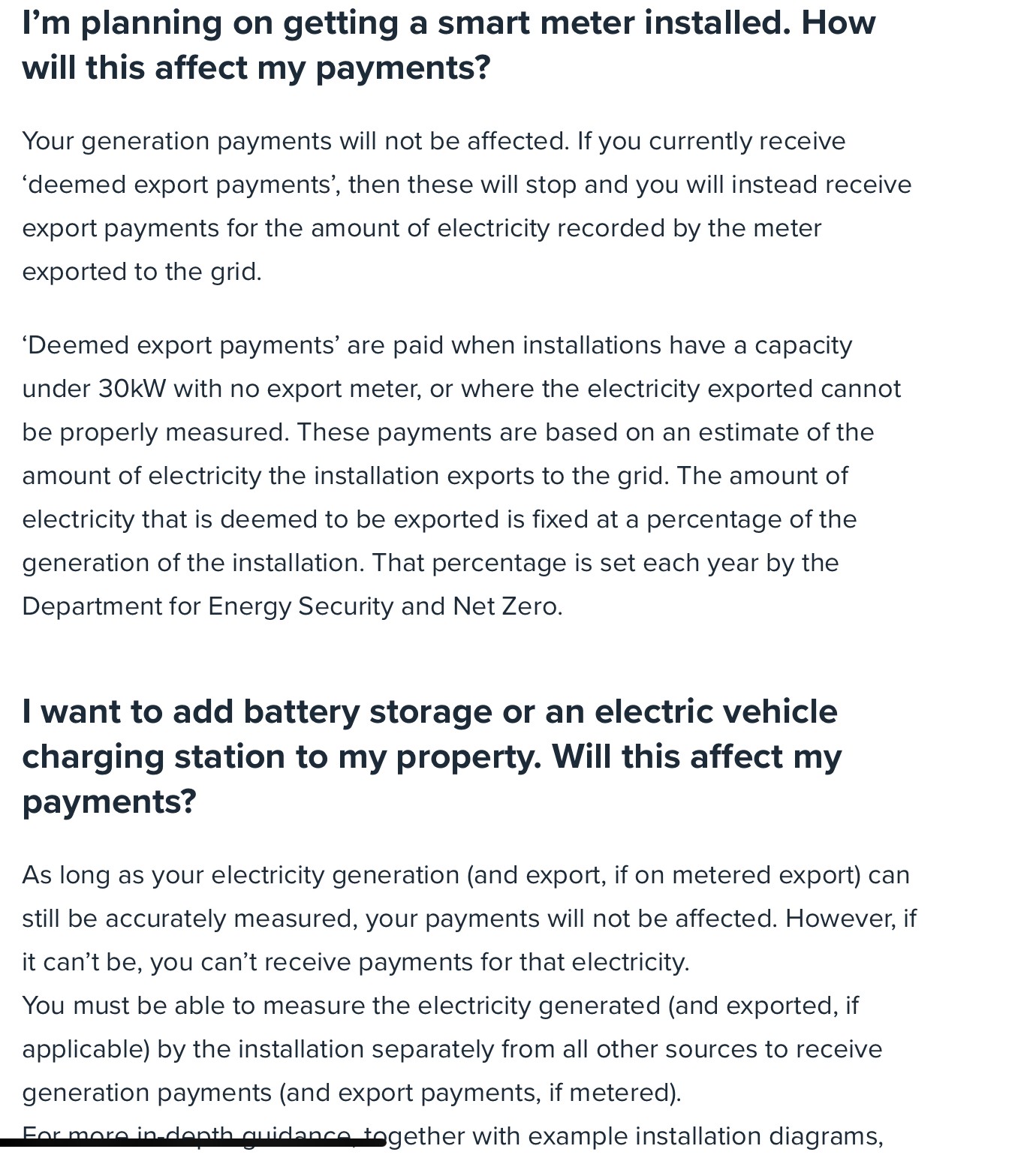
If you have a legacy FIT agreement then you are paid (1) for what you generate from the solar array and (2) a ‘deemed export’ of 50% of what you generate.

thebdj I have exactly the same, a FIT array, paid based on the meter attached to the FIT array. The key point is the amount you export is estimated to be 50% of your generation. It of course may be more or it may be less, but its not measured.

Its likely this FIT array is 4kW in size as that was the maximum you could have at the time.

Separately you have had a new givenergy inverter with solar array. Again I had the same, in my case fitted January last year.
As others have said the GivEnergy inverter tries to balance house demand and supply it from the battery to minimise your import. It knows nothing about your FIT array by the way and so any FIT generation will in effect reduce the home demand (giving you a lower home consumption figure in the givenergy app/portal).

Once the battery is full the excess solar will be exported by the inverter. It can’t be “lost” (unless you turn the inverter or panels off), it is exported.
This isn’t an issue. Whilst you may not have an export tariff and you are not getting paid for the export, there’s no case that the DNO “refuses” it. The DNO may have imposed an export limit when your installer sought approval for your system, and if there was, the installer will have configured that limit in the inverter as part of the installation process.

I was like this for 7 months, generating energy from my new givenergy panels, charging the battery up, and then when full, exporting the excess. For free. I gave away 3mW like this :-(

Separately you need to decide whether you want to keep your FIT deemed export or move onto an export tariff and get paid for all that you export from your FIT array and your GivEnergy array. You’ll need to do the sums and work out whether it is worthwhile for you to do or not. In my case I did this in July/August last year, giving up about £100 of deemed export payments and receiving £333 of measured export payments from mid August to end December 2023. So it was definitely financially worthwhile.

Giving up deemed export payments does not affect your FIT generation payments, you’ll continue to get these.

And if you do decide that you want to move back to deemed export in the future, you can do.

Oh and there is one other thing to highlight, which I didn’t know about, but if you have a smart meter fitted and are on the FIT payment scheme then you have to give up your deemed export payments and moved to measured export payments. Its in the FIT scheme terms and conditions. I presume deemed export was a way of rewarding people for their generation and export at a time when smart meters that could measure the actual export were not commonplace. Once you have a means of measuring the actual export you’re supposed to get it changed.

S
#6 SimonP

BUT... With another system exporting as well the OP will have to go onto an export tariff?

G
#7 geoffreycoan

SimonP No you don’t have to go onto an export tariff, you just don’t get paid for the export. I had my panels fitted in January but didn’t get my export tariff submitted until June and went live in August. All my export up to the point I went live with the export tariff (and supplied a start export meter reading) was given away for free

T
#8 TX200

As long as the old system has its own generation meter, you can get paid FIT generation and FIT export if not opted out of that.

Can opt out of the FIT export and go to SEG if preferred. But do the maths on that!

It gets complicated if it's a hybrid on a FIT though - need to read the net rather than generation (e.g. count what goes into the system and what goes out of the system to subtract any charge and discharge from mains).

S
#9 SimonP

Ah yes, I was forgetting the deemed export. But what about your comment @geoffreycoan that if you have a smart meter you have to move to measured export?
(Sadly, we don't have a FIT system anymore -- moved house! But do now have a GivEnergy Hybrid/PV/Battery system.)

T
#10 TX200

SimonP supposedly, but I'm not sure it would work in all scenarios

Will they be able to tell how much export was from solar and how much was from battery?

The government wouldn't want to pay for the brown energy, only the agreed solar energy that wasn't used but exported.

So in theory yes, in practice, who knows!

V
#12 Vestas

I thought the problem was that @thebdj didn't have permission to export more than the existing plant did - and the GE kit was doing that despite supposedly being set not to export?

If so then they should give the installer a call.

S
#13 Slartibartfast

Warning - exporting power to the grid above 16amps (3.68kW) may cause the supply voltage to rise above the 256VAC limit. If the DNO are having problems in your area they may pay you a visit. A meter should be fitted that can control i.e. reduce the solar power if needed.

R
#14 rjp

Slartibartfast I know from experience that exporting can raise the grid voltage over allowed limit, but what happens is that the inverter will throttle or cut the solar generation when this happens. It's measuring the grid voltage itself.

If you've got high mains voltage to start, and a lot of your neighbours also have solar PV, it can happen even if you're not exporting much at all.

T
#15 thebdj

Thanks for all the replies!!! There's some amazing info in here. I have been out today or would have tried to respond sooner!

So to give some information which may help. I have a legacy solar array on my house which has a FITS tarriff/payment and its own meter. It's a fairly small array but the legacy FITS arrangement is extremely beneficial to me.

I have had a completely new array put on a fairly sizable outbuilding at my property. It is quite a bit larger than the original solar array, but were I to put it on to export (a new one) it would likely not be as beneficial as the current one I have.

Anyway ... when I had this installed, I was told that it was not allowed to export to the grid. I believe it is on the same phase as the main electric supply, and I was told that this may cause issues with the original export meter and I may be questioned as to electric going back to the grid that is way beyond the expectation of the original solar array.

Consequently I was expecting to see nothing showing as 'exported to grid' on my portal but logic says to me that if more electric is being generated than is required and/or can push to the battery then it must go somewhere right? Or does it not?

So maybe my actual question is, can the 'spare electric' just not go anywhere, which would mean I would then see a 0 export to grid, or does it send it there anyway because it has to 'discharge' it somewhere.

Sorry again if this all seems a bit half-cocked. As you may have guessed, I am not especially ofay with everything going on here.

G
#16 geoffreycoan

When your FIT array was installed it would have had a generation meter as you said. This is a dedicated meter completely separate from the normal meter that your electricity supplier reads. That FIT generation meter should be fitted between the inverter and the rest of your house wiring which obviously in turn connects to your incoming meter and main grid connection.

As long as your new inverter and solar array were connected somewhere in that chain of wiring BEFORE the FIT meter, everything will be fine. The FIT generation meter will only record what was generated by the FIT array and won’t have anything to do with the new array and your FIT payments can all carry on as normal.

If your installer for some reason didn’t wire it up like this and the FIT generation meter is actually recording the power from both your solar arrays then (a) they wired it up wrong and (b) this is still possible, you have to tell your FIT supplier about the new solar installation and they will pro-rata your FIT generation readings. I would be very surprised if it was wired up like this especially as you have said that the new array is on an outbuilding. My guess is that the installer ran a cable from the outbuilding into your main fusebox or Into the meter box - in either case it should be before the FIT meter.

There will always be some delay in the inverter responding to house load and sending it to/from the battery so its impossible for there to be zero ‘exported to grid’ all the time. Likewise if your batteries are full the extra energy coming from your solar panels has to go somewhere.

Do you have a copy of the approval letter from your DNO for your new array. It should say either G98, G99 or G100 on it. This will say what (if any) export limit your new array has. It is possible I suppose for the DNO to impose an export limit of zero from your new array but I think this unlikely. It sounds more to me that your installer didn’t understand the FIT array and hasn’t quite given you good advice.

Finally on the whether it is worth giving up your FIT generation payments or not, it depends of course how early a FIT scheme you were on, they were very generous in the early days. Mine was a later one and as I said I gave up £100 to earn probably about £1000 over the year.

But do note the point about if you have a smart meter fitted.

#17 nophead

thebdj So maybe my actual question is, can the 'spare electric' just not go anywhere, which would mean I would then see a 0 export to grid, or does it send it there anyway because it has to 'discharge' it somewhere.

No technically it doesn't need to go anywhere, the inverter can simply not draw as much current from the panels as they are capable of generating. We have G98 approval which limits our export to 16A or 3680W. We have a 4.4kW array and a 5kW inverter so our installer set an export limit in the firmware to make it compliant. I don't know if that register could be set to zero, so nothing gets exported, other than the tiny inverter control errors.

So far we have never seen the limit take effect because it is the darker half of the year and it is always cloudy at midday. The last day where there was no cloud all day was in January.