Finding out what's possible

38 comments started 2024-03-19 last 2024-03-25
GivEnergy ProductsBattery
T
#1 TheMongoose

I have a 9.5kWh battery and panels on the roof. I've got the Octopus 7.5p rate between 23:30 and 05:30 so I 100% charge the battery then. My usage very very rarely goes over 7kW in a day, so I can theoretically run the whole house off just the battery. I've now gotten onto the Octopus 15p export tariff. So I'm presumably better off if I run everything off the battery and sell 100% of the solar generation back to the grid?

Is there a combination of settings I can use to achieve this?

When commissioned, I had Eco mode on and set Timed Charge to 100% it between 23:45 and 05:29, which worked, but I'm noticing now we're getting more sun, it prefers to do the following:
1) Solar to house
2) Excess solar to battery
3) Only export when the battery is at 100%

I've currently turned off Eco and set Export Power Priority to Grid First, but while this is fine when there's sun, I've noticed that when not generating, it will then prefer to pull from the grid rather than the battery. If I turn Eco back on, it starts using the battery, but then when the sun comes out again, it starts charging the battery.

What I think I want is:

1) Battery to house
and
2) Solar to grid

Is this possible? It just seems a waste to use solar to charge the battery (which would otherwise cost me 7.5p/kWh) when I could be selling it instead (for 15p/kWh)

M
#2 MarkyG82

That's an interested thought but I don't think there is a setting for it. You need to have eco on to make best use of the battery as you have found. For your setting there needs to be a kind of sub-eco mode where the excess solar goes to the grid instead of the battery. Eco clearly handles demand from solar or battery but you would then need that to tweaked to stop solar from going back to the battery. Hmmmm....

G
#3 geoffreycoan

TheMongoose You want to set Eco mode and additionally a pause charge from 5:30 to 23:30 which should stop your battery charging from the sun. However this won’t stop solar to house. I don’t know if there is a combination of settings that will do that

By the way, the overnight charge and export is not quite as profitable as you have it because there’s 10-20% conversion losses on charging then discharging the battery, and maybe 5-10% on converting PV to AC for export, but its still more profitable to charge the battery overnight and export during the day

D
#4 DD

TheMongoose What I think I want is:

1) Battery to house
and
2) Solar to grid

Is this possible?

No. The inverter cannot really distinguish house and grid. It has a single AC output port onto which it generates electricity. The house will take the first cut, and the grid gets the rest. In 'eco' mode, the inverter expends effort to manage the discharge power to exactly cover the house consumption, which it does by trying to get grid usage to as close to 0 as it can (ie neither importing nor exporting). AFAIK it doesn't measure consumption directly, only infers it based on the power it is generating and the power flowing through the CT clamp on the meter tails.

You don't want to turn eco off, really... as you've already found, that inhibits discharge to cover shortfall in solar. It also prevents solar charging battery, but you may not care about that. I have found that the 'priority' setting has no effect whatsoever on my system, unfortunately.

I'm in very much the same situation as you: on IOG, and battery is big enough to cover daytime consumption. I use the 'timed pause' to prevent battery charging from solar during the day.

However, one thing you might need to take into account: if your solar generation exceeds the AC power limit on the inverter, then you'll get clipping if you don't allow it to put the excess into the battery. This is what 'grid first' is supposed to let you do, but that doesn't work for me. I've not yet got proper automation set up, so I just allow 1kW of solar charging around noon, when solar is likely to be strongest.

N
#5 Niceguy

geoffreycoan I must admit that although I love my new solar system, the conversion losses are higher than I'd hoped for.

I wonder if they're about the same for all the manufacturers. Certainly for EVs there is quite a variation in charging/discharging efficiencies.

T
#6 TheMongoose

@geoffreycoan - Ah, I didn’t know about the pause charging, that might be what I need, thanks. And unless the loss is 50%, I think I’m still winning if I’m exporting rather than using the solar directly

@DD - Thanks. I wasn’t sure how magic it was when it came to working out where the power came from. That does make sense. I’d not heard of clipping. I’ll keep an eye on the solar generation as we get closer to summer. If it starts going over the inverter’s 3.5kW rating I guess I’ll reassess the battery thing. I can’t see a way to unpause the battery in the middle of the day, so I may need to rethink that.

Thanks everyone, I’ll have a look at these settings over the next few days and see how I get on.

D
#7 DD

TheMongoose I can’t see a way to unpause the battery in the middle of the day, so I may need to rethink that.

My inverter only has a single timed pause, but I really want one from 8am to noon, and then a second from 2pm. So I have a simple script running using the API to move the single available slot back and forth between the two settings. I think I'm going to have to adjust things slightly so that:

  • it's paused from 0800 to 1130
  • unpaused with max charge rate of 500W until noon
  • unpaused with max charge rate of 1000W until 2pm
  • unpaused with max charge rate of 500W until 3pm
  • paused after that.

But longer term, I really do need to make it dynamic - it was all completely pointless today, since solar didn't even make it to 1kW. So I need to monitor the solar generation, and adjust the battery charging power to consume any excess over the inverter's 5kW limit.

The inverter does itself consume a fair bit of power while exporting. I'm not quite sure whether that comes out of the AC budget, or the DC charging budget of 3.6kW, or if it's taken from the DC input from the PV side, in which case it's extra. I'm currently thinking it's extra, since when solar is generating 6kW and inverter is exporting 5kW, putting 500W into the battery seems to be enough to prevent any obvious clipping.

P
#8 phoenix

TheMongoose

Electricity is either being drawn into your house or being exported (if you have the capacity to do so). Ergo if you are generating via solar, you can either use it (in house, including charging battery, if set to do so) or it will flow out to the grid if those demands are less than the solar is supplying, and there is net demand from the external grid. If you are charging your battery, you will draw from solar first, and then from the grid. That is how I understand it. Kind of like water - you would not expect it to be able to flow bidirectionally in the same pipe! It's fungible, as is domestic electricity, so the concept makes little sense. It will always be a net flow going in one direction.

R
#9 Rogerbu

TheMongoose I use Wonderwatt to achieve what you are trying to do (google wonderwatt)

I have it set up with 2 schedules.

  1. Charge to 100% 23:30 to 0530
  2. If batteries >75% at 19:30, then discharge at 3kw 19:30 to 22:30

The only issue is if IOG sets up a car charge outside the 23:30 - 05:30 period, then the car is charged from the house battery - not what I want.
If the slot is before 23:30, Then I manually charge the house battery using the app for the same period.
I have set the 'car must be ready time' to 05:30 as I have seen that IOG often changes its overnight slots during the night.

As a result I export about 8 kWh at a profit of about 5p/kWh each night. Not much but more importanly, I am exporting virtually all I generate at the full 15p/kWh as it doesn't go near the battery with its in/out losses.

T
#10 TurnerSN13

As a daily manual workaround, you could set your battery charge rate very low during the day, and ensure you remember to revert ready for charge from grid in the evening.

D
#11 DD

Just trying an experiment for another thread, and may have discovered another way to prevent solar charging the battery... if you use one of the spare charging slots to configure a charge from 0530 to 2330, but with a charge target of something low (4% or something), then I thought that would mostly be a no-op. But it appears to prevent solar charging. Would need to do more experimenting to check for any other side effects, though.

C
#12 comms

TheMongoose Hi Mongoose, I've just had a GE solar system installed ie solar panels and battery (8kw) (no EV charger), my electricity supplier is Octopus.

The primary aim of my solar investment was to generate free solar electricity to power my home which uses iro 6kw per day. Clearly, during the winter months there's a need to supplement the battery with some off-peak grid electricity. I limit the off-peak grid charge to 70%. I work on the principle that on good solar days the sun will provide the final 30%. When the sun shines this scheme seems to work, however on completion of charging the solar panels export to the grid. What I'm looking for is a cheap off-peak charging rate that I can mix/match with exporting excess solar to the grid.
I'm currently pondering over the Octopus plans/tariffs.

Which Octopus plan do you have for cheap off-peak charging?

Which Octopus export plan do you have?

Noteworthy, I have no interest in off peak grid charging to 100% and thereafter rapid discharge back to the grid during peak hours. I believe that cycling the battery in such a manner would only serve to accelerate battery failure.

Kind regards Pete

V
#13 Vestas

comms Octopus Agile is probably the import tariff you want as its easily the most flexible in terms of top-ups on the battery when the weather isn't ideal. For example today isn't great for solar so I'll put a couple of units into the battery when the price is cheaper around 2pm (14p today so not great) and that'll get us past the peak rates period of 1600-1900.

Octopus Outgoing Fixed pays 15p/unit at any time which isn't the best if you have a large PV array & hence export a lot in summer. It's fine for us as we have a small array and export very little (94% self-consumption).

In case you're unaware, there are various PV forecasting websites, Solcast being the one most people use. GivTCP also has that integrated so you can use that to automatically control the SoC target you charge to based on the forecast for the next day/later that day. Doing it manually gets old REALLY quickly 🙂

M
#14 MarkyG82

So it seems my original reply was misplaced. It can be done. This community never ceases to amaze.

D
#15 DD

comms Which Octopus plan do you have for cheap off-peak charging?

Almost certainly Intelligent Octopus Go, which requires a compatible EV. If you're not strongly tied to Octopus, there's a couple of people here on Eon NextDrive, which despite also being an EV-only tariff, seems to allow people with solar batteries to use it. That has rates similar to IOG: about 8p overnight for 7 hours, and export of 16.5p I think.

But the nice thing about sticking with Octopus is that it's fairly easy to switch between tariffs as conditions change. Eg Flux for summer, and maybe Agile for winter. (Tracker is an exception, however.) And of course Octopus' customer service may be suffering a bit as they grow, but probably still a lot better than most of the competition.

#17 positor1

comms
I am sure there is a word to describe what you are doing by adding that link to every recent post.
At best it is annoying so please stop it.

V
#18 Vestas

positor1 Spam is the word you're looking for. Best to ignore him.

#19 Cdent

Vestas if we all flag it as off topic hopefully GE will do something...

C
#20 comms

It's not spam, it's the ground truth associated with a GE solar system and the associated clunky software.
Yes, let's hope GE decides to do something, perhaps even answer my support request with logical English.

But at least GE's web portal is correctly confirming the status of the weather outside my office window!

V
#21 Vestas

comms Its spam. End of.

T
#22 TheMongoose

Thanks all for the continuing suggestions! I didn't realise this was going to be such a nerdy community (and I say that with love!), so I can imagine getting into all sorts of automation shenanigans going forward...

Probably worth mentioning that although I've got a theoretical maximum of 5,525kW of generation, my house is an end terrace and that's split around all three sides of the roof. So I'm not sure I'll ever get over the 3.6kW that's the maximum the inverter can handle. I've only had them since mid-December so I'm not sure how much I'll get in mid summer. Maybe I'll be pleasantly surprised! But I'm expecting slightly less than maximum possible generation, but increased time for generation.

@DD - interesting idea. I haven’t gotten much into automation yet, but as I mentioned above, I’m not adverse to the idea. Although depending on maximum generation, I might be OK just limiting battery charging to a certain rate all day. I shall also look at the other suggestion for setting a low charge target during the day too, thanks.

@phoenix - yes, I understand that, what I’m trying to do is make sure I export the maximum possible while not having it draw back from the grid during the day. Eco seems to do that as I’ve just run the air fryer and watched it go from exporting (and not charging) to using the battery (and not importing). So I just need to gather more data as we get closer to summer and make sure I’m not clipping when generation is high, and I think I’m good!

@Rogerbu - oh, I like that! I’ll have a closer look at it. I don’t have a GivEnergy charger, it’s an Octopus-provided Ohme one, so that’s set to not charge if the cost per unit is above 7.5p/kW. Less integration with the battery, but I’m not doing anything clever enough to make it worth swapping for a fancier one.

@TurnerSN13 - nah, I’m both lazy and forgetful, so anything that involves me manually changing settings and having to remember to change them back is not going to work for me 🙂

@comms - I’m on the Octopus Intelligent Go import tariff (7.5p/kW between 23:30-05:30, way more outside that, but I have the battery so I never have to pay it) and the Outgoing Octopus 12M Fixed for solar export, which is the fixed 15p/kW rate. That means I don’t have to worry about how sunny it is, or what I’m currently getting. I pay 7.5p and anything I sell back gets me twice that. And as long as I export 3.6kW per day, that should cover my standing charge. I’m gambling on modern batteries having at least 10 years of use in them, and I’m not doing 100% down to 4% cycles every day or anything. Once I’ve been running it for a couple of months, I’ll see if I can get som stats out of the GivEnergy account to see if I should be setting the battery to a lower max charge because I’ll still get to the end of the day. Although that itself will change - if I’m running the house off solar during the summer and not charging/discharging the battery at all, I’ll need fewer cycles than during the winter when I only have a few hours of minimal generation.


D
#23 DD

TheMongoose I shall also look at the other suggestion for setting a low charge target during the day too, thanks.

Sorry, I meant to followup: doesn't seem to work as I had remembered. Or maybe its different on different systems/firmwares, but it turns out that on my system, it prevents both charging and discharging of the battery - it just goes completely idle.

D
#24 DD

Rogerbu If batteries >75% at 19:30, then discharge at 3kw 19:30 to 22:30

I do similar, but rather than discharge at a fixed rate, I calculate what discharge power would be required to get the battery down to about 10% by 22:30. (Or if it's already lower than about 25%, how long to discharge for at 1kW until it reaches about 10% - don't want to let the power get low enough that it can't cover base load.)

And for the IOG "random charging" thing, I allow Octopus until 7am to charge the car, but set the max discharge power to around 250W or so, which is enough to cover the house until we wake, but if the car does charge late, it only takes a little power from the battery. [Octopus engineer is supposed to be coming soon to change the wiring so that the inverter didn't see the chargepoint.]

I just use a raspberry pi with scripts running from cron to send API requests to adjust the various parameters. Which does mean it could go wrong if there are network outages. I may change things to speak to the inverter directly... one day...

#25 Wonder Watt

DD

And for the IOG "random charging" thing, I allow Octopus until 7am to charge the car, but set the max discharge power to around 250W or so, which is enough to cover the house until we wake, but if the car does charge late, it only takes a little power from the battery. [Octopus engineer is supposed to be coming soon to change the wiring so that the inverter didn't see the chargepoint.]

For this reason (allowing car charging to not drain the battery) and for AOI (EMS), we allow users on Agile to specify a 'hold-charge' between the charge slots, but allow a max discharge rate to be set during those gaps.

R
#26 Rogerbu

Wonder Watt Re -For this reason (allowing car charging to not drain the battery) and for AOI (EMS), we allow users on Agile to specify a 'hold-charge'

Like Agile, IOG users have a similar need to 'hold' the house battery SOC when Octopus changes its mind and creates charging slots outside the standar 23:30 to 05:30 window.

Is there any chance that Wonderwatt can help here now or in the future?

The issue to me is that Octopus seems to have recently started to update its provided charging schedule at random times during the night. (I assume to dynamically balance its distribution).
As a result, when Octopus changes its car charging slots during the night after I have triggered Wonderwatt charging, then when car charging occurs after 05:30, the car charges from the house battery instead of the grid - clearly not what I wanted to happen.

#27 Wonder Watt

Rogerbu

Is there any chance that Wonderwatt can help here now or in the future?

Yeah, we're pretty busy, but Intelligent integration is on the radar.

In the interim though, there may well be an opportunity to provide a fix of sorts to allow a separate schedule to be set up 'hold-charge' (but with max discharge rate).

Can these Intelligent charge slots be literally any hour of the day or do you have some control of the window this occurs in?

V
#28 Vestas

Wonder Watt You're coming along in leaps & bounds. Really well done 🙂

#29 Wonder Watt

Vestas Thanks very much, very kind of you to say. 😊

D
#30 DD

Rogerbu I have set the 'car must be ready time' to 05:30 as I have seen that IOG often changes its overnight slots during the night.

Rogerbu then when car charging occurs after 05:30

Does it still charge after 05:30, even when you've told it that's when you want the car ready ?

I tend to ask for charging to be done by 7am, and I don't think it has ever gone as late as that.

The Octopus interface allows you to specify a ready time between 4am and 11am. (I don't know what would happen if you plugged in at 8am and asked for it to be ready by 11am, though.) I understand that, when using the Ohme integration, you can specify any ready time - in that case, it's Ohme rather than Octopus that chooses the schedule. (There were even rumours that Ohme were targetting peak-rate hours to somehow game the savings sessions, but I think Octopus have clamped down on that.)

#31 Wonder Watt

DD

I tend to ask for charging to be done by 7am, and I don't think it has ever gone as late as that.

That's interesting so for @Rogerbu - if a similar scenario applied to you, a separate hold-charge schedule with max discharge % configurable would work for you, between 5:30-7:00 AM or such?

D
#32 DD

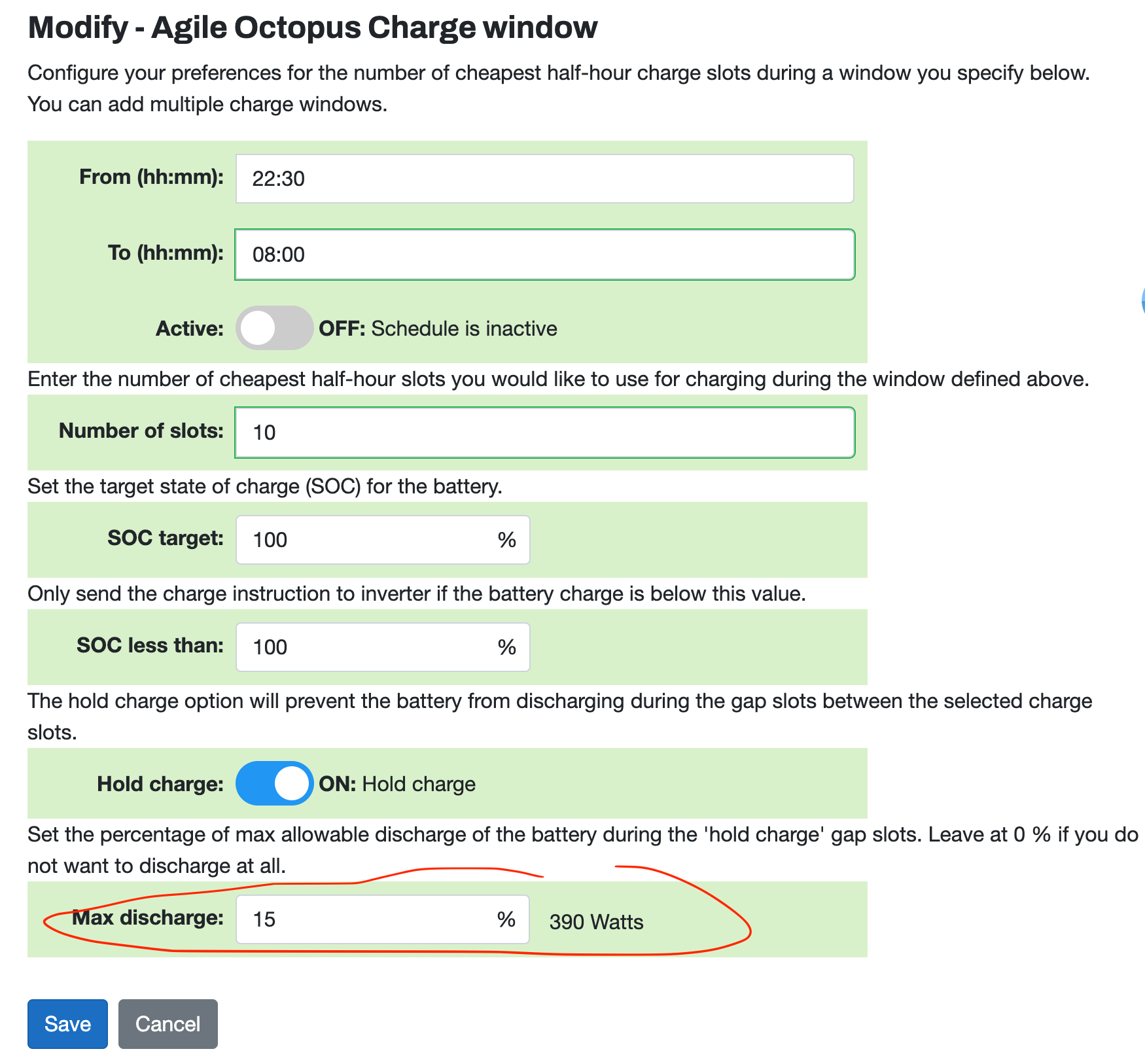
Wonder Watt Yes, I should think so. Though I don't quite understand what the 15% and 390 watts refer to in the sample above. I set max discharge power to 250W between 0530 and 0700 which is enough to cover base load, but will stop the car taking much.

On Agile, I assume hold-charge is intended to mean that the grid is cheap enough that it's better to run the house from grid rather than battery, but not quite cheap enough to actively charge the battery ? Whereas on IOG, we grid is usually expensive after 0530, but might be cheap only if the car charges.

#33 Wonder Watt

DD

Though I don't quite understand what the 15% and 390 watts refer to in the sample above.

It simply is a percentage value of the max battery discharge for a user's system, just useful to see the Watts value so people can more precisely dial it in for battery to meet home demand.

C
#34 ChrisRowe

DD I plugged in at 08.15 this morning and instantly got a charge slot from 08.15 - 11.00. Very handy!

S
#35 SimonP

Plentiful energy today, Agile was down around zero for hours. So I guess Octopus were happy to let you have some of it!

D
#36 DD

Yeah, I wonder if weekend morning is more permissive than weekday ?

R
#37 Rogerbu

Wonder Watt Sorry, I am thick, I dont quite understand your 'a seperate hold-charge schedule with max discharge..' actually meant?
Does it mean that it would hold the house battery at (say) 100% whilst allowing the grid to charge the car and run the house?

I assume that until you integrate IOG, and hence can see the charging slots, then using the extra schedule would have to be manually activated.
The manual activation still wouldn't resolve the issue that Octopus changes slots in the middle of the night, leaving us either
-charging the car from the house battery between 05:30 & ready because Octopus has added a post 05:30 slot very late. or
-We are using the expensive grid to run the house because Octopus has later deleted a post 05:30 slot that it scheduled the night before.

#38 Wonder Watt

Rogerbu

Sorry, I am thick, I dont quite understand your 'a seperate hold-charge schedule with max discharge..' actually meant?
Does it mean that it would hold the house battery at (say) 100% whilst allowing the grid to charge the car and run the house?

Yeah, so it means battery charge will be held, though you can override the max discharge you want to allow within that period, which enables you to supply the house load, and EV draw would come from the grid due to this max discharge being low.

I assume that until you integrate IOG, and hence can see the charging slots, then using the extra schedule would have to be manually activated.

You're right, it would be manual. We may need to expedite IOG integration.

So much to do, so little time... 😉

R
#39 Rogerbu

Wonder Watt Thanks for what you are doing. Your app is excellent.