Battery appears to charge when it isn't

18 comments started 2024-03-22 last 2024-03-24
GivEnergy Products
P
#1 Pete Thomas

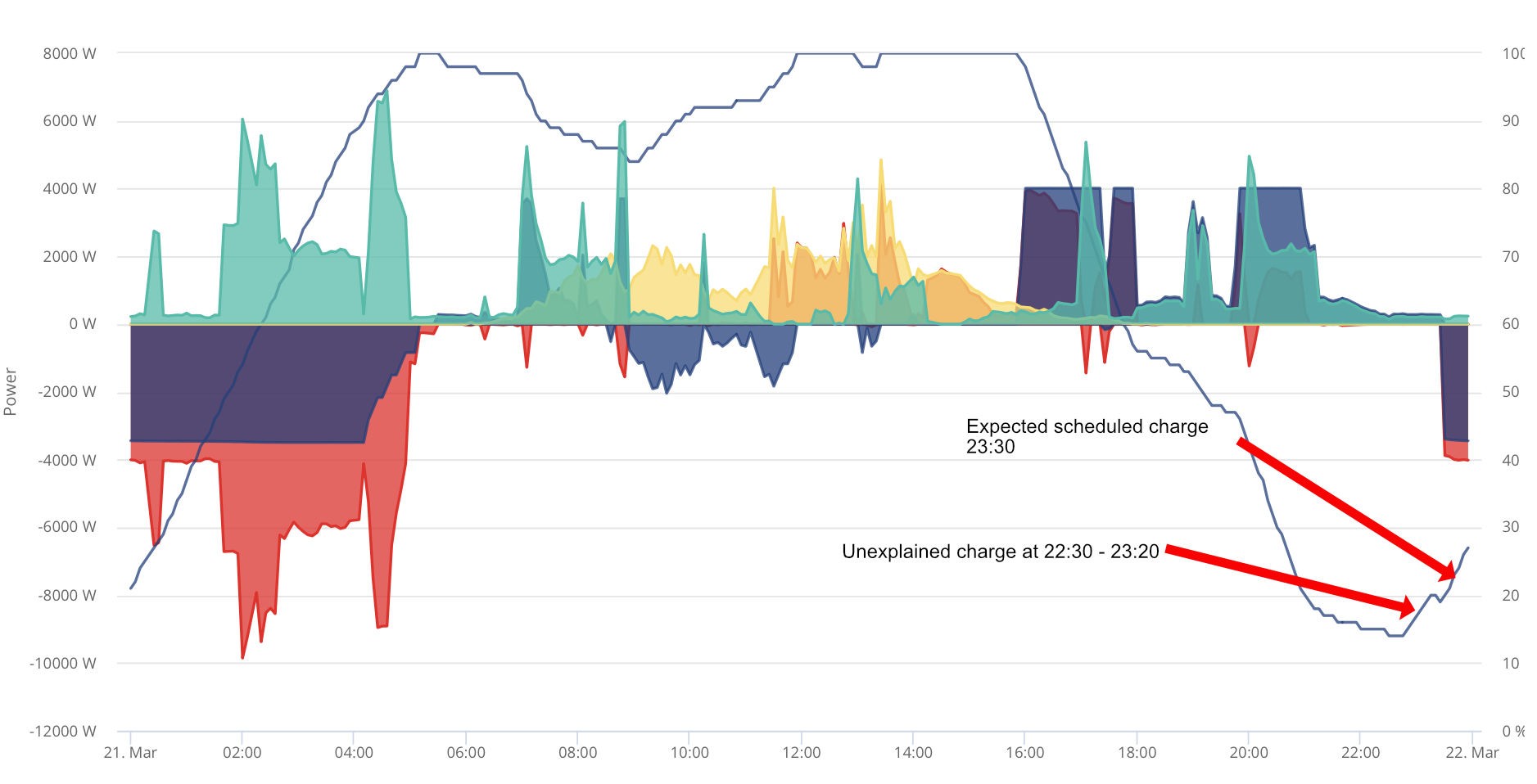
According to the graph, the battery was at 14% at 22:30. It then went up to 20% by 23:20 even though nothing was charging it (The charge at 22:30 onwards is expected as it is scheduled). No solar, no grid import. Does anyone know what is happening here? Thanks

D
#2 DD

Pete Thomas Yeah, mine does that. I think it might be rebalancing the cells, which happens when the battery is idle at a low state of charge. Any time the battery is discharging, the voltage is reduced, and then it drifts up when you stop drawing power. So it might just be that, rather than actually rebalancing. (Also, if there's a weaker cell, the battery will tend to stop when that one reaches min voltage. As that cell recovers, the power available from the battery as a whole is restored.)

[Some of this is speculation - I'm not a battery chemist...]

I now deliberately allow the battery to idle for an hour before I start charging - I have 6 cheap hours overnight, and don't need all of them, so idling for an hour is not a problem. I used to often have a problem where it jumped from about 80% to 100% when charging from solar, but since I changed to allow this low-voltage recovery, it hasn't been doing that. (Correlation may not be causation, of course. And it might just be confirmation bias speaking.)

(It does feel like I'm missing out on some of my battery capacity, somehow... in effect, it is underreporting the true SoC by up to about 10%, since it's getting down close to 0 when in fact it still has around 10% extra it can give, once it's had a bit of a rest.)

Time                  Voltage Power    Temp     Percentage
2024-03-19 23:28:49	52.14	124	13	8
2024-03-19 23:33:56	52.24	0	13	8
2024-03-19 23:39:03	52.27	0	13	8
2024-03-19 23:44:10	52.29	0	13	9
2024-03-19 23:49:17	52.31	0	13	11
2024-03-19 23:54:24	52.33	0	13	14
2024-03-19 23:59:31	52.34	0	13	16
2024-03-20 00:04:38	52.39	0	13	18
2024-03-20 00:09:45	52.38	0	13	20
2024-03-20 00:14:52	52.39	0	13	21
2024-03-20 00:19:59	52.4	0	13	21
2024-03-20 00:25:07	52.4	0	13	21
2024-03-20 00:30:14	52.41	0	13	21
2024-03-20 00:34:33	53.12	-862	13	21

See also https://community.givenergy.cloud/d/4066-giv-energy-battery-charge-to-capacity
and https://community.givenergy.cloud/d/1342-new-givenergy-inverter-bms-firmware-beta-testing-chat/2577

G
#3 geoffreycoan

DD I now deliberately allow the battery to idle for an hour before I start charging - I have 6 cheap hours overnight, and don't need all of them, so idling for an hour is not a problem.

There is commentary elsewhere that slow charging is better for the battery than always doing everything at max rate. It certainly means the battery is warmed more consistently through the night than getting hot and then cold which we know doesn’t help charge/discharge rates

R
#4 Rubikcube

Perfectly normal. The percentage is just an estimate. The estimate has been revised, but the charge in the battery has remained the same.

V
#5 Vestas

As it happens I've been playing around with monitoring cell voltages on a G2 9.5 battery and a G1 inverter during charge/discharge. Mainly to stop overvoltage whereas with the last firmware it was undervoltage. Anyway.....

I've basically got a GivTCP/HA automation which checks cells 1-4 (the ones with temp sensors) and if any of them go over 3.49V OR the battery goes over 55.8V then the charge rate is set to zero. Wait an hour and reset charge rate to 2600.

I'm pretty certain that 3.49V works, 55.7V on the battery might be better in terms of preventing overvoltage notifications as the charge has to ramp down. Best way to test is with variable PV input plus grid so no problems there 😉

Result of a trigger on 55.8V - BMS SoC 98%, Inverter SoC 100%. No overvoltage notification on portal.

I'd probably recommend 3.45V on the cells because I think that's 95% charge on the published value of 9.5kWh.

Meaningless until it gets taken through a few cycles but promising 🙂

#6 hoggy

@Vestas I settled on 55.2V on mine.

V
#7 Vestas

hoggy Ummm and 3.45V x 16 is..... 😉

V
#8 Vestas

Tricky bit is testing 4% or whatever but I think I decided on 49.6V for 3 minutes (kettle) on v3013.

I didn't like what happened after that with cell voltages.

#9 hoggy

Vestas yes I’m aware!

V
#10 Vestas

Mmmm I thought that would be too simple. I think it needs one set of limits for AC charge, one for PV charge and one for combined.

D
#11 DD

Vestas Interesting... on the AIO thread, they suggest that charging from AC is relatively well behaved, but charging from solar can mess with SoC tracking.

V
#12 Vestas

DD I don't know about the AIO so I'm not going to comment.

Basically the BMS on standalone G1/G2 batteries isn't suited for anything other than linear charge to max/discharge to min with at least an hour a day idling.

Anything else and next-door's cat is as likely to be able to predict the SoC as the GE systems.

They can throw firmware at it until we're all dead, it won't fix the basic problem which is the BMS isn't capable of doing the job.

#13 nophead

I don't know what gen my 5.2kWh battery is but it works perfectly on my Gen3 hybrid inverter since it was installed 6 months ago. I never experience jumps in SOC apart from a very occasional small bounce back when it has fully discharged.

G
#14 geoffreycoan

nophead The 5.2 is a gen 1 battery.

I’ve too have never noticed any notable SoC jumps on either my 5.2 or my 9.5 batteries. I have more issues with the inverters deciding not to force discharge when I want them to, but SoC is stable and behaves itself (Gen 1 hybrid inverters)

V
#15 Vestas

geoffreycoan I wouldn't imagine yours gets very empty or full using predbat?

G
#16 geoffreycoan

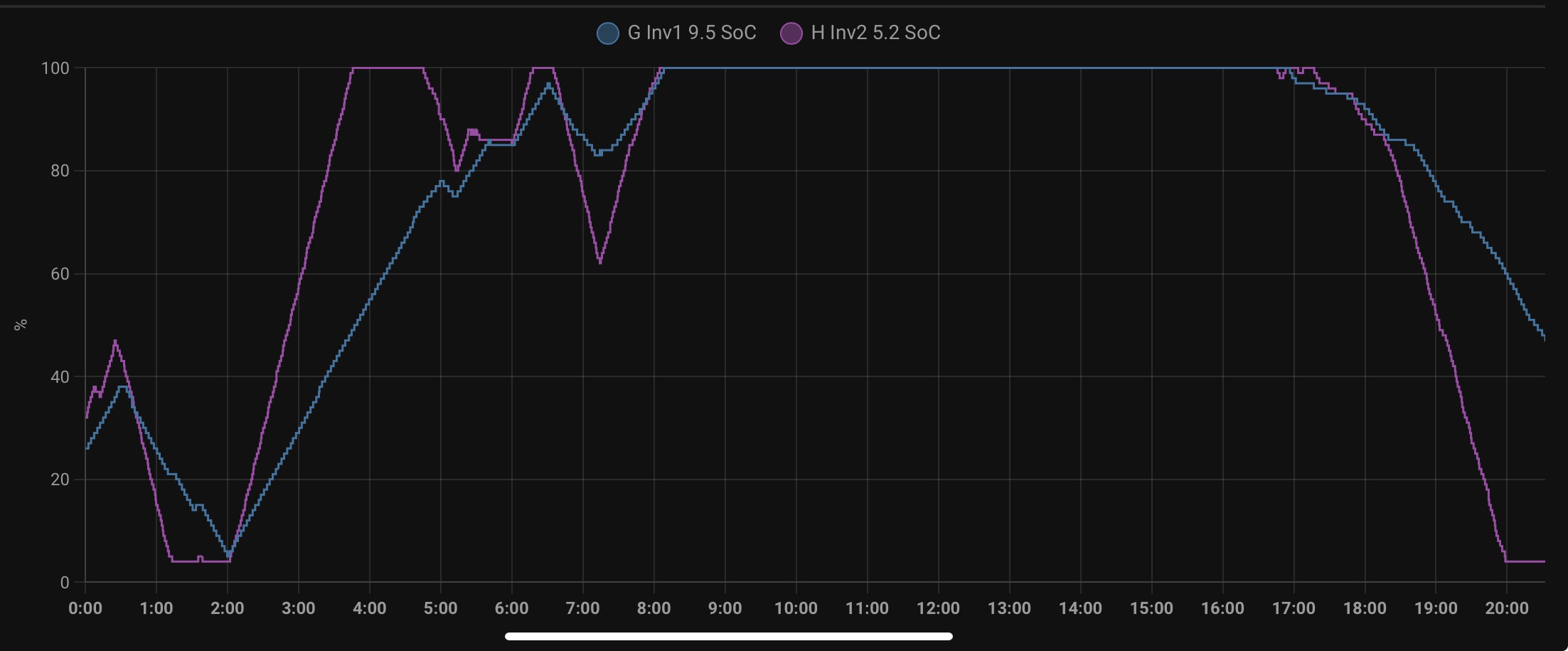
Vestas Both of my batteries get fully drained and refilled every day, sometimes twice a day with predbat

e.g. here’s today’s SoC traces

We go through 14 kWh a day or so in summer, but 20-50 a day in winter. ASHP uses about half our daily consumption

V
#17 Vestas

geoffreycoan Yeah they'll run fine like that in terms of SoC.

If you take them all the way from max to min every day you won't see massive SoC jumps. The SoC won't be correct but its probably not too far out.

Its when the batteries only go down to 20-30% several days in a row that you'll see SoC which is seriously inaccurate. The more days that goes on, the worse it gets. That's also when the battery will generally overvolt to the extent that it generates a notification - basically the cells are unbalanced and hence some are hitting higher voltages under charge because the SoC is wrong and the inverter depends on it being right.

Unfortunately most people aren't going to be discharging the battery to 4% during summer so we'll be seeing more of these sort of issues.

Thank gods for GivTCP 🙂

#18 nophead

We charge to 100% on flux each morning and usually hit 100% during the day from solar charge but we don't discharge to zero in the winter, more like 50%. No SOC jumps.