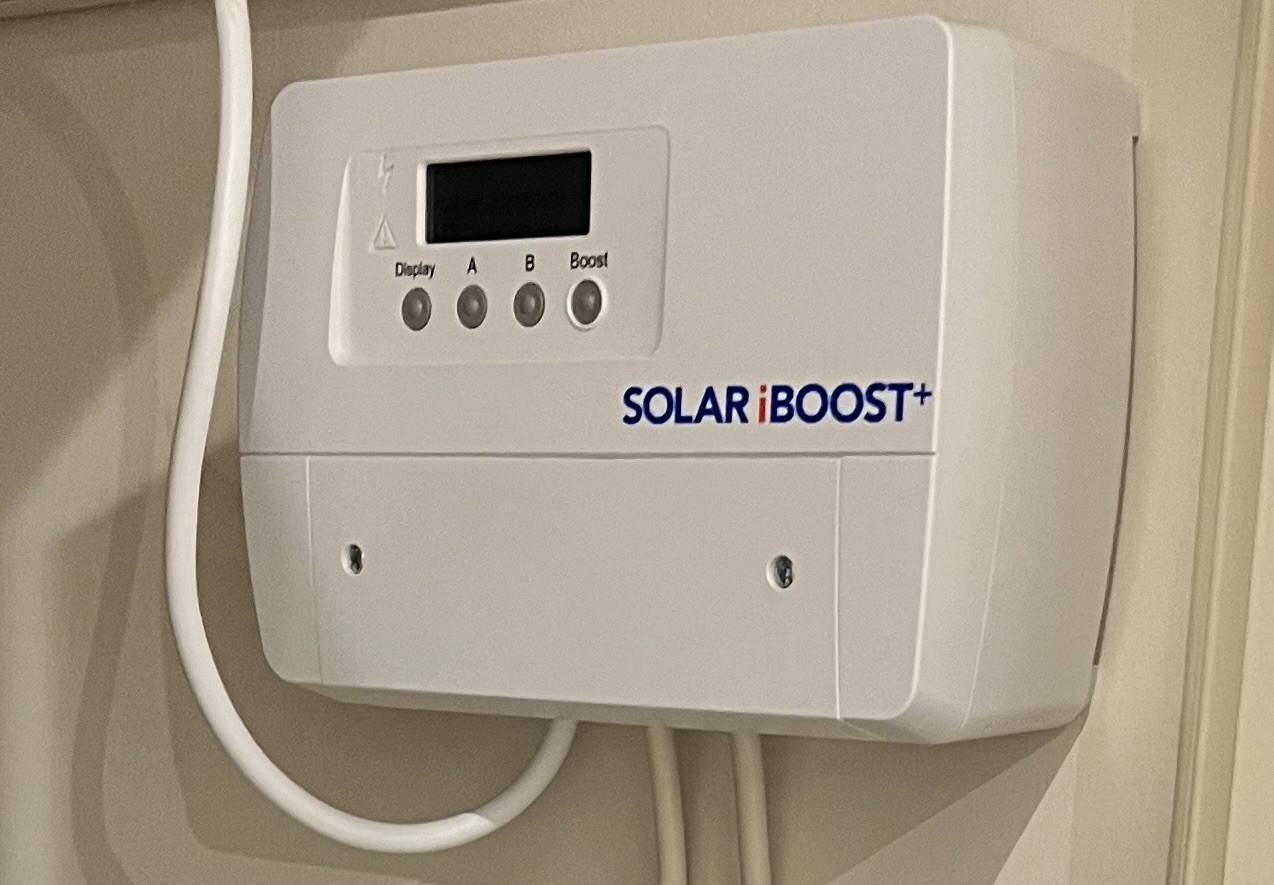
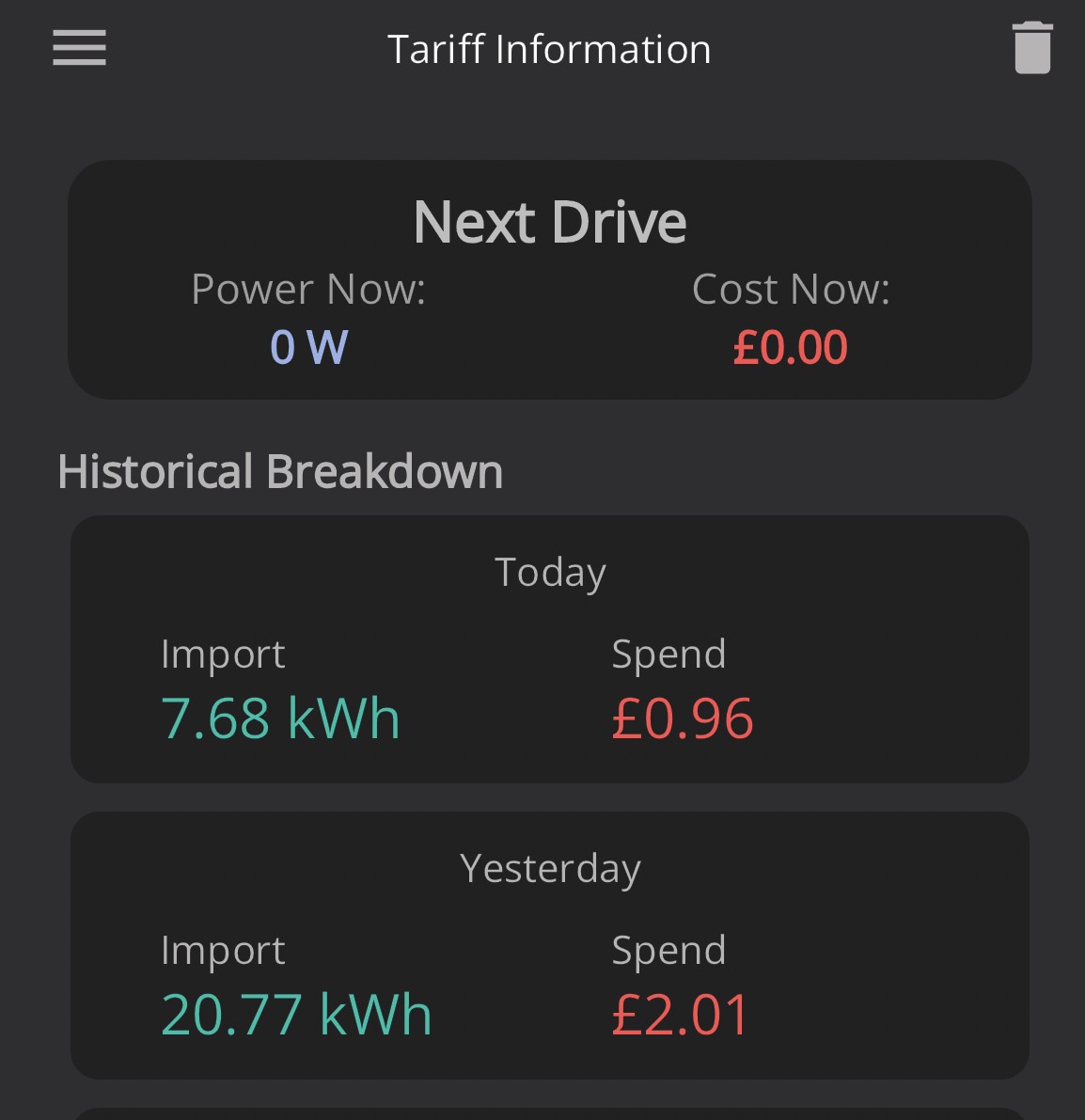
After I moved the battery charging to the day, and installing a Iboost + unit for water heating, so much power was being sent back to the grid, I felt the iboost + was naturally the right thing to buy
I bought this unit in “as new” condition off eBay and just £126 delivered, working like a dream! I’m still waiting on my SEG from EON
Long may the power consumption reduction continue!
G
#2geoffreycoan
Great news. Definitely a big change from where you were before on your over-heated immersion heating
Once you get your SEG though you may well find its more profitable to export than to use the iboost.
K
#3kram
I looked at an eddi and canned the idea as I can’t see how it would ever pay for itself. I am far more likely to fit a bog standard immersion timer and consider additional battery rather than fit a diverter these days.
K
#4killythebid
kram I did have an eddi installed but the reality is for our use and means of heating water by oil boiler it is not so worthwhile. I pay a little under 7p per kWh for heating oil so I am better off using that to heat the water and export more giving me 16.5p per kWh exported. On the other hand of course if one's intent is to be as green as possible and use less imported energy, particularly oil products it makes sense to self-consume as much as possible and a solar diverter for the water heating in turn makes more sense.
In other circumstances like Midlands_Solar where the main source of heating the water is electric anyway, it does make sense to have one to heat the tank with excess solar especially if one has not got a means of export yet.
I’d suggest it makes more sense to heat it at night, export for twice the money. I guess it’s a trade off and at £250 I might do it, but at £400+ it is a money loser. It would be nice but not when I lose money using it year on year. I suppose if export stopped paying we always have a zappi to dump it out.
The £126 the OP paid makes for a different story.
Obviously circumstances vary, but I think the prices need to match the economic reality.
FWIW, exporting means someone else gets to use green energy, so even the green message isn’t clear cut now.
#6Midlands_Solar
My iBoost + saved 7.04 kWh between 10:00 - 17:30 today, at my day rate of 35.1p per kWh that's £2.47 today, multiply that by typical number of days a month so that's a £66 saving monthly over the lighter days in the spring/summer. So my iBoost + has paid for itself after just 2 months
G
#7geoffreycoan
Midlands_Solar Don't disagree with your maths and you got the iBoost at an excellent price, especially when you're not being paid for export, its using the free electricity more efficiently than a simple on/off immersion heater.
But when you get your export (16.5p I think you said?), the picture will change. What's your night rate? You'll be able to heat a full tank of water overnight for half that price and export during the day.
I think for most people now with batteries, export income and time of day tariffs, these solar diverters are not economically viable.
For me heat pump owners like me the maths are even worse, it consumes just 1-2kW a day to heat the hot water in summer, probably less now I have changed it to heat pump only and not heat pump+immersion for the hot water.
Horses for courses
K
#8killythebid
kram It does not make sense for me to heat water at night economically. I can heat the water any time using the oil boiler for 7p per kWh but using the electricity at night costs me 9.5p per kWh and of course, the spare solar can go to export.
Also as I said for some saving of money is not the goal so making the economics add up is not as important as consuming green energy. I agree exporting the excess solar means it makes the grid a bit greener for everyone else but if self-generation and consumption are the goal this is not as attractive.
The economics for Midlands_Solar makes a lot of economic sense to use his iBoost.
D
#9DD
killythebid I had a similar sort of quandary: gas on tracker is typically cheaper than the 7.5p overnight electricity. But gas is a lot less efficient, and heated more water than we needed, so I stuck with electric.
K
#10killythebid
DD Our oil boiler is modern and efficient but even taking into account any efficiency difference the oil price per kWh is cheaper than the overnight electric tariff. Of course the oil price can fluctuate and it may get much more expensive in the future compared to electricity.
I shall be switching on the eddi again shortly and using it for the summer. It is not necessarily the best economic decision for me but I do wish to reduce oil use and so it will help with that.
S
#11SimonClarke
killythebid I’ve just switched our boost on as we are down to 2 chunks on the oil Watchman and I don’t want to order any more until the end of the summer if possible. Not a money saving exercise as it is definitely better to export but it is greener
Only downside to electric is you will wear your immersion heating element out more quickly so factor a more frequent replacement cost in.
D
#13DD
DreadorUK Yes - water is quite hard here, and I am surprised it has lasted this long. Hope to get a heat pump soon, so it only has to hold out a little longer.
K
#14killythebid
SimonClarke We, fortunately, have a big oil tank that could last up to 18 months or so without refill. Generally, I just fill up once a year in the autumn unless there is a price crash. I will switch on the eddi in the next week probably. It is not all about getting the best price for me I do like to generate and self-consume and reduce the oil use if I can.
Sometime in the future, we may go for a heat pump I'd certainly like to but it is very expensive just now.
S
#15SimonClarke
killythebid been looking at heat pumps and I think we could make it work for us despite microbore pipe. Biggest problem is where to put it. Octopus quoted over 4k which seemed a bit rich. I think the oil tank will be the decider as it’s 25 + years old and replacement will be a good chunk towards the ashp. Selling to my other half on the gain in garden area!
K
#16killythebid
SimonClarke Yes the size of the internal hardware is significant from what I have seen. It is a problem of where it would go. The oil boiler we have is only a few years old too but at some point, I expect to get a heat pump of some sort.
G
#17geoffreycoan
SimonClarke One thing that may further tip your decision making about ASHP vs Oil tank replacement is the rules for Oil Tank siting. We live in a village with no gas so pretty much everyone is on oil heating.
Our oil tank started leaking and I found out then that we couldn’t just have it replaced in the original location which was in the back garden next to a couple of sheds. Oil tanks now have to be 1.5m from any buildings or sheds and 760mm from any boundary fences so we failed on both counts.
Other than having the new tank in the middle of the lawn the only other place I could find to site a replacement would have been in the front garden which obviously wasn’t ideal.
So for us this tipped the balance to get an ASHP. Fortunately we got the RHI grant at the time which will repay a lot of the capital cost over 7 years, and the recent high inflation has increased the repayment amounts as well !
But it was a serious chunk of money. £4k from Octopus sounds a bargain to me. A new oil tank is about £2,500 for comparison
S
#18SimonClarke
geoffreycoan I felt it was expensive because I think it would be an easy conversion as the oil boiler is already outside and we have a hot water tank. Biggest task would be sorting powerful enough towel rails!
Our oil tank probably just about conforms to the new siting rules. Still an attractive idea though. Bigger garden, mains hot water and greener.
G
#19geoffreycoan
SimonClarke I’m sure you know already, there’s lots of variables in a heat pump installation.
For our own installation they replaced our hot water cyclinder with a much more modern and super-insulated one, there was the heat pumps themselves, a buffer tank in the loft and pretty much every radiator in the house apart from three in our extension got replaced - with either larger or larger and more panels to them.
Interestingly none of the towel rails were replaced, they calculated that all of them would be sufficient.
Subsequent to the install last year we had the lounge radiator replaced with a bigger one (we originally had one smaller than recommended fitted which was a mistake) and this yearwe had the large vertical towel rail in the kitchen and a smaller one in the utility room replaced with a big vertical radiator and a more standard radiator respectively as these rooms were just not getting warm enough. I have been running the system at a much lower flow temperature than the original design so maybe the original design temp would have been OK, although more expensive to run.
The oil tank base was dug out by me last year and in its place my wife’s got a new shed for her horse stuff so everyone’s a winner!
S
#20SimonClarke
geoffreycoan Probably get some quotes this summer but I need a new EPC (extra insulation done) or heatgeeks won’t do one. I think all bar one radiator needs replacing but they are all 25+ years old so might also be a good idea anyway. Definitely need to be 40c or lower to get at least a break even COP.
#21nophead
We have solar panels that cover our electricity needs but would be dwarfed by the needs of an air pump and there is no more south facing roof.
We have microbore pipes and a solid ground floor so the radiator pipes are ducted down the downstairs walls, which are behind the wall paper. So putting in bigger pipes would need redecorating the whole of the ground floor.
We have a combi gas boiler, so there is nowhere for a hot water cylinder. They are currently digging up all the roads in my village to replace the gas pipes, so I don't think it is going away soon. Our plan is to replace the gas boiler just before they stop selling them and it should last until we die.
G
#22geoffreycoan
nophead We have solar panels that cover our electricity needs but would be dwarfed by the needs of an air pump and there is no more south facing roof.
We have microbore pipes and a solid ground floor so the radiator pipes are ducted down the downstairs walls, which are behind the wall paper. So putting in bigger pipes would need redecorating the whole of the ground floor.
We have a large East-West roof with panels on both sides and the integral sloping garage roof, 44 in total over 3 arrays (2x GivEnergy and 1 older Growatt FIT array). We've had some good days already this year, yesterday (Sunday) was 48kWh for example, but the heat pump on the same day consumed 29kWh as it was a cold night.
Realistically our solar panels will never cover our electricity needs in the winter, and even if they did, we don't have enough battery capacity nor is the payback on extra batteries worthwhile. But overall over a full year import and export £ it should balance out well enough.
Microbore can be a problem for heat pumps as you need to have a decent flow rate, but there are ways around that with extra pumps etc and heat pump engineers are no longer saying you have to rip it all out and start again at huge disruption.
For us we got a strong push towards the heat pump when the oil tank failed. I could see it was the direction of travel, maybe I was a bit too early and a system installed today would have been cheaper, but I got a generous government grant and its done now. Our overall annual heating and hot water costs are comparable to the oil we had before plus the advantage that I can generate my own, unlike oil !
D
#23Dave_Sw1
I use a tesla T smart immersion heater, basically just wifi enabled immersion but I can see it takes 7kwh to heat the full tank from cold to 60 degree, at night 7.5p = 52p
I now need to wait until the heating goes off and it gets warmer so I can see what it costs in gas to heat the same tank from cold, unsure which is cheapest without forgoing the heating one morning
#24Tenkaykev
Dave_Sw1
We have a relatively new HW stainless steel tank after our old copper cylinder failed. Theres a very large finned coil that spirals from the bottom to the top of the cylinder so you get a more even distribution of heat throughout the tank. When we switched to using the immersion it was noticeable that the element/ thermostat was heating the top layer of water whereas there was less stratification using the gas boiler. We're now on the Octopus gas tracker and with gas costing about 4p per kWh equivalent it makes economic sense to use gas and export the electricity at 15p
G
#25geoffreycoan
Dave_Sw1 You can roughly work it out. Your immersion heater is pretty much 100% efficient so take the 7kWh as a baseline.
Gas boiler 80-90% efficient depending on age etc, so take 85% as the midpoint, it’d be 7/0.85 = 8.2kWh of gas to heat your hot water.
I had 4kw of solar array installed in March last year, by May I was exporting excess from the 9.5GE battery. So scrapped heating water by oil burner in June and installed a 2nd hand Sunamp 10kwh heat battery(£550) for purely DHW. Saved buying 400 litres of oil for starters over one summer. I looked at getting an eddi/iboost but instead bought a £37 timer. Does the job in winter and now will just use it on manual. Boost for 1hour or2. I’m now on an export tariff so any excess this summer will yield 15p a unit. On a good day the panels can do 23kwh and we only need about 10kwh/ day for the house. The diverters don’t impress me much, as Shania says!
D
#27DD
geoffreycoan boiler efficiency would only be high when condensing, which wouldn't be when heating water.
#28Simon_C
DD, same here, I use the electric immersion for water heating as it probably cost neutral with using the gas boiler.
The electric immersion only heats the top half of the traditional tank, so 1/2 the required kWh compared with the gas boiler heating the full tank. This suits two of us for showers and washing up for 6 of the 7 days a week. On typically 1 day per week, the system boiler gets turned up to 70-75 C flow setpoint for around 2 hours whilst heating the full tank for a bath. The rest of the time time the boiler is turned down to 50-55 C for higher efficiency used just for heating the house.
Using an Eddi, typical consumption is 1.5 to 2.5 kWh on cheap overnight rate along with 1-2 kWh solar top-up during the day, average is probably around 4 kWh/day for 6 days/week.
The economics all depend on the relative costs of the electric import and export and gas, along with the relative efficiencies of each system.