Octopus Flux vs EON Drive

13 comments started 2024-03-27 last 2024-04-01
Commisioning
#1 Midlands_Solar

I see a lot of votes for Octopus Flux but wanted to fly the flag for EON drive.

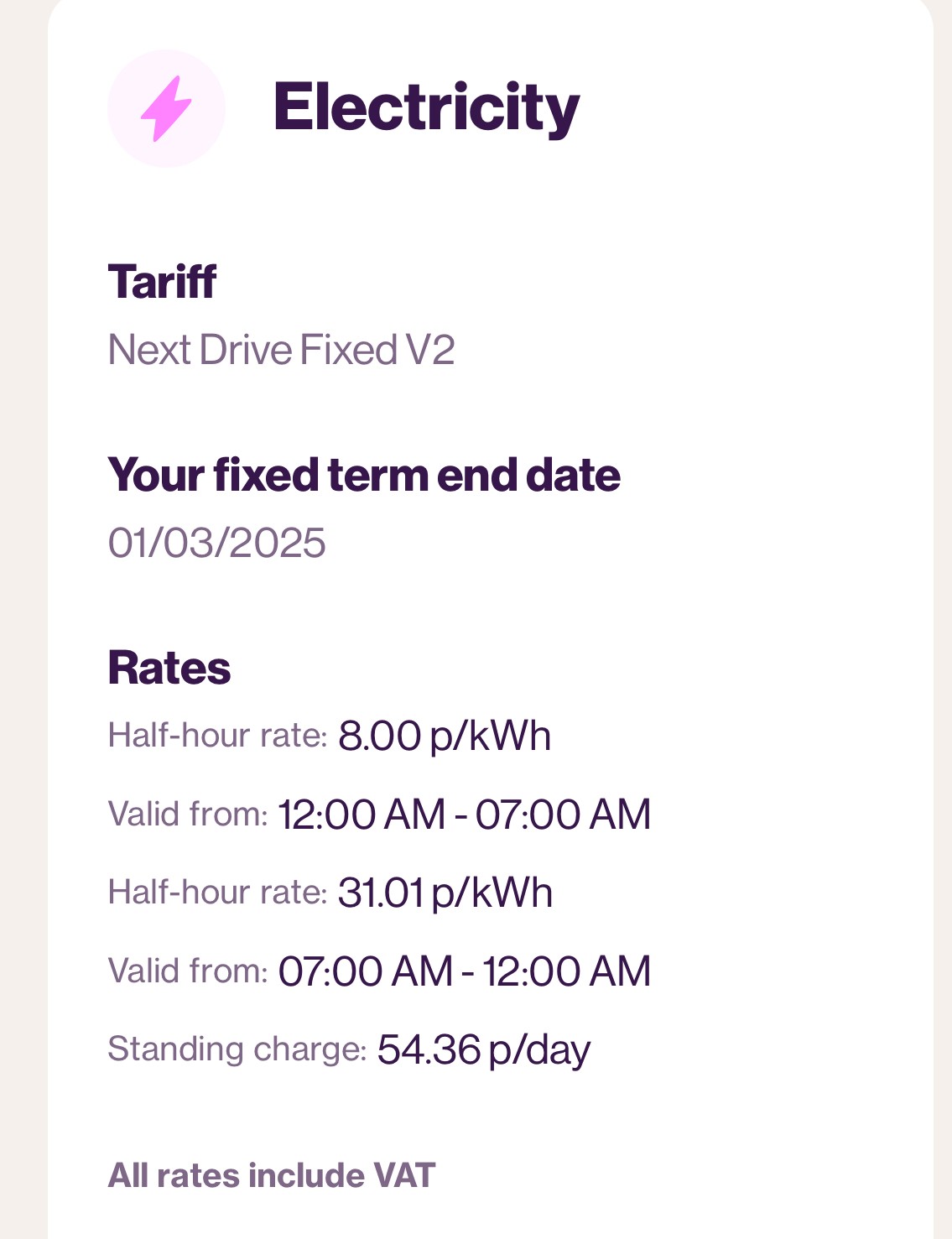
I’m a EON Drive customer (I don’t have an EV, but was told I can use this tariff)

I see Octopus Flux has a lower peak rate but a higher daily standing charge, the off peak rate with Octopus is 30 minutes shorter that with EON Drive

Might be horses for courses but just wanted to hi-light

EON SEG is 16.5p per kWh

D
#2 DD

Midlands_Solar the attraction of Flux isn't the import rates, but the higher export rate, particularly during the afternoon peak.
(Overnight cheap rate is only 3 hours. I wonder if you're thinking of intelligent Go?)

#3 Midlands_Solar

Thanks, yes possibly

I believe the export rate is simply
By kWh, and not limited to times of the day on EON Drive

T
#4 TX200

I'm guessing those with more export than import would be better off on Intelligent Flux Vs normal Flux?

Import rates seem to be better most of the day.

Yes you miss out on the three hours cheap charging overnight, but for most guessing that wouldn't be an issue?

Maybe those with massive batteries would swing that in their favour rather than IOF?

Although with IOF the grid is the battery! Borrow from the grid at the same price you export to it.

D
#5 DD

TX200 A couple of the youtubers released videos on this yesterday. "Tim and Kat's Green Walk" (or similar) and "Gary does Solar". The former assumed that all import was cheap-rate, half of the export would be during the flux peak rate, and came to the conclusion that once export exceeds 1.4*import, Flux is better than Go/IOG, and (surprisingly) Intelligent Flux was even better. (DIdn't consider Agile.)
But assumes Octopus runs Intelligent Flux as you would (ie optimised for min cost / max income), and some have reported on here that it doesn't work that way in practise. (Perhaps they don't export as aggressively during peak hours as you might choose to ?)

T
#6 TX200

DD in the early days my system didn't always export at peak. But it's pretty much done it every day through the winter and still does.

It does sometimes stop exporting and the grid gets used for small imports like 300W base load. Slightly annoying but it doesn't add up to much.

It's also recently stopped charging from grid overnight (it used to charge to 60% overnight) and seems to be charging in the day instead now, as it's generally sunnier. Some might still come from the grid as it sets a low rate timed charge say 800W and if the sun goes in, it'll continue charging from off peak grid rather than solar.

Likewise if it gets really sunny, it'll charge at 800W as planned and the rest will be exported. But that doesn't matter too much given the same price to import vs export.

It seems to be working quite well except for the occasional peak import.

Currently in profit, I've been paid more for export than I've paid for import this month. Probably covering 2/3 of the electric standing charge too so far. Just hope the last few days of March are sunny too!

D
#7 DD

TX200 If you're happy to share, it would be interesting to see a snippet of the activity log, particularly around the afternoon peak period, to see what sorts of things they do.

It is my understanding that they turn off eco mode, and control charging and discharging explicitly. If they're not discharging at high power during the afternoon peak, and you start cooking, I can imagine it wouldn't be hard to exceed the discharge rate and have to import. (We come close to meeting max discharge rate - OH still wants to turn everything on at once, rather than sequentially.)

T
#8 TX200

DD yeah they turn eco mode off all day. As they want to control when it discharges - makes no sense discharging from the battery to the house when the off peak rate is in play (due to conversion losses).

Then yes at peak, they don't discharge at max rate. But if you need to cook you could accidentally knock the rate up 😜 and do it again when they reset it back down. 🤣

Will post some screenshots later.

T
#9 TX200

DD

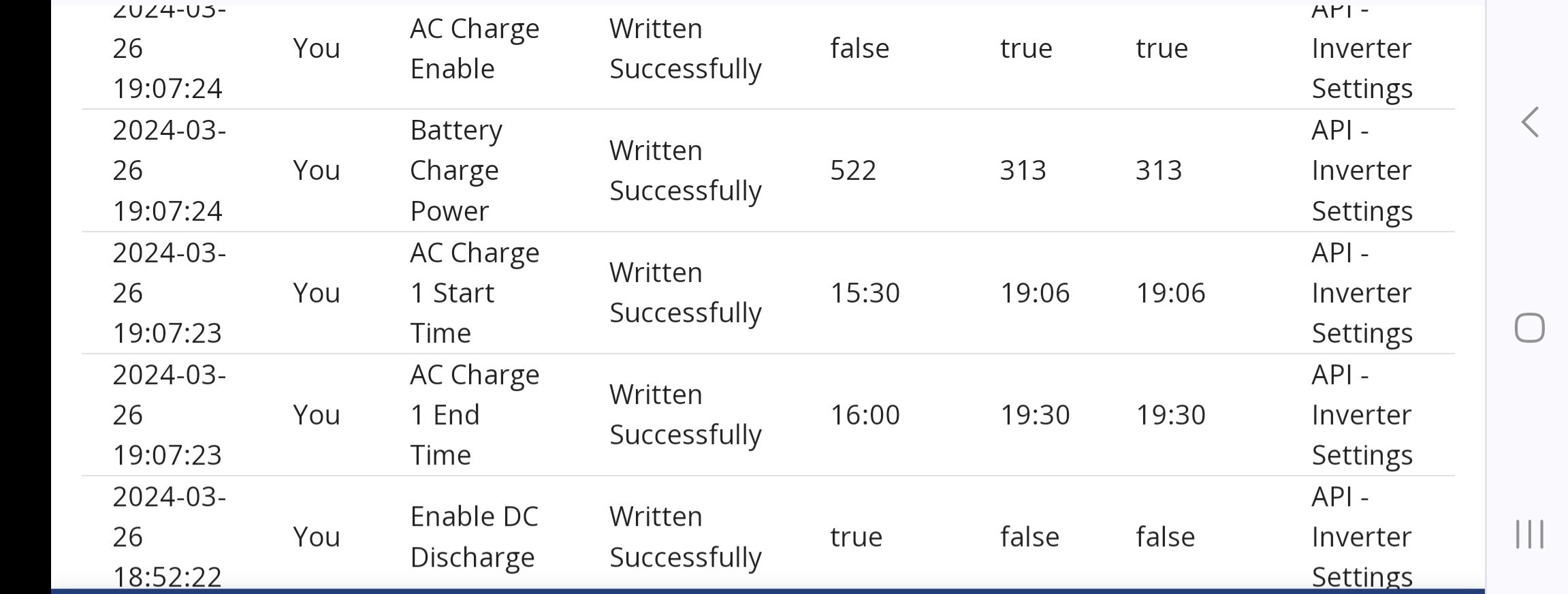
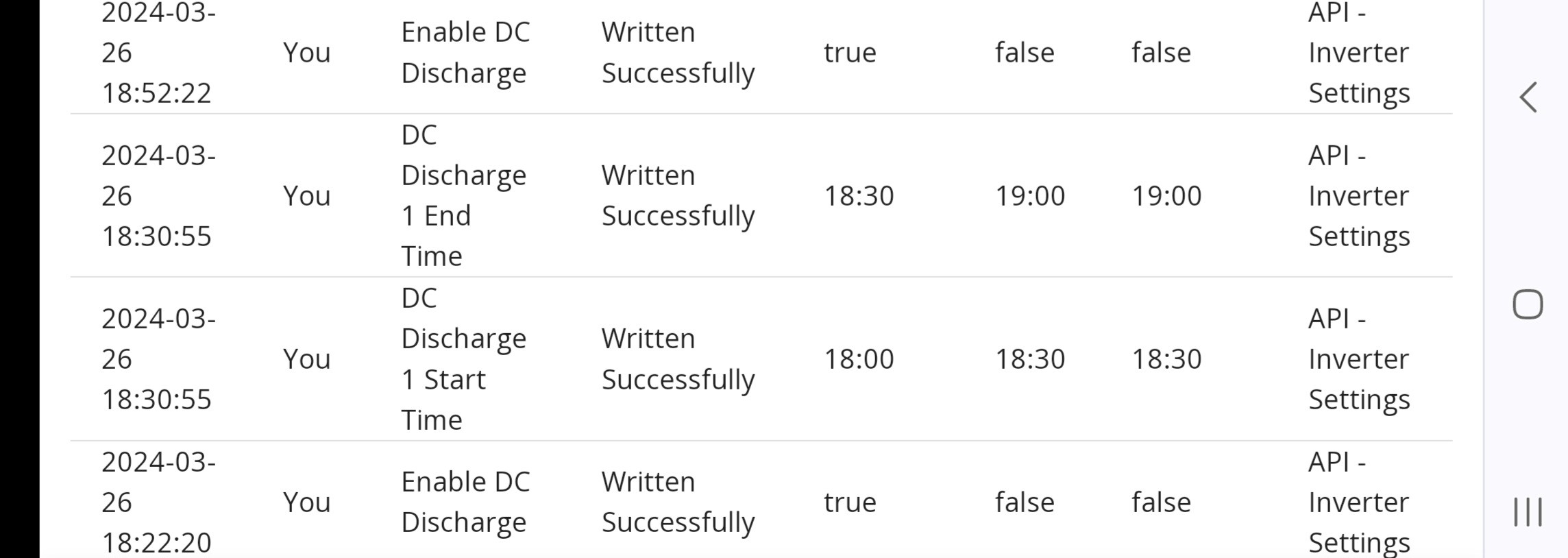
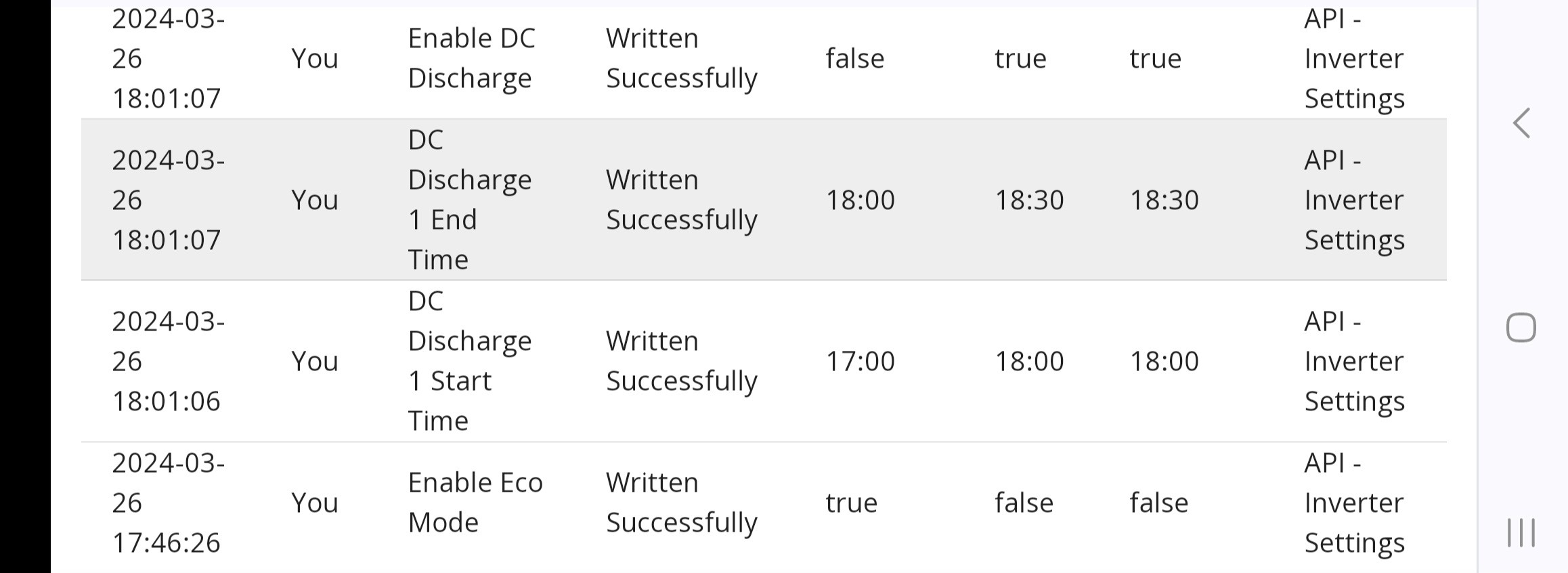
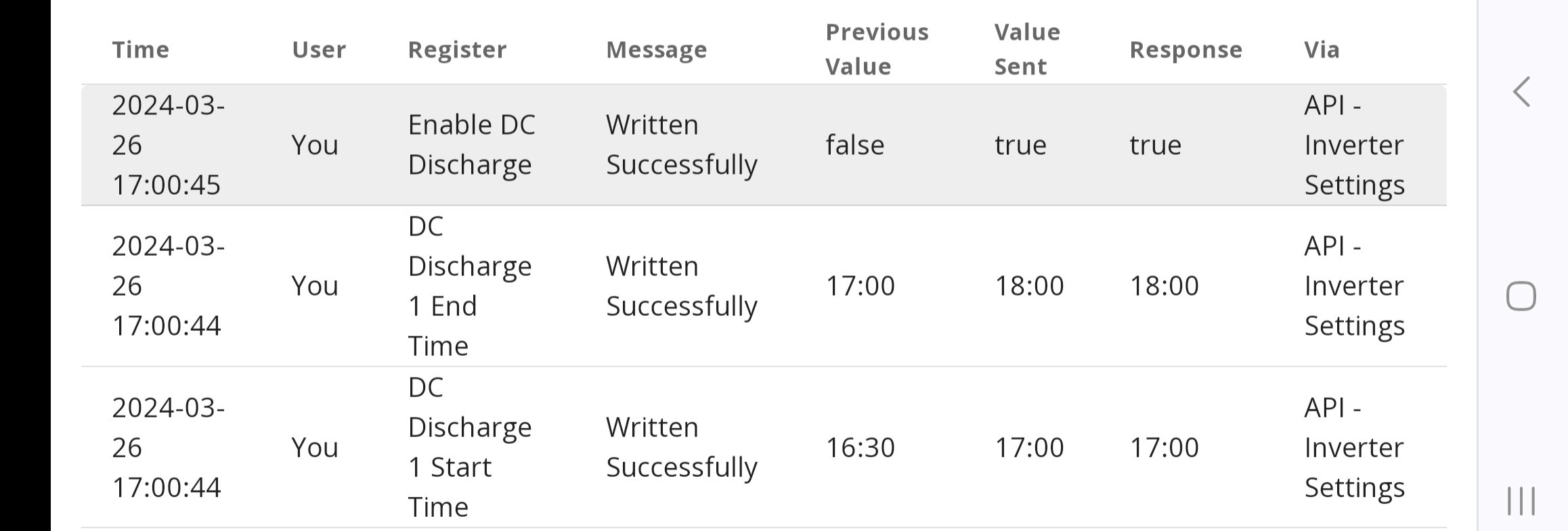
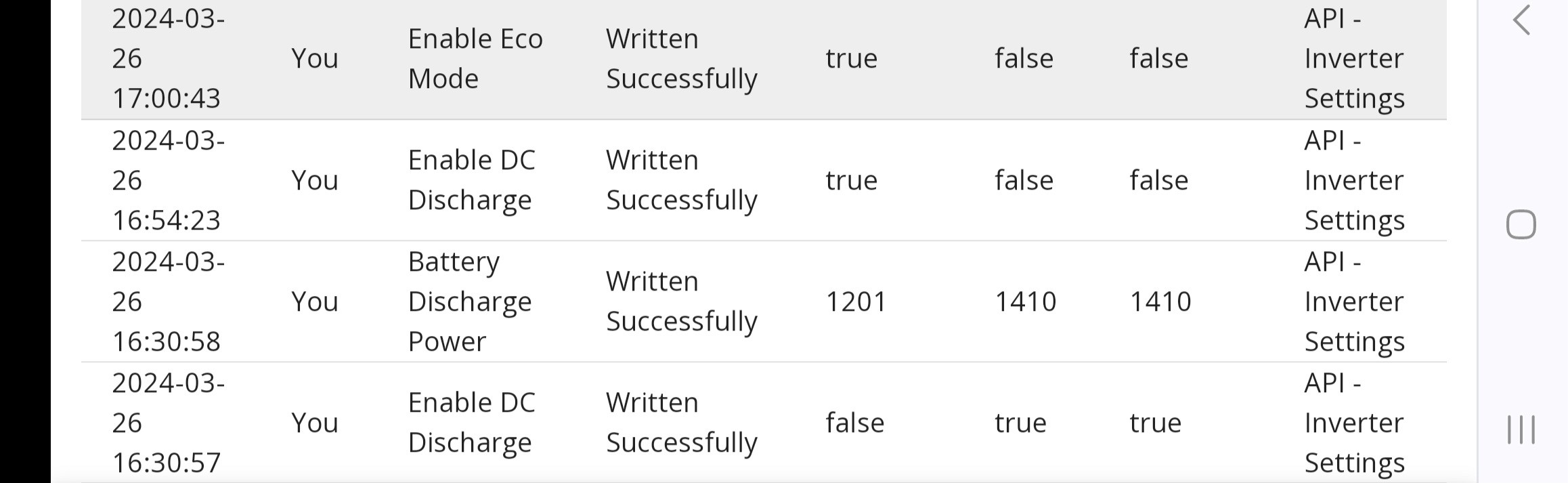
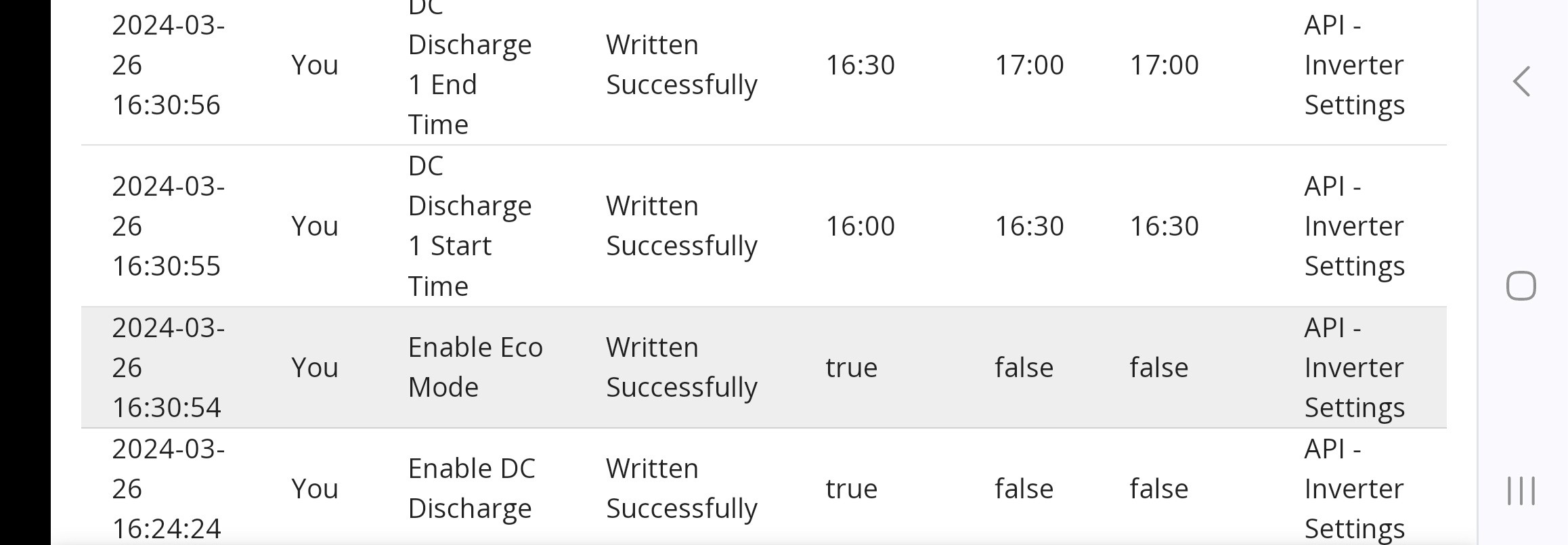
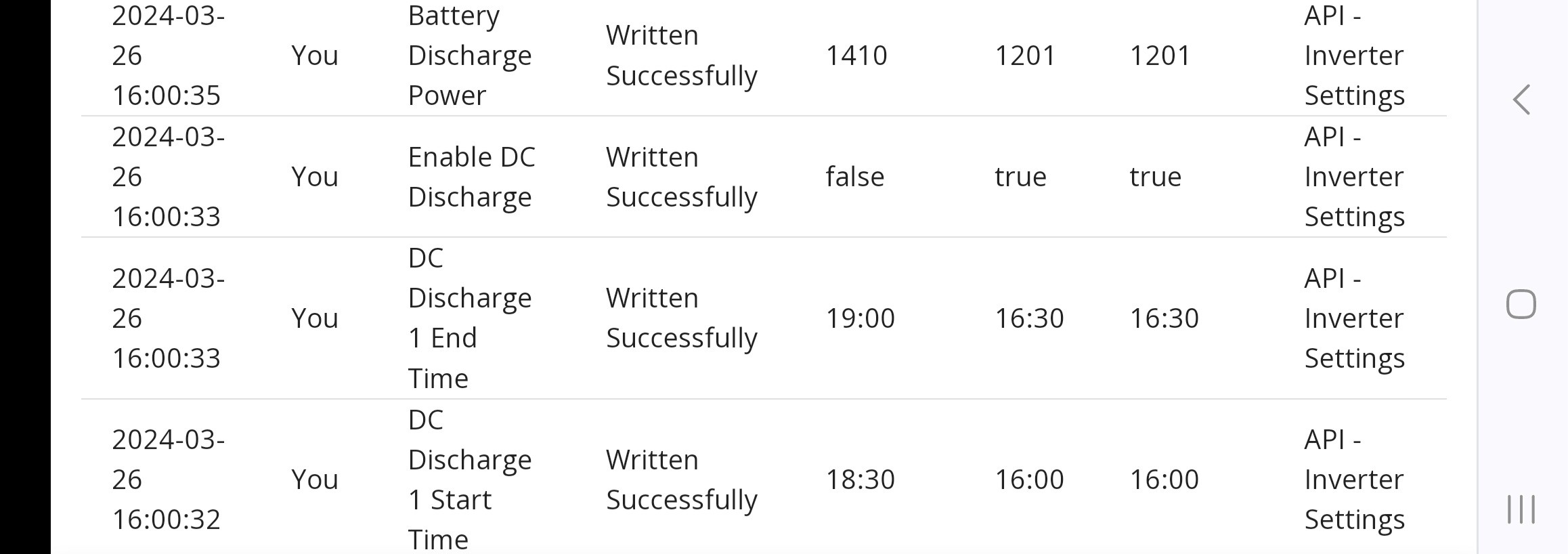
A bit of charging at the end there, but otherwise the 4-7pm peak shown below:

D
#10 DD

I wonder why they keep adjusting charge/discharge start and end times - because they're also changing the enable charge or discharge flag, they could just leave the timers as 0000 to 2359 ? I guess changing them does almost certainly force the portal to update the inverter, just in case you're manipulating the registers locally via modbus.

I see they do enable eco mode, but leave the max discharge power low. That seems odd - cover household demand, but only up to 1kW. Why wouldn't they set it to max ?

Disappointing that they don't identify themselves in the API calls.

D
#11 DD

One observation (from elsewhere) - the Octopus Outgoing is fixed (for me, until January) whereas Flux presumably drops in April and is expected to do so again in June.
https://octopus.energy/octopus-smart-tariffs/flux-rates-april-2024/

So where I am, daytime export price more or less matches the 15p Outgoing Fixed price from April (next week). Need to do some sums to see how much the extra 10p for peak-rate export pays off...

Looking at Tim's spreadsheet, modelling is quite simple. Doesn't consider importing overnight to export during the day, and a fixed 0.5 fraction of export during peak rate doesn't obviously take into account battery capacity / inverter capacity. Eg his July averages 25kWh per day, but some days will be higher (maybe 40kWh ?). Can't reasonably expect to export 20kWh in the 3-hour peak period. But then in the shoulder months, you might be able to export more than half during the peak rate.

At best, you could export entire battery capacity during peak, but if you don't hold some back, you'll have to re-import overnight. For Flux, that doesn't really matter, since daytime import rate roughly matches peak export rate, so you're just cancelling any excess exporting you did. Works even better on Intelligent Flux, but the evidence is that Octopus don't really drain that much of the battery during peak rate. But for IOG, running out of battery in the evening is a bit more expensive.

Presumably those running predbat can actually emulate the behaviour on different tariffs, to see what would actually happen.


D
#12 DD

I've been pondering this a little more... I'm interested specifically in whether to switch from IOG to Flux. Taking a slightly different approach from the one used in Tim's video above:

Daytime export on Flux from April is close enough to 15p (in my region) that I'll just treat them as identical
https://octopus.energy/octopus-smart-tariffs/flux-rates-april-2024/
So I'll model it that all my export units get 15p (and therefore all that cancels), but on Flux, I'd get an additional 10p for those units that I export during the peak rate.
And (as per Tim's analysis), all consumption will be at the off-peak rate import - 7.5p for IOG, 15p for Flux. (But I get more hours on IOG.)

So all I need to compute is the relative merits of the cheaper import for IOG vs the profit for the units I can export during Flux peak rate.

  • My consumption is probably roughly 12 units per day, in summer (including EV - I don't drive much)
  • With a 9.5kWh battery, and the need to hold back some power for evening use, I can probably export about 6kWh during peak rate.

Correction: 12x7.5p beats 6x10p, so IOG seems like a win.

The only additional factor, I guess, is that on the longest summer days, there will still be significant solar generation during the peak period, so I'll be able to export a little extra at peak rate. But then price cap will be changing again at the start of June, and is expected to fall.
And of course I might drive a little more in the summer.

So I'll probably just stick with IOG for now.

D
#13 DD

One other minor benefit of IOG: there's scope to fill battery overnight and export in the morning, for a small extra boost. Flux doesn't really offer that, since export price is close to the import price of the previous timeslot.