
Extending Battery capacity questions

17 comments started 2024-05-10 last 2025-01-14
CommisioningGivEnergy ProductsAC CoupledBattery
#1 Judith

We expect to need more battery capacity in kWh and also the output power to pull/re-charge more rapidly because over the summer the ASHP will go in.
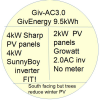
We want to build on the AC3 plus 9.5kWh set up (and 6kW PV panels and 2 inverters with them) that we have at present.
My first thought was to add an AIO but that was naive and GE state that they are incompatible (cross charging, etc), unless we are home assistant compatible (& that may take some time).
So alternatives?

One is to simply add another 9.5 to the existing AC3 but then we only have 3kW out. We’d no doubt end up paying peak rate electricity prices and that would hurt.

Two is another AC and 9.5 battery and then I need to know what Paul @TheDragon (GivEnergy) meant by do the meter cabling & terminate it properly!
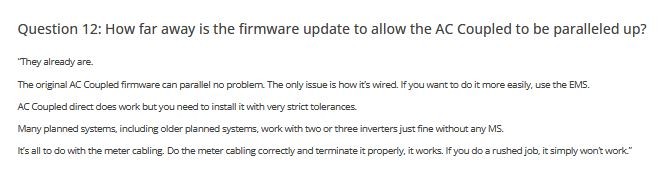
Two parallel AC3s would give us 6kW output if they play nicely together, and also enough storage.

Is there an application note on this for our installer to be able to do it?

Several of you out there seem to have multiple AC3 so how well do they work in practise (everyone’s house and systems are different).
Did your installer wire them right?

A third option but longer term is an AOI plus gateway which would help us with being able to use the PV system if there was a power cut so then we’re waiting on the CEMS (Paul’s question 4b)

The extracts are from Pauls talk back in March https://givenergy.co.uk/givenergy-firmware-head-of-testing-systems-security-paul-landregan-answers-your-questions/

What would anyone recommend? At present we are waiting since that seems best right now.
#3 Judith

That sounds great Paul!
I’ll call our installer on Monday and sound him out.
Does he then get a quote from you?

M
#4 mrand31

TheDragon (GivEnergy)

What is GivEnergy's view on supporting the selling and buying/installing of systems second hand?

Just in case the opportunity came up 😃

G
#5 geoffreycoan

Judith another much cheaper option is to go to Octopus Agile.

I have an ASHP and for most of the winter we only had a working 5.2kW battery (4.2 usable) which was enough to see us through the peak import period. November average import price 19p, February 14p.
I'd suggest your battery is sufficient, but you need to be on the right tariff and have good battery management

#6 Judith

TheDragon (GivEnergy)
I can’t commit to purchasing in the near term since we’ve got to find the pennies for the ashp first. But I do need to know how much that option would cost.
But if the duplicate ac3 option +ems mk1 remained open until the cems was available then we always have a way forward
Why can’t the gateway+Aio control an Ac3? I’ve been told it can’t but why not? (ok that’s a whine!) but I would like to understand.

geoffreycoan I've read some of the very detailed strings on cosy vs agile but I’d be terrified of the agile potential price peaks. I don’t have a crystal ball on global politics/gas price/electrity market price so it could be eye-watering

G
#8 geoffreycoan

Judith geoffreycoan I've read some of the very detailed strings on cosy vs agile but I’d be terrified of the agile potential price peaks. I don’t have a crystal ball on global politics/gas price/electrity market price so it could be eye-watering

You are right to be concerned, I was too. I spent a long time looking at Agile price history and doing spreadsheet models before I decided go onto Agile last October. It was never my intention to only have 4.2kW battery storage, but my 9.5 battery died (another story) and that's all I had. My point was to illustrate that you don't need lots of battery storage for Agile, you just need enough to see you through the evening peak running the heat pump and cooking, lighting etc.

Anything could happen on Agile pricing and you have to take the rough with the smooth, but again, my personal experience, average import prices were significantly lower than any other tariff, I spent £250 a month in December and January, any other tariff would have been roughly double.
The peak we saw on Agile last winter was 65p on 29th November, but we only paid 17p of import in t G at slot, the battery met the rest of our consumption. On that day we imported 74kW at an average price of 24.98p/kWh.

For heat pumps the most efficient way to operate them is to run them all the time, on a low, slow setting, just putting enough heat into the house to replace lost heat. There's a recent Heat Geek video on tariff choices, worth watching for the analysis of different tariff strategies. I'd argue Cosy is not a good tariff choice as the daytime rate is too high.

Also worth noting that you can leave Agile at any time without penalty.

Just putting it out as a cheaper option

#9 Judith

Thanks geoffreycoan your original input made me think again. I’ve looked through your other inputs on threads and realised that your heat pump (because of house size) is larger than our target. So providing we can run agile well then it would work. Short term that will probably mean wonderwatt and as a personal longer term project getting to grips with HA.
I’ve done a lot of ‘what if’s’ on excel and the daytime rate of cosy is certainly an issue. Assuming we get a 10kW pump (another typical story of too high a heat loss calculation by installers) with a cop of 2 for the coldest hours of the months with our gas worst case daily consumption is 180kWh. Then we would need 5kW output capability at a few times and 90kWh in the day, with storage required for coast-through peak tariff of 15kWh.
Hence my thoughts on increasing our current 9.5kWh capacity.
But it all depends on the total and when we remove the gas hob we’ll need more early evening capacity then. So possibly that’s when to buy extra battery capacity.
If you’ve “got away with” only 5kWh of storage on your 18kW ashp system then that’s a good pointer.
I really liked your octopus compare figures for Nov 23 and they certainly reinforce your point about cosy vs agile. We don’t have any actuals for electric consumption yet only gas values, but running over 24hrs with a nighttime setback to simulate a ashp usage pattern we know we don’t need a huge system.

G
#10 geoffreycoan

Judith Hi Judith, happy to help.

As you say, we've got an 18kW ASHP (2x 9kW). The heat loss indicated a 15kW requirement but there wasn't an MCS accredited pump of that size at the time, hence the two 9's. In hindsight I lean towards our system being over sized and hence consuming more than we need to, but over the last 2 years I've tweaked the settings and got consumption down by 20-30% and overall it costs about the same as the previous oil boiler with the advantage that the house is warm all the time, so that's the main thing.

I can share graphs of daily consumption if that helps, but sounds like you're already well advanced with your calculations. Your coast-through peak 15kW figure seems a bit high to me, depends what else you have on of course, but we have electric oven and cooker (no gas in our village) and the 4.2kW usable with the ASHP on would generally last most of the peak, say 4:30-6:30pm depending on outside temperature of course.

The first year or so we ran the ASHP just like an extended run conventional boiler, on from say 1pm to 11:30pm. This year we ran it all the time with overnight setback to 17.5 degrees and as I said the house retained its heat pretty much all the time with the heat pump only coming on overnight on really cold nights. There were a couple of times with exceptional agile rates where I turned the heating off for an hour, and I turned it off in the DFS saving sessions, but otherwise I left it on and let predbat optimise the battery. Wonderwatt would do much the same.

#11 Judith

Sorry for the delay in responding (some work stuff got in the way). I agree 15kW is worst case and I should be planning for ~ 90% case, but although I could try and work through from other people’s results it’s still finger in the air.
https://protonsforbreakfast.wordpress.com/2024/02/10/5-reasons-heat-pump-installations-have-problems/ Michael has some good analysis and shows how few days you need the full power. Since we have a wood burning stove which we can use a few days per year we could have a pump which is only just enough. But that’s not what we are offered (usual MCS story). Then we wouldn’t need the increased battery size that much, but probably would benefit from the larger output capability of two in parallel.

#12 Judith

An update on the original question and repeated thanks to geoffreycoan for making me think again.
We got a 7kW Vaillant heat pump in the end and it’s worst case daily COP in all the bad weather has been 3, which we have been VERY pleased with.
The built in control options give us plenty of load control to add to the in-built weather compensation so we’re nicely warm.
The 9.5kWh battery keeps us mostly out of peak rate except for some multiple appliance spike in cooking.
So 80%of kWh at cheap rate, 18% on std and 2%on peak (ish). This is on COSY.
No need to add to or replace the battery system!

G
#13 geoffreycoan

Nice to hear your update Judith and that you’ve got a good heat pump system that doesn’t cost the earth to run. Since our original discussion last year Octopus have changed Cosy so its now 3 cheap periods a day which makes quite a difference.

I’m still on Agile which has peaked at 99.99p/kWh a few times in the recent cold weather this year so its not for the nervous. Have done comparisons against Cosy and for me Cosy is a couple of £ a day cheaper when the Agile rates peak like they have, but most of the time when its milder and the heat pump is on 30-40kWh a day (rather than 70-100 in the peak), there isn’t anything in it, Cosy sometimes more expensive or its about the same.
We should be coming out of the worst of the winter now as well so again another reason not to change.

What I have noticed is getting the heat pump coniuguration right is key. With weather compensation and other settings changed my year 3 consumption is 35% down on year 1 and 2 and the annual heat pump running costs down from £1500 to £550.

M
#14 mrand31

I guess that Cosy is a better bet if you if you aren't either OCD or don't want to go down the Predbat route.

Planning to get a heat pump in the very near future because the gas boiler has got another heat exchanger leak and in two minds about adding more panels, string inverter and an AIO.

#15 Judith

mrand31 yes the raspberry pi is waiting for some more free time and Predbat is probably a step too far for me. So Cosy with octoR&D is enough.
GE never think backward compatibility and future upgrade in their product launch strategy. I realised that after only 2 years a complete battery system replacement would be the simplest option (with a pitiful resale price on the still working system). So I’m glad you guys advised me to hold fire.
My next battery upgrade will have 5 wheels when bidirectional charging systems come out properly.

G
#16 geoffreycoan

mrand31 Planning to get a heat pump in the very near future because the gas boiler has got another heat exchanger leak and in two minds about adding more panels, string inverter and an AIO.

In terms of payback and value for money, adding more panels and a string inverter (or adding to your existing inverter) will almost certainly be (a) cheapest and (b) the quickest payback. As long as you can export the energy you generate and are not subject to DNO restrictions, the strategy is to export as much as you can in the summer, build up a big account credit and use that through the winter. That’s very much the approach I take.

Adding batteries is comparatively more expensive and if you are only saving at best 20p/kWh on the night/daytime rate then it’ll take a long time to payback your investment. I’ve done calculations myself that extended to 22 years payback !

W
#17 wrighar

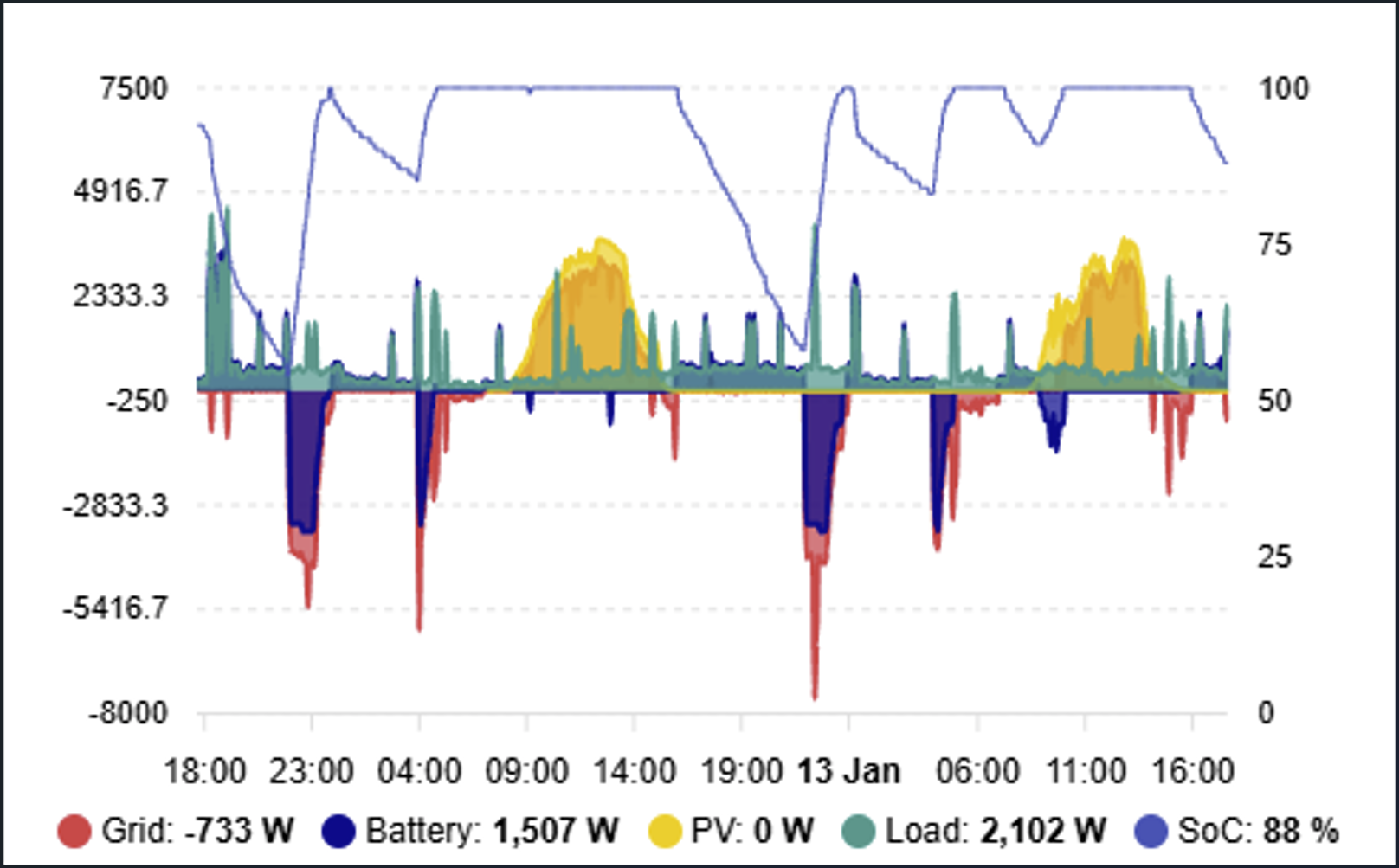
I'm also on COSY for the winter, 5kWh inverter and 9.5kWh battery, around 12.5kWh per day use in winter, more in summer.
I did consider, and often do consider a 2nd 9.5 battery, but cost over saving don't currently justify:

Our usage normally looks like:

T
#18 TimHutchings

Cosy is a much better tarrif this year with the evening 2 hour slot. I was on Flux again last summer and moved over to Cosy again with fixed export from October, as the balance between the 2 tariffs crossed over.
It worked really well till I bought an EV (Volvo EX30). Then the 7p tariff was too much to lose.
I have a small open plan bungalow with A2A heat pump, 5.46kw array, 5kw inverter and a 9.5kw battery. This setup has worked really well since Nov 22, and the last 2 years, my total annual net energy, standing charge and gas costs, have been zero with a surplus of £100pa back from Octopus
So the battery has worked to save us a lot! I've looked, like others, at adding another battery but I just can't get the figures to make it economic. Now with the EV battery at 69Kw (64Kw usable), 6.5 times the size of the house battery, I realise how little electric I've been using, and how much I now need to import. So the IOG tariff at 7p is really the only option. It means I can fill the Volvo up for £4.50 (0-100%) for around 220 miles in the winter (260 miles in summer).
The problem now is with this really cold weather, I sometimes empty the house battery if there's almost no sun during the day before the 11.30pm to 5.30am cheap window. With Cosy the cheap rate 1-4pm was really useful.
I know this is only a temporary problem in the deepest darkest days, and it certainly isn't viable to install a new battery just for the winter. The only reason to add battery capacity is if load shifting is still not sufficient during peek periods, but with all the many tariffs available now, I really can't see a need. If you want to spend some money, then extra PV panels would be a better financial bet.
