Octopus Flux v Intelligent Octopus Flux

13 comments started 2024-07-17 last 2024-09-16
Home AutomationForums/Meta
C
#1 Claire

I have 1 x 9.5kwh battery + an inverter. I have just switched from Octopus Flux to the "Intelligent" version, basically because I was fed up of manually having to activate a forced export at 4pm and switch back to eco at 7pm (especially is I would sometimes forget!). However, I am wondering if this was a good decision or not for the following reasons:

1) Intelligent Octopus Flux doesn't seem to benefit from a low charging rate between 2am and 5am that I used to get with plain old Octopus Flux
2) Whist IOF switches forced export on (at 4.30pm) it doesn't then seem to switch back to Eco mode, so I never benefit from the rest of the charge that is in the battery. In fact Eco mode is permanently switched off.

Because of these factors I am wondering if I am better off with IOF or should I switch back to Octopus Flux? (#confused!)

TIA!

T
#2 TX200

The export rate is very good, so if you export more than you import, it's probably worth it.

Have a look at the other threads on here re intelligent flux (there's a search feature) and/or YouTube videos e.g. Tim and Kat's Green walk or Gary Does Solar.

Probably want to be aiming to generate 1.4x (or more) your consumption or something like that (as covered in one of Tim's videos).

D
#3 DD

Claire In fact Eco mode is permanently switched off.

From what I've heard, IOF never runs in eco mode - Octopus choose when it charges and discharges. But, other than during the peak rate, there's no reason to run in eco mode, because the import and export prices are the same, so it's much better to use the grid as a perfect, virtual battery, avoid losses from your inferior chemical battery.

I assume you have a gen-1 system to be having to turn eco off to export. Are you aware of wonderwatt.com - a free external agent which can remotely enable an export for you, and will never forget to (try to) turn eco mode back on again. [Does rely on the network being up, of course.]

T
#4 TimHutchings

Claire If you do decide you want to keep control of your system and go back to std Flux, I use Rubicube's Inverter app to automate charging and discharging. The app is free but costs just a 1off £10 if you want to use it to change settings, and you need an old or cheap android phone or tablet. It works really well, and allows you to set up any timings you want. Here's the link if you want to take a look.
https://givenergymonitor.wixsite.com/tutorials

A
#5 Ange

Claire I have exactly the same issue as this. On IOF it's Not running in Eco mode and it doesn't allow me to use power from the battery for my consumption which seems really daft, but it does generate a good export income!

I'm looking for a way not to have to do that manual switch at 7pm too.

G
#6 geoffreycoan

Ange have exactly the same issue as this. On IOF it's Not running in Eco mode and it doesn't allow me to use power from the battery for my consumption which seems really daft

As @DD explains above, its actually to your benefit to not use Eco mode with IOF because of the losses incurred when charging and discharging your battery.

Very rough example with slightly made up numbers to make the maths easier to write quickly.

You have 2kW of energy stored in your battery and the house wants to draw 1kW of energy:

Option 1: Using Eco mode, you discharge the 1kW of stored energy from the battery, but in discharging you incur losses of 10% so to get the 1kW into the home you have to draw 1.1kW out of the battery.

The next day you generate 2kW of solar energy.
The battery has 1.1kW of space, but when charging there are charging losses incurred so it actually takes 1.2kW to refill, leaving you with an export income of 0.8kW.

Option 2: Using iOF the battery will NOT held in Eco mode and you will import from the grid. You want 1kW of energy in the house, you get 1kW from the grid, and your battery is unchanged.

The next day you generate the same 2kW of solar energy but this time the battery is full so the entire 2kW gets exported and you get paid for 2kW.
Minus the 1kW you imported the day before leaving you with 1kW net income.

So option 2 is 0.2kW better off than option 1.

Deliberately simplified, ignoring solar DC to AC losses, but you get the idea

R
#7 Robgy

I have 1 x 9.5kWh battery and a Gen3 5kW hybrid inverter with 8.2kWp of panels facing south.
Whilst I am very interested in all the little tweaks that can be done along with different tarrifs, for the first year I decided to more or less set it and let it do it's own thing as a kind of baseline to see how both our system and Octopus performed over the seasons.
I did have a close look at a number of peoples systems but soon realised they are all very different even with similar spec systems and people's life style.

Our PV system was installed in December and we moved to Octopus Flux for import and export 7th January 2024.

January and February was a trial and error time, exporting and importing at different times of the day and night but I didn't want to continue that all year. I found that with eco mode on the battery would be full by 5pm most days and allowing for cooking and night time usage TV, lights, fridge, 2x freezers, computers, etc that I could export at full power 3.6kW for just 1 hour leaving enough to run the house until solar kicked in again.

In mid March I set "Timed Export" in the GE App to start at 17:58 and end at 18:58 just to make some space in the battery for any solar the next day, I also set in the battery options "Charge Power" to 760W so the battery didn't fill up too quickly in order to reduce any clipping on the occasional sunny day!
So since March thats how it's been left with a small amount of testing (play time) here and there and five very dark days when I turned off the export.

The only lifestyle change we have made since February is remembering not to turn everything on at once so the battery or solar can cope with the load.

The results so far have been quite interesting for what might be termed a set and forget system that doesn't rely on external control or my manual intervention or swapping tarrifs.

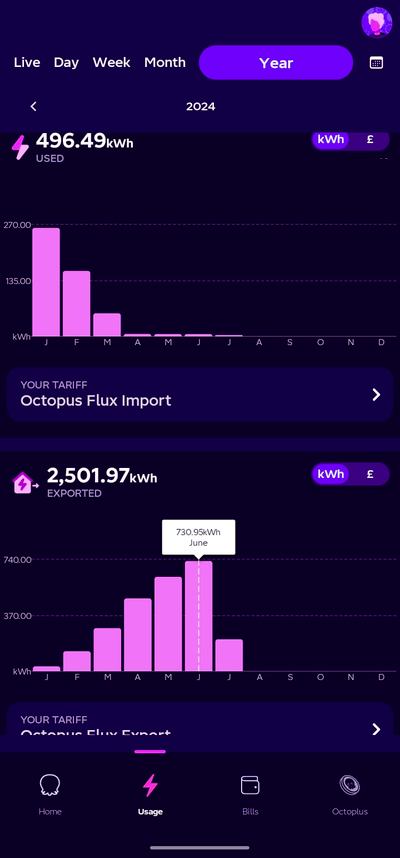
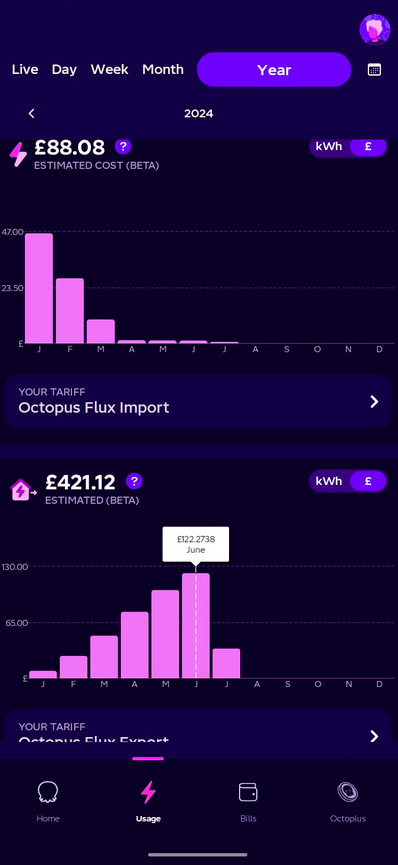
Our total Electricity draw from the grid 7th Jan to 18th July was 496kWh at a cost of £88 - since April we haven't used the grid apart from the annoying one or two watts every 5 mins that the inverter likes to pull from the grid and then immediately send back.
In the same time period we exported 2,501kWh resulting in a credit of £421

The idea of going off grid I find quite appealing but would need a load more panels and more batteries to cope with December.
Just need an EV for the summer to use the surplus generation rather than export it.
G
#8 geoffreycoan

Robgy Nice results, thats a good set of strategies to use Flux in a ‘set and forget’ way.

Winter is a different kettle of fish. We have 14kW of panels aligned East/West and some winter days we only get a couple of kW generated ☹️
You’d need so much battery storage to see you through such days it would be cost prohibitive.

But build up a decent summer export credit and it should pay for the winter is my strategy and its working out OK so far.

R
#9 Rogerbu

Use Octoprice (https://octopriceuk.vercel.app/) to compare your actual usage against IOF & Flux.

It will aso tell you which month ot may be advantagious to switch to IOG or another tariff.

Very useful

G
#10 geoffreycoan

Rogerbu I agree Octoprice is an excellent app/website and its that that turned my head towards IOF

But the tarrif hopper is not perfect for me. It reckons that IOF is a few pounds slightly worse than Flux for May whereas the tarriff compare reckons that IOF is £90 better. I did email the author about this bug, will chase him up

R
#11 Roy124

I tried Octoplus Intelligent Flux and found, as said here, that the battery was only used to export. In fact it only exported 30% of its capacity. This was very frustrating as I was importing energy when I could have used the battery, and later in the day solar could have recharged the battery. It did not seem very intelligent.

I reverted to Fixed.

Today I tried a short export to prove the time export worked, and then switched to Octopus Flux. Having switched I fine I am sitting with a 100% battery and drawing from solar and the grid. I can see an advantage in waiting until 1600 and exporting but not at the expense of using the grid and not the battery.

I then tried to export to see if it worked; it doesn't. I am not even sure now that it will feed the home or even export during the 1600-1900 period.

D
#12 DD

Roy124 This was very frustrating as I was importing energy when I could have used the battery, and later in the day solar could have recharged the battery. It did not seem very intelligent.

Is there any particular reason for preferring to use battery rather than the grid ? The matched import/export prices mean that (on paper, at least) the grid is an infinite, virtual, perfect battery, whereas discharging your battery then recharging from solar would incur round-trip losses.

(Except 4pm to 7pm, of course.)

G
#13 geoffreycoan

Roy124 I tried Octoplus Intelligent Flux and found, as said here, that the battery was only used to export. In fact it only exported 30% of its capacity. This was very frustrating as I was importing energy when I could have used the battery, and later in the day solar could have recharged the battery. It did not seem very intelligent

Agree that Octopus Intelligent Flux doesn’t seem to force discharge/export all that much, that seems to be a common experience.

Whilst it might not seem intelligent, not using the battery to meet the house demand is actually the best option.
Your import price and export price are the same so your bill will be the same by exporting your solar and later importing, vs using the battery. In fact it’s actually cheaper for you to export and then import than use the battery as you will incur DC to/from AC conversion losses using the battery - somewhere between 10-20%.
You can consider the grid as being a limitless and lossless battery so it’s better to use this than use your own battery.

You say your export doesn’t work. Best thing is to go into the GivEnergy portal and do a reset to defaults and ensure your inverter is set to Eco mode.