
Intelligent Octopus Flux Import/Export NOW with Predbat!?

28 comments started 2024-07-18 last 2024-07-19
APIsHome AutomationHome Assistant
A
#1 ANT80

Hi, I am relatively new to all this and have probably been running before I could walk, so I appreciate everyone's patience whilst I compound my noobism. I have had a 14.5kw system fitted with 2/3west 1/3 south. feeding into a Fox 10.5kw that maxes out by 9.30 am. Coupled with an AIO 13.5kw, I am pleased with the system's delivery and performance. I immediately signed up to Intelligent Flux once I had jumped through all the MPAN hoops and immediately felt.. ugh... (leave feelings out of it, he says after the rollercoaster install)

It turns out I had just spent the last month intensively gamifying my energy production and usage patterns to max out during the day when production was 'hot', and the DNO can't get its grubby paws on my export for free! Minimising nighttime usage to maintain the battery through the night—never run any washers in the evening if it's going to touch the battery. Then, on the tariff switch to Intelligent Flux Imp/Exp, I suddenly had no control over the battery - which, of course, I wholly accepted. 'Instead, moving to just observing a forced charge, force discharge tick.. tock.. utilising less of the capacity than ever, frequently left with an irrelevant 20%, which doesn't load balance the house. I still find any import irritating at this point - I mean, it's colour-coded 'RED' ha! I understand that is a mindset I must shift from (and I admittedly have one hell of a mindset).

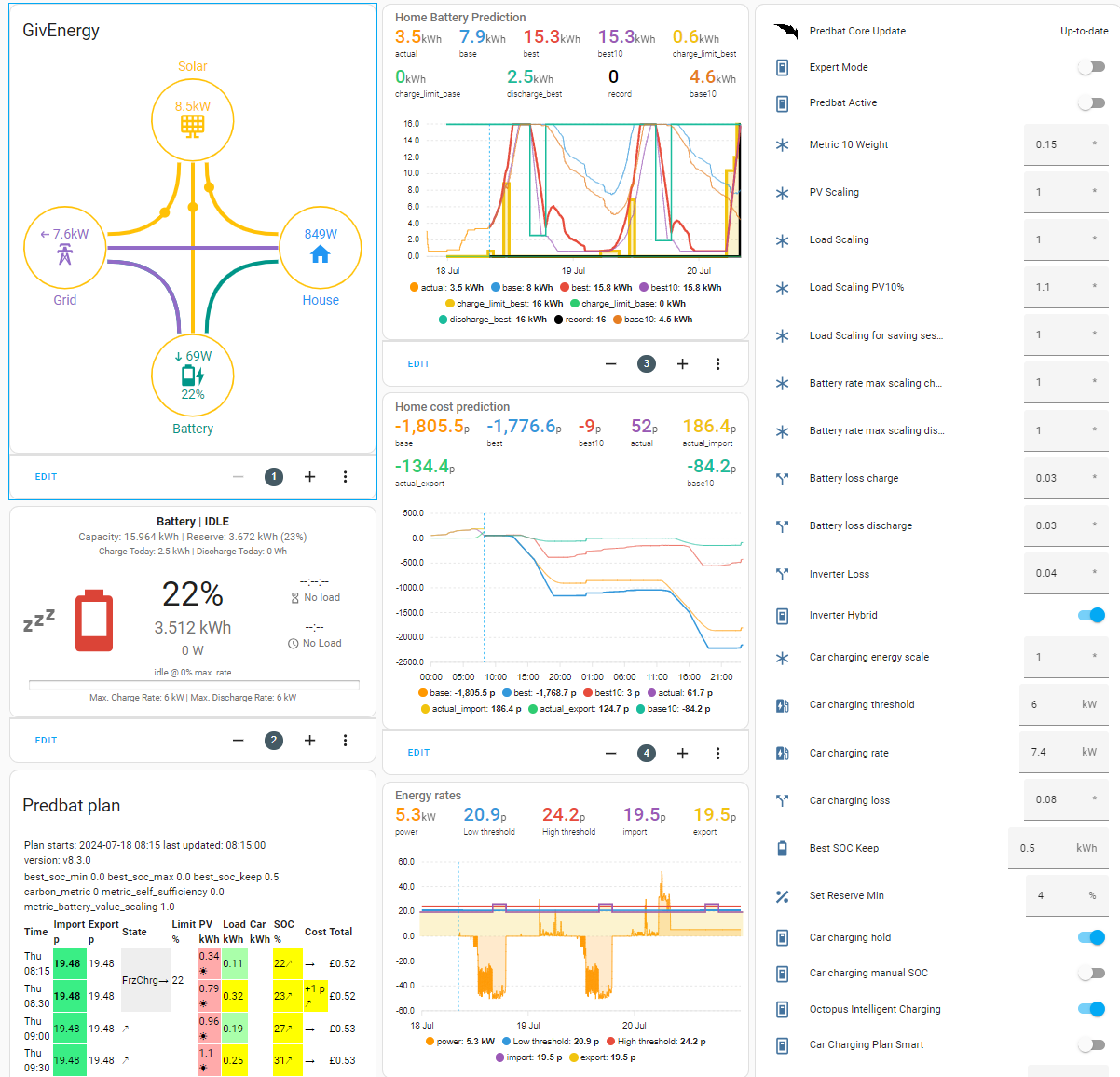
So - I have to tinker; I work in AI with some bright people, so of course, when I discovered Predbat.. I had to optimise. I did a late one and got everything in place meticulously, running back and forth over your informative videos, Trefor - thank you. With minimal adjustment, everything is in place. I already had the Sol API running, so I just generated a new key to kick Giv off, and now it's running. I am now wondering several things.

  • Fundamentally: Am I on the right Tarrif.. before I consider most other questions. For instance, how does Predbat play with the Octopus API battery control? They must be fighting. I need to come straight off this?? to Agile?? or ??
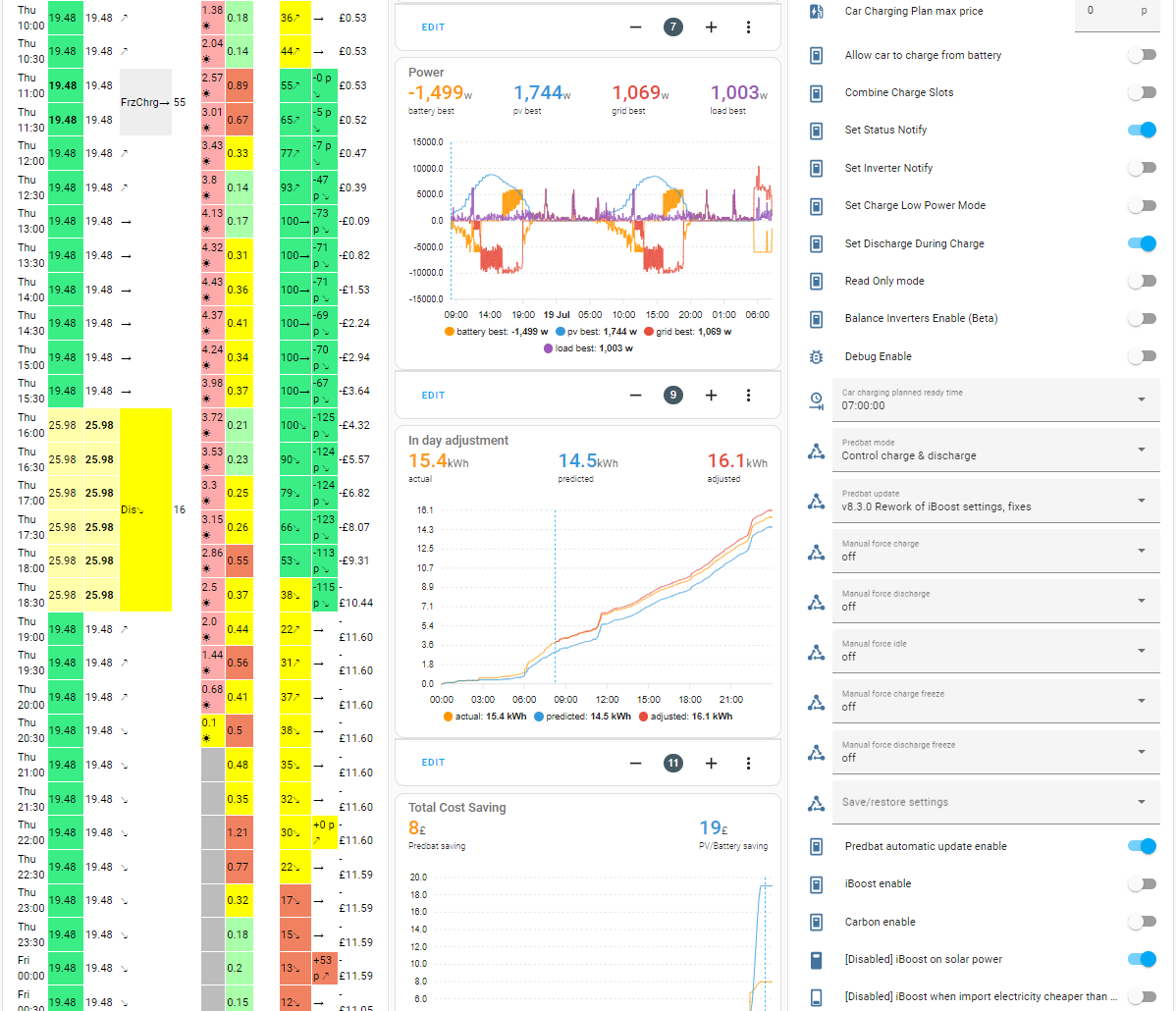
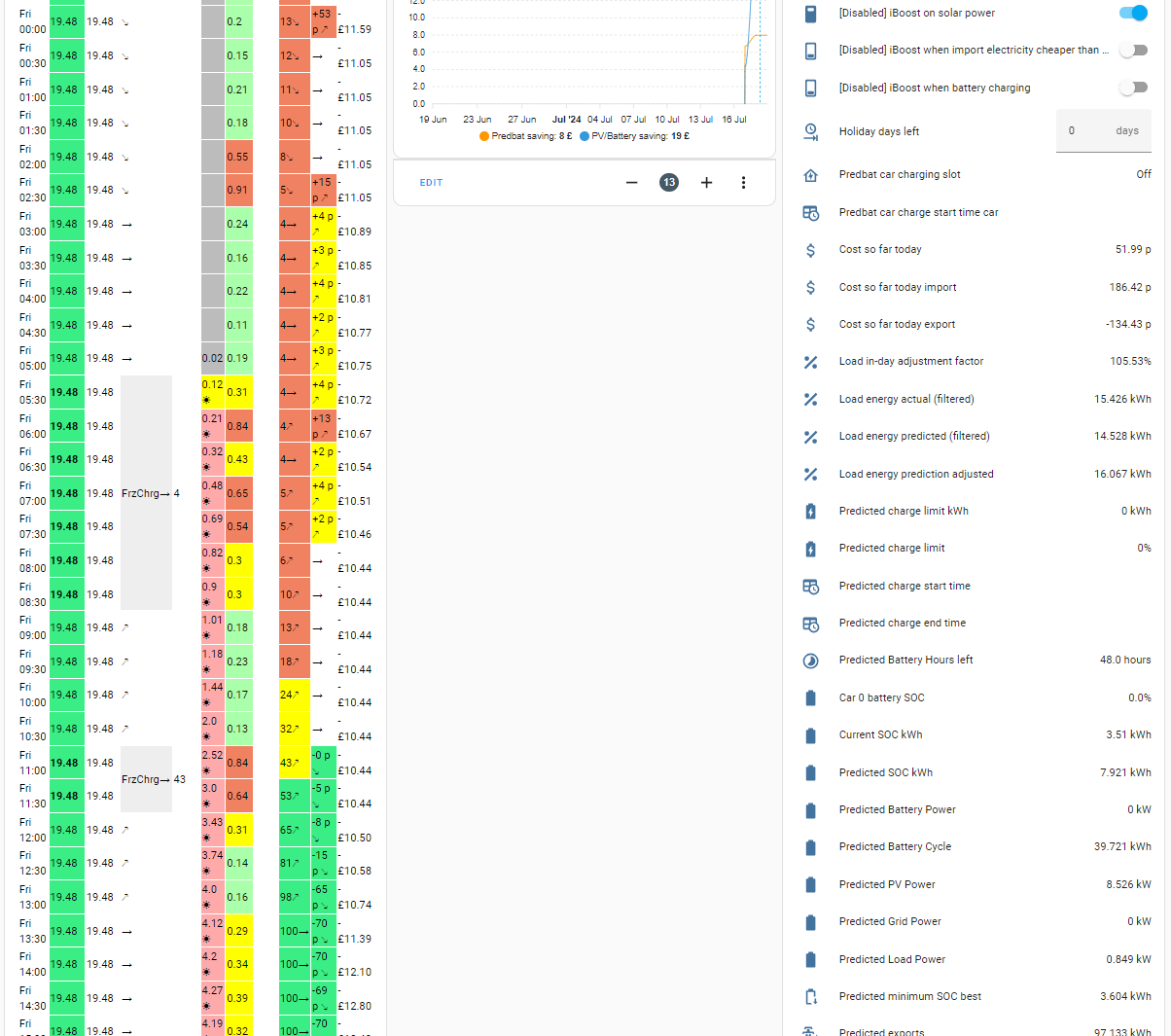
  • Are my settings appropriate for this current tariff in any way? Having watched the videos on tariffs, I see most of those are blended (i.e., different exports from what I'm still on).
D
#2 DD

ANT80 Fundamentally: Am I on the right Tarrif.. before I consider most other questions. For instance, how does Predbat play with the Octopus API battery control? They must be fighting. I need to come straight off this?? to Agile?? or ??

I haven't read all the details, but yeah, sounds like you're on the wrong tariff: the deal with IOF is that you hand complete control of the battery to Octopus. You might be able to find ways to fight it - eg I think someone discovered that Octopus don't currently notice if you set the battery reserve level - but the spirit of the agreement is that the battery is theirs.

Standard Flux might be a good choice if you have a lot of export. A recent video from Tim & Kat concluded that Flux and Intelligent Flux are pretty close in return. And I suspect that Flux with predbat may well beat Intelligent Flux.

D
#3 DD

ANT80 I need to come straight off this?? to Agile?? or ??

Looking back through earlier posts, you have an EV, and were considering swapping GE EVSE for a Zappi? If you did that, and qualify for IOG, that might be your best bet ?
https://www.youtube.com/watch?v=BB-in7snbxY

If not, and you're not wedded to Octopus, EON Next Drive offers rates possibly even better than IOG, for any EV, without the strings. (Though some view the bonus charging slots as a boon rather than something they have to work around.)

(Some on here report that EON will let you on even without an EV, if you have solar + battery.)

A
#4 ANT80

DD Hi - Yes, we had a GE EVC included in our original install. But it was a bit of a nightmare. It kept throwing up overvoltage errors and stopping and would not behave within its set parameters. So I pushed them to switch it up for a Zappi tethered at no additional cost, which, I think, was a good move. The GE EVC over-promises and still has some firmware issues they must resolve.

I went through a load of testing and issues borrowing a neighbour's EV. We are preparing for the future, so I do not have to factor EV into the equation. But we certainly will make a move at some point as a one-car family in a T6 Cali Ocean - it's a big thing to be moving around for all the kid's school drops and clubs, etc. (that stage of life.. wouldn't change for the world! Ha). I am determined to find the best I can with Octopus for now, as I like the setup. I have had years of issues with Eon and they're awful billing; I couldn't imagine adding export to it personally. I would bet my experiences with them shaped my desire to have the PV in the first place! : - ) Flux or Agile, it appears, but it is an incoming tarrif vs an outgoing tarrif. I guess I should track what others do and follow suit, but I want to be sure it best fits my use case.

V
#5 Vestas

ANT80 I am determined to find the best I can with Octopus for now, as I like the setup. I have had years of issues with Eon and they're awful billing

Best of luck with Octopus, they've failed to get our last 8 bills anywhere near correct and resorted to making things up (like a 14.99p export rate) in order to reconcile their errors as they went along. Nothing wrong with smart meters or DCC, just Octopus and their failing systems.

I'm pretty convinced that once an account on an Octopus ToU tariff has had any form of "manual intervention" then they simply can't fix it, errors will continue to occur until the account is closed.

We'll find out soon enough once the Ombudsman looks at it.....

A
#6 ANT80

Vestas Ouch, it's frustrating when you put so much into getting it right to have poor service provision. It seems the same in all walks these days. Algorithms might do a better job than most humans since the only decent service appears to be attached to an intelligent, pro-active person in their scarcity, Meldrew over and out..

A
#7 ANT80

Im happy to just be told what to do with tariffs and settings so I can get a baseline going; I know the all-seeing- eye will be along shortly to point out my stupid tarrif and ridiculous settings.

D
#8 DD

ANT80 I do not have to factor EV into the equation. But we certainly will make a move at some point

You'd need to check the small print, but having a zappi might be enough to qualify for IOG? That's the device that Octopus actually control, and there's no need to actually do a smart charge during setup.

I haven't looked at agile rates recently, but looking now, on my usage the comparison app reports IOG is better for me than agile. Haven't looked at flux, though - that might be better if your generation significantly exceeds consumption

G
#9 geoffreycoan

ANT80 the short answer is that there isn’t a single or easy answer to your question!

Have a look at Tim & Kat’s Green Walk on Youtube, Tim did a comparison model underpinned by a set of assumptions about how you use the battery to compare different tariffs (except Agile which he felt was too volatile to model).
His conclusions were (based on the assumptions) that the tipping point is your solar generation to self consumption ratio. If its about 1.4 or above then Intelligent Octopus Flux is best, then Flux.

I’ll give you my personal experience: I have a 14.4kW solar system with 14.7kW of batteries (a 4kW FIT AC array and two Gen 1 hybrid 5kW GivEnergy inverters each with their own battery).
We started off with Flux last summer, then installed Predbat, and after a lot of spreadsheet modelling concluded that Agile would be best for the winter as we have high consumption with our ASHP so swapped to Agile+15p fixed export.
Very pleased with Predbat and the optimisations it was doing through the winter, especially when we lost the 9.5 battery so only had the 5.2 (4.2 usable), Predbat still managed to keep us on the cheapest consumption, and an average import price of around 19p/kWh in the peak of winter.

Coming out of winter I looked at going back to Flux again and concluded that the benefits were limited. The day-time export rate is about the same, the peak export is good but the offpeak import was more expensive than Agile, so I stuck with Agile for the summer.

Then in early June my head was turned to looking again at IOF, concluding that I could earn more from the better export rate (and high generation:consumption ratio), so I applied, but 5 weeks later Octopus have still been unable to onboard me due to my twin inverter setup. I’d have swapped back to Agile for the winter anyway so the benefits are reducing as time goes on.

My conclusions:

  • IOF is great if you want a simple ‘fire and forget’ tariff, don’t want to optimise the battery, have to have manual control, etc.
  • If you have high generation to consumption then the better export rate will still probably make it worthwhile
  • Flux and Agile, there’s not a lot of difference in it
  • Predbat is brilliant at optimising your battery usage and getting you onto the whole home automation journey. If you want something simpler without the HA dependency, Wonderwatt seems to do a good job and lots of people are using it successfully

Worth mentioning Eon Drive which seems to be quite competitive as well, even more so if you’ve had Eon install your solar. Personally I am quite happy with Octopus, the customer service is OK, the Octopoints perks are nice, the DFS in the winter last year earnt me £80 (all managed by Predbat).

A
#10 ANT80

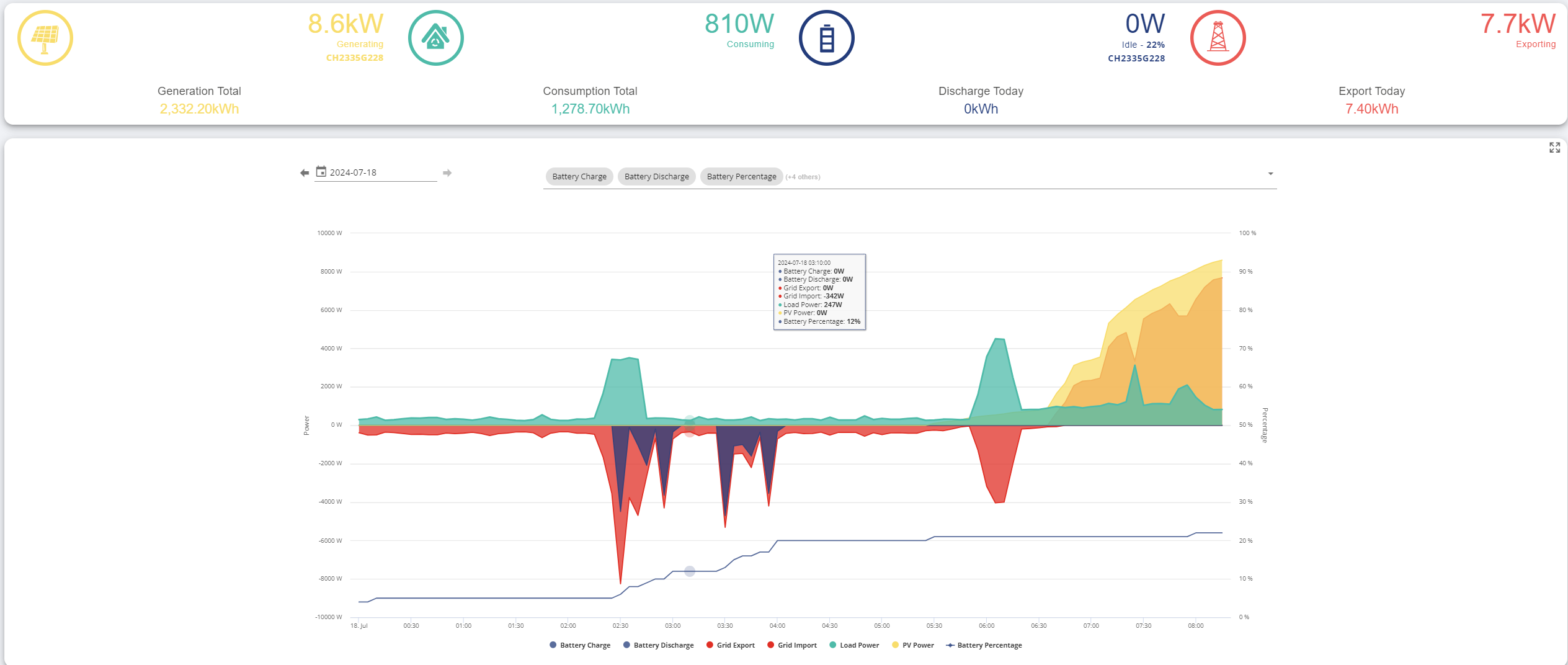
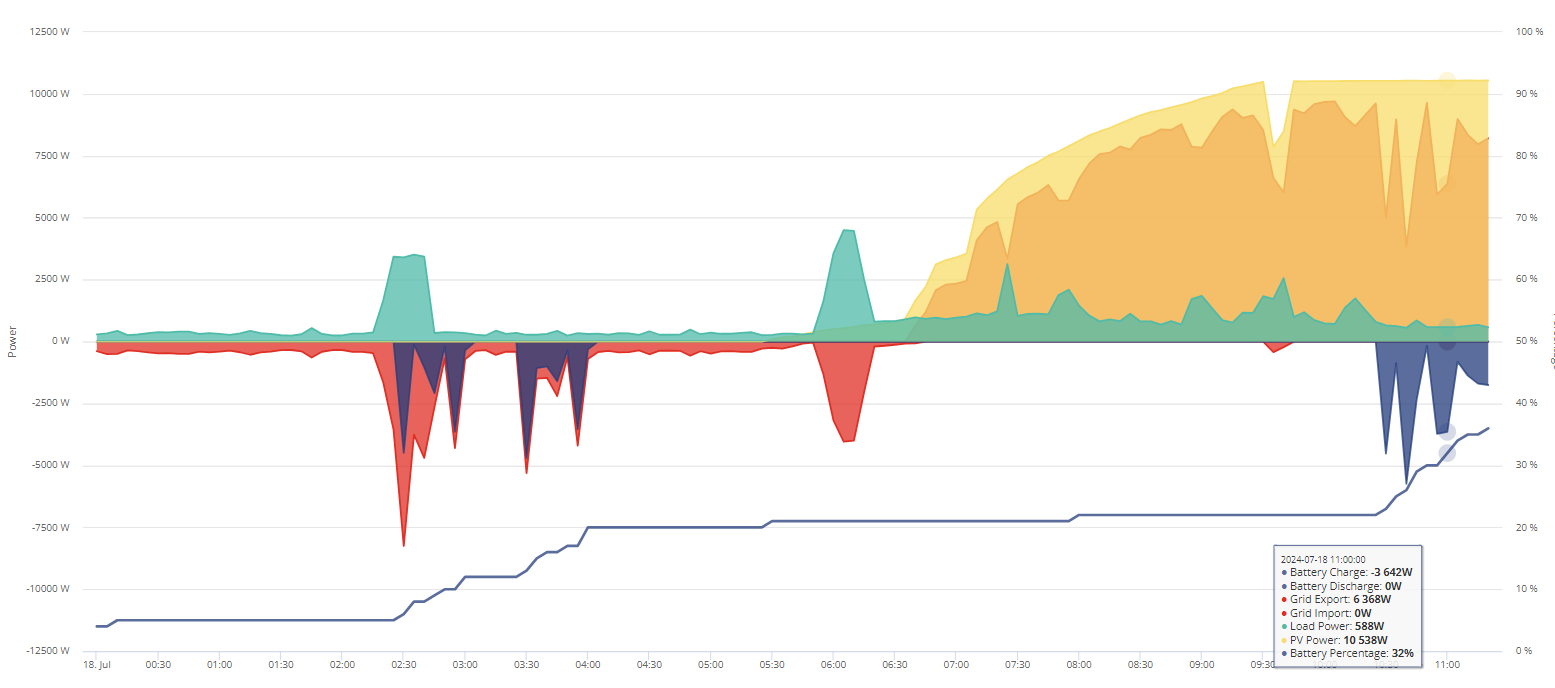
geoffreycoan Thanks, this is useful. I think the export rates are critical to this as on a sunny day, generation is pretty vast - today being a prime example:

I wonder what, if anything, Predbat can optimise on this tarrif, arguably nothing if Octopus API interferes with it. Probably set for an 80Kw generation, and c.60Kw export today.

D
#11 DD

ANT80 I wonder what, if anything, Predbat can optimise on this tarrif, arguably nothing if Octopus API interferes with it.

I'd argue you'd got that backwards - you've given Octopus control of your battery in exchange for a good tariff, and now you're trying to interfere with how they choose to use it.

A
#12 ANT80

I fully agree, I'm trying to understand if predbat on another tarrif would be better; my gut feeling is yes.

#13 PianSom

ANT80
As Geoffrey said, it is very hard to know whether another tariff would be better for you (perhaps not least because people's understanding of "better" varies).

FWIW I have a pretty similar setup to you, and - by the look of it - a similar mindset. I decided to go the Predbat/IOG route and have few regrets. It's probably reasonably optimal and - importantly - is fun to tinker with. Even after 7 months using it I am far from convinced that my settings tuning is finished.

If I was to be hit by a bus then my last action would be to sign up my tech-disinterested family up for IOF.

G
#14 geoffreycoan

ANT80 On a big sunny day like today there’s nothing that Predbat can practically optimise and you basically want to have the best export rate you can.

Where Predbat comes into its own is with varying import rate (especially Agile), or less sunny days when the balance of generation vs house load is much closer.

If I had an EV then I’d definitely be getting an EV tariff and take advantage of the even cheaper overnight rate.

#15 Tenkaykev

I'm on Agile with a fixed 15p export tariff and have been following the Predbat and IOF discussions. I have not got a Raspberry Pi yet but probably will as autumn, and tinkering time approaches.
Ran my numbers through Octocompare yesterday and I am slightly better off with my current arrangement. On IOF I would have paid £370 more for import, but earned more for export with the difference being about £35 over the year to date. I have an AIO with 5.25 kWh array.

A
#16 ANT80

PianSom ha, love this. Yes I don't think 'the nack' or desire to tinker is running through to the next generation somehow. I got it from my father, who has since lost so much of his brain function he can't remember what he was capable of. I might give it a go on IOG and see how it goes. Do you do that all rear round or switch at all? Also do you utilise much of the EV benefit? As we have the zappi but no EV at this stage. Thanks.

A
#17 ANT80

Tenkaykev wasn't aware of octocompare, I shall take a look at that. Highly reccomend the Pi home assistant firmware version of the instal. Made things really easy, and probably much more stable but makes the pi a dedicated HA.

D
#18 DD

ANT80 Also do you utilise much of the EV benefit?

We have EV, but don't use it all that much. So most of our overnight use is charging battery (to export back to grid at 15p), and to heat water.

Currently, sticking with IOG year-round. Reluctant to yield control to IOF - sceptical that Octopus' objective is fully aligned with maximising profit for customer.

#19 PianSom

ANT80
When I first got solar nearly a year ago I signed up to Go and then when Octopus started accepting IOG for people with a Zappi I moved to IOG. (I didn’t have an EV at that stage; that didn’t seem to matter to them though I didn’t make a big thing if it. ) I haven’t switched since.

I started as a Predbat user around last Xmas. It’s complex, and sometimes frustrating, but very good.

#20 Tenkaykev

ANT80
Yes, that's the way I would go, using the Pi 5 solely to run HA / Predbat.
Reading various posts on various forums I think I have all my ducks in a row: Raspberry Pi 5 8GB, Argon Neo 5 NVME case and a compatible drive.

D
#21 DD

PianSom I started as a Predbat user around last Xmas. It’s complex, and sometimes frustrating, but very good.

Out of interest, how much do you think predbat adds when using a relatively straightforward tariff like IOG? I don't wish to go down the line of exporting during the cheap rate, and even if I did, shouldn't static configuration be sufficient? - charge to 40% by 1am, discharge for an hour, then up to 100% by 5:30am. That sort of thing. If the starting point is reasonably consistent, so too should be the rest of the night

I suppose one thing I miss out on is not taking advantage of the rare bonus charging slots to do additional cycling. We don't get powerups in my region. I don't need to predict solar (I just export all solar, so don't need to adjust behaviour based on how much solar there will be). Ant-clipping regime is in place.

I just wonder what's left to optimise.

I may have to reconsider when heat pump goes in, of course.

G
#22 geoffreycoan

DD Out of interest, how much do you think predbat adds when using a relatively straightforward tariff like IOG?

Given the current huge import/export rate difference on IOG, as you say, a fixed charge and discharge schedule is going to give great results. Predbat can add some benefit in managing the evening discharge to get rid of excess battery charge and maximise your export before recharging overnight (with discharge dependent upon SoC and predicted house load), but that is only at the margins.

Bonus charging slots are as you said automated with Predbat.

As an aside I do wonder how long IOG will continue in its current form. But whilst it does, and for those that can get it, worth maximising the benefits

#23 PianSom

DD
Yes, a primary advantage comes from managing one-offs - Power-ups (which I do get - 5 in June, 3 in July so far) and the late-lamented DFS sessions. Much easier to manage these.

If I made use of the bonus IOG cheap sessions then it would also be very useful for that.

Otherwise, it depends, as you say, on how you want to use the tariff. At this time of year Predbat is very good at minimising cost by (a) dumping any battery charge before the cheap rate starts and (b) charging fully and then partially discharging and then re-charging during the cheap rate. Predbat's advantage is that it does this dynamically - for example by starting the dump earlier if the battery is fuller.

Outside of the summer, for me it is sometimes better not to export solar, but to store it if usage later in the day is expected to be high (eg because laundry tends to get done on a Friday).

If minimising cost is not a priority then an alternative is to choose a different optimisation. I haven't yet looked at the Carbon minimising strategies, but they could be useful if that is a priority.

A
#24 ANT80

Tenkaykev runs dreamy on a Pi4 in a heat dissipating passive aluminium case with a 64gb MicroSD if you want to save a few, after all that's what this is about :-)

D
#25 DD

ANT80 with a 64gb MicroSD

I have heard that HA rather hammers the filesystem with database updates. rpi tends to be a bit hard on sd cards anyway.

#26 Tenkaykev

DD
That's what I read and pushed me towards the M2 NVME route.

#27 PianSom

Personally I avoided SD cards and used a decent power supply for HA (before I moved to Docker on a NUC). But the official advice (https://www.home-assistant.io/installation/raspberrypi) is that SD cards of Application Class 2 are recommended.

I've just bought a Pi5 with an NVME base and a PoE hat which I am planning to move my HA instance to. All part of my master plan to put all my energy devices on to their own dedicated vlan.

D
#28 DD

PianSom I don't know if it's done me any good, but I partitioned my pi's sdcard to use f2fs on /var, in the hope that frequently-updated files would be reasonably gentle.