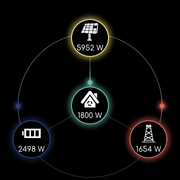
HI everyone. I only went Live on Friday, so all is a bit new to me. However, I am finding that the running Home Load value on the Portal is always showing low by around 300w. The phone App show the values accurately and you can instantly tell there's an issue as the other values do not reconcile. I do find that the totals do end up being more accurate so it does seem isolated to live portal values. Does anyone else experience this? Is there a fix? How should I report. Thanks in advance.
New Portal Running Load Value always low.
You're being generous saying there's an error of about 300W. Mine is always low and seems to only show "house load" from one inverter. My Zappi is currently drawing 5.8kW.

Mines other way - portal is accurate (I.e consumption is calculated as "actual Inverter Power" +/- "grid import/export"
App in local just seems to add battery, PV and Grid together to get consumption figure and so seems to ignore all losses or the "inverter powrr register" at all.
Hence mine on the app in local when up at >7kW load is out by nearly 1kW and shows >8kW (proven with a clamp on the actual load for my sanity)

TurnerSN13 Something definitely seems wrong to me as I would be surprised if there was ever actually 'No Load' from your house!

What metering devices have you got in place, and are they located in the correct place for the load being monitored?
There are a number of options for the GivEnergy inverters, all with different levels of accuracy.
1/ Grid CT only, wired direct to the inverter. Can only provide information on grid import/export.
2/ EM115 meter with split core CT on the grid cable. Modbus network cable back to the inverter.
3/ EM115 meter with solid core CT on the grid cable. Modbus network cable back to the inverter.
4/ EM115 meter with split core CT on the inverter a/c cable. Modbus network cable back to the inverter.
5/ EM115 meter with solid core CT on the inverter a/c cable. Modbus network cable back to the inverter.
6/ EM418 meter direct connected, inline with the grid cable. Modbus network cable back to the inverter.
7/ EM418 meter direct connected, inline with the inverter a/c cable. Modbus network cable back to the inverter.
Options 6 and 7 required for FIT payments.
The DC metering for the solar PV and battery charge/discharge are presumably built-in to the inverter with unknown accuracy.
Simon_C I don't know about @TurnerSN13 but my installation is both HY5s have their own Modbus EM115 with split core CT in the correct place and orientation. The app does seem to reflect the house load better than the portal but last week there were hours where the portal had house load at 0W when that was simply not right.
I've raised a web feedback about my specific installation and emailed @Danlambert (GivEnergy) directly asking for it to be looked at but got no feedback from either route. TBH I'm not overly concerned with the "at the moment" figures as I'm hoping it will all be resolved in time. The main thing for me is what my energy supplier (EdF) is seeing which is an import of less than 1kWh/day. I'm happy that the actual plant is performing as well as I could hope and that our electricity costs have dropped to about £22 per month, hopefully soon to be reduced by a SEG tariff.
Simon_C I have a EM115 in the Consumer Unit, quite how CT is attached I don't know. The thing that stands out to me is that the figures on the GE Phone App seem a lot more accurate and at the very least add-up! So I would say the metering is OK, it's just the Portal is way-out. And having investigated further, the reports use the erroneous portal data rather than the more accurate App data for compiling totals. Seems to me to be a relatively easy bug-fix to use the accurate data-set?


TurnerSN13 the numbers add up in the app because that's how the maths in the app calculates consumption in local mode (PV + Battery + Grid = consumption)
On the face of it that sounds fine, but the PV and possibly Battery readings come from the DC side of the process therefore it doesn't appear to take into account any losses in conversion whatsoever like the portal does.
This stands out like a sore thumb if you put the EV on charge in my case as it can be 100s of Watts out.
The portal does it the (frankly proper way) by taking the value of the ac side inverter output (inverter power register) which includes both PV and battery your actually getting to use and adding or subtracting and import/Export from the grid to give you the consumption figure.
Some people may want the "everything adds up" way and the majority may win out in the end but GE need to pick a side for both live data and portal as its currently both ways.
This is just what I've seen - maybe my (Hybrid 5) is just knackered as nobody else seems to have brought it up other than a post I did on FB (which was met with "nah your wrong" despite having a fixed load the entire time while flicking between local and portal data to back it up being massively out)
Thanks hoggy I did not take losses into account. Though, whilst that may take account of some of apparent discrepency, there are extended periods of 0 load - including at least 1 half hour reporting period - which is simply not right. Appreciate your input 😄
hoggy I'm quite happy with the app (whether it mathematically adds up correctly or not) for an indicator of "right now" import/export/consumption as it's fairly reliable over 4G when I'm away from home and good over wifi when I am at home. I am more interested in reliable historical data from the portal that I can download to a spreadsheet to take different cuts of, just to see what's interesting about our patterns of use. The main one for me currently is the avoided cost of import, which is already on one of the reports; except it's just not correct.
Inverter losses will become of interest when we start to charge the house battery overnight in the darker months. We will be paying 4.5p/kWh overnight but there's obviously two inverter losses to take into account when we consume the stored energy later in the day. Putting the dishwasher and washing machine as well as the EV on overnight in the dark months obviously makes more sense than running from battery power during the peak periods if possible.
It would be interesting if the inverter losses were also able to be extracted to be able to monitor any longer-term trends or to see if/how they vary with ambient temperature.

My list of possible metering options was not laid out very logically, so here goes a second attempt.
Grid
G1/ Grid CT only, wired direct to the inverter. Least accurate.
G2/ EM115 meter with split core CT on the grid cable. Modbus network cable back to the inverter.
G3/ EM115 meter with solid core CT on the grid cable. Modbus network cable back to the inverter.
G4/ EM418 meter direct connected, inline with the grid cable. Modbus network cable back to the inverter.
Inverter A/C Input/Output
AC1/ Built-in to inverter.
AC2/ EM115 meter with split core CT on the inverter a/c cable. Modbus network cable back to the inverter.
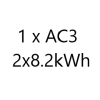
AC3/ EM115 meter with solid core CT on the inverter a/c cable. Modbus network cable back to the inverter.
AC4/ EM418 meter direct connected, inline with the inverter a/c cable. Modbus network cable back to the inverter.
Options G4 and AC4 required for FIT payments.
Solar PV D/C Input
PV1/ Built-in to inverter. Presumably different losses depending on whether directing to battery or a/c.
Battery D/C Charge/Discharge
B1/ Built-in to inverter. Again probably different losses depending on charging from A/C or solar PV, or discharging to A/C.
It looks like a standard install has G2 as the only external meter with AC1, PV1 and B1 all built-in to the inverter.
Maybe for better accuracy of the household consumption, an external meter of option AC2, AC3 or AC4 is required.
Then the un-metered House = metered Grid - metered Inverter A/C.
As you said Tim , it will be interesting to learn how efficient you can charge from a/c overnight on a cheaper rate, then discharge to meet the house load during the daytime more expensive rate. If the price differential is too small, then it will not be worth a/c charging overnight.
I am still in the process of getting in quotations for installation of a GivEnergy system, so will probably specify an EM115 meter to monitor the inverter a/c input/output in addition to the normal EM115 on the grid cable. Now just need to plan where it can be located, with the Modbus network cable back to the inverter.

Simon_C Modbus network cable back to the inverter
My installer used what looks like standard Cat 5 from the EM115s in the DNO meter cupboard to the inverters and ran the Modbus for both inverters over two of the twisted pairs. I had toyed with specifying that the MCS meter between the "Solar" consumer unit and the house consumer unit should be wifi enabled or at least Modbus. In the event, they installed a "dumb" meter that registers import and export but only displays export on the LCD. It's not very convenient to look at the meter as it's in the loft. Of course, the Givenergy inverters should be able to provide the information I'm looking for. It would be really handy if they provided a specification for which values are used where in their portal. I'm supposing that the "Generation Today" value in the Inverter Meter Data tab is the ac output of the inverter, whether from PV or battery.