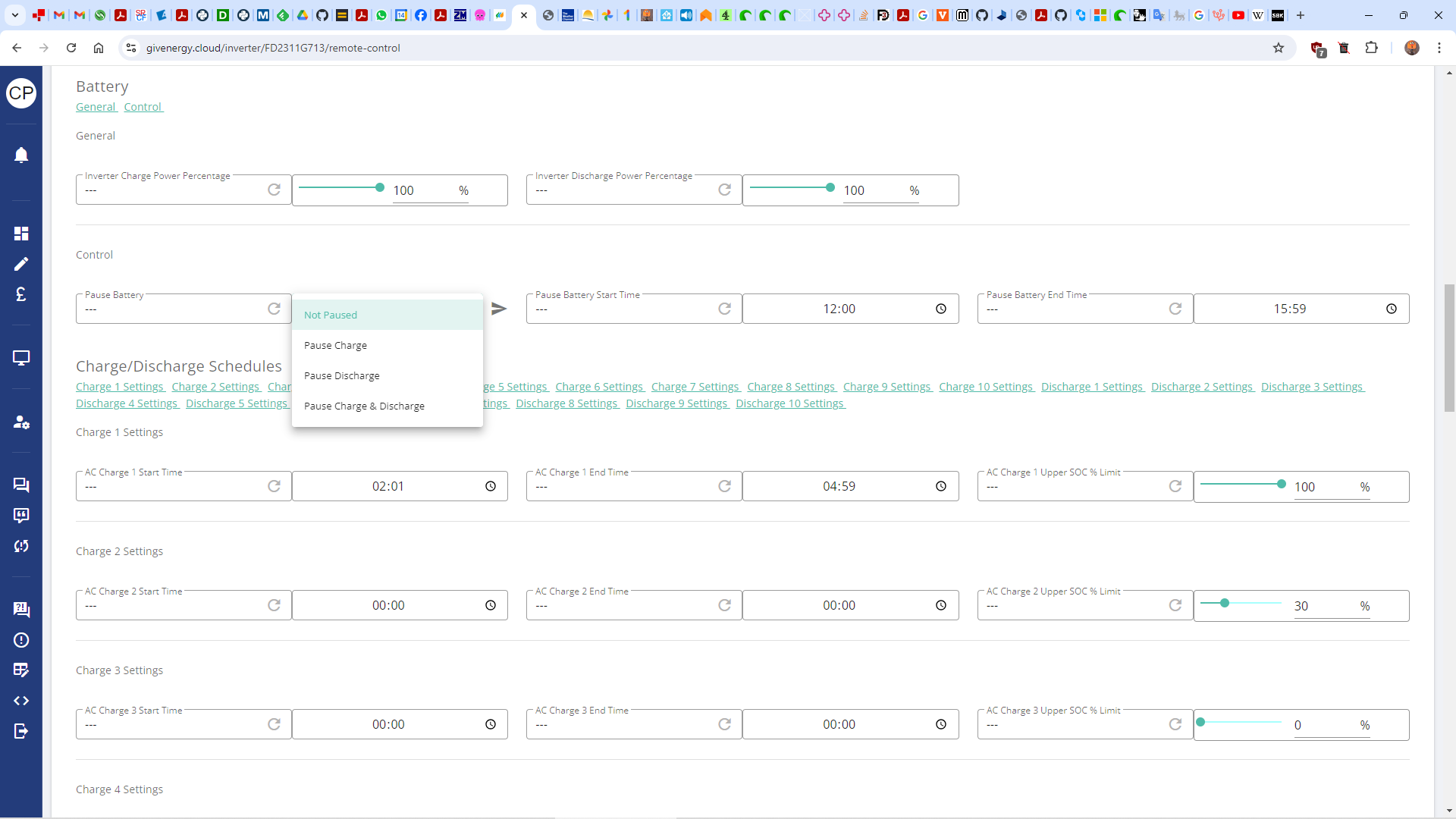
OK - I've recently updated firmware on my gen 1 AC3 to 205-205, and battery 3015. Response times certainly very much quicker, but now I find I can't prevent the system charging the battery when there's excess solar.
Reducing the charge power to 0W, or using pause mode on the app results in still approx 520W charge going in.
Turn off eco mode in the app and it starts dumping to export at full power.
The previous firmware (which I think was 535-535) used to stop charging right down to zero. What am I doing wrong, or is this a new 'feature'??
D
#2DD
richardsmith99 on my gen-3, as you say, setting charge power to 0 still charges at a few hundred W. When you say pause, do you mean via the app? I think that just sets charge power.
Some gen-1 firmwares add timed pause - for my gen-3, that gets it down to 28W.
I hadn't heard about turning eco mode off causing an export. Is it possible you have a timed export configured? From what I've heard, that doesn't work until you also turn eco mode off.
I think I possibly do but deactivated so must have taken over when I switched ECO off. Didn't think of that!
But yes - pause mode via the app still allows charge at 520W. The old firmware would shut it right down to zero. Seems odd to have an option to set to zero that.... well doesn't set to zero!
R
#4Roberto
richardsmith99 same issue with my ac3 and that firmware. Emailed Giv you could not work out why it was an issue ! Previously zero charge meant 0w. Now the minimum is like 500w. Very annoying.
R
#5richardsmith99
Roberto Yes. It is. I'll try and raise a ticket myself to highlight it.
#6nophead
Yes since a firmware update of the inverter the Android app can only reduce the charge to 300W on my system. I can use the web portal to pause the battery charge and that does work.
R
#7Roberto
The Giv guy I emailed could not see the issue ! He thought using PV ti top the battery up was a goid idea. I had to explain a few things.
A
#8AlanV
Just to add here having the same problem: i.e. setting battery charge power in app to zero still allows battery to charge from solar excess. The pause shortcut also makes no difference too. Previously zero meant zero.
I haven't tried settings via the web portal as others have suggested - will have a go at that tomorrow.
Battery BMS has recently updated to 3015 and AC3.0 inverter firmware to D0.205-A0.205.
I'm assuming it's an inverter firmware issue rather than on the battery side.
A
#9AlanV
Web portal also fails to set battery charge to zero. With battery charge now set to an indicated zero either using the app or web portal it still allows approx. 300w of charge. Pause shortcut also has the same effect (allowing 300w of charge).
#10nophead
Setting the power to zero hasn't worked for a long time now. It just reduces it to 300W but you can pause charge and discharge separately in the web portal and that does work.
A
#11AlanV
nophead How are you doing that in the portal? If I go to the portal and set discharge to zero (via Settings > Battery Options) it still exports 300w?
D
#12DD
AlanV using the timed pause should get closer to zero, if you have that feature.
This has no effect on mine. Still the standard 500W charge. I emailed support who said they were going to call me today but nothing.....
R
#17richardsmith99
Have spoken to support on the phone who's only solution was to roll back the firmware.
I've also in the last day or so found that it does the same if you try and set battery discharge to zero too - it'll discharge anyway at the same 500ish Watts.
Can't decide on the trade off between faster response times vs control not working correctly......
T
#18TimHutchings
I have a Gen 1 with the faster response firmware, and I've found that while the sun is shining switching off Eco mode stops the battery completely and it reads 0 watts. Don't know about other gen versions.
D
#19DD
TimHutchings I have a Gen 1 with the faster response firmware, and I've found that while the sun is shining switching off Eco mode stops the battery completely and it reads 0 watts.
Except when solar exceeds the AC capacity of the inverter, when it sends the excess to the battery.