Who became more energy aware after solar/battery install

44 comments started 2024-08-11 last 2024-08-13
Forums/Meta
C
#1 CW

I have noticed since installing my GE kit earlier this year, that I have become much more aware of energy usage generally and try to schedule appliance use to keep within inverter draw limits and reduce draw from the grid.

I would be interested to understand how others have adjusted their behaviour and reasons why since installing solar and/or a battery.

V
#2 Vestas

Everyone 🙂

S
#3 SimonClarke

Do you mean obsessed?! My other half certainly thinks I am. Wait till the ashp is in….

J
#4 Jellybaby

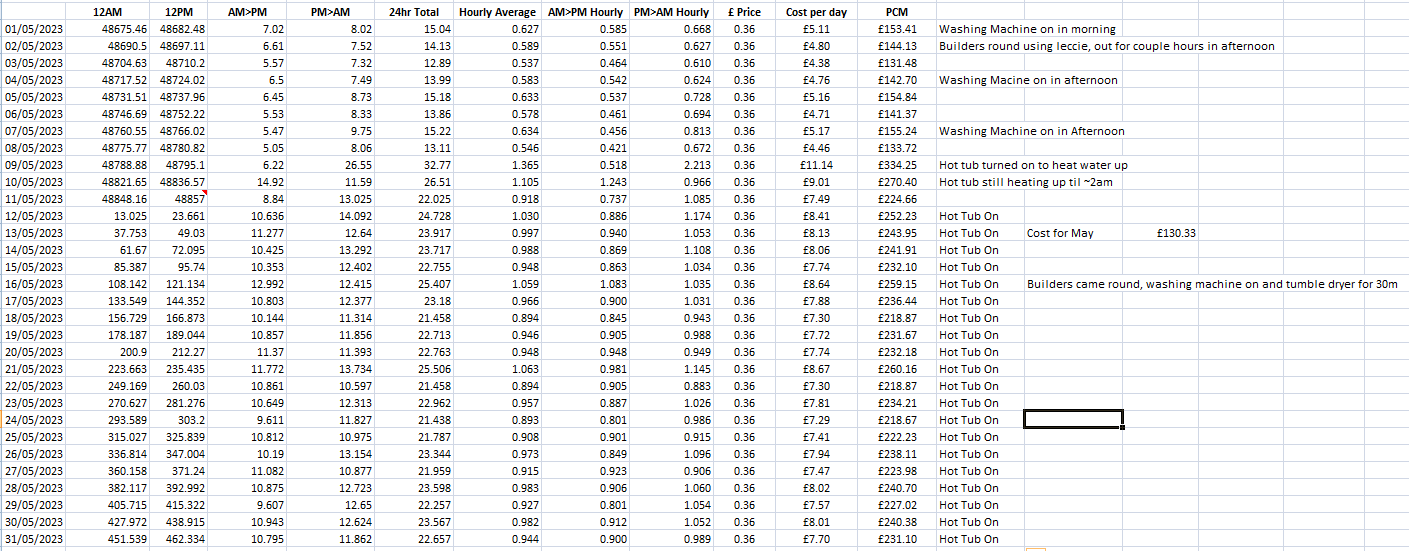
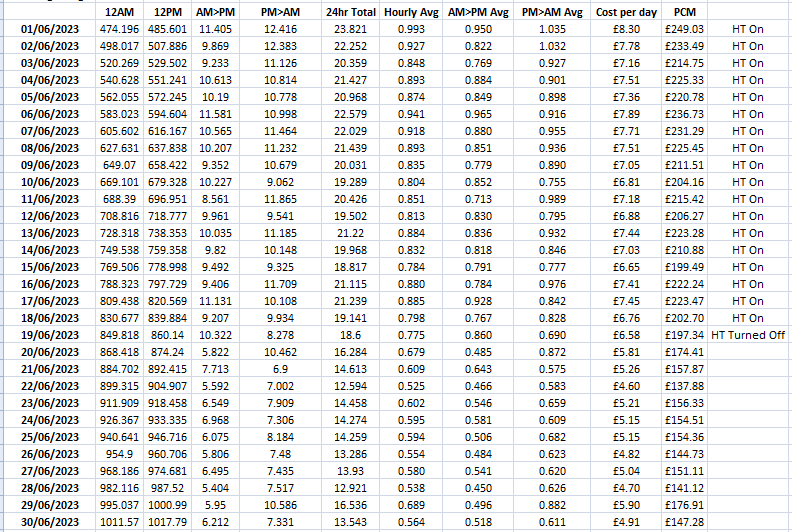
Not me, used to keep meter readings every 12 hours before solar was installed.

V
#5 Vestas

Jellybaby Hmmm now what runs on a 12 hour light cycle 😛

J
#6 Jellybaby

Vestas The red marked cell on the 11th is when smart meter was installed.

Easy to spot things like washing machine/tumble dryer use on any particular day.

Hot tub used a LOT of leccie to heat up lol.

#7 Windy Miller

CW I'm sorry to say I've been monitoring our electric usage in a reasonably fine way since the end of 2010 when I got some "Current Cost" energy clamps and smart plugs which I added to many of my circuits and devices (I had over 20 at one point and used a web service called Xively to plot out the usage - now closed). I didn't get smart meters until 2022 11 years later and have since had the panels fitted (2023) and have started to migrate measuring across to an Emporia system (11 clamps, 12 smart plugs not counting those in the GE system).

Really it's not until you can measure something that you can truly change behaviour without guessing at improvements.

T
#8 TX200

Yeah I think most of us are. 🤣

Although I mostly let Home Assistant do it for me

E.g. I get an automatic push notification at the start and end of the peak rate, plus at sunset, telling me things like total generation, total export, etc.

V
#9 Vestas

Jellybaby I think that joke went "whoosh" straight over your head 😉

J
#11 Jellybaby

Vestas too hot for jokes atm, brain can't process it whilst its begging for mercy 😃

G
#12 geoffreycoan

Vestas thanks, I’ve written a bit, will see if I become famous as a result !

I definitely agree with the earlier comments about being more aware of electricity usage since having the solar and batteries, but especially so since I added Home Assistant and smart energy plugs and Shelly EM monitors so I can see what’s actually being used by different appliances. We try to schedule high load appliances to cheap overnight agile rates, and the batteries mean we don’t have to scrimp on when we put the cooking on

J
#13 Jellybaby

geoffreycoan Nice cheapie night tonight 🙂

D
#14 Daveb01

I am one as well, I have got 10 smart plugs, now on the things I want to control. But I did go round every device in the home first to get readings and add them to a spreadsheet.

The dishwasher and the chest freezer were interesting as they were not constant watts (as expected I guess), also eco mode was very good even though the dishwasher was on for 3 hrs. I thought the 65 deg for 1 hr would have been better but it was not. The LED lights we now have are good and are 6w

I have stepped back now and just use Wonder Watt, and don’t worry to much about what’s on when (between March and October)

T
#15 TimI

Very much so - for us, the biggest eye opener was the overnight idle load... you know standby devices use a little power... but its actually surprising how much when you add it all up. I think we got 175-200W of idle usage killed by turning more stuff off at the wall. Obviously across teh span of 24hrs it adds up for a device that might be used for half an hour of the day etc.

T
#16 TimHutchings

I've been obsessed with it all since installation in Nov 22. My wife now just yawns as I start quoting figures, then her eyes close! 😴
This obsession, which is what it is, I think is because we all love beating the system. There are so many 'distressed purchases' like council tax, or a new washing machine, putting fuel in the car, which nobody wants, but we all have to pay for. With solar energy we can control and minimise the out flow of cash which makes us feel better.
However, the reality is we're saving a pound here or there which is great, fantastic, brilliant, and then we go out to celebrate and buy a latte at £3.50 to undo all the good we've achieved!!! 🤣🤣
As for the time spent tinkering with our systems....... the cost per hour at just say £30 per hour, £240 per day if we were working - well it just makes your eyes water!!

#17 Cdent

TimHutchings but just think about how many "free" lattes you've had with your earnings 🤣

K
#18 killythebid

I think most people will have had to have been energy aware to have solar and/or batteries installed in the first place. It is then adictive to see what you are generating, consuming and exporting.

I was first taught energy awareness when we first had our narrowboat some 15 or so years ago. We started with just batteries charged by an engine alternator plus petrol generator. Now we have solar panels on the boats roof that in the summer at least keep the batteries topped up when we stay put for a day or two on one of our long trips. Being self relient and contained on the boat teaches you a lot about energy production and consumption.

Now with the solar and batteries at the house I am even more obsessed.

D
#19 DreadorUK

Okay I'll be the odd bod here (though no solar so that might be why).

Before my Battery was installed, I was obsessed with making sure all the heavy duty stuff was done within the Octopus Go time period (which was easier way back as it started at 21:00) this was including lots of automation.

Since having the battery I have a simple house rule that is if the Home Assistant AIO gauge (Ipad display) is below 30% dont put on any big load appliance and thats pretty much it, for sure much of the automation is still there so things like the Cars are still charged over night, but many of them have been relaxed, and Ive yet to see one day where my draw is higher than AIO can manage.

I guess that was one of my main justifications in getting the Battery as we were managing to restrict the day rate use to 6-7 kWh and so got the AIO to allow that greater flexibility (read that as less moaning), my usage has gone up but then I think most of that is due to battery loss over anything else

There is the odd slip but Im paying 7.7p overall per KwH and I can live with that.

This could all change though as mulling the idea of getting a second AIO with solar and putting in A2A heating

S
#20 SJB

We were pretty aware before the install - always turning things off, etc.
Now we generate enough that the exports in the summer pay for the winter imports we're (I'm) more relaxed about it what is being consumed as long as it isn't being imported! I cannot really complain about the microwave not being unplugged when I've got a HA server and Octopus Home Mini running 24x7 just to watch the system!

Of course there is so much more data to watch it has as @SimonClarke and @TimHutchings say become an obsession.

#21 Watcher

DreadorUK

FWIW sitting in 21c air con splendour using my A2A unit (mainly installed to warm the shoulder months) and it is using 0.6kwh at a cost of……..zero because the sun is shining to power it! (Ok, losing 7p an hour not exporting but so what)
A recommendation for you.

C
#22 CW

Windy Miller I really didn't give anything a thought until I installed the AIO. Now I try to schedule consumption so that I don't break the 6 kW limit the inverter can manage. This I have found works well for most things, apart from the electric shower which is 7.2 kW (still I console myself that it's only 1 kW I am consuming and only for a short period of time... I sleep better thinking like that!).

Before the AIO I would put everything on regardless whereas now I do try to stay within the inverter limit (which is a sea change for me) - even my better half takes a look out the window before putting the washing machine on, so a "win" there as well.

Although I don't have many smart plugs, I do (now) have a good idea of what most of the electrical appliances consume. A big suprise to me was that things like the WM/DW oven don't consume their rating continously, just when (typically) something needs heating up - I had never thought about that before.

I will certainly now be taking a closer look at those energy efficiency stickers that come with all the white goods these days 😺

V
#23 Vestas

CW I will certainly now be taking a closer look at those energy efficiency stickers that come with all the white goods these days

Freezers/fridges, dishwashers (with zeolith/zeolite) and dryers (heatpump ones) are the big wins. Also actually using more than a couple of programmes on the washing machine helps but who does that? 🙂

#24 Windy Miller

CW It's funny but I have become a bit more relaxed about electric usage since I had the panels. As you see from above I was keenly aware of the cost of running things. Now with Solar mostly being exported and the batteries being used to transfer cost to the lowest priced energy from Octopus Agile my average unit cost has dropped from 35p at the peak of the crisis (prior to getting panels) to well below 10p. I sleep much better as a result (but always glance at the Android app permanently on display on a spare tablet to check things are as expected if I need to get up at night :-O)

We have a little chart in the kitchen with a score of usage for the highest consumption devices trying to keep it below 3 (my inverter limit) and my better half does her best to follow it without my prompting (yay). We avoid using the washing machine and dishwasher whilst cooking etc. No electric shower here and don't use battery or solar to heat the water, only cheap electric or gas.

I use my smart plugs to turn off the Dehumidifiers and Aircon units during the evening peak (except today where I've kept the Aircon on as it's 32oC outside).

C
#25 CGoode

I think it's almost a given that after instigating a solar / battery install that "most people" become more energy aware, except perhaps our wives / partners / other halves / SWMBO's etc.
Like many others have observed many of our other halves seem totally oblivious to the concept of how much power appliances uses & how easy it is to exceed a 3.6kW inverter by running a dishwasher, washing machine, tumble dryer, toaster & hair dryer all at the same time. My wife doesn't even understand what a kilowatt is, how energy is generated or, what appliances use the most power. She thinks I'm obsessed with all things solar & glazes over at the first sight of of a GE graph on a laptop or phone App in much the same was way as I am totally uninterested in how difficult it was for her to find a dress on her latest shopping expedition!!
However, she does become slightly interested when I told that our last few energy bills were negative & that we made money courtesy of our solar & battery exports. She just doesn't understand how this happens.
Venus & Mars, Venus & Mars, & never the twain shall meet!!

S
#26 SimonClarke

I am testing my other halves tolerance. We started with a tesla in 21, then solar, battery etc last year and now in two weeks an air source heat pump! So far things have been an improvement, especially the car, so I have got away with it so fingers crossed for the heat pump.

C
#27 CW

SimonClarke Let me know how that ASHP goes - it is something I have been (sort of) considering, but can't get my head around the economics of the whole thing

S
#28 SimonClarke

CW seems to work economically if you ignore the initial cost! We are replacing our pushing thirty year old radiators, tank etc, gaining a cupboard, gaining mains pressure hot and cold water, and gaining 10 sq/m of garden. And we can look our grandchildren in the eye…..

J
#29 JasonF

I started with one AIO trying to push all the big load to the night. Worked fine until summer (we only have 1kw solar that came with the house) and we started to put the Air con on….got a second AIO and now just let predbat take care of things.

C
#30 CW

JasonF How is the second AIO going - As I understand it, if you have an AIO it is the only supported option for an additional battery. It is something I am considering, but waiting to see how well the second one behaves as it is relatively new to market

C
#31 CGoode

CW If you are on Oil or bottled gas it's a no brainer. If you are on Mains gas then you can be better off financially with a Air to Water HP IF the system is designed properly for the highest possible SCOP. That said, many people are ditching gas / oil for other reasons.
My son has just had a 9kW ASHP installed by Octopus. It replaced an old permanent pilot light Baxi Bermuda boiler (inside chimney breast) & front gas fire fed by a big green Calor gas tank in the front garden. He recently moved into the house & after a winter of expensive gas re-fills made the decision to switch to a HP. After grants I think he paid around £2.5k which is about the same as a replacement gas boiler. Quite a bit of disruption though, new larger rads, floor boards up everywhere, HW cylinder in loft (too big for existing airing cupboard), scaffolding up the side of house for exterior pipes into loft (very H&S) & lots of boxing needed to hide new inside pipes. Took 5 days. I'll be over to have a nose in a few days time & see how they did (I'm ex- aircon industry & have been working with & designing A2A Heat Pump systems for 45 years).
As for me, I'm in too minds. I'd like to make the change & get rid of our gas boiler. However, finding a location for the outdoor unit is an issue. Add to that, I have a relatively new 4 year old boiler & I have 10mm microbore pipework which are not great for Air to Water HP systems. Loosing gas also means I'd need a new oven & hob. Instead I'm considering an Air to Air Heat Pump / Aircon system with a separate solution for hot water (Mixergy iHP or possibly a SunAmp thermal battery). I already have an Air2Air split system in our conservatory for winter heating which work well. Cost is an issue as there are no grants available on Air to Air / Air Con systems so I guess I'll procrastinate on this for a while longer.

G
#32 geoffreycoan

CGoode We had an oil tank and oil boiler, the oil tank failed and that’s what precipitated our move to an ASHP. The oil tank regulations now preclude a tank being sited within 760mm of a boundary or 1.5m of any building/shed, both of which we fell foul of. There was nowhere really suitable for a replacement tank plus at the time the RHI grant was still available which was more generous than the current BUS grant.

We had to have almost all of the rads replaced and subsequently I’ve replaced two towel rails (kitchen and utility room) and the lounge rad to improve the overall comfort level. There is exterior pipes from the ASHP up into the loft where the buffer tank is and the connection to the radiators, but it was all done on ladders, no scaffolding. The only floorboards that had to come up were in our bedroom so that an emergency overflow expansion pipe could be fitted from the hot water cylinder (in the middle of the house) to the outside. 5 days installation.

Overall running costs are similar to the oil system, except of course that I can generate my own electricity. Annual running costs for electricity and heating were -£11 for last year. In the winter we have the heating on all the time to maintain a constant temperature so one benefit (on top of the others mentioned) is that the house is warm and comfortable all the time

C
#33 CW

geoffreycoan TBH reading your comments makes me wonder if I will make the move. We are on mains gas so the COP of 4 basically cancels out the 4* price per kWh (electric vs gas) - this was the big one for me when trying to decide on the economics of the whole thing.

Now that you mention it, we too would have an issue on where to place the outside unit and replacings rads all over the place would not appeal (I have assumed we wouldn't need to as we have an old housean no micro-bore) but the whole thing sounds like a right faff!

C
#34 CW

CGoode Hmm, our boiler is a little older than yours (getting it serviced next week so will find out how efficient it is) but still a condensing one with hot water tank. As I mentioned to @geoffreycoan, siting the external unit sounds like a challange as well (which I hadn't considered) and being on mains gas make the economics much more difficult for me

S
#35 SimonClarke

geoffreycoan we are preempting the oil tank failing! It’s pushing 30 years old like everything else we are replacing. Just seems a nice update from burning kerosene which feels a bit victorian. We gave up oil lamps some time ago! Solid concrete floors, 10mm microbore in the walls so staying, new tank going where the two header tanks are, just a long run of pipe from the heat pump under a small path up a wall and across the loft in a bungalow est 5/6 days in a couple of weeks time. Should be fun …..

#36 Midlands_Solar

100% obsessing here!, With Solar certainly some lifestyle changes have happened quickly

V
#37 Vestas

geoffreycoan OT but did you hear anything back from the Grauniad?

C
#38 CGoode

CW Finding an unobtrusive location for the outdoor unit that meets the planning regs & manufacturer requirements for adequate airflow can be a right pain. No one wants a big metal box in eyesight & surrounding it with shrubs & panels to disguise it will kill it's efficiency & make servicing it more difficult (yes they do need cleaning / servicing). In my case the best place for the outdoor unit would be out of sight down the side of the house. However, this is too close to a fence / boundary & would not meet the minimum airflow obstruction requirements either. Also, this location is also just about the furthest possible distance from my consumer unit where a dedicated power supply would have to come from. The only other location that might work is against the back wall of the house facing a patio area. However, there's an opening window above & an outside drain to one side where the OD unit would be so this would be a problem if it was an R290 refrigerant model (flammable gas location restriction). Also it would not be great visually but, a bonus in the summer as we would get the cold air discharge from the outdoor unit while sitting around our outside table in the warmer weather. Outside air con!!
Every installation is different & there's no "one size that fits all" solution. A decent installer will need to do a detailed site survey to assess all the options & come up with the best solution. Still not sure I'm ready to take the plunge (financial or the upheaval).

#39 nophead

I don't think you get a cold discharge from the outside unit unless you are heating the inside.

It doesn't make any sense for our house either because all our pipes are microbore and descend from the ceiling down the corners of the walls in tiny trunking that is papered over over and then run behind the skirting boards to the radiators. The ground floor is solid. I have no idea how you could get bigger pipes to our radiators without it looking crap.

And we have nowhere for a water cylinder because the gas boiler is a combi. No great place for the outside unit either.

Cadent are replacing all the gas pipes in our area so they must think gas is going to be around for a good amount of time to be worth it.

S
#40 Slartibartfast

Anyone want a couple of oil tanks - one an nine year old bunded tank. Grant boiler and all the bits plus an unvented cylider. All because of a ASHP (if it ever gets fitted ...) - outside fridge with a big fan.
It's quite amazing how much scrap the thing generates. Forgot - 8 rads goilng begging as well.

C
#41 CGoode

nophead Granted it won't be running for long periods but cold air will be produced from the outdoor unit when it's doing hot water which, in summer, could be scheduled to use solar / battery during the day for free instead of off peak at night. Also, warmer daytime temps make for higher efficiencies for the HW cycle.

There was a government edict a while ago that said no more new gas mains for new house builds from 2025. Not sure if that is still in force - probably not. There's also plenty of new houses going up without any solar as well.

Yep, microbore pipework is not ideal for A2W HP - especially if it's the smaller 8mm. Mine's 10mm &, like yours, comes down the walls on the ground floor behind the plasterboard. Our ground floor is concrete with no insulation (1986 build) so digging it all up to insulate & install UFH would be a right pain & prohibitively expensive - & not covered by any grants. That said I've seen some ATW HP systems running on 10mm microbore rads. Not the best COP's but they do work if optimised properly.
Gas will be around for some time to come but my worry is what will happen to the price vs electric? Only one way it's going & that is up which will make the case for HP's stronger. I bet it will also be at that point that Government will pull the plug on any current HP installation grants.

S
#42 SimonClarke

Slartibartfast pretty much exactly what we will have soon but I think I’ve sold the boiler - also a Grant

W
#43 wrefordj

Our oil boiler is now 24yrs old (same as house) and apparently likely to suffer a water jacket leak, at some point. I was considering replacing it soon, since it will likely be mayhem next year when new oil boilers will be banned - anyone know the date? Luckily our house has underfloor heating so an ASHP should be straightforward, but I am worried about power cuts. However, we also have a propane hob and "log-burner" in the lounge, and I have found a very good designer/installer. So the current plan is to allow space for a small supplemental propane boiler to be retrofitted if the Grid proves unreliable. We'll see how it goes...

G
#44 geoffreycoan

Lots of good discussion, I'll chip in a few points..

Radiator upgrades. Yes most of our radiators were replaced, including the ones fitted only 8 years ago when we had the extension built. For best efficiency you want to run on as low as a flow temperature as possible, so have the biggest radiator surface area to conduct heat into the room. Most of our upgrades were to swap a single panel for a double panel radiator, a few of them were slightly narrower than the original and one (in the lounge) was quite a bit bigger.
In practice the radiators are mainly under windows, not really space you use anyway, so there was minimal disruption.

Microbore. We have 15mm throughout so not a specific issue for us, but the installers did fit two pumps in a push/pull configuration to ensure a decent flow rate round the system. 10mm microbore with an ASHP is do-able, 8mm is more problematic. But a decent installer will do a full heat loss survey and design your system from there.

Gas vs Electric. At the moment electricity prices are artificially tied to gas prices which makes gas boilers comparatively cheap to run when compared to ASHP's. At some point as the UK grid is more based on renewables I believe this tie will be severed, but even now, gas is about 1/3 of the cost of electricity, any well designed heat pump installation should be at least 350% efficient so it should cost about the same to run, if not slightly less. There are of course people who have had badly installed systems with poor efficiency, but plenty of good installs now and Heat Geek installs (very much at the premium end of pricing) are achieving 450-500% efficiency.

Hot water cylinder. Definitely an issue if you don't have a conventional hot water tank, however there are now high efficiency cylinders that will fit in a standard sized kitchen cupboard that can provide sufficient hot water to have a shower, bath, etc. YouTube video from Heat Geek on this, it was very impressive, he ran a shower connected to the tank for I think 50 minutes with the heat pump continually reheating the tank with no loss of shower temperature.

Siting the ASHP. No single easy answer, every home will be different. Our heat pumps are underneath the lounge window (our bedroom above), and yes you can sometimes hear it humming, but its not particularly noisy. Planning regulations do vary by region though, Wales in particular has quite stringent requirements (see Speak to the Geek videos).

Overall after 2 years living with it I'm happy enough with our A2W heat pump. It does use a lot of electricity in the winter, but negligible in summer and as I said, overall running costs are similar to the oil boiler (but with what we generate from our solar panels the actual running costs over the last year was zero). We've gained more space in the garden, don't have the stress of running low or out of oil and we have mains pressure hot water for showers now.
If doing again there are some aspects of our install I would challenge and do differently, but nothing major. I would also consider the A2A systems which are much cheaper to run but are more invasive to install (although you can remove the radiators afterwards), and you need to have a separate system for heating the hot water, and at the moment no BUS grant.