Battery

13 comments started 2024-08-24 last 2024-08-28
GivEnergy Products
L
#1 L

I have a 5.2 k.w battery and was assured that it was adequate for my needs. It charges up but does not seem to last all evening. My system is drawing power from the national grid and this is what I wanted to get away from. Most days it doesn’t seem to charge until lunch time. Would it be beneficial to install another battery as I can see that I am going to have a problem in winter when I put my oil filled radiator on. Bit worried that I could still be paying big electric bills and this defeats the whole point of having solar power.

T
#2 TimHutchings

L That's one option but it very much depends on how much electric you use over the year, the number of solar panels you have on your roof and the tariff you are on with your energy company. It may well be that moving to one of Octopus's smart tariffs where you get a cheap overnight rate to charge your battery, may work out financially better than buying another battery .

G
#3 geoffreycoan

L A 5.2kW battery is only actually 4.2kW usable capacity. As @TimHutchings says whether that is sufficient for your needs depends on a number of factors, including house size, how you heat the home, whether you have gas, etc.

The ofgem ‘average gas and electric annual consumption’ figures give you somewhere to start from https://www.ofgem.gov.uk/average-gas-and-electricity-usage.

Ofgem suggest 1800kWh electricity for a small flat/house alongside 7500kWh of gas. Even just assuming a constant consumption every day of the year, this slightly exceeds the capacity of a 5.2kWh battery and of course most people use more in winter when there’s much less solar generation. An oil radiator could consume 1kW an hour for example.
I think whoever proposed that a 5.2kWh battery would be sufficient was being economical with the projection.

First thing is to gain an understanding of how much you really consume a day, you can take daily meter readings or have a look at your old electricity bills. You’d need to work out what you consume overnight, during the day and in the evening peak (4-7pm). A 5.2kWh battery could well be enough to see you through the evening peak, so a tariff that charges more in the peak but less outside those times in the day might suit you. Tariffs such as Economy 7 where you get cheap rate overnight but pay more in the day probably won’t work out as your day-time consumption is likely to exceed the battery capacity.
One option could be Octopus tracker which charges a fixed rate per day based on market rates, or Agile and use WonderWatt or similar to automate charging the battery in cheaper rates and releasing it for the peak periods.

Have a look at https://energy-stats.uk/ to get an idea of what different Octopus rates are, especially Agile or Tracker.

D
#4 DD

L perhaps you get diminishing returns from increasing battery size: the first few kWh probably give the best payoff; the next few are still good, but don't give quite the same return; then once you have loads, adding a few more might only save a few extra pennies per year.

So in one sense, more is always better, but perhaps discover how much you can get from what you have before deciding whether it's worth getting more. Eg as mentioned, if 5kWh gets you through the peak-rate period on agile, you're probably already doing quite well.

It charges up but does not seem to last all evening. My system is drawing power from the national grid and this is what I wanted to get away from. Most days it doesn’t seem to charge until lunch time.

You can't expect to not draw from the grid. Goal should be to do so as cheaply as possible.

D
#5 DD

L I have a 5.2 k.w battery and was assured that it was adequate for my needs.

I wonder if they were thinking of it purely as somewhere to store generated solar, rather than importing from the grid at cheap rate? If you have a 2kWp solar array, 5.2kWh may well the "correct" size battery by some metric or other.

Further to what I was saying about diminishing returns from bigger batteries (and possibly just repeating what has already been said), an actively-managed small battery can probably out-perform a large battery just left in eco mode 24-hours a day (which is effectly what a friend with a powerwall has). So one additional question we should have asked is whether you have any interest in any sort of active control.

C
#6 CGoode

When I was quoted for my system 18 months ago I was offered a 5.2kWh battery by my installer. Based on our usage 5.2kWh seemed a bit low to me so I decided to go for a 9.5kWh. After 8 months of use over the winter I decided to add another 9.5kWh battery because the single 9.5kWh was running out around 2pm in the afternoon (we are home most days with a gas boiler for CH & HW).
I think many installers offer smaller batteries (& inverters) to make their prices look as competitive as possible without actually properly assessing what size battery you actually need, at least that's what I think happened with me.
Come spring & summer this year & the 2 x 9.5's easily last all day &, on OIG tariff, allow me to dump the excess battery capacity back to the grid for extra income prior the the 6hr cheap rate charging slot over night.
The other reason I got the extra battery is that I am considering getting a Heat Pump at some stage so extra capacity to run that during the day / evening will be needed.
Based on the experience gained over the last 18 months I would also have gone for a larger inverter. My 3.6kW hybrid is not really enough to run everything we sometimes have on in the house at the same time. My installer didn't really want to offer me a larger inverter because it required G99 approval, involved more costs & paperwork for them &, a much longer wait for approval (or rejection) from the DNO. I guess you live & learn.

G
#7 geoffreycoan

CGoode Based on the experience gained over the last 18 months I would also have gone for a larger inverter. My 3.6kW hybrid is not really enough to run everything we sometimes have on in the house at the same time. My installer didn't really want to offer me a larger inverter because it required G99 approval, involved more costs & paperwork for them &, a much longer wait for approval (or rejection) from the DNO

Confusingly there are two different inverter limits. The 3.6kW limit in the product name is the amount of DC that your inverter can convert to AC, so if you have a larger inverter (e.g. the 5kW hybrid) you can fit more panels and not suffer from clipping on sunny days, but does mean you need a G99 and DNO process.

Separately is the amount of charge that your inverter can charge or discharge your battery. The Gen 1 hybrids could charge and discharge at 2.6kWh, the Gen 2’s and 3’s are limited to 3.6kWh. You’d need an AIO to get a higher 6kWh charge/discharge rate or more than one inverter in parallel. And yes, DNO approval.

We have two gen 1 hybrids each with their own battery so combined ~ 5.2kWh charge/discharge rate (slightly higher on discharge, lower on charge). It covers house peak demand well. As DD says, a small well managed battery can perform extremely well; for most of the last winter we only had a single 5.2kWh (4.2kWh usable) battery and this covered most of our peak usage on Octopus agile, cooking and running the heat pump as well.
Even now with the 9.5 fitted our daily heat pump demand in winter consistently exceeds the battery capacity and it’s not worth seeking to extend the capacity for limited payback on just part of the year.

S
#8 SteveCook

before I had my system installed I tried to work out my base load (in bed all things off) as much as they could be.
I still got to 500w. In 24 hrs that is two 5.2 kwh batteries.
Fridge/freezer
House alarm
TVs on standby
PCs/laptops on standby
Router
CCTV cameras fitted by previous owner
Boiler controls and pump
Microwave clock
NAS box
LCD room thermostats
etc etc it all adds up

D
#9 DD

SteveCook In 24 hrs

though you can typically disregard several of those hours, assuming you're on a tariff with some cheap-rate power, and so are running from grid anyway.

TVs on standby

tut tut ;-)

Fridge/freezer

I did read somewhere that modern freezers consume a fraction of the power of older ones. So replacing our 20-year-old freezer is likely to pay for itself in just a few years.

(I think we're down at about 300W, with a similar list to yours, except for the cctv. We turn microwave and tvs off when not in use, though.

S
#10 SteveCook

DD
Try getting wife and kids to turns lights off when not in the room.
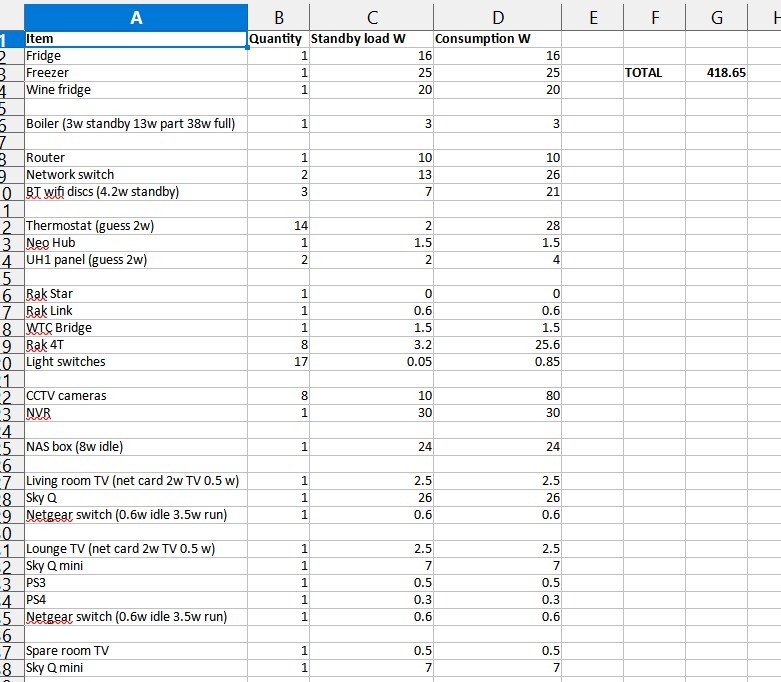
Snip from my spreadsheet. I got to 418w and yes on the cheap overnight slot it is covered.
I was just illustrating how quickly it adds up

D
#11 DD

SteveCook Ah, you'll already have one of those new-fangled fridge and freezer - mine are more like 200W each (as is my boiler pump).

S
#12 SteveCook

DD
I guess it will pull more power if I open the door for a nighttime R Whites lemonade (you need to be a certain age), but if the door stays shut it is quite low consumption - according to Hotpoint data sheets

Those are all "standby" numbers -as in bare minimum base load. Almost as though we are away

N
#13 Newman

L the answer to your question depends upon your setup and electricity usage.
In summer I need 6 kWhr of storage to get from end of solar (4PM) to start of solar (9AM),
during periods of poor solar I use Agile to top up the batteries.
In winter I need 10 kWhr of storage to get from end of Eco 7 Charge (7AM) to start of Eco 7 Charge (Midnight),
I charge to 70 to 90% to allow some solar charging depending on weather.
The use of automation and different tariffs allow others to maximise their own installations.
I have given typical usage figures but roast diners, wash days and visitors increase power usage.
Xmas is double normal usage and virtually no solar.

AC3 2 x 8.2 205 / 3017 System working well.