
Do I have a faulty cell in my battery?

19 comments started 2024-08-30 last 2024-09-03
GivEnergy ProductsBattery
B
#1 Brassy

Inverter GIV-HY5.0, Software Version D0.309-A0.309
Battery GIV-Bat 9.5 Firmware Version 3017

I have noticed recently that when my battery SOC falls below around 30% (typically), it then rapidly drops to the minimum 4% without a corresponding increase in load. The rapid fall from 30% to 4% typically happens over about 1 hour, with no increase in the normal background load of about 450W, say 0.5 kW consumed from the battery equivalent to 30% SOC.
The slope from 100% to 30% before that typically takes around 8 hours with the electric oven, microwave etc on top of the base load, around 5.4kW consumed from the battery over 8 hours, equivalent to 70% SOC. A simple summation of consumption from the battery between 100% and 4% SOC gives less than 6kW capacity for a nominally 9.5kW battery.
See the attached typical graph from 25th August for example.
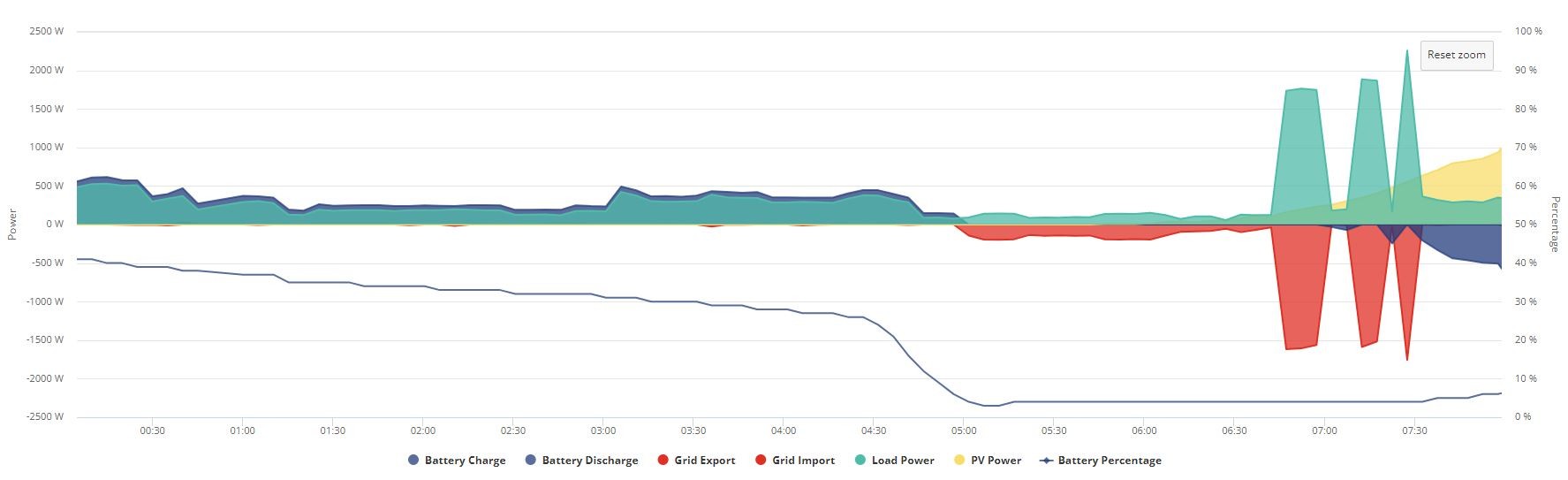
There is no EV charging connected.

The system is less than 6 months old, it should not be degraded to this extent. The problem has been apparent since the end of May, Before that the SOC was not dropping rapidly below 30%, but continuing to slope downwards at the rate as above 30%.

It has been suggested that a battery re-calibration will resolve this issue. I do not believe this, a re-calibration will only hide the symptom, not cure the cause.

Is it possible I have a faulty cell in my battery?
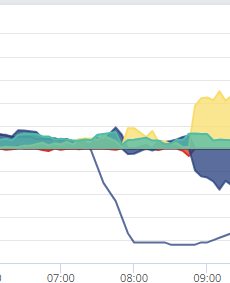
K
#2 killythebid

It would be worth trying a battery BMS recalibration first.

It is also possible to see the individual cell voltages so that may help. If you have not seen this you can find the Givenergy inverter app on the google appstore for android by Andrew Miller. I am not sure if it is available on iphone.

C
#3 CW

killythebid It is also possible to see the individual cell voltages so that may help. If you have not seen this you can find the Givenergy inverter app on the google appstore for android by Andrew Miller

Does this work with th AIO? I always get Battery Information not available ,,, the protocol doesn't support it

A
#4 arczi19

I don't have any answer for this, but just noticed the same behavior on my battery tonigh, 9.5kWh, same firmware.

M
#5 MegaVolt

Hi al
Just had the same thing this morning - rapid drop in SOC from above 50% to 9%
5.2.kWh Gen3. Installed last December

.

D
#6 DD

BMS may just have lost track of state-of-charge.

The advice from GE now is to, once in a while, fully discharge battery. Effectively visit both ends of the range, but without a formal calibration cycle. This allows BMS to track the SoC more accurately.
https://www.youtube.com/watch?v=s7lAUEvJpwU

I saw a recent video on YouTube - something like "how to ruin your LFP battery". Aimed at cars, but I assume everything holds much the same. Advice there was that you need to visit 100% from time to time, but in fact cycling only between 75% and 100% is bad. Of course, with buffers it's hard to know where 100% really is.

https://www.youtube.com/watch?v=w1zKfIQUQ-s

(My battery seems to be charging very slowly right now - guess I need to follow my own advice.)

K
#7 killythebid

CW I don't think it works with an AIO but the OP said they had a 9.5kw battery with a 5.kw inverter.

I
#8 IJHHH

My 9.5kw battery, installed January 24, has been behaving like this for the last couple of months. Now awaiting replacement battery from GivEnergy. After various interventions they diagnosed faulty cells in battery.

B
#9 Brassy

Thanks for your thoughts everyone. It seems I am not the only person who has seen this battery behaviour.

killythebid t would be worth trying a battery BMS recalibration first.

It is also possible to see the individual cell voltages so that may help. If you have not seen this you can find the Givenergy inverter app on the google appstore for android by Andrew Miller. I am not sure if it is available on iphone.

Unfortunately I have iPhone, and the Andrew Miller app does not seem to be in the appstore. I downloaded an iPhone app by Richard Russell but it doesn't give battery cell visibility.
I don't know how to trigger a re-calibration. I'll look at the video.

DD The advice from GE now is to, once in a while, fully discharge battery. Effectively visit both ends of the range, but without a formal calibration cycle. This allows BMS to track the SoC more accurately.

The battery discharges to 2, 3, or 4% whenever the rapid fall from 3% happens. Is this not sufficient? I have read somewhere that letting the battery discharge to 0% might damage it.

IJHHH My 9.5kw battery, installed January 24, has been behaving like this for the last couple of months. Now awaiting replacement battery from GivEnergy. After various interventions they diagnosed faulty cells in battery.

Have GivEnergy agreed to replace it, or your installer? How long have you been waiting?

D
#10 DD

CW Does this work with th AIO? I always get Battery Information not available ,,, the protocol doesn't support it

It is possible to get cell voltages on AIO but they're in different registers from the low-voltage systems.

Brassy Unfortunately I have iPhone, and the Andrew Miller app does not seem to be in the appstore. I downloaded an iPhone app by Richard Russell but it doesn't give battery cell visibility.

Do you have a pc of some sort. Anything that can run python. I have a script that uses the modbus library to display cell voltages.

B
#11 Brassy

Thanks DD.
I do have a PC and it think it already has python installed ( .py file extensions?) but nothing modbus.
Where can I find this script?

D
#12 DD

Brassy I've added lvcells.py to https://github.com/divenal/modbus-scripts with some brief notes added to the README for getting started.

I get output along the lines of

$ python3 ./lvcells.py 192.168.1.94
11:19  47%  1484   3.254  3.254  3.256  3.254  3.243  3.256  3.256  3.248  3.256  3.251  3.256  3.256  3.241  3.254  3.250  3.251
11:20  46%  1484   3.254  3.254  3.256  3.254  3.243  3.256  3.256  3.248  3.256  3.251  3.256  3.256  3.241  3.254  3.250  3.251
11:21  46%  1484   3.250  3.254  3.254  3.254  3.241  3.251  3.256  3.240  3.251  3.253  3.250  3.253  3.237  3.254  3.248  3.250
11:22  46%  1484   3.250  3.254  3.254  3.254  3.241  3.251  3.256  3.240  3.251  3.253  3.250  3.253  3.237  3.254  3.248  3.250
11:23  46%  1484   3.250  3.254  3.254  3.254  3.241  3.251  3.256  3.240  3.251  3.253  3.250  3.253  3.237  3.254  3.248  3.250
11:24  45%  1483   3.250  3.253  3.254  3.253  3.243  3.254  3.254  3.241  3.253  3.250  3.254  3.251  3.233  3.254  3.248  3.251

where the SoC is as reported by the battery (which seems to differ from that reported by the inverter). That's followed by current battery power (currently discharging at 1.5kW), then the individual cell voltages.

Weak cells are likely to show up under load, rather than when idle. With my battery idle, cells #8 and #13 fall back into line:

12:01  32%   -27   3.272  3.274  3.272  3.270  3.270  3.270  3.270  3.272  3.272  3.272  3.272  3.272  3.270  3.270  3.270  3.272
I
#13 IJHHH

Brassy Last Monday I was informed by my installer that GivEnergy were sending a replacement battery for them to fit a replacement. Prior to this I had been waiting a month for a GivEnergy site visit as they had tried all the remote interventions. I suspect GivEnergy are struggling to cope with all the site visits required and have probably little or no field staff in Scotland. Hopefully my installer will receive the battery soon. I've worked out that my 9.5kw battery currently takes about 2kw max before displaying 100%. Then rapidly discharges under light load. So frustrating!

N
#14 NSR2

I've seen something similar.
I had my 9.5kwh battery not give out a full charge, with a rapid decrease from 10%.
I saw the EV Man / Giveenergy suggestion video, and did A LOT of washing etc for the past couple of days.
Yesterday it chucked out a good amount of power so I think it just needed to be recalibrated.

If you think about it, during summer the solar & fully charged battery means it doesn't discharge fully. It's when we have bad weather / lack of solar and use all the stored power can it fully discharge / charge.
Autumn is "recalibration season".

B
#15 Brassy

DD Thank you DD. I'm not a python/Modbus techie so I will have to spend some time reading the python documentation to get this to run.

B
#16 Brassy

IJHHH Thanks IJHHH
I don't think my battery problem is as bad as yours (yet!) but it seems to be heading there. This rapid fall in SOC when below 30% is happening regularly, and with a corresponding plummet in battery voltage. I had a different battery problem back in June when it was charging at a slow rate (about 300W) above 70% and they told me it was not a cell problem then re-calibrated it - the reduced capacity seems to start from there. The concealed the problem.
I'm in south Birmingham so hopefully I'll get a better response time than you have.

B
#17 Brassy

NSR2 Thanks NSR2
This is interesting, I'll take a look at the video.
My battery SOC has been down to a nominal 2%, 3%, 4% quite a lot in the last 2 months, and even down to "0%" a few weeks ago.

D
#18 DD

Brassy I had a different battery problem back in June when it was charging at a slow rate (about 300W) above 70%

I saw similar the other day. I decided to charge to 100% for a change - I usually stop around 80% - and it was charging a bit erratically near the end (sometimes as slowly as 50W, other times 2kW). I think that when it's going slowly, it's not very confident about where 100% is, or maybe one cell is a little higher than the others, and it mustn't overshoot (since that could cause damage). So I just allowed it to very slowly make its way to the end. (At the end, it jumped from 95%, where it had more or less stopped, to 100%.) I then allowed to sit at 100% for a few hours (it was quite sunny), and noticed the cell voltages shuffling a bit - rebalancing, perhaps ?

Next night, and asked for 100% again, and it got there fairly smoothly.

D
#19 DD

Brassy Thank you DD. I'm not a python/Modbus techie so I will have to spend some time reading the python documentation to get this to run.

Okay. I assume you're using windows ? To expand a little on what I put in the README:

python -m venv modbus creates a subdirectory called modbus (you can call it anything you want), and it will populate a workspace (they call it a virtual environment) where you can install modules. Doing it this way, you can isolate the modules that different packages need. (Perhaps it's better now, but when I last used Windows years ago, it suffered "DLL hell" where different packages needed different versions of DLLs.)

Then you need to "activate" this virtual environment - on Windows, I think that just means running the activate script it has created within the workspace.

Then the 'pip' line installs (my working version of) the modbus library into that workspace, plus third-party packages it depends on.

Once all that's done, you're ready to run the script. That just needs the IP address of your inverter so it can speak to it directly.