Switching to Octopus Flux

15 comments started 2024-09-18 last 2024-09-21
Forums/Meta
R
#1 Roy124

I got a message they will need to install a new Smart Meter.

I started with Octopus Fixed and registered my Solar for SEG which has been working fine. I then tried IOF but it did not do what I expected so I switched back to Fixed. On Monday I then tried OF. So far this is working well and I get my battery topped up in the low cost period. However the SEG Export remains on Fix at 15p/kW.

This is not a problem apart from my being charged the high Flux rate from 1600 to 1900 but not benefiting from the higher export rate.

The other message from Octopus was they would tell n]me when the could implement the switch to Flux for export. I don't know why they could put me on IOF or Fixed but have to do something more for OF.

Have other experienced the need for a new meter or had other delays?

G
#2 geoffreycoan

Roy124 Very strange that Octopus 🐙 could put you on IOF which requires a working smart meter, and then decide that the smart meter needs replacing for Flux. IOF has peak import and export periods so would think it’s exactly the same.

I moved from Eon and started on Octopus variable and then went to Flux. I can’t recall that my smart meter had to be changed, as far as I remember the only delay I had was due to needing to cease my FIT deemed export payments.

On your fixed export rate - DO talk to Octopus and get this fixed, its a mistake in their processes and I had very similar when I went from Flux to Agile import but yet still remained on the Flux export rate for about 6 months until they finally noticed and rebilled me back to my switch date.
I find messaging Octopus via Twitter/X works quite well, much quicker than sending emails

I’d query the need to replace the smart meter, your IOF tariff proves your smart meter works fine

R
#3 Roy124

Geoffrey, thanks for that. Not entirely worried right now as my export rate is slightly more than the Flux rate except for the 4-7 period.

Agree about being stuck on the wrong rate. I was on IOF but with a full battery I was drawing power from the grid. Then in the export period it only took 30% from my battery. I reverted to the Fixed rate but was stuck on the IOFlux rates. It took a phone call before they gave me control of my inverter and battery.

R
#4 Roy124

Check the message from Octopus, apparently it can take up to 6 weeks to enable Flux SEG rate. No idea why as they already paid Flux for IOF or Fixed.

R
#5 Roy124

Just had a reply to my email about Flux Export, no idea why it had not been fixed when I switched. Anyway the helpfully sent me the next rates from 1st Oct (though he said now but I am still on the current rates).

Anyway from 1st Oct the Import rate is going up to 23.768p with low rate of 14.261p and high rate of 33.275p, all marginal less than a 10% increase. Export rate is 12.558p with low rate 4.282p and high rate of 24.964p. The standard and low export rates have been reduced but the high export rate has been increased by over 3p.

G
#6 geoffreycoan

Roy124 As you come out of summer and solar generation drops it may well be that Flux isn’t the best tariff to be on. Worth doing some sums and looking at options depending on your daily consumption.

R
#7 Roy124

Thanks Geoffrey, I do a daily check and so far, even with light Sun, it is working. When on IOF at the beginning of the month it was not good. The problem was the battery was only used for Exporting between 1600-1900 although it actually only discharged by 33% between 1730 and 1820. It was annoying drawing power from the grid when I had a full battery.

Reverting to Fixed showed an immediate gain. I agree, using Flux, will demand close attention to battery levels in mid afternoon to avoid the high tariff period. As we are retired and now tending to eat earlier we can minimise grid use between 1600-1900.

As you say, when there is much less solar from October it may be too much work to keep up. However we are away for two week in October. One Import on day one should carry the battery through the first day and very small imports thereafter will cost little. The typical standing usage when we are away is 0.15kW/day, any export over that will be a bonus.

When we return we will obviously need more light and power with the peak rate tariff on Flux being difficult to avoid. If I can revert to my previous Fix until Jun 25, good. If not Fixed variable might be better, or IOF. What would you suggest?

Before the winter is out however I expect to able to get Cozy tariff.

G
#8 geoffreycoan

Roy124 wow, 0.15kWh a day base load. I’ve used 0.9kWh on the fridge/freezer and 0.7kWh on the internet and home assistant PC so far today, and we’re only 2/3 of the way through the day ☹️

If you stay with Flux then you can easily hold the battery charge until the peak period - either put a PauseDischarge from say 8am to 4pm, or set a charge for that period. Either way assuming you charge the battery overnight on the cheap rate you should be able to preserve this for the peak and avoid those expensive Flux peak rates.

In terms of alternatives, I doubt there would be much benefit in having a standard fix, the rates are not going to be much better than the variable rate. If you have an EV then Octopus Go or Intelligent Octopus Go are probably your best bet. If you just have solar and batteries then Eon Next Drive is worth looking at, whilst it is aimed at EV owners, it is also available for solar-only customers.

Depending on your battery storage size and your daily home demand, Economy 7 might work for you as long as you have enough storage to meet your daily needs.

Octopus tracker is another I’d recommend looking at. Simple daily charge, linked to the market rates, so potentially can go up a lot but historically it has been cheaper than the variable rate. I was looking seriously at tracker last year, only thing that put me off was that if you leave tracker you can’t rejoin for 9 months so it’s not really suitable as a winter-only tariff.

Cosy you obviously need a heat pump. I have a heat pump and last year after running the numbers decided that Cosy wasn’t for me as my daily consumption exceeded my battery storage and I’d have ended up having to run the heat pump off the peak Cosy period prices.

I went for Agile last October and it worked very well, you do need decent battery automation though to avoid peak rate import, but I’ve stayed with Agile through all of this year as there wasn’t a big improvement to go back to Flux.


#9 nophead

geoffreycoan 700W for a PC and router? That's crazy. Our base load is only about 100W for all the house WIFI, cameras, PVR , two RPI4s an RPI5 with a AI accelerator and a RPI0. There are 29 devices on the WIFI. One of the RPI4s runs home assistant, NextCloud and WireGuard. The other runs ZoneMinder.

My current PC's only take about 40W max although I don't run them while away.

R
#10 Roy124

Thanks for that, lots to absorb. I will use October and our holiday on Flux to consider the other options.

That base load is only applicable while most things are shut down over out time away, but is soes include a fridge freezer and a standalone freezer together with my wifi net and TV/Recorder on standby. I did make the mistake once of switching the TV off but then didn't get my recordings 🙁

That PauseDischarge sounds interesting for when we are at home provided we can use the battery in the 1600-1900 period or setting up a regular import before 1600.

We don't have EV and not sure if Economy 7 is available. I will look at Agile.

Regarding Cosy, there are 3 low cost periods through the day, if I can also top up the battery at the 50% cost then that could work well. I don't have ASHP yet as Octopus hasn't extracted its digit yet. My sales contact is having to escalate the process.

R
#11 Roy124

nophead 700W for a PC and router? That's crazy. Our base load is only about 100W for all the house WIFI, cameras, PVR , two RPI4s an RPI5 with

Thanks for that confirming my figure. I include about 6 LED on timers for security. The two freezers and extractor fans on humidity control may account for mine being higher.

G
#12 geoffreycoan

nophead 700W for a PC and router? That's crazy.

it is what it is, about 1.1-1.2kWh a day. Its the broadband router, the primary mesh node and my PC for HA.

But by far and away most of the power is being used by the HA PC

I am thinking about buying a Pi 5 for the lower power consumption, but ~ £75 for the Pi, £15 for the case, £10 power supply, £30 SSD = £130-ish

I was going to say the economics of buying the Pi don't stack up, but having just done the maths,
1.2kWh @ 40p/kWh (really bad peak rate) * 365 = £175 a year
in reality half of that because of solar generation, batteries, agile tariff, etc

But still, makes you think.

Any recommendations for Pi/SSD setup?

R
#13 Roy124

I wonder if it is the bitcoin mining you are doing on the side 🙂

After your post I double checked my figures. When away it averages 160w/d. What has occurred to me is that this base load is after my solar/battery input. I forgot that when I first posted. Clearly if there is no solar input or battery supply it will be much higher. That residual load is grid feed which never goes away.

Come winter, be there no solar at all, the battery will be charged at low rate and supply my standing loads, freezers etc. After day one the low rate charge will only be required to replace the previous day's consumption which hopefully will not be as high.

#15 PianSom

geoffreycoan Any recommendations for Pi/SSD setup?

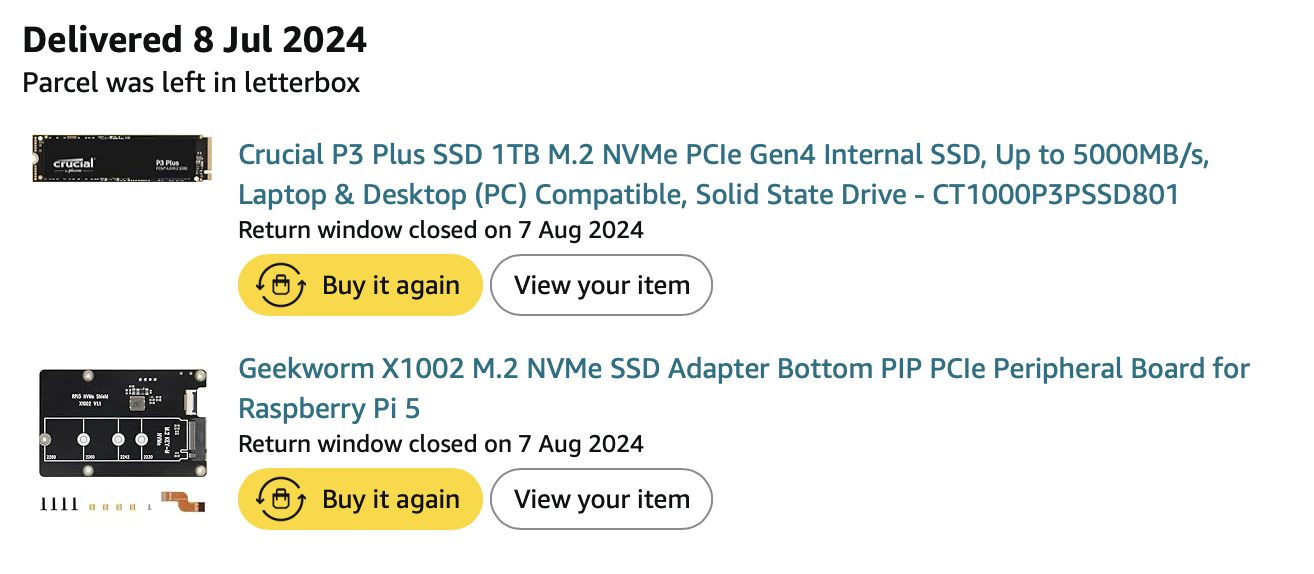
This is what I got for a Pi5 a couple of months ago. Slightly fiddly to set up the NVME base iirc, but has worked seamlessly since. I don't use a power supply, as I prefer to run kit like this through a network switch, so also have a PoE hat for it.

(I agree with @nophead - a Pi5 is wildly over the top for HA. It will run quite happily even on a Pi3/4. Still, #yolo.)