Time Discharge Issue

17 comments started 2024-10-02 last 2024-10-10
GivEnergy ProductsBattery
M
#1 Mondriver

Hi all

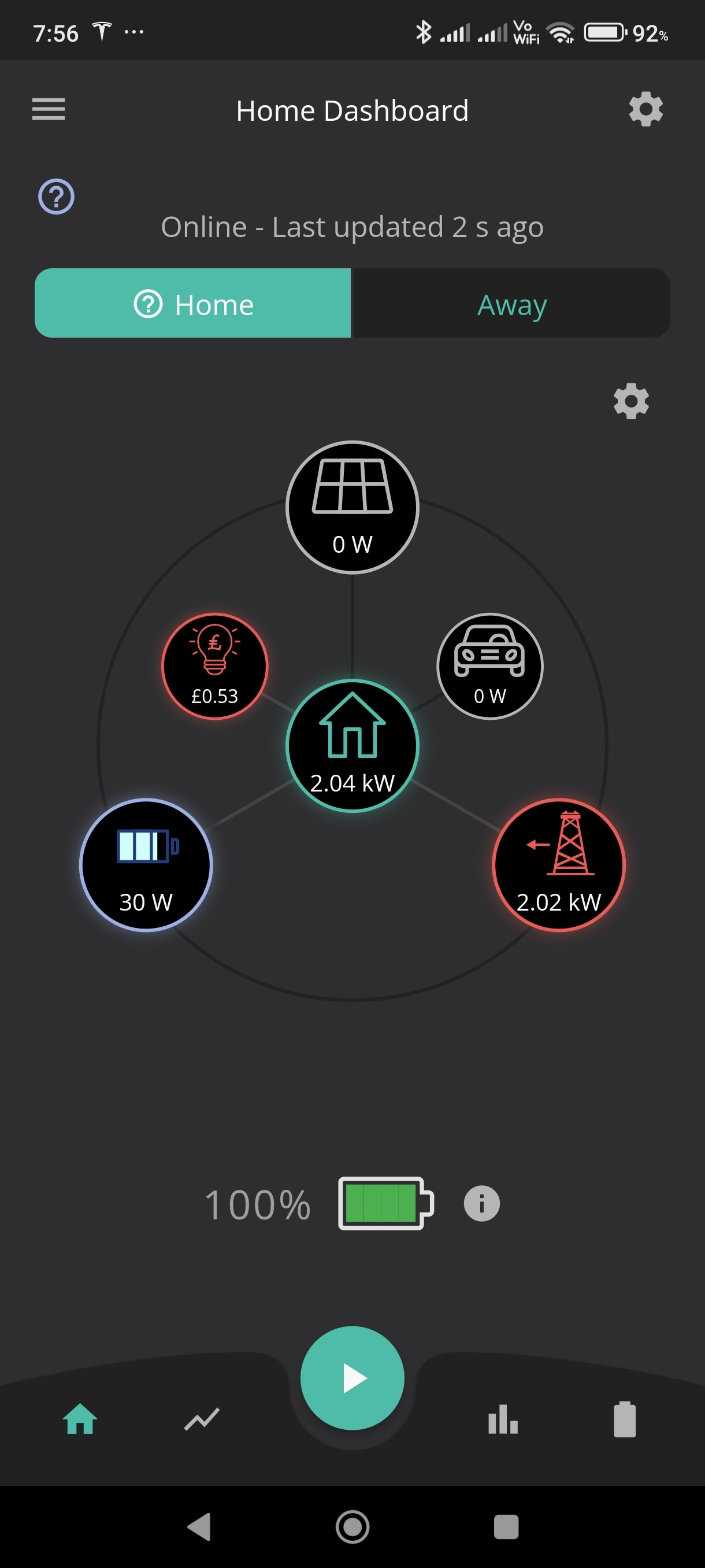
Sorry - but I must be doing something wrong. New to the app/system and can't seem to get this to work as intended.

I have ECO setting turned on. My timed charge seems to work fine.
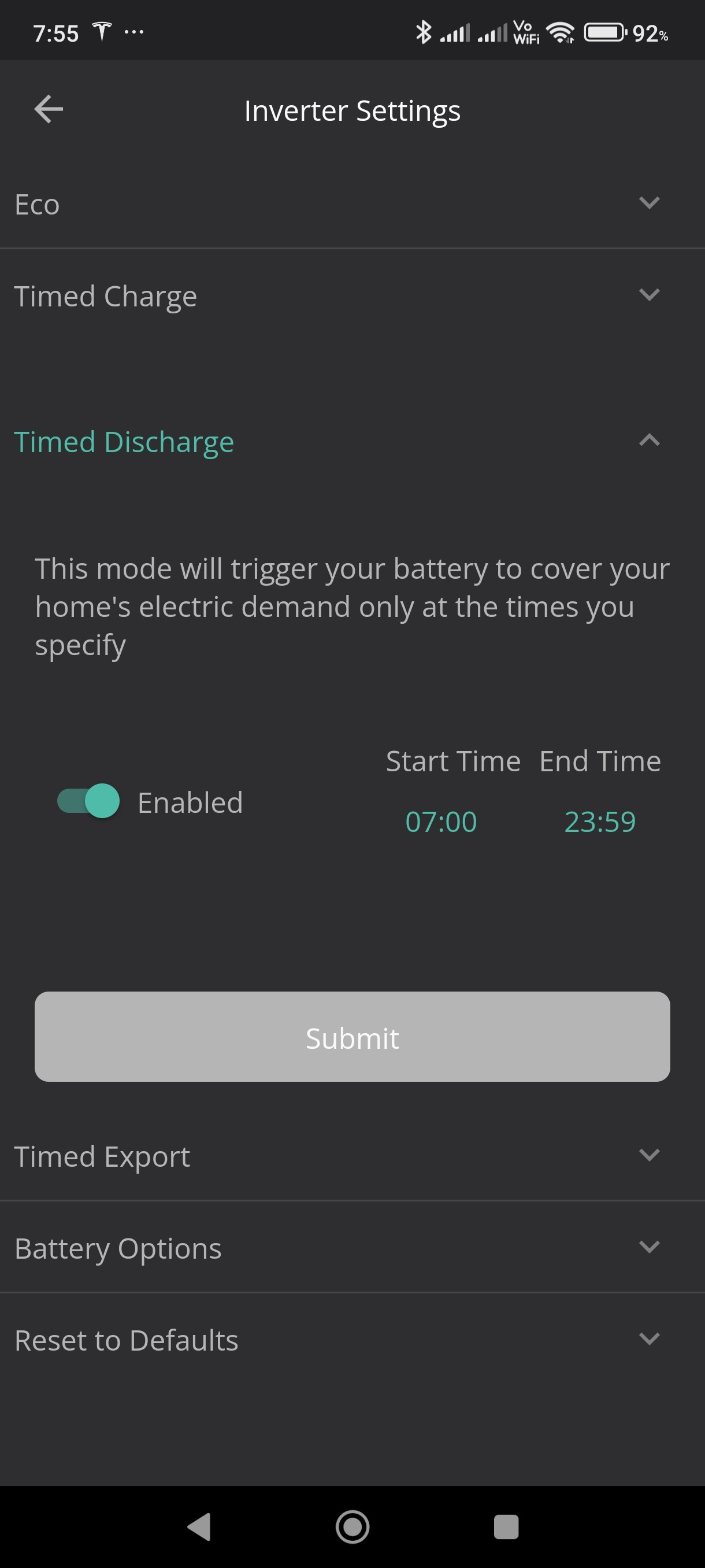
My timed discharge setting is this:

My battery doesn't want to start supplying the house past the time I've set.

I've checked the time in the remote control page and also my profile account setting as suggested on another thread (I had Amsterdam GMT+2) originally set for some reason, but it doesn't seem to have worked.

Any help gratefully received.

Many thanks

D
#2 DD

Mondriver Seems to me there are two possiblilies: the feature doesn't work for some reason (clash with some other setting ?) or the inverter has the wrong time.
To distinguish, I'd try changing your time window to see if it starts behaving. Eg have it start at 4am or 1am or something.

And does it discharge as expected if you turn off timed-discharge ?

It is harder than it ought to be to just ask the inverter what time it thinks it is. There are (different) free third-party apps available for android / iOS which can read its time.
Android: https://givenergymonitor.wixsite.com/tutorials
iOS (actually multiplatform): see https://community.givenergy.cloud/d/438-how-accurate-are-the-import-from-grid-metrics/16

Just out of interest... why do you want to use this feature? Is this an off-peak price? If you also charge the battery over this interval, that will automatically inhibit battery discharge.

M
#3 Mondriver

Thanks again DD for the help.

So - if I'm right, what you are saying is I could set the timed discharge period from say 2330-0530 and this would inhibit the battery being used until 0530. At that point, the battery would 'come on line' and supply the house as needed?

I think I'm getting there slowly...!

D
#4 DD

Mondriver No - the window you give it is the window during which you want to allow it to discharge. I was only suggesting playing with the numbers in an attempt to figure out what the time on the inverter might be. (Eg if at 9am it immediately enables discharge if you set the start of the window to 10am, but not 9am, that suggests the inverter is an hour slow.)

You could also do it by configuring a timed charge, and playing with the times to try to pin down what time the inverter is set to. (But much easier to simply ask it, using one of the third-party apps I suggested. As seen on other threads, even setting it from the portal is a little uncertain since it appears to take into account the time zone configured on the portal. So even after sending the request to set the time, best to actually be able to check.)

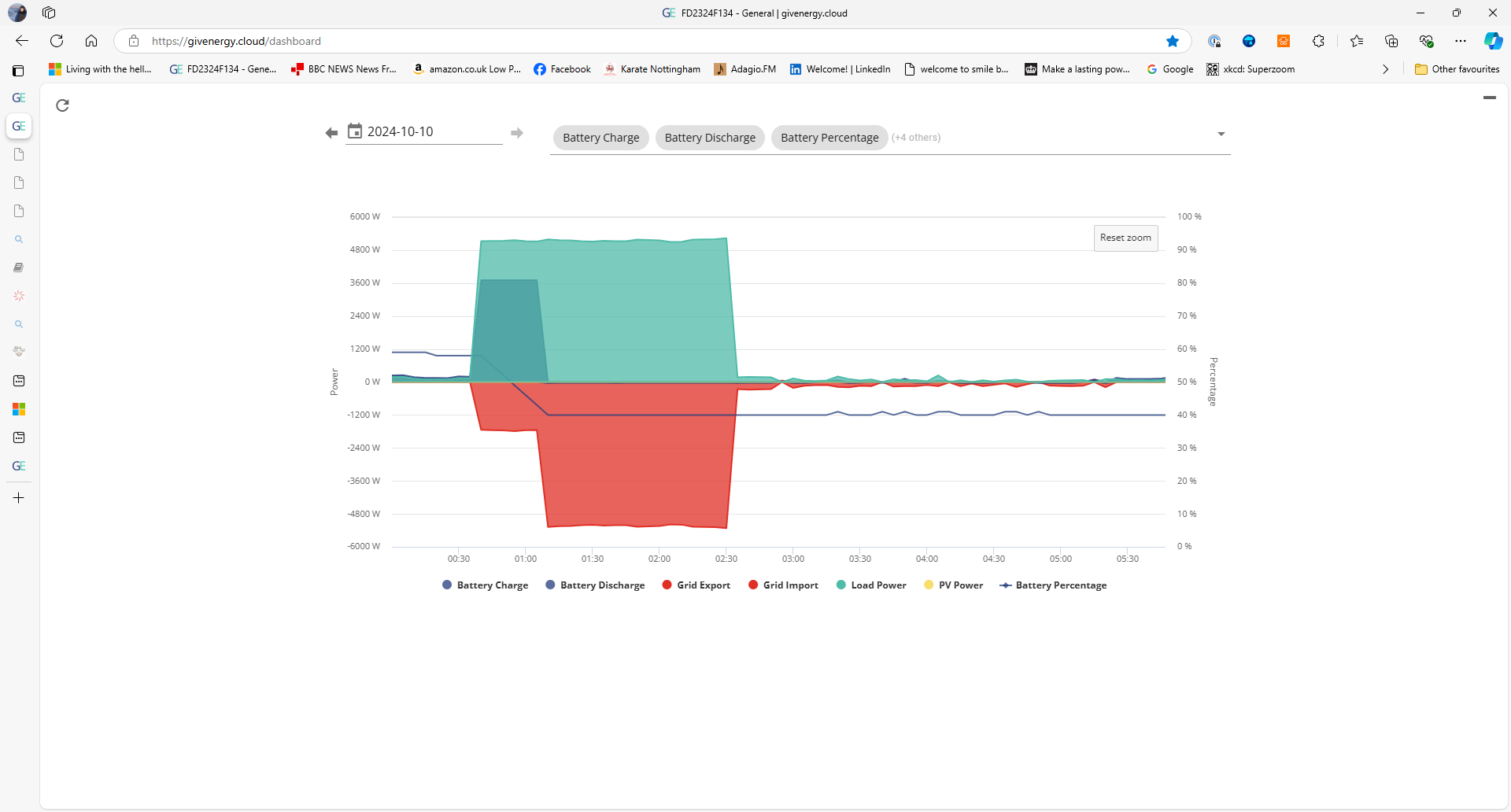
The way timed-discharge is implemented, it actually reverses the two times: if you set timed-discharge = 0530 to 2330 (so that discharge is allowed from 0530 until 2330), then what it actually does is configure a timed-pause from 2330 to 0530, so that discharge is paused from 2330 to 0530, and then permitted outside of that timed window, which achieves the desired timed-dischage behaviour. It is instructive to look in the activity log (at the bottom of the remote control page) on the portal to see what changes are actually sent to the inverter when you configure various features.

M
#5 Mondriver

DD sorry...I totally mis-type my reply to you....
I actually meant to say, set a timed charge (not discharge) between 2330 and 0530..!

Your explanation makes sense, but the logic to me is 100% in reverse!!

D
#6 DD

Mondriver Ah, okay, yes, a timed charge from 2330 to 0530 (Octopus Intelligent Go ?) would inhibit discharge during that period, whether you actually charge the battery, or set a low target SoC.

Note however that when I tried it myself a while back, it seemed to ignore a low SoC target and always charge to 20%. Possibly a firmware bug. [I was trying to get my battery to idle for an hour at low SoC, to allow cell balancing to take place.] A timed-export with a high limit SoC should have had the same effect, but a similar bug meant that it appeared to want to actively charge the battery up towards that minimum target SoC.

M
#7 Mondriver

Thanks for the help and info DD, I'll give that a go 😁👍

C
#8 CazT

Hi, I'm in my second week of my new system so still trying to get my head round everything. I'm on Octopus Go, so just got the cheap window from 00:30 to 5:30. I have a Gen 3 inverter 9.5kWh battert and GE car charger. I want to charge my car by about 10kWh overnight which I can do by setting a shortish charging period, but I don't want to take power from the house battery unless it's SoC is in excess of 40%. If the SoC has already fallen to less than 40% then I want to charge it back up to 40% before the end of the cheap period as this would cover our normal daily use, and allows for some top up with solar during the day.

So would this work?

  1. Set a timed discharge from 05:30 to 00:30 with a lower SoC limit of 4%.
  2. Set a second timed discharge from 00:30 to match the end time of any car charge settings with a SoC limit of 40% (this should mean that if the battery is >40% it will contribute to the car charge down to 40% and then stop discharging, but if its below 40% it won't discharge any power to the car?)
  3. Set a timed charge to 40% starting after the car charging window and ending at 05:30 (this would mean if the battery was <40% it would charge back up to 40%, but if already above then it would hold it's charge until the end of the charge period?)

So would this mean the battery doesn't dump out down to 4% while the car is charging, only to be refilled to 40% by the grid shortly afterwards?

Am I right in understanding that

  1. a battery will not supply to the house while set to charge from the grid
  2. a battery on a timed setting to discharge to the house will still charge from solar during the day?
D
#9 DD

CazT So would this work?

  1. shouldn't be necessary - that's the default behaviour anyway.
  2. can't have more than one timed discharge, but you probably mean timed-export ?

When I was last experimenting with timed-export, I found what seemed to be a bug - if you have a timed-export with min of 40%, and it starts below 40%, it actually started charging up to 40%. But this is possibly very firmware-specific (and I may just have imagined it).

One thing to be careful with is that the UI provides a discharge limit, but that's actually the global reserve. You need to use the remote-control section to be sure that you are setting the per-discharge slot. Similarly, there are two different config registers that set charging limit, and the UI may offer the wrong one.

C
#10 CazT

DD Through the remote control section I can see up to 10 timed discharge sessions that can be configured, so I am not talking about timed export. The charging seems to be working fine if the battery has dropped below 40%, it's just that currently the car sucks the power out down to 40% while there is nothing set up to prevent this.

D
#11 DD

CazT Through the remote control section I can see up to 10 timed discharge sessions that can be configured, so I am not talking about timed export.

Hmm... yes, you're right. But on the inverter settings page, there's timed-discharge and timed-export, and it's definitely the latter behaviour you want. (timed-export means remove energy from battery at fixed power ; timed-discharge means discharge only enough to meet demand and only during the time window.)

Note that you definitely don't want discharging-at-fixed-power behaviour for your item 1 in the first post. That will just empty the battery to the grid.

T
#12 TX200

Don't set a timed discharge. Just use eco mode and a timed charge that starts when off peak starts and ends when off peak ends.

Timed discharge complicates matters.

Only use that if you want to hold the battery until say 4pm for the evening peak. For those on tariffs where there's an off peak, normal rate AND a peak.

For most people eco + timed charge is the simple and easy way to do it.

C
#13 CazT

TX200 Thanks for this. So looking around other posts and at the data I now have from my own system I can see that if I set a timed charge to 40% but the battery SoC is >40% at the start of the charging period then it continues to discharge to meet demand until such time at the battery is at 40%. So last night I scheduled 10kWh to go to my car from 00:30 - 2:30 and a timed battery charge to 40% for the whole of the cheap rate period. My starting battery SoC was 58% and I can see it contributed 18% of it's charge to the home demand and then kept state at 40% for the rest of the charging period - perfect! It's all a matter of understanding exactly how each setting works in every scenario that might occur. It's still very early days for me - a lot to learn and digest but for now this looks good for my winter settings.

D
#14 DD

CazT if I set a timed charge to 40% but the battery SoC is >40% at the start of the charging period then it continues to discharge to meet demand until such time at the battery is at 40%.

That's interesting... I thought the usual behaviour was to hold charge, at whatever level, rather than discharging down to target. I'll try to remember to do a test after the sun has gone down.

What firmware is your inverter running?

C
#15 CazT

DD My inverter firmware is D0.309-A0.309

T
#16 TX200

Yes that's how I believe it works, it's a target percentage to reach by the end of the timed charge period. Either by charging up or discharging.

Once it has got to that percentage it continues to use the grid to power the house (as whilst the rate is cheap, there's no point emptying the battery).

D
#17 DD

DD I'll try to remember to do a test after the sun has gone down.

Just remembered in time before my timed-export started...

SoC is 35% @ 21:55. I set up charge slot 2 from 21:00 to 22:00. When I set the limit to 40%, it actively charged, as expected. When I changed the limit to 30%, the battery went idle, and consumption was covered from the grid, which was how I remembered it behaving. But I'm also on firmware 309, so that's very odd.

While I was at it, I tried the other experiment: timed export has just kicked in. If I temporarily set the discharge limit to 40, it starts charging the battery from the grid.

So it seems that if you set a discharge timer with a target of 30%, then if the SoC is above 30 it will discharge down to there then stop, and if the SoC is below 30 it will charge up to 30 and then stop. But charging timers are asymmetrical.