Octopus now installing enphase rather than givenergy ?

53 comments started 2024-11-01 last 2024-11-07
Forums/Meta
D
#1 DD

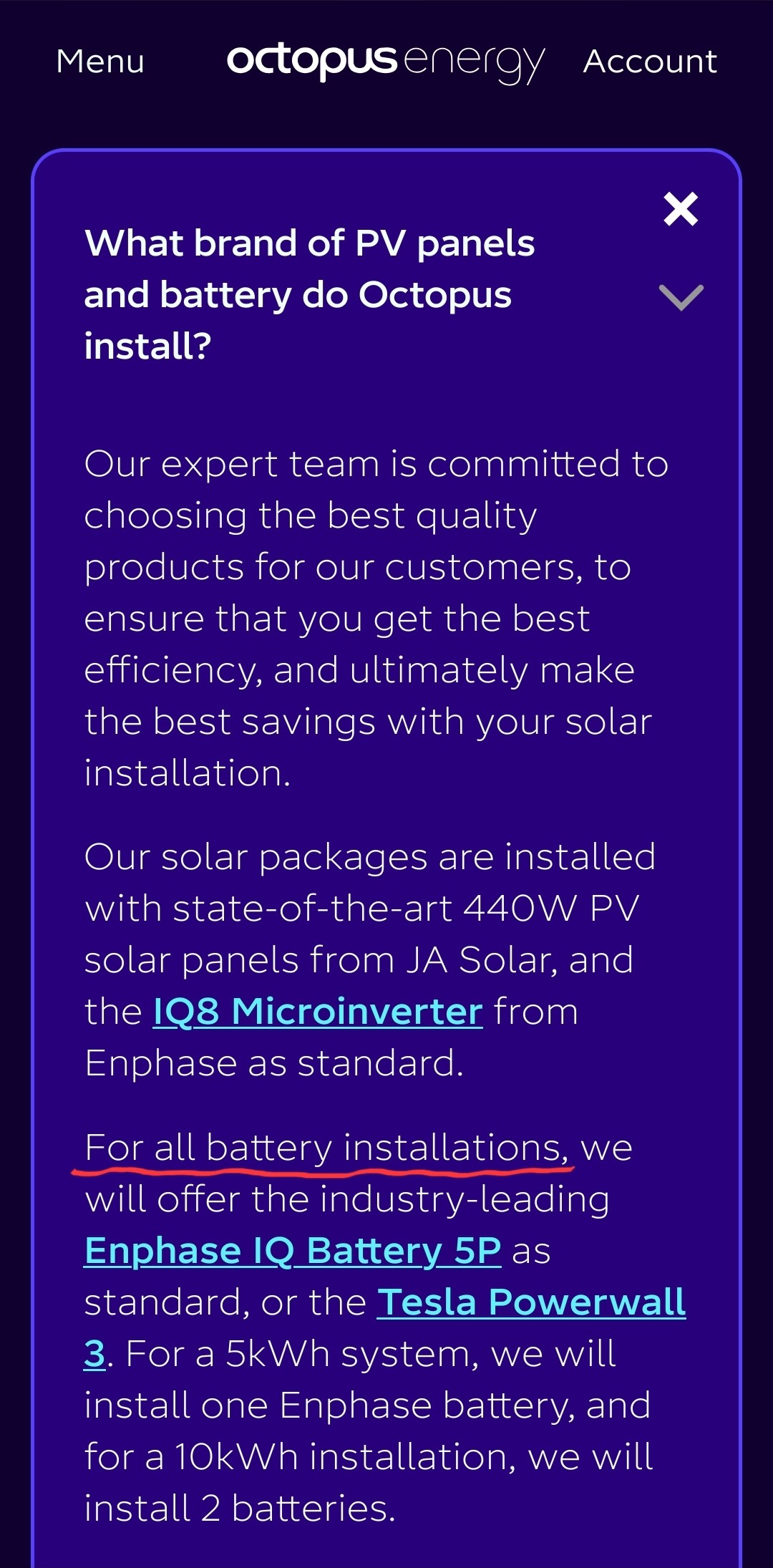
A friend has got a quote from Octopus for solar - it's for enphase microinverters plus battery. From https://ecoaffect.org/solar/solar-panels-octopus-tariffs/ :

"For most solar setups, Octopus now install Enphase IQ8 microinverters"

Which is interesting... That page also suggests it's not (yet ?) compatible with IOF.

#2 hoggy

It does indeed appear Givenergy has been ditched and its Enphase or Tesla. May or may not be related but I've noted a marked increase in Givenergy marketing push and offers lately (which atleast in my little brain would be the course of action had I lost a probably quite lucrative customer)

D
#3 DD

Hmm... wonder if that's bad news for those hoping GE EV charger will be integrated into IOG.

G
#4 geoffreycoan

DD Hmm... wonder if that's bad news for those hoping GE EV charger will be integrated into IOG.

It’ll be completely different departments within Octopus, those that do IOG and those that do solar and battery installs.

I don’t have an EV but TBH I don’t think I would elect for a GivEnergy EV charger if I did, the number of people on this forum reporting connectivity issues, ‘it doesn’t work in mode X’, modbus doesn’t work over wifi (or is it wired?). It all just says to me that it’s suffering from firmware issues like the inverters have done.

The news of Enphase is interesting. I’m not a great fan of micro inverters, stories of failure rates and the difficulty of replacing those inverters on the roof. Tesla powerwall 3, yes please!

V
#5 Vestas

Given the percentage of GE battery failures/issues (unacceptably high apparently) on systems Octopus have installed I'm not at all surprised.

There's a few people on here who've had serious problems with Octopus installs (faulty batteries) and these forums contain a vanishingly small percentage of GE users.

A friend of my daughter got a recent quote from Octopus and asked his mate who works on their PV/ESS/EVC team about this and got told "we don't use them anymore, batteries keep failing".

Apocryphal? Maybe but after the v3013 fiasco followed by the v3015 overvoltages, followed by GE hiding all the battery overvoltage warnings and now the app changes? I think I'd be inclined to think its true.

S
#6 SteveCook

All very worrying.
My inverter and battery are under GivEnergy guarantee/warranty, but that will only be "worth" anything if I ever have to claim, providing there is a company in existence to claim against

V
#7 Vestas

SteveCook The company behind GE is unlikely to go bust.

V
#9 Vestas

Thinking about it, there are also the new building regs coming, which would make installing anything other than an AIO difficult due to low temperatures.

I know the Powerwalls don't have that problem, no idea about Enphase.

C
#10 CW

TBH, had the powerwall 3 been available in the early part of this year when I installed solar, I would have gone for it over the GE AIO

Edit: multiple MPPT's, still AC coupled, multiple inverter power outputs, all-in-all it would be a much cleaner install (just the battery/inverter and gateway on the wall)

S
#12 SteveCook

Rubikcube
Thats what I was thinking. The parent company just float GivEnergy down the river

V
#13 Vestas

Rubikcube Indeed and if the UK was the only place selling these it'd be a higher probability that's what would happen. There's a fair few other countries they operate in plus of course their budget PolarESS range is sold in the UK.

None of that precludes them closing UK ops but it'd have knock on effects on Euro ops at the very least and obviously who's going to want to install PolarESS in the UK if GE void warranties?

There's obviously more than one factor in play with Octopus ditching GE.

S
#14 SteveCook

I was thinking of adding another 9.5 as I have been quite pleased with it and the Hy 5.0 (other than having to get HA and Predbat going to get the best out of them), but this just makes me think if I should go another route

V
#15 Vestas

SteveCook You've bought into the GE ecosystem now so you may as well just buy another 9.5 battery rather than potentially ripping out what you have now and starting again.

Ask yourself "what's the cheapest for the next 5 years?" after which time you'll probably want to review things anyway. Might not be any point in having a battery other than for storing excess PV generation.

Five years ago load-shifting using home batteries was niche stuff, fractions of a percent of tiny amounts of PV installs mainly running on old Economy 7 tariffs. Five years from now batteries (home/EV) might have levelled out grid load variations enough that its more or less flat rate all the time. Who knows?

G
#16 geoffreycoan

SteveCook I agree with Vestas comment, since you are already invested in GE equipment, it does what you want, there’s no reason to ditch it for something else. Adding a separate inverter and battery from A.N.Other company will only cause incompatibility issues, not least cross-charging.

But do the maths on whether adding a second battery makes economic sense or not. Prices of the batteries have fallen but you’re still looking at something like £4k for a 9.5 fitted. You’ve got to save £400 a year over a nominal 10 year warranty lifespan or roughly £1 a day to make it worthwhile. Of course there is more to life than money, but it is important.

#17 Judith

I worked out that with our ashp a 2nd 9.5kWh battery would only save£150-£200 per year so it was not worth it, plus needing another inverter (to have higher wattage out) and the ems. It just isn’t worth it. Good advice from Vestas to see what 5years brings

V
#18 Vestas

geoffreycoan Of course there is more to life than money, but it is important.

There is also the carbon cost of the battery to add to the "accounts". I have no idea what that is but given the 9.5kWh batteries get shipped half way round the world then that's not a good start to the calculation.

I think ultimately the hope of govt is that we all end up on EVs and enough of us use them for V2H to balance out the heatpumps 😉

I'm being mildly facetious there, just for the avoidance of doubt.

There is no plan 🙂

#19 hoggy

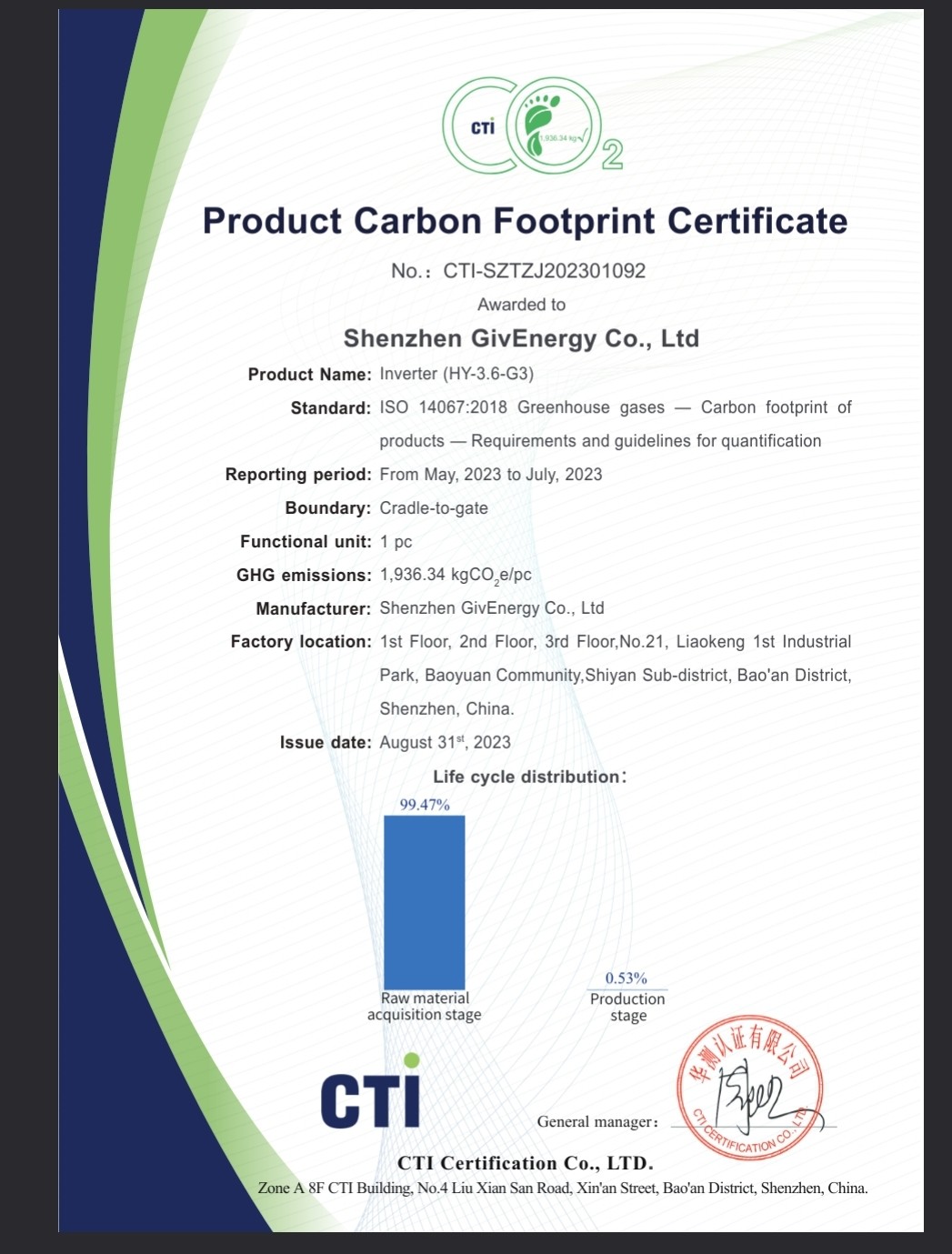
Over on the Chinese site they do have some carbon accounting. The battery one just 404's but the inverter one atleast plays ball:

R
#20 Rbor

Vestas I got solar panels 2 years ago with one GE 8.2 kWh battery with an AC3.0 inverter. Last April, I got a 2nd 8.2. kWh battery.

In this time, a lot has changed: export rates have increased and the plan of 'use as much solar generation you can' has changed to 'export what you can'. A lot will likely happen over the next 5 years. Currently, we seem to be moving towards the IOF and IOG type models, offloading charging and discharging decisions as in IOF and IOG and using a battery as a buffer.

I have wondered over the last year whether I was correct to get a 2nd battery. I did so as I was getting a heat pump. I have also discovered that when rates are as of now, there is little difference between using the grid directly and using the battery, especially when losses are taken into account. But I have the 2 batteries so I my choice has been made. Predbat looks after things for me and has decided to use the grid overnight instead of my batteries which are down to 4%. Not been helped by solar generation of 3 kWh today and my heat pump.

So let's see what happens in the coming years.

Rob

V
#21 Vestas

hoggy 2 tonnes of CO2. More than I expected and suggests that heatpumps are probably well above the 1500kg of CO2 which a study claimed a few years back.

I suspect the battery is going to be well above that figure given how lithium is mined. Rough estimate for the 9.5kWh battery would be in excess of 2000kg of CO2 just for the lithium component of the cells - depending on where the lithium is coming from, if its spodumene then its around 37 tonnes of CO2 per tonne of lithium obtained, brine extraction is lower at about 17 tonnes of CO2 per tonne but pretty much devastates the local environment for decades to come.

Nobody is saving the planet by installing PV/ESS on domestic properties then. It'll take me over 3 years just to "pay back" the carbon cost of the inverter, never mind the battery or PV panels.

D
#22 Daveb01

As the new GE AIO-2 is coming out next year and is nearly same as the PW3, my prediction would be:

GE will be promoting AIO-2 (especially with the new inverter with 6 MPPT’s)
GE will only support AIO-1 and stop selling it.
GE may stop selling 5 & 9 kWh batteries in the future.
GE may stop selling old inverters and go with the new one as it can be set up to export 3.6, 5, 6, 11 kWh etc.
GE may bring out a new EVC so it complies with the industry standards that Octopus have now adopted.

All speculation of course, so let’s see (sorry no beers rewarded if I am wrong)

https://youtu.be/cKc0l08frIc?si=gAJORfrhcjHnOJ9M

C
#23 CW

Daveb01 GE may bring out a new EVC so it complies with the industry standards that Octopus have now adopted.

I've in the proceds of purchasing the GE EV charger - what standards does the current charger not meet? Is this something my installer could resolve by adding something else at installation time?

G
#24 geoffreycoan

CW I've in the proceds of purchasing the GE EV charger

Have a look at other posts on this forum before buying a GE EV charger. I get the impression that they are still suffering from ‘teething troubles’ - wifi connectivity, not charging off excess solar, etc. Plus they are not (yet) accepted for use with Intelligent Octopus Go. Other than the GE ecosystem and you can see the GE EV charger in the GE Daveb01 app, I don’t see a killer reason to buy the GE EV charger.
(No personal experience of the GE EV charger, just what I read).

Agree with Daveb01 I suspect the older inverters will get killed off. The AC coupled inverter is effectively replaced by the AIO, with MPPT’s in a new AIO that does the same for the hybrid inverters.

Maybe 🤞we’ll see a sale on 9.5 kWh batteries as a result

V
#25 Vestas

geoffreycoan Maybe 🤞we’ll see a sale on 9.5 kWh batteries as a result

Check the serial number on them (if possible) would be my advice. There's quite a lot of them at one local wholesaler which haven't moved in months and have mid-23 datecodes, hence the batteries are probably so flat damage may have occurred to cells.

S
#26 SteveCook

Vestas
Is this a genuine issue?
How would I ever make sure I got a "good" battery if I buy one via my installer so he/she can correctly install and commission. Will he/she have to check all 9.5 build dates before placing order?

V
#27 Vestas

SteveCook Yes it is.

https://kb.givenergy.cloud/article.php?id=77&oid=1 details how to recover a battery so it can be charged but IMHO its likely cell damage will have occurred by then.

Theres various regs about how you can ship lithium-ion batteries and in the UK they have to be transported with a charge level not exceeding 30% of the maximum capacity, so that's how they're shipped from China.

All batteries self-discharge and even if the BMS is disconnected (no idea if it is) the cells in the 9.5kWh battery will gradually lose charge. How rapidly they lose charge will be a function of the ambient temperature, the warmer it is in the storage area then the faster they will self-discharge.

There's unlikely to be much of that 30% charge left a year and a bit after the manufacturing date in the case I mentioned above.

S
#29 SteveCook

Vestas
Thanks.
So I presume if one was bought and installed and then started to fail it would be a straight warranty claim?
Seems crazy that GivEnergy dont track them to make sure they dont end up in this crazy position

V
#30 Vestas

SteveCook Seems crazy that GivEnergy dont track them to make sure they dont end up in this crazy position

I'm sure GE have records of what s/n went to which wholesaler but from that point onwards its the wholesaler who needs to manage their stock properly. GE aren't going to call them up and say "we haven't seen battery s/n xyz being commissioned yet, have you sold it or not?" 🙂

Edit - in the instance I mentioned before there was a pallet of them that hadn't moved in 6 months, for whatever reason. I'm rarely there but I went to get a flashing kit two weeks ago for our PV panels as our installers are useless tossers & it was still in the same spot as it was in March.

W
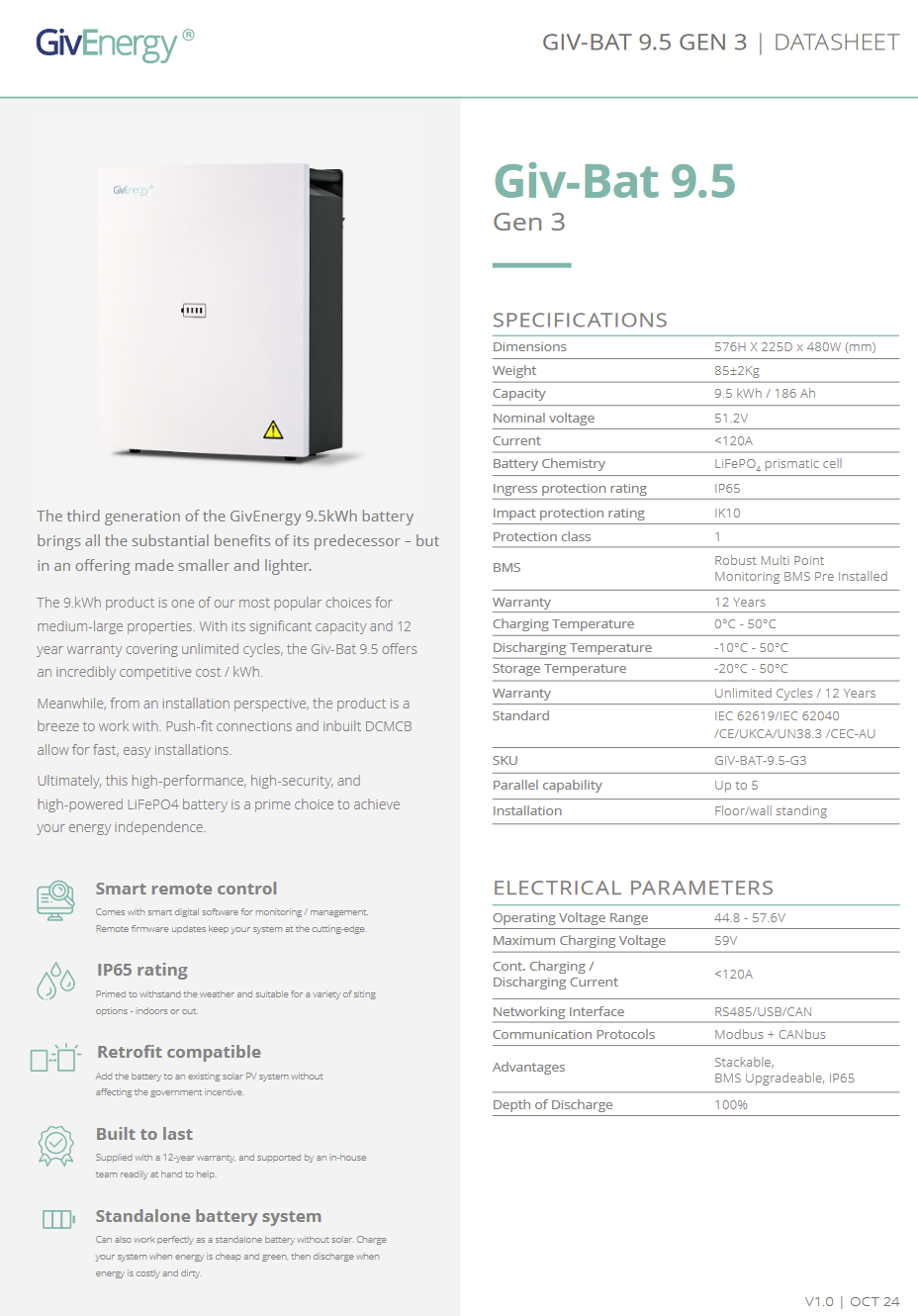
#31 wrighar

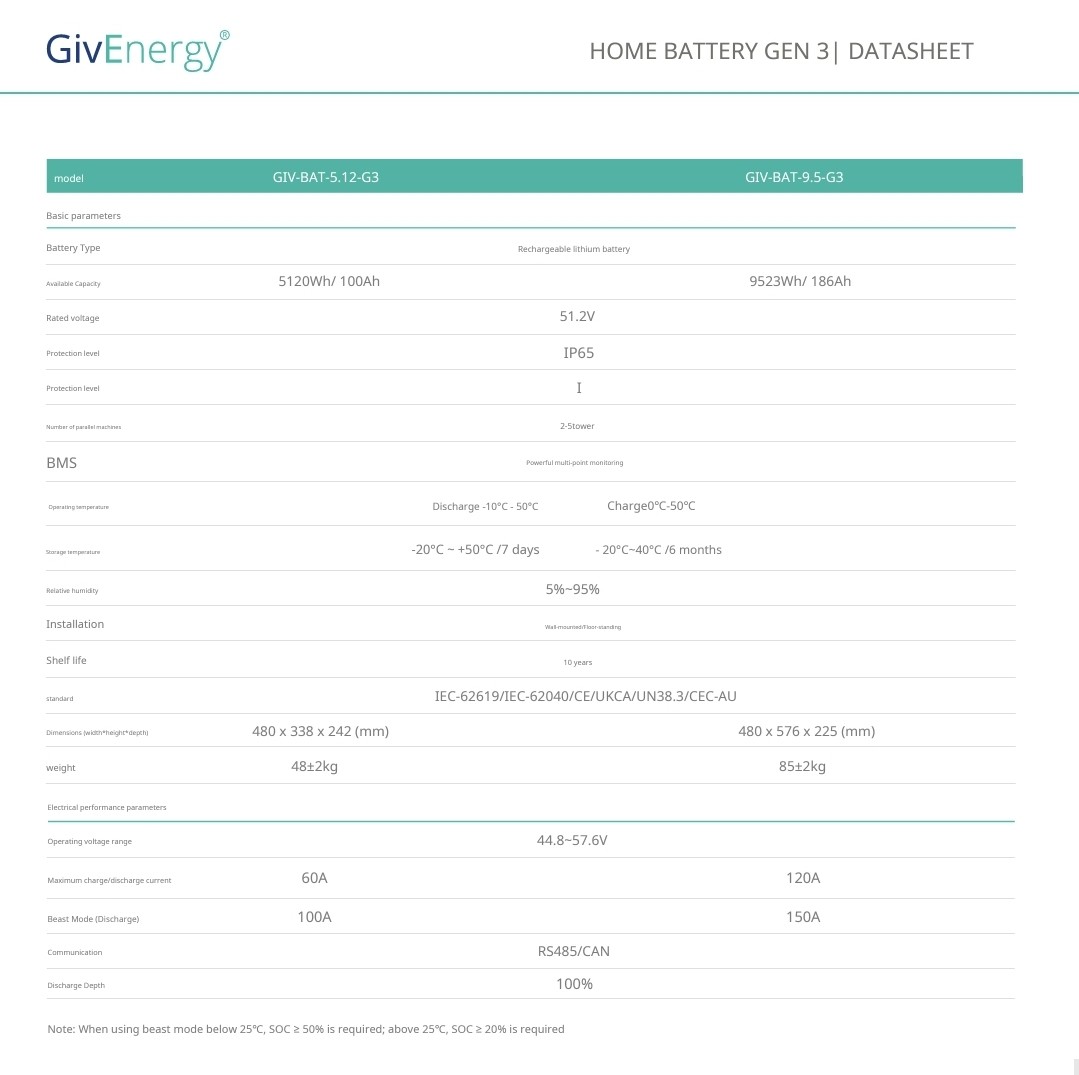
geoffreycoan They are just launching a new Gen 3 9.5kWh battery. spec PDF's are on the website.

V
#32 Vestas

wrighar Hopefully it has a BMS which tracks SoC somewhat better.

Edit - also "Remote firmware upgrades keep your system at the cutting edge"...had quite enough of that over the last year thanks 😃

#33 hoggy

They have a seperate Firmware section for those newer batteries so I'm guessing it's somewhat different BMS (probably more aligned with the HV stuff I guess)
I'm yet to see an inverter that supports the upwards of 5kW "Beast Mode" or Canbus (again rummaging around China datasheets)

V
#34 Vestas

hoggy 100% to 20% in under an hour for "beast mode".

EV charging? Why else would you want to output 7.5kW but it'd have to be to the EVC and not the inverter.

Hmm, that'd be quite attractive to suppliers where they take control of the battery for EV charging.

D
#35 Daveb01

CW

The GivEnergy EV charger currently lacks compliance with the Octopus Intelligent Go tariff primarily because it doesn’t integrate with Octopus’s software system for intelligent load management. Octopus Intelligent Go requires chargers to be able to “communicate” with the tariff’s system to schedule charging during off-peak, low-cost periods automatically, and to adapt based on grid demand.

Some smart chargers (like those from Wallbox or Myenergi) already have this integration, allowing Octopus to control the timing of EV charging to align with off-peak periods and green energy availability. GivEnergy may need software updates or a compatibility upgrade to make it work with Octopus Intelligent Go in the future.

If you have a GivEnergy system, you could manually set up charging based on Octopus’s low-rate windows, but it won’t have the same automated convenience or grid-adaptive features.

#36 hoggy

Vestas I have no idea what the intention is with all that. Its not even mentioned on the UK ones so who knows. As ever, there's lots of ifs and buts involved (battery has to be a certain temp, has to be a certain SOC....moon has to be full, owner has to be stood on 1 leg...)

G
#37 geoffreycoan

wrighar Interesting, thanks. ITS technologies selling the Gen 2 9.5 battery for just over £3k inc VAT so they must be shifting the last of the old Gen 2 stock.

The Gen 3 looks to be physically smaller than the Gen 2, otherwise same spec except a brand new BMS to debug

V
#38 Vestas

geoffreycoan except a brand new BMS to debug

I don't think I'd want to be the first to mix'n'match G2 BMS with G3 BMS on the same inverter. I can see that going hideously wrong.

W
#39 wrighar

Vestas I think you need at lease 3017 BMS before a G2 (or G1) will talk to a G3 battery

V
#40 Vestas

wrighar I was referring more in terms of managing two batteries at the same SoC, one with the old BMS which doesn't track SoC adequately and one with the "new" BMS which presumably is somewhat better at it.

Going to be a brave (or ignorant) person who tries that first 😃

S
#41 SteveCook

This is really putting me off buying another 9.5 battery.
Dead cells?
BMS that wont work?
All seems too hit and miss, especially when going via an installer who will just want to purchase the battery do the install/commission

V
#42 Vestas

SteveCook Look its exactly the same risk you took buying the first one 🙂

If you buy the same battery model you have now, make sure your existing battery is flat (4% cutoff) and the new one is the same then run a calibration on both when installed and you should be fine.

Whether it makes financial sense for you to do so is another matter.

S
#43 SteveCook

Vestas
Agreed, but then I was not aware of all these things. Now I am, I am not sure I want to go through with the possible grief.
Or should have to?

V
#44 Vestas

SteveCook Its just like anything else in life mate, the more you know the more you have to worry about 🙂

V
#45 Vestas

hoggy The temperature and SoC stuff match up with the testing/validation stuff on the cell datasheets I've seen so that's fairly standard. Its the sweet spot for lithium transfer in the battery and supposedly upping the discharge current doesn't have as bad an effect as was once thought. Or not. Pick your study really.

7.5kWh "beast mode" just sounds like a boost mode for an EV when you don't want to/can't use the grid.

T
#46 TX200

Vestas I thought it was best to have the old one at 20% as the new one is likely to be around that value too, so the calibration discharges and charges nicely.

V
#47 Vestas

TX200 One way or another they have to be roughly the same SoC. With the existing battery the best way of making sure the SoC is accurate is to let it effectively go flat and leave it for a few hours - eg overnight before new battery install.

Were it me I'd want the new battery as primary and its easy enough to discharge that to cutoff before kicking off a calibration of both.

Reasoning is that the GE batteries are chained so assuming your existing battery has been good then you want the unknown (new) battery as primary, that way if its got dodgy cells then its unlikely to cause problems with your existing battery as that won't be the fault current path.

Also the "new" battery will be a bit over the design capacity, whereas the old one won't. Think of it as a one-off version of swapping front/rear tyres each service.

T
#48 TX200

Vestas I think new battery first is the recommendation anyway (unless I'm confusing that with bigger battery first).

I suppose you could connect only the new battery, discharge that to the same percentage and then connect the old battery and then calibrate them. But I may be overthinking that. I'm good at overthinking. 🤣

V
#49 Vestas

TX200 I suspect the "new battery first" doesn't happen in most cases - far easier to plug into existing neat setup than take that apart etc.

#50 26Left

Vestas

Has anyone done any due diligence on the GE company structure and who actually owns what, especially as they continue to expand globally?

The idea of a roll-up / shut down of subsidiaries to eliminate long-dated liabilities (eg warranties) is always a risk, but I don’t have a complete understanding of the GE corporate structure, different brands and countries of operation.

What I’ve learned so far:

Jason Osler founded JMHing Power Ltd - this is in some of the original inverter compatibility statements. At some points assets are sold transferred into GivEnergy Ltd.

UK entities with Osler as an officer include

  • 1001010101 LTD
  • Energy Storage Consultants Ltd
  • GivEnergy Property Ltd
  • GivEnergy Commercial Ltd
  • GivEnergy Software Ltd
  • GivEducation Ltd
  • JMHing Power Ltd
  • JMHing Power No2 Ltd (being dissolved)
  • Orange Power Ltd
  • Osler Holding Ltd (previously GivEnergy Support Team Ltd)
  • Satori Education Ltd

Jason Howlett becomes global CEO in June 2024, previously group CEO (joined GivEnergy from Segen in Oct 2022).

1) GivEnergy Ltd (UK) shareholders transferred equity in May 2023 to become shareholders in…
2) GivEnergy Group Ltd (UK), who then transferred their equity in Aug 2023 into…
3) GivEnergy Pte. Ltd (Singapore), which is owned outright by…
4) ZHUHAI HENGQIN GIVENERGY INVESTMENT CO., LTD.

GivEnergy Australia Pty Ltd appears to be the entity that operates the Australian business. There’s also another registered entity with GivEnergy in the name: GivEnergy UK (Aust) Pty Ltd.

GivEnergy Europe BV is based in the Netherlands (.de and .nl domains).

GivEnergy SouthAfrica (.za domain) is based in Johannesburg - announced as a 50:50 JV with Invicta Holdings.

I’ve found references to Shenzhen GivEnergy Technology Co., Ltd - which I believe is the manufacturing arm.

So it looks like it all rolls up into the Chinese investment company. So perhaps no longer UK owned?

Addresses:

SG : 9 RAFFLES PLACE, #20-05, REPUBLIC PLAZA, SINGAPORE (048619)
CN (invest co): 2314, B, 23/F, 108, HUITONG THIRD ROAD, HENGQIN, ZHUHAI, CHINA
AU : Level 1, 1 Queens Road, Melbourne 3004
Victoria, AUSTRALIA
NL : Pelmolenlaan 16 – 18, 3447 GW Woerden, Nederland
ZA : 3 Droste Cres, Droste Park, Johannesburg, South Africa 2001

V
#51 Vestas

26Left I was under the impression the company was always effectively funded and controlled from China.

D
#53 Daveb01

Hook

Oh no does that mean when I go to Scotland and order fish and chips I will not get chips any more?

Sorry for the pun 😛