Maximum Mains Input Limit to Prevent Overloading a 100A Supply

25 comments started 2024-11-10 last 2024-12-30
GivEnergy ProductsAC CoupledBattery
M
#1 MikeMessy

Hello, I’m looking to limit the mains input drawn by my GivEnergy system to ensure it doesn’t accidentally exceed the 100-amp fuse capacity of my mains supply. With car chargers, GS heat pumps, inverters (2x GIVAC3.0, with 32KwH of batteries) and a couple of other appliances running at full pelt this is possible and I have had two instances of the 100 amp fuse melting in it's box recently (not blowing, melting!). I've had a quote of £60K from the DNO for 3-phase supply, so that isn't happening...

Is there an option within the GivEnergy system to set a maximum mains input limit, to modulate the battery import current when nearing the 100 amp fuse limit? I am putting in an independent 100amp trip fuse and surge protection immediately after the meter, but I'd like to prevent that from tripping too. Any guidance or recommended configurations to manage this would be greatly appreciated.

Thank you!

T
#2 thevilla

Which EV chargers do you use? I know the Zappi can throttle EV charge rate to respond to total grid import current. You can also reduce the AIO charge rate but I don't think that's possible dynamically in response to grid demand. Probably possible with Home Assistant.

V
#3 Vestas

MikeMessy s there an option within the GivEnergy system to set a maximum mains input limit

No.

#4 hoggy

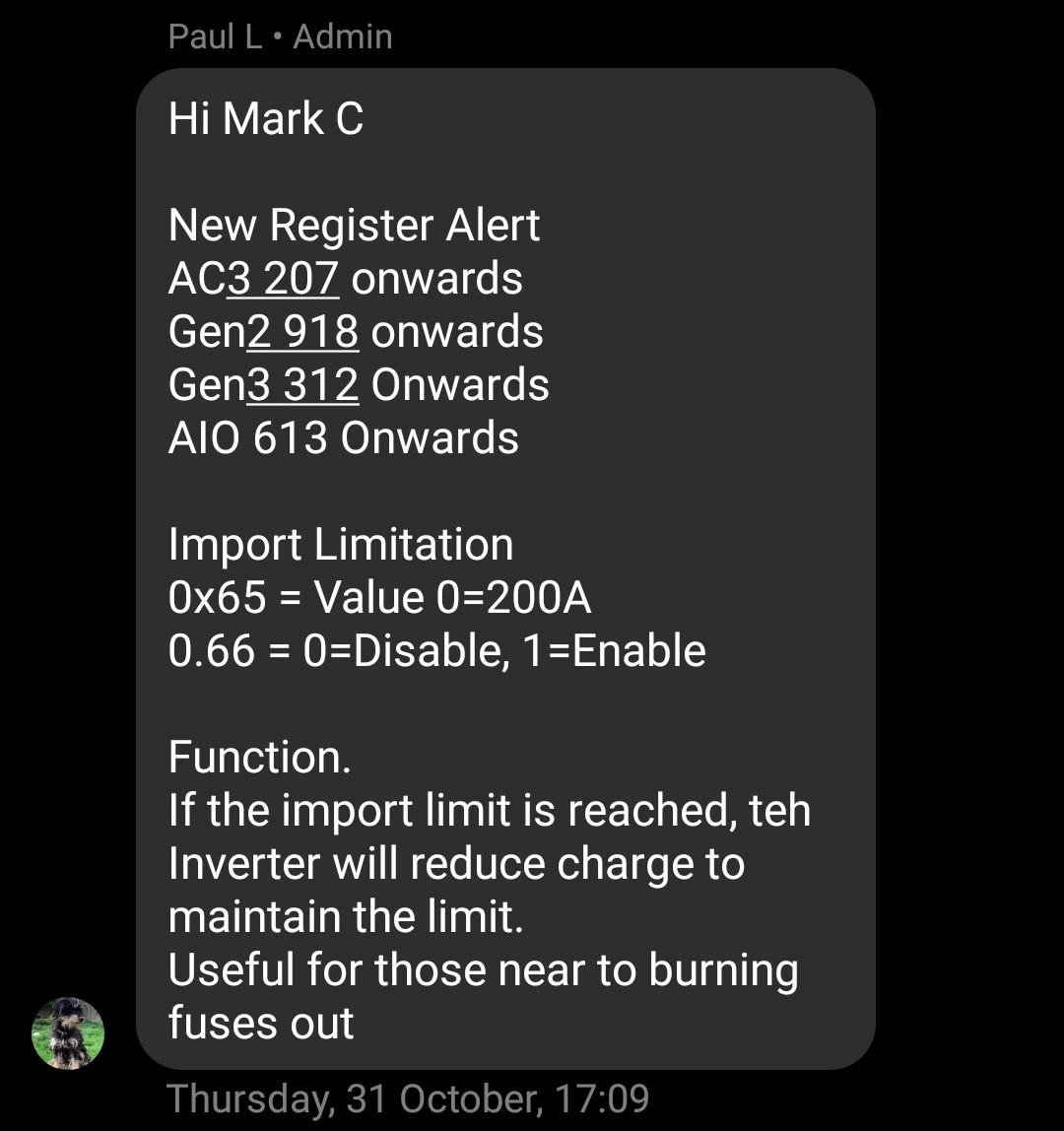
Next FW there will be

Gen 1 will need to be careful with this as that is the first time a register has been repurposed across FW (as opposed to just adding new ones out of bounds)
How GivTCP (if its even worth bothering with seeing as you shouldn't need to move it around) will deal with that is yet to be seen.

G
#5 geoffreycoan

MikeMessy Yes you’ve got a lot running but I’d suggest you focus on the car chargers first as they can draw a lot more current than your two GIV AC3.0’s. The battery capacity is immaterial, the inverters are limited to 3.6kW charge and discharge rate each.

Impressive that you have managed to melt the fuse. The most I’ve seen importing on mine is 12kW (roughly 48A), with 2x 9kW ASHP’s, 2x Gen 1 hybrid inverters (2.6kW each), tumble dryer, dishwasher, etc, and that’s usually only on a free electricity event when I’m hammering it

V
#6 Vestas

hoggy I'm not going near any new firmware for the G1 inverter at this stage in its life cycle. Edit - or any newer version of GivTCP/HAOS.

K
#7 kram

I’d expect a gateway to provide this functionality, but…

7kW car charger = 32A
3kW = 16A (well 14.5, but a touch of slack is good)

7+3+3 is under 14kW or 64A

100A at 207V is approximately 21kW and we limit our system (not GE) to approximately 19kW or about 90A.

If you were to run your loads and 2 appliances at 10A each your still at 84A. Add 5 for the rest of the house and it’s still under 90A.

As others have suggested, if it were my system I’d just set the zappi with a grid limit and grid CT so it can throttle if required.

#8 Windy Miller

MikeMessy I've been told by a DNO engineer that this is the way their fuses work. Unlike breakers which are quickly trying to limit the current in a fault condition the DNO fuse is trying to protect their cable from melting so their fuse is designed to melt first. At the 100A limit it may never blow and you need quite a lot above that to cause it to melt. The engineer suggested feeling the body of the fuse to understand how close to melting it is (watch your fingers if it's hot).

(We had twice blown their fuse at the local Church with 2 heat pumps and some fan heaters running along with some water heating. Our answer was to re-balance the loads across the phases which was possible with a 3 phase supply).

D
#9 DD

MikeMessy what I've heard is that the fuse is there to protect the cable, not to set the limit on the power you can draw. I think you're only really entitled to draw something like 16kW (60A) on domestic supply.
But I can't immediately find anything to back that up.

G
#10 geoffreycoan

DD I think you're only really entitled to draw something like 16kW (60A) on domestic supply.

I don’t think that’s right. As part of my getting an export MPAN I had to prove that my main fuse had been upgraded to 100A and that I had 25mm cables from the meter into the house. I think my default houses have a 60A or 80A supply fuse. Obviously the feed cable to the house has to be sufficient, can’t just swap the fuse and hope all will be well.

e.g. 80A fuse = 18kW https://goodwinelectrical.com/electricity-power-in-my-home/#:~:text=The%20majority%20of%20homes%20in,18%2C400%20VA)%20or%2018.4%20kVA.

T
#11 T-M

geoffreycoan 80A is the new black!
https://www.nationalgrid.co.uk/downloads-view-reciteme/633928
An 80A cutout fuse is now the standard and will happily run at 100A for nearly 4 hours. The bigger problem is whether anything else (cables, consumer unit etc) will cope with this without overheating. In my opinion, anyone considering running at such power levels for extended periods really needs to get/borrow a thermal camera and check for hot spots, or get an electrician to do the same. You may recognise the name of the Policy Engineer.

D
#12 DD

T-M And from that document:

The Distribution Network Operator fuse should not
be used by the customer as the primary method of
limiting the demand within an installation. The
primary function of the fuse is to disconnect the
premises in the event of a fault occurring between
the DNO and customers apparatus.

I think the point of requiring persmission from the DNO before installing kit like EVSE or Heat Pump is that it gives them the opportunity to check your local vicinity and that they're happy with increasing your supply. I assume persmission is not guaranteed.

So since OP must have had permission to install all that kit, the DNO must be happy(ish) to supply how ever much the diversification calculation came up with.

P
#13 Pete UK

MikeMessy

Are you charging two cars at the same time then?
Both on 7.4kW chargers? - I assume so.

I guess if that’s the case then you could perhaps look to reduce each cars charging rate by 50% or 25% (for example) and extend the charging time or charge them one after the other using the car/ chargers schedules so they aren’t actually charging at the same time but would both be ready when needed, or charge one at a really slow rate, although I assume you’re probably on Intelligent Octopus Go or similar, so that might not work too well with the on/ off intelligent charging slots !

Or charge one car one day and one the next? Although that likely isn’t an option for you(?), as I assume the reason you’ve got two car chargers is because you need to charge them both regularly at the same time. Or at least have them both charged and ready in the morning. And you want to do it at the cheap time whilst also refilling your home batteries to 100%.

Maybe EON NEXT Drive tariff might help a bit (7 hours off peak) at a reduced car charging rate on both cars and also might allow home battery charging at a bit of a reduced rate also to help out.

It’s a bit of a nightmare with high power things ticking on and off isn’t it? (Heatpump, cars, electric floors, ovens). Very hard to manage the max load. But as suggested above try to manage the big power draw items (the cars at 14kW+ as this would probably be the easiest to do). Not sure how smart a charger you have but usually most cars you can dial the charging rate down in the car.

Interesting about the 80 Amp fuse article. Glad I got my 100A fuse fitted already. I must have just got in before they decided to change their standards.

For me I’ve seen 19kW going into the house during the recent 1 hour free power event. Had the car charging at 7kW, had the batteries charging at 7kW, turned all the electric floors on etc but also I had 2kW of solar helping (not helping 😂) to reduce grid import. The other night it peaked at 19kW. But it’s usually 15-17kW at its max, when the car is charging in a IOG slot, home batteries charging at 7kW continuously for 6 hours and the electric floor kicks in.

I assume(d) 24kW sustained would be the max for a 100A house fuse (240v x 100A = 24,000w). I mean, not probably sustained for 6 hours but that wouldn’t be too much of a big deal if it was. Am I wrong here? I may be. Don’t know to be honest.
Probably their cable to the house is rated much higher (perhaps 120A+ and the 100A fuse will melt in time to protect the cable? - But that’s just a guess at what it’s actually rated at).

Do you have any scope to modify you dual car charging as suggested above ?

K
#14 kram

Pete UK

Don’t forget UK mains voltage can drop as low 216V and still be in spec. I seem to remember as 207V being mention somewhere too. 21.6kW is still plenty.

If the two chargers are zappi they can share the grid limit. For example both charge at 3.6kW and if one car finished the other could ramp up to the full 7kW.

P
#15 Pete UK

kram

Perhaps. But probably a very rare occurrence dropping to 207v.

OP doesn’t say what make of charger(s) they have. I think Tesla wall connector(s) can do that sharing thing as well, either of which would no doubt help the OP. Although they still might have problems filling both cars in a 6 hour window. Who knows? OP needs to come back with a few more details.

B
#16 bRhFDKtjRMK9

kram If the two chargers are zappi they can share the grid limit. For example both charge at 3.6kW and if one car finished the other could ramp up to the full 7kW.

I am on 60A fuse and I can confirm this. Zappi charger has an internal setting which has been set by my installer to 60A. Charger knows what is the load on the fuse, and I presume it will automatically restrict the charge when getting closer to the limit.
There may be a similar setting inside the AIO, can't quite remember, but installer has set everything so it should not trip.
Installer contacted local DNO to get my fuse upgraded to 100A, but so far they made no effort or contact to schedule this. I don't need 100A, so no rush.

M
#17 MikeMessy

thevilla I think I need to look into this. I have an old Relec wallpod, so no smart functionality…

M
#18 MikeMessy

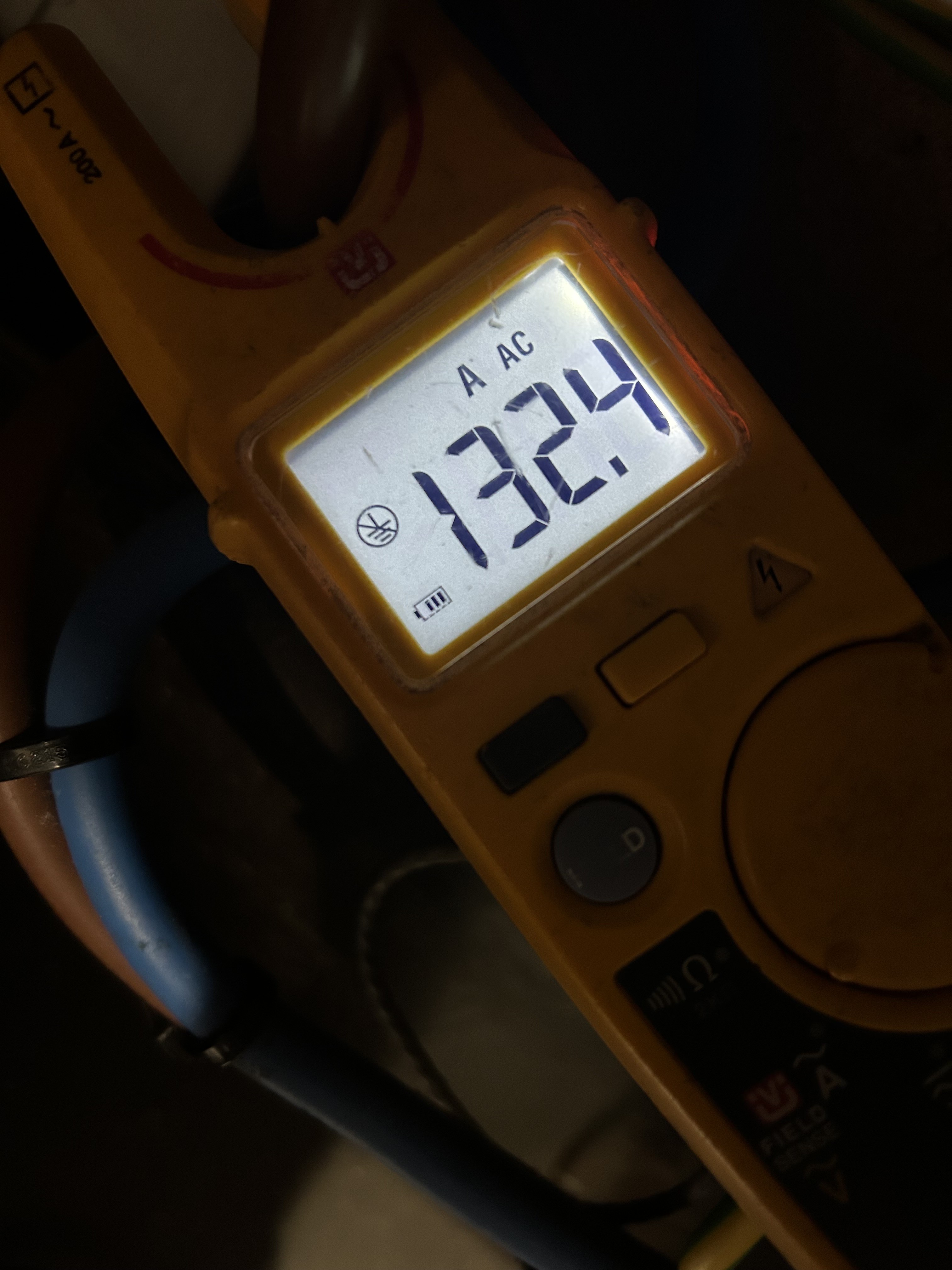
kram I managed to draw 130 amps off it with my electrician the other day during a test…😬

W
#19 wrighar

bRhFDKtjRMK9

I had my service head, 60A fuse and street to head cable all upgraded for free earlier this year.

I'm now on 25mm2 copper (from aluminium), modern head, and 100A cutout fuse.

Max draw so far has been just under 19kW / 82A

M
#20 MikeMessy

Pete UK I’ve only got one car on a 7Kwh charger, other is a plug in hybrid so fully charged on a normal 3 pin.

M
#21 MikeMessy

wrighar I’m definitely on a 100amp fuse and generally have a high voltage 240-250. We did have 250-260V for a while but DNO have now stepped it down.

T
#22 T-M

DD I was thinking more about making sure that everything after the meter is working properly, ie no hot spots in CU due to screws that have worked loose, that sort of thing. The DNO is only responsible for everything up to and including the cutout.

M
#23 MikeMessy

Thanks for all your feedback! I just wanted to let you know that after consulting an electrician I’m going to put the car charging onto a Zappi and also put a 100amp breaker after the main supply to prevent overloading.

S
#24 Slartibartfast

Set the grid limit on the Zappi. I've set mine to 55amps - stops the grid voltage from dropping too low when the car is charging + batteries charging + ASHP kicks in. It drops the Zappi charge rate leaving the rest to get on with it ...

K
#25 kram

If you have a 100A incoming fuse, I would make sure the zappi can monitor grid and solar and battery (or combined solar/battery if you have a hybrid).

I would probably the set a somewhere around a 90 Amp grid limit and see how you go. If that fine then brilliant, if not try dropping it to 80A.

Worth noting that I was told by a meter fitter that I just because the plastic fuse holder says 100A, that doesn’t mean the DNO put a 100A fuse in it and it could in fact be lower. If you have not already, get the DNO to confirm the fuse rating and then set the zappi grid limit approximately for the actual fuse.

Obviously it goes without saying that the advice of a trained and qualified professional electrician would overrule anything I’ve suggested.