Agile - calculating average price - with export or not??

5 comments started 2024-11-14 last 2024-11-14
Home AutomationGivEnergy Products
T
#1 TX200

When people calculate their average price per kWh, to see if it's cheaper than SVR (or your previous tariff) how do you do it?

Do you just calculate it using the total imported energy and total import costs? (Not incl the SC).

Or do you look at the net energy and net price after considering exports?

The downside of that, I guess, is it's not really a true reflection - as some of that export may be from imported energy and some from solar?

Then again, is price all that matters, my net cost?

(Yes once again I'm overthinking something! I also wondered about looking at consumption data, but that I think overcomplicates it). 🤣

V
#2 Vestas

TX200 Octopus provide the average import rate* on the 30+ page monthly electricity statement.

*both daily and for the entire month

G
#3 geoffreycoan

TX200 It depends on what you are trying to measure of course !

I had lots of different spreadsheets calculating different things and pulled them together into a single spreadsheet earlier this year. There’s still some gaps and things I need to look at in the underlying data so hence some shaded cells, but it shows my approach.

I think there’s two things I want to think about:

  1. What’s my annual net electricity cost, i.e. import-export
  2. How does that compare to what I would have paid if I didn’t have the solar and batteries, i.e. import on SVT

I don’t include standing charge as I have to pay that regardless . For me its a bit more complex because I have an older 4kW FIT array (so to keep the figures simple I include that generation in the solar total), and I am interested in the heat pump consumption so have that broken out as well:
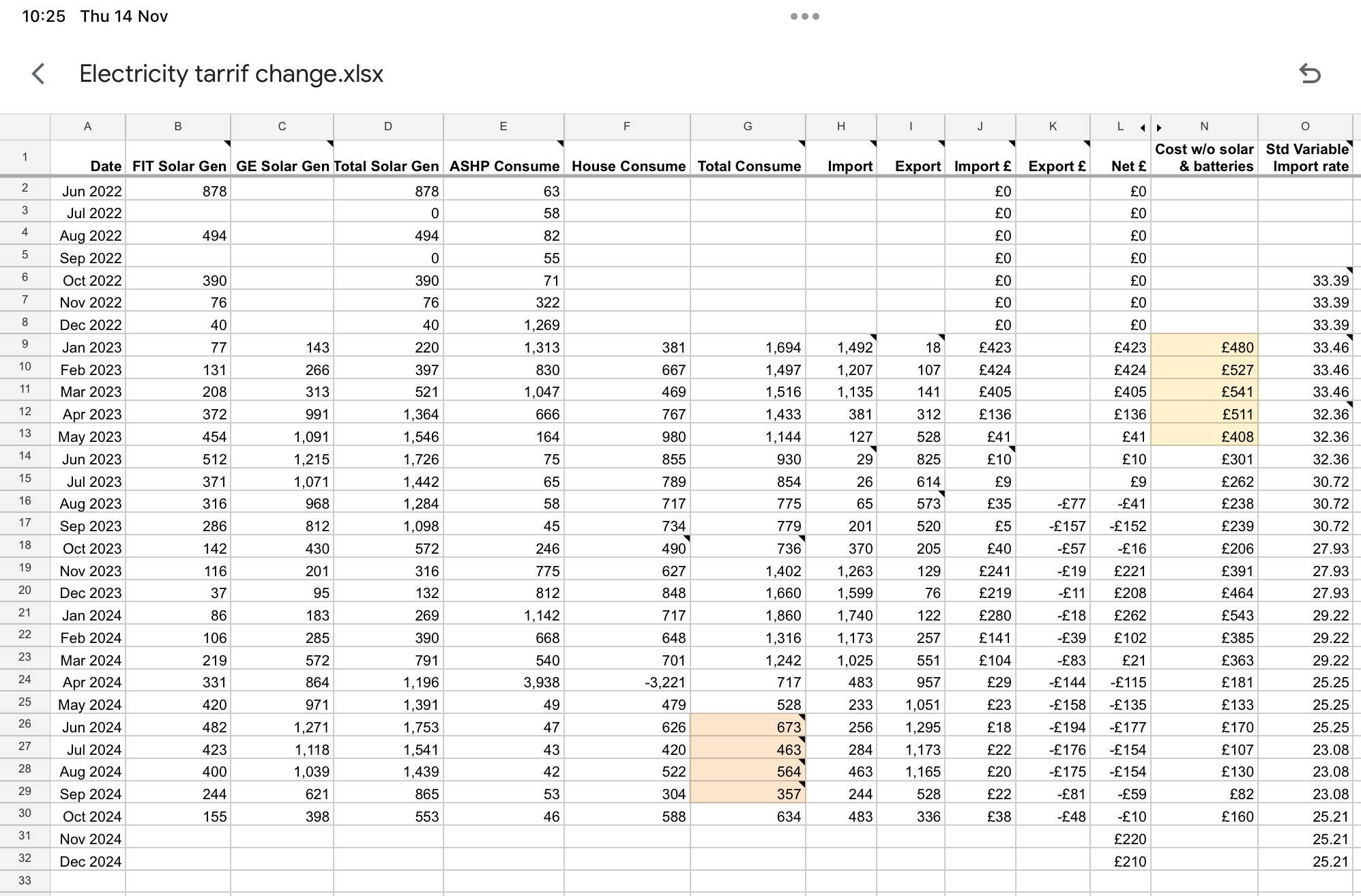
I work out house consumption from import -export -solar generation (which lumps battery and inverter losses under house consumption), then can determine comparative import cost for the house consumption if I didn’t have any solar or batteries on SVT.

Import/export kWh and £ come from the Octopus bill (adjusting for power up and free electricity events). DFS savings not included.

I do this on a monthly basis. Summary is about £0 net annual bill (well -£10 to +£10 actually depending on which year you measure over), and about £3,100-£3,300 annual saving against SVT which gives me a ‘solar payback’ of around 4-5 years.

T
#4 TX200

I've given up monitoring the payback of my system. At the end of the day the money was sitting there earning not much in savings (as at the time the rates were very slow).

So I'm purely just looking at import or net import costs.

I'd forgotten about the bills, it's a long time since I've looked at a bill. And quite some time since I was last on agile.

I've just been keeping an eye on my usage via home assistant energy dashboard and keeping an eye on my credit balance and balance history on octopus website.

#5 Watcher

As above, monthly bills - ignoring export because that is bunce.
For a quick look, Octopus Watch app.