AIO Battery charge / discharge totals

22 comments started 2024-11-23 last 2024-11-23
GivEnergy Products
#1 Tenkaykev

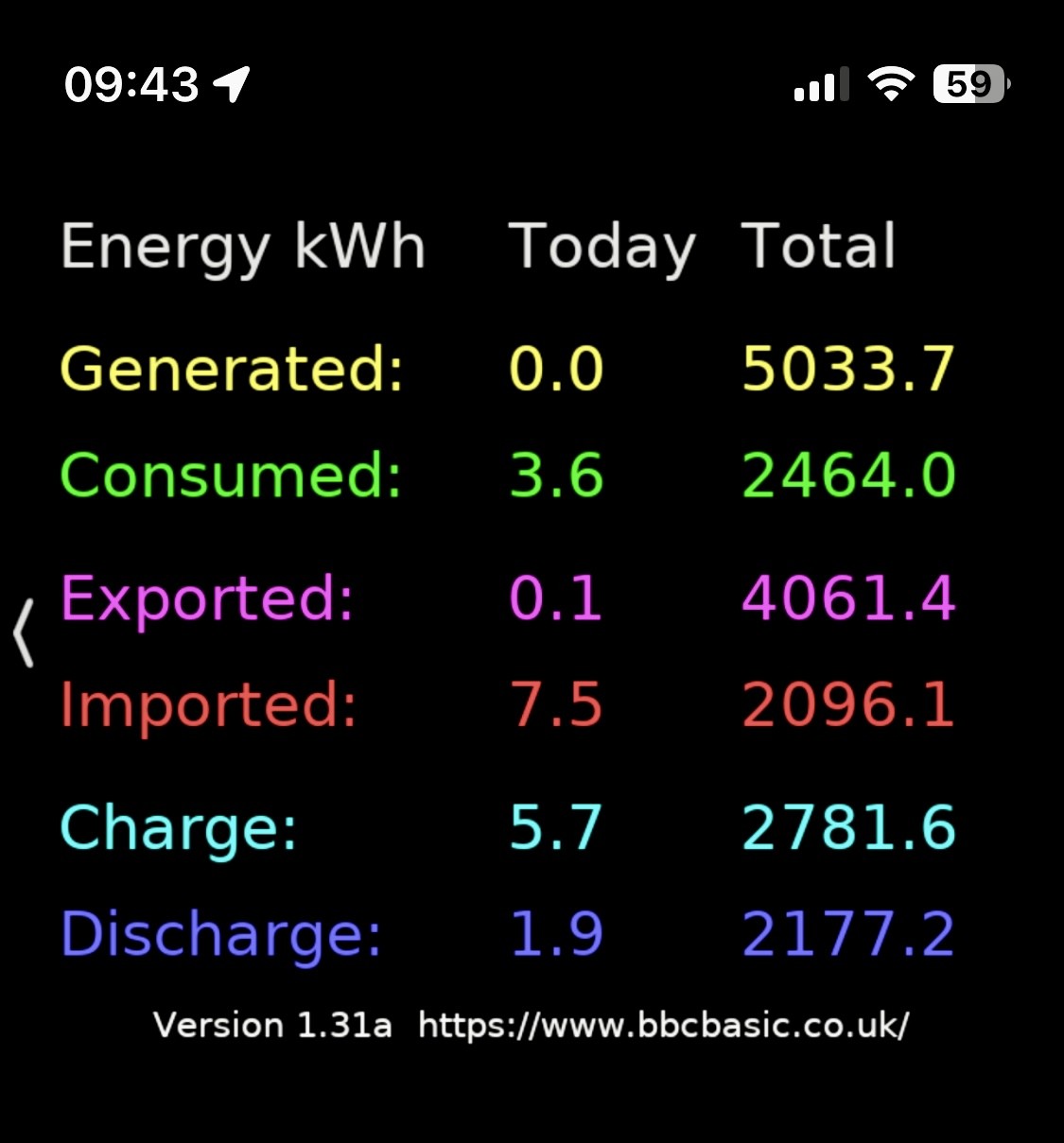
I have had my AIO for a year. Looking at the " Inverter " app from bbcbasic it shows my total charge to be 2781kWh and total discharge to be 2176kWh. On the face of it that's about 25% discrepancy which doesn't seem right. Am I misunderstanding the figures, and is there a way to easily verify the numbers. I would be interested to hear what others with a similar set up are seeing.
T
#2 treborUK

My total discharge is circa 84% of total charge after 15 months of use

C
#3 CW

Interesting - not sure what is actually being shown here, but I am the same as treborUK with about 84% discharge of total charge after 8 months

#4 Tenkaykev


A mystery indeed! I've been trying to figure out where the missing 600kWh has gone. I'm aware of conversion losses but those figures look excessive.

W
#5 wrighar

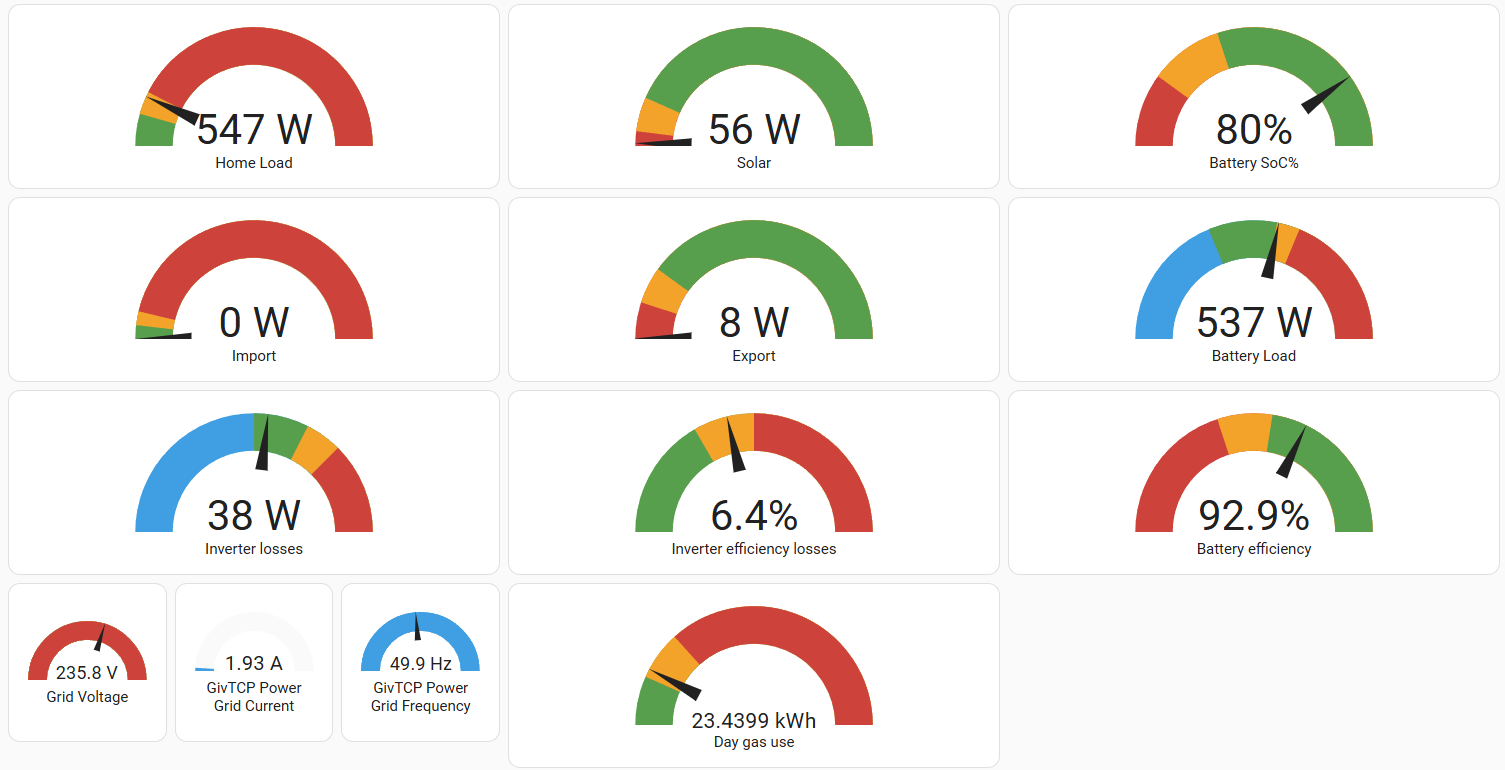
That seems a lot, I have the low voltage 9.5kWh battery and if pushed hard on charge and discharge from AC I get 88% efficiency.
If I use lower rate change/discharge and some solar charging, I'm getting 93% efficiency from initial install.

#6 Tenkaykev

wrighar
That's an impressive display, is it Home Assistant? As the " Inverter " app is reading directly from the inverter itself I don't think there's another way of looking at or interpreting the numbers.
I might contact Givenergy and see if they have any observations ( I won't be holding my breath )

D
#7 DD

Tenkaykev are these numbers not the same as those shown in the meter section on the portal?
The hybrid has an unhelpful behaviour where daily charge and discharge are maintained, but the all-time register contains a total average of in and out (this obscuring this statistics)
Ah - the portal just shows a battery throughput, whereas total charge and total discharge are available as different modbus registers. But whereas on hybrid those registers show the average, perhaps on AIO they do track in and out separately.

#8 PianSom

Tenkaykev
After 14 months, my AIO numbers are 86%.

Though mine are approx 5x yours, at around 10k! I work my system hard.

R
#9 Rubikcube

Tenkaykev Logically the difference is the power consumed by the battery.

2781kWh - 2176kWh = 605kWh.

605000 / 366 / 24 = 69W (366 because it was a leap year!)

This seems in line with other postings that suggest the AIO consumes around 100W in total.

R
#10 Rubikcube

treborUK

CW

PianSom

Please can you post actual figures, not just a percentage. If the consumption is continuous (because the BMSs run continually) a percentage is meaningless.

#11 Tenkaykev

Rubikcube
Thank you 👍 . A fresh pair of eyes looking at the numbers from a different perspective. I don't know why I didn't think to do that myself, I just saw the big numbers.
Be interesting to see other users data.

C
#12 CW

Rubikcube Here you go....
Mid April - 22 Nov:
Total Charged: 1,633.23 kWh
Total Discharged: 1,373.90 kWh

W
#13 wrighar

Tenkaykev

All read from HA / GivTCP, so from the GE Inverter.
3rd row are calculated sensors by me from Givtcp data, and the gas obviouslyy from another plugin.

#14 PianSom

Rubikcube
Since mid September last year
Charge - 10,573
Discharge - 9,106

R
#15 Rubikcube

CW Thanks, that's 7 months I think.

Multiplying up to a year:
1633 * 12/7 = 2799
1373 * 12/7 = 2354

Similar figures, seems you might be doing a bit better than Tenkaykev.

I get the impression having an AIO will increase your net (import - export) electricity consumption by about 50kWh per month. Has anyone compared utility bills from a year before to check this?

R
#16 Rubikcube

PianSom

Let's do the maths:
Convert Ten and Pia figures to monthly:
T: Charge = 2781/12 = 232 ; Discharge = 2176/12 = 181 ; Loss = 232 - 181 = 51
P: Charge = 10573/14 = 755 ; Discharge = 9106/14 = 650 ; Loss = 755 - 650 = 105
Assume there is a fixed loss (X) and a loss proportional to the charge (Y)
Loss = X + Y * Charge
T: 51 = X + Y * 232
P: 105 = X + Y * 755
Solve X = 51 - 232Y = 105 - 755Y
755Y - 232Y = 105 - 51
Y = 54/523 = 0.103 = 10.3%
X = 51 - 232 * 0.103 = 24kWh

So AIO seems to consume 24kWh per month even if you don't use it, and then it is 89.7% efficient when charging and discharging.

** All figures approximate **

C
#17 CW

Rubikcube that's 7 months I think

I can't count 🫤

#18 Tenkaykev

Rubikcube
That's difficult as we still have our conventional " Y " plan gas central heating. Having the AIO and solar, plus being on the Agile tariff has affected how we use energy, sometimes importing before dumping battery to grid, using immersion heater etc in order to make the most of negative / low pricing.

T
#19 treborUK

14 months
Charge 4012
Discharge 3370

#20 PianSom

Rubikcube

Interesting analysis!

But, as you say,

Rubikcube This seems in line with other postings that suggest the AIO consumes around 100W in total.

has been widely suggested, and that equates to 72kWh per month. Plugging that in gives an unrealistically low charge loss %. 🙁

V
#21 Vestas

PianSom Best you're going to do with LFP batteries is about 93-94% efficiency.

NB - that figure is ONLY chemical-based losses in the battery - no AC-DC-AC conversion or voltage multiplier losses which will inevitably incur much higher losses than the chemical losses in the battery. In theory the AIO should have lower conversion losses than the LV batteries/hybrid inverters as there's no need to boost DC voltages up to AC levels. I wouldn't expect the overall figure to be much better than 85% efficiency though.

Oh and for anyone relying on figures "from the inverter", well it rather depends on where GE choose to measure them. My G1 figures changed remarkably when the "fast response" f/w was installed, although the smartmeter suggests not a lot changed 😉

R
#22 Rubikcube

As Vestas rightly says, figures from the inverter are as at where GE choose to measure them. And battery losses are not the same as inverter losses nor system losses.

The key thing to take away is that there is a fixed consumption PLUS a consumption proportional to use. Difficult to separate the two on an AIO because it's ALL_IN_ONE.

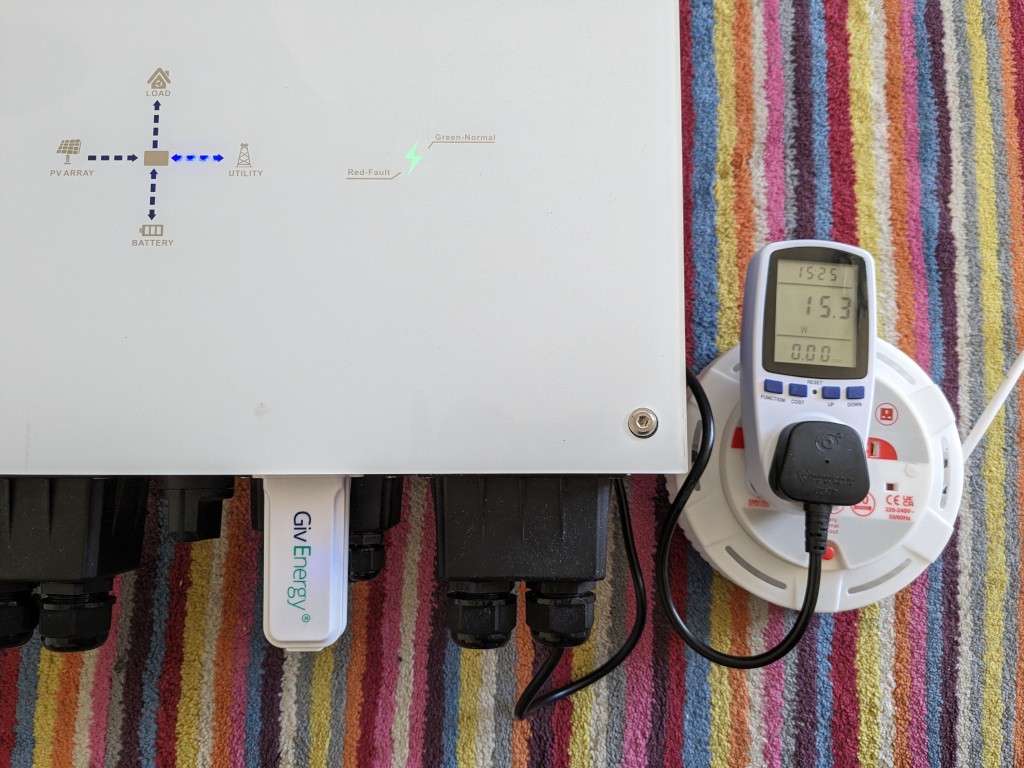
On older kit with separate batteries, the consumption of the Gen 1 inverter is 15.3W. Easy to measure with no batteries or solar, just a 3-pin plug.